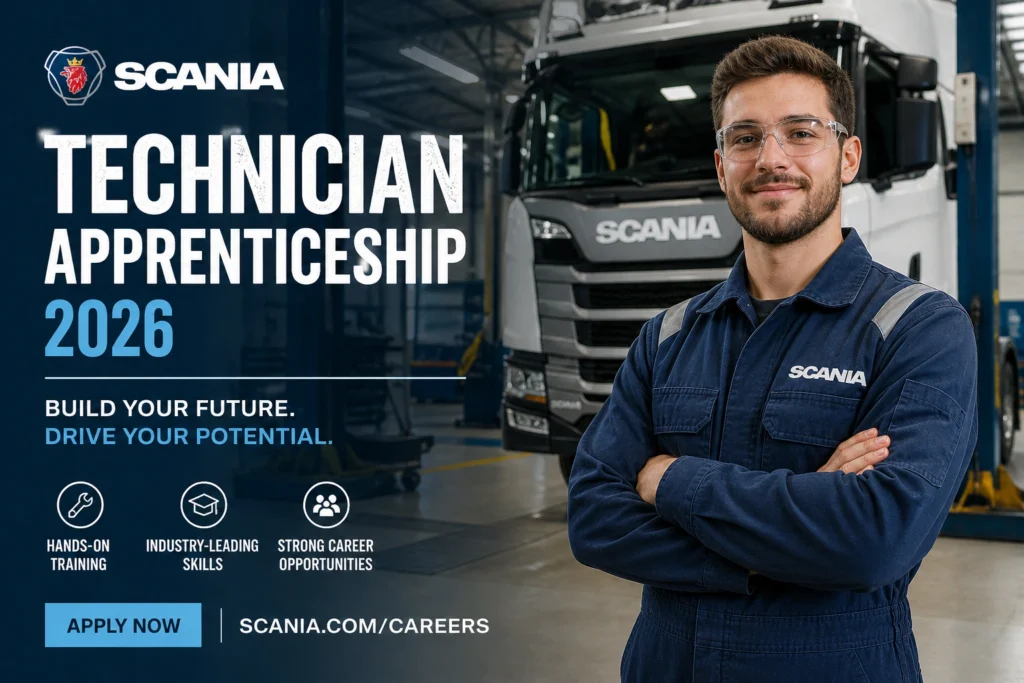

There’s a reason the phrase “Scania Technician Apprenticeship 2026” is suddenly gaining traction across job boards and social feeds. At first glance, it looks like another entry-level opportunity in South Africa’s competitive automotive sector. But dig deeper, and a different story emerges — one that says more about the shifting demands of the heavy vehicle industry than about apprenticeships themselves.
Because this isn’t really an apprenticeship.
It’s a signal.
A signal that companies like Scania are raising the bar — and fast.
A Misleading Label — Or a Strategic Shift?
The listing circulating online under the banner of Scania Technician Apprenticeship 2026 has sparked confusion for a simple reason: it targets fully qualified diesel technicians, not beginners.
This isn’t about training from scratch. It’s about plugging highly skilled professionals into a high-performance environment.
The requirements are uncompromising:
- A completed diesel trade test
- At least three years of post-trade experience
- Hands-on work with heavy vehicles
- Proven time in a current role
That’s not an apprenticeship pipeline — that’s a talent filter.
APPLY HERE: Scania Technician Apprenticeship 2026
And it reflects a broader shift happening across South Africa’s logistics and transport ecosystem.
How We Got Here: The Skills Gap No One Can Ignore
South Africa has long struggled with a mismatch between training output and industry demand — particularly in technical trades.
Organizations like merSETA and QCTO have invested heavily in formalizing artisan development. Apprenticeships, learnerships, and TVET pathways have expanded.
Yet employers still report a shortage of “job-ready” technicians.
Why?
Because modern heavy vehicles are no longer just mechanical machines. They are:
- Digitally integrated
- Software-driven
- Diagnostics-heavy
- Efficiency-optimized
A technician today isn’t just turning spanners — they’re interpreting data, working with onboard systems, and making decisions that affect uptime, safety, and operating cost.
That evolution has outpaced traditional training in many cases.
So companies like Scania South Africa are adjusting their hiring strategies accordingly.
Inside the Role: Precision Over Promise
What makes this opportunity stand out is not just the brand — it’s the structured expectation of performance.
The role is built around three distinct phases:
Before the Work Begins
Planning is everything. Technicians are expected to ensure that tools, parts, and technical data are in place before touching the vehicle.
During the Repair
Execution must follow strict manufacturer protocols — no shortcuts, no improvisation. The emphasis is on first-time-right repairs.
After the Job
Documentation, communication, and turnaround time matter just as much as the repair itself. In a commercial environment, delays equal losses.
This isn’t workshop culture as many remember it. It’s closer to engineering discipline applied to service delivery.
Recent Developments: Why Listings Like This Are Increasing
Across the transport and logistics sector, several trends are converging:
1. Fleet Modernisation
Companies are investing in newer trucks with advanced systems — especially in fuel efficiency and emissions control.
2. Pressure on Downtime
In logistics, every hour a truck is off the road costs money. Skilled technicians directly impact profitability.
3. Global Standards, Local Implementation
Multinationals like Scania bring international service standards into local operations, raising expectations across the board.
4. Retention Over Recruitment
Rather than training from zero, companies increasingly prefer technicians who can contribute immediately — and then upskill internally.
The result? Roles that look like apprenticeships on the surface but function as high-performance technical positions.
Public Reaction: Opportunity or Exclusion?
The response from job seekers has been mixed.
On one side, experienced technicians see this as a rare chance to join a premium global brand with access to advanced tools, training, and career growth.
On the other, younger applicants — especially recent graduates — feel locked out.
There’s a growing perception that:
“Entry-level opportunities are shrinking, while expectations keep rising.”
And that tension reflects a real challenge in South Africa’s labour market.
Bridging the gap between qualification and employability remains an ongoing struggle.
The Real Value Proposition: What Scania Is Offering
Despite the strict requirements, there’s a compelling case for why technicians are paying attention.
Working with Scania means exposure to:
- Advanced diagnostic systems
- Manufacturer-certified training
- Global service standards
- A safety-first work environment
More importantly, it offers career mobility.
Technicians don’t just stay technicians.
They move into roles like:
- Master Technician
- Workshop Foreman
- Technical Trainer
- Service Advisor
In a sector where growth paths can feel limited, that structure matters.
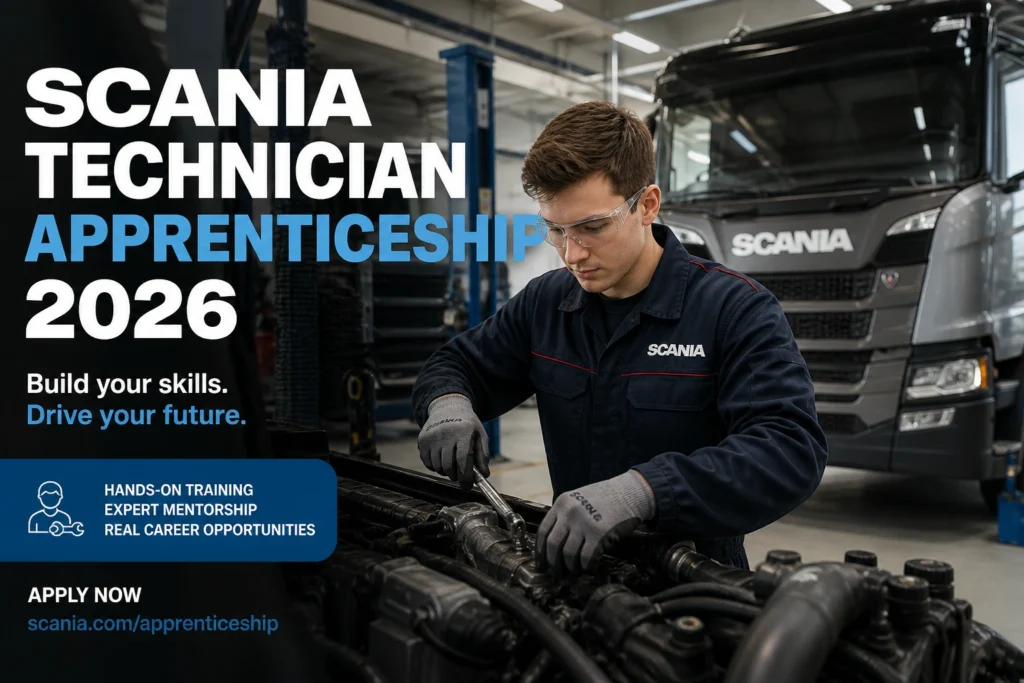
APPLY HERE: Scania Technician Apprenticeship 2026
Why This Matters Right Now
The timing of this opportunity is not accidental.
South Africa’s logistics sector is under pressure — from fuel costs to infrastructure challenges to rising demand for efficient freight movement.
At the centre of all of that are vehicles that must keep moving.
And behind those vehicles are technicians.
Roles like this highlight a crucial reality:
The future of transport doesn’t just depend on drivers or companies — it depends on highly skilled technical professionals who can keep complex machines running at peak performance.
For job seekers, this means rethinking career strategy.
It’s no longer enough to qualify.
You need to:
- Build real workshop experience
- Develop diagnostic expertise
- Stay current with evolving technologies
Because the market is rewarding competence, not just credentials.
APPLY HERE: Scania Technician Apprenticeship 2026
ALSO APPLY FOR: Toyota Boshoku (TBSA) Apprenticeships 2026
What Could Happen Next
If trends continue, we’re likely to see several shifts in the near future:
1. Fewer “True” Apprenticeships
Entry-level roles may become more structured and selective, with stricter progression pathways.
2. Increased Demand for Hybrid Skills
Technicians who understand both mechanical systems and digital diagnostics will be in the highest demand.
3. Stronger Industry-Training Partnerships
Organizations like merSETA could deepen collaboration with employers to produce more job-ready graduates.
4. Wage Differentiation
Highly skilled technicians may command significantly higher salaries as their impact on operations becomes clearer.
5. Internal Upskilling Becomes Standard
Companies may invest more in training existing employees rather than hiring externally.
The Bottom Line: A Career Move, Not a Starting Point
Calling this opportunity a Scania Technician Apprenticeship 2026 misses the bigger picture.
This is not about learning the basics.
It’s about proving mastery.
For qualified diesel technicians with the required experience, it’s a chance to step into a role where:
- Precision matters
- Standards are global
- Performance is visible
- Growth is possible
For everyone else, it’s a reminder of what the industry now expects — and where the bar is set.
Final Thought: Read Between the Lines
Opportunities like this tell you more than just where to apply.
They tell you where the industry is heading.
And right now, the message is clear:
The future belongs to technicians who can combine hands-on skill, digital fluency, and professional discipline.
If you’re already there, this could be your next move.
If you’re not, it might be time to start building toward it.