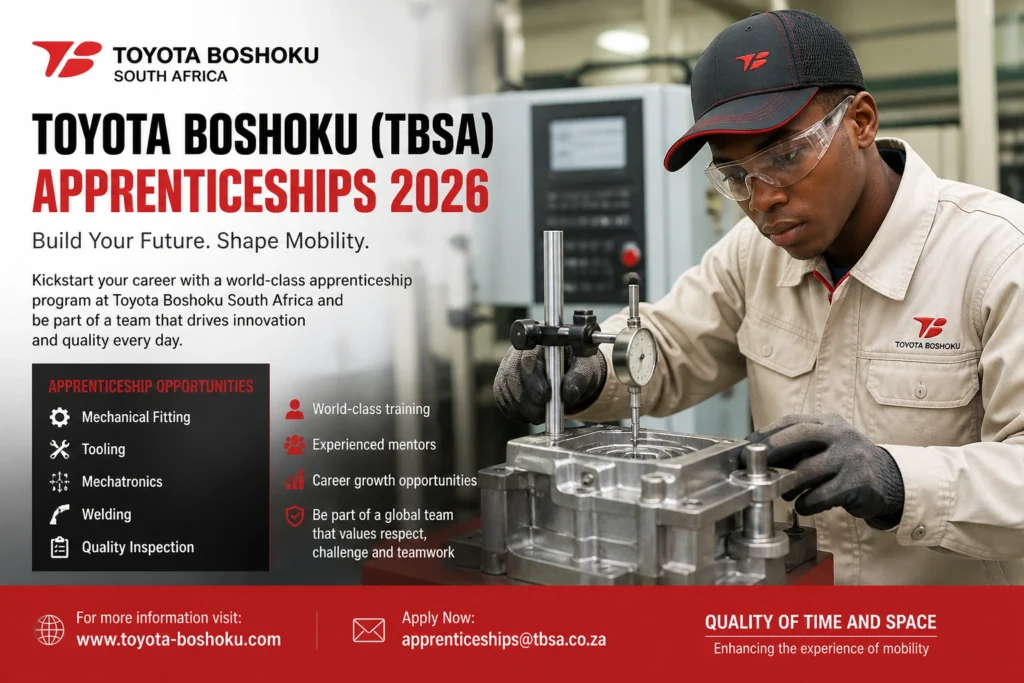

There’s a noticeable shift happening in South Africa’s graduate job market—and the Toyota Boshoku (TBSA) Apprenticeships 2026 are right at the center of it. What might have once been just another engineering graduate programme is now drawing serious attention from students, career advisors, and industry insiders alike.
Why? Because in a year where many graduates are struggling to find meaningful entry points into technical careers, structured programmes like the one offered by Toyota Boshoku South Africa are starting to look less like optional stepping stones—and more like essential gateways.
This isn’t just about one opportunity. It’s about what this opportunity represents in a changing economy.
A Programme That Reflects a Bigger Shift
The Toyota Boshoku South Africa Graduate Trainee Programme 2026 offers a 24-month structured development experience in Durban, KwaZulu-Natal. On paper, it looks straightforward: practical training, technical exposure, and alignment with engineering qualifications.
But the growing interest in this programme says more about the broader environment than the programme itself.
South Africa has long faced a paradox: thousands of qualified graduates entering the workforce each year, yet persistent complaints from employers about a lack of “work-ready” candidates. The gap between theory and practice remains one of the biggest barriers to employment.
That’s where structured graduate programmes step in.
By combining hands-on workplace experience with mentorship and technical exposure, TBSA’s initiative directly targets that gap. And in 2026, that makes it incredibly relevant.
The Rise of Engineering-Focused Graduate Pathways
A decade ago, many graduates aimed for corporate roles in finance, administration, or general management. Today, there’s a noticeable return to technical and industrial career paths.
Fields included in the TBSA programme reflect this shift:
- Mechanical and Mechatronic Engineering
- Chemical Engineering
- Industrial Engineering
- Information Engineering
- Electrical and Electronic Engineering
These aren’t random selections—they mirror where demand is growing globally: automation, manufacturing efficiency, and smart systems integration.
South Africa’s automotive sector, in particular, has remained one of the country’s strongest industrial contributors. Companies like Toyota Boshoku, which specialise in automotive components, sit at the intersection of manufacturing and innovation.
That makes their graduate programmes especially valuable—not just for employment, but for long-term career positioning.
Recent Developments Driving the Buzz
Several recent developments have helped push the Toyota Boshoku (TBSA) Apprenticeships 2026 into the spotlight:
1. Increased Competition for Graduate Programmes
Graduate unemployment remains high, and structured programmes now attract thousands of applicants for limited positions. TBSA’s offering—just a handful of placements across disciplines—naturally creates urgency.
2. Industry Demand for Practical Skills
Employers are placing more emphasis on real-world experience over academic results alone. Programmes that provide exposure to live production environments are becoming more attractive.
3. Government and Industry Alignment
There’s growing alignment between government initiatives and private-sector training. While TBSA operates independently, its model aligns with national priorities around skills development and industrial growth.
4. Shift Toward Long-Term Training Models
Short-term internships are losing appeal compared to multi-year structured programmes. A 24-month commitment signals depth, not just exposure.
What Makes This Programme Different?
Not all graduate programmes are created equal. TBSA’s approach stands out for a few key reasons.
Structured Learning Over Random Exposure
Instead of rotating graduates without clear direction, structured programmes typically follow a planned development path aligned with specific competencies.
Direct Industry Integration
Participants don’t just observe—they contribute to real operations within the automotive manufacturing environment.
Focus on Engineering Excellence
The programme is tightly focused on engineering disciplines, avoiding the dilution seen in broader, less specialised programmes.
Clear Entry Requirements
The criteria are strict:
- South African citizenship
- Completed NQF Level 8 qualification
- No prior participation in graduate programmes
This ensures a level playing field for first-time entrants into the workforce.
Public Reaction: Optimism Mixed With Pressure
Among graduates and career platforms, the response has been largely positive—but not without tension.
The Optimism
Many see programmes like TBSA’s as rare, high-quality opportunities in a tough job market. Social media discussions and graduate forums often highlight:
- The credibility of the Toyota brand
- The value of automotive industry exposure
- The long-term career benefits
For engineering graduates, this feels like a direct pathway into a competitive industry.
The Pressure
At the same time, the limited number of positions creates anxiety.
With only a few roles available per discipline, applicants are acutely aware that competition will be intense. This has led to:
- Increased focus on perfecting CVs
- Demand for career coaching and application support
- Growing awareness of the importance of academic transcripts
In other words, opportunities like this don’t just offer hope—they raise the stakes.
ALSO VISIT: https://www.toyota-boshoku.sa.com
The Application Process: Simple but Competitive
The application itself is relatively straightforward:
- Submit a CV
- Provide certified documents (ID, qualifications, transcripts)
- Email application to the designated TBSA recruitment address
- Clearly indicate the chosen graduate stream
But simplicity doesn’t mean ease.
Behind the scenes, selection processes for programmes like this often involve:
- Rigorous screening
- Technical assessments
- Behavioral interviews
- Alignment with Employment Equity goals
How to Apply
Email your application to: TBSA.Recruitment@toyota-boshoku.com
Make sure to clearly indicate the graduate stream you are applying for in the subject line.
ALSO VISIT: https://www.toyota-boshoku.sa.com
Only shortlisted candidates are contacted, adding another layer of uncertainty for applicants.
ALSO APPLY FOR: John Thompson Apprenticeships 2026
Why This Matters Right Now
The Toyota Boshoku (TBSA) Apprenticeships 2026 matter because they reflect three critical realities in South Africa today.
1. The Graduate Employment Gap Is Still Wide
Despite increased access to higher education, many graduates struggle to transition into meaningful employment. Programmes like TBSA’s act as bridges—but they are still limited in number.
2. Industry Is Taking a More Active Role
Instead of waiting for “perfect candidates,” companies are increasingly investing in developing talent internally. This signals a shift in how skills shortages are being addressed.
3. Technical Skills Are Regaining Value
There’s a renewed emphasis on engineering, manufacturing, and applied sciences. In a world driven by automation and technology, these skills are becoming essential again.
4. Structured Training Is Becoming the Gold Standard
Graduates are beginning to prioritise programmes that offer clear development pathways, rather than short-term internships with uncertain outcomes.
In this context, TBSA’s programme isn’t just another opportunity—it’s part of a larger transformation.
What Could Happen Next
Looking ahead, several trends could shape the future of programmes like the Toyota Boshoku (TBSA) Apprenticeships 2026.
Expansion of Similar Programmes
If demand continues to grow, more companies—especially in manufacturing and engineering—may introduce structured graduate development initiatives.
Increased Competition and Higher Standards
As awareness grows, so will competition. This could lead to:
- Higher academic requirements
- More complex selection processes
- Greater emphasis on soft skills
Integration of Digital and Automation Skills
Engineering roles are evolving rapidly. Future programmes may include stronger components in:
- Artificial intelligence
- Robotics
- Data-driven manufacturing
Stronger Industry-Academic Partnerships
Universities and companies may collaborate more closely to ensure graduates are better prepared before entering programmes.
Potential Policy Support
Government incentives could encourage companies to expand graduate training, especially in sectors critical to economic growth.
The Bigger Picture: More Than Just a Job Opportunity
It’s easy to view the Toyota Boshoku (TBSA) Apprenticeships 2026 as just another listing on a job portal. But that misses the bigger picture.
This programme sits at the intersection of:
- Education and employment
- Theory and practice
- Individual ambition and national economic needs
For graduates, it represents a chance to enter the workforce with purpose and direction. For the industry, it’s a way to build the next generation of engineers. And for the country, it’s part of a broader effort to tackle unemployment and skills shortages.
Final Thoughts
The buzz around the Toyota Boshoku (TBSA) Apprenticeships 2026 isn’t accidental. It reflects a moment where opportunity, necessity, and timing have aligned.
Graduates are searching for meaningful pathways. Employers are looking for adaptable talent. And programmes like this are bridging the gap—one cohort at a time.
But the reality remains: not everyone will get in.
That’s what makes opportunities like this both exciting and challenging. They highlight what’s possible, while reminding us how much competition exists.
In the end, the real value of programmes like TBSA’s isn’t just in the positions they offer—it’s in the standard they set for what graduate development should look like in South Africa today.