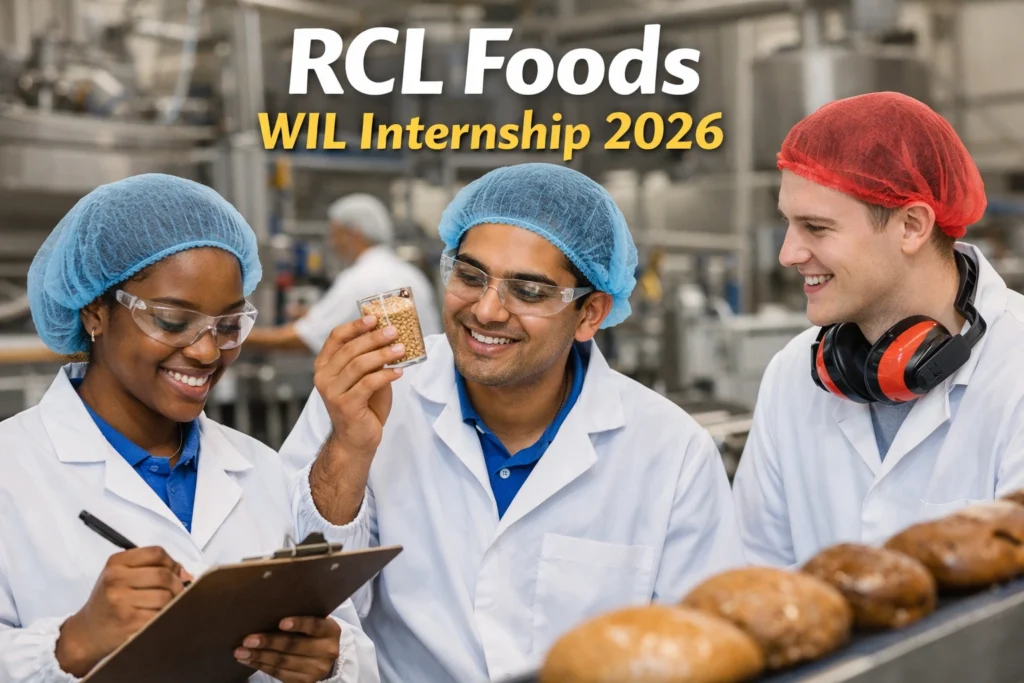

In the past few days, one phrase has quietly begun circulating across student WhatsApp groups, campus noticeboards, and LinkedIn feeds: RCL Foods WIL Internship 2026.
It’s not just another internship listing.
For many diploma students in South Africa, this announcement feels like a lifeline—arriving at exactly the moment when thousands are stuck between finishing their studies and actually graduating. Because in reality, for many, the biggest obstacle isn’t passing exams.
It’s finding a place willing to let them in.
Now, with RCL Foods opening a structured 12-month Work Integrated Learning (WIL) internship in Randfontein, the conversation has shifted. Students aren’t just asking what’s available anymore.
They’re asking: Is this the opportunity I’ve been waiting for?
The Quiet Crisis Behind Diploma Education
To understand why the RCL Foods WIL Internship 2026 is gaining attention, you have to look at the system behind it.
South Africa’s diploma programmes—especially in fields like food technology, engineering, and supply chain—require students to complete Work Integrated Learning (WIL) before they can graduate. It’s not optional. It’s not flexible.
It’s mandatory.
But here’s the catch: universities and colleges don’t always provide placements.
That leaves students in a frustrating limbo—academically qualified, but technically incomplete.
Every year, thousands of students across institutions—from traditional universities to TVET colleges—find themselves chasing limited placement opportunities in an already competitive job market.
That’s why when a company like RCL Foods opens its doors, even for a relatively small intake, it sends a ripple effect across the system.
APPLY HERE: RCL Foods WIL Internship 2026
Inside the RCL Foods WIL Internship Programme
The internship itself is straightforward on paper—but its impact goes deeper.
Hosted within the Groceries Operating Unit, the programme offers 12 months of structured workplace training in a real manufacturing environment. It’s based in Randfontein, Gauteng, placing interns at the heart of one of the country’s key industrial zones.
But what makes this opportunity stand out isn’t just the duration.
It’s the environment.
RCL Foods operates some of South Africa’s most familiar household brands—Yum Yum peanut butter, Nola mayonnaise, Ouma rusks, and Sellati sugar. These are products that move through complex production lines daily, requiring precision, quality control, and coordination across multiple departments.
For interns, that translates into exposure that goes far beyond observation.
It means participation.
Not Just “Work Experience” — Real Industry Immersion
There’s a growing distinction in South Africa’s internship space between “placement for compliance” and “placement for development.”
The RCL Foods programme leans toward the latter.
According to the company’s outline, successful candidates will gain:
- On-the-job technical training
- Mentorship from experienced professionals
- Exposure to industry-grade manufacturing standards
- Involvement in meaningful, business-impacting projects
This matters more than it sounds.
Because in many cases, WIL students are placed in environments where they spend months doing administrative or observational work—barely touching the core of their field.
Here, the expectation is different.
Students are stepping into a live operational system, where production targets, quality benchmarks, and teamwork aren’t theoretical—they’re daily realities.
Who This Opportunity Is Really For
The eligibility criteria tell a story of their own.
This isn’t a general internship open to anyone with a qualification.
It’s specifically targeted at students who:
- Are currently studying toward a diploma
- Still require 12 months of WIL to graduate
- Have not completed WIL before
- Can provide official institutional confirmation
- Demonstrate strong academic performance and soft skills
Fields of study include:
- Food Technology / Biotechnology
- Chemistry / Microbiology
- Chemical Engineering
- Industrial Engineering
- Operations Management
- Procurement / Supply Chain Management
That range reflects something important.
RCL Foods isn’t just looking for lab-based or technical candidates.
They’re building a pipeline across production, operations, and supply chain systems—areas that form the backbone of modern manufacturing.
The Detail That Could Make or Break Your Application
If there’s one subtle but critical insight in this opportunity, it’s this:
Your institution letter matters more than you think.
Applicants are required to submit official confirmation that they need 12 months of WIL. But in practice, many students submit vague or incomplete documentation—letters that mention WIL, but not duration, or fail to clearly confirm it as a graduation requirement.
In a competitive pool, that small oversight can quietly disqualify you.
It’s a reminder that opportunities like the RCL Foods WIL Internship 2026 aren’t just about meeting criteria.
They’re about presenting clarity.
Recent Developments: Why This Listing Is Gaining Momentum
Internship listings come and go, but some gain traction faster than others.
This one is doing exactly that.
There are a few reasons:
1. Timing is tight
With a closing date of 17 April 2026, the application window is short. Urgency naturally drives attention.
2. Location matters
Being based in Gauteng—specifically Randfontein—makes it accessible to a large student population.
3. Sector relevance
Food manufacturing remains one of South Africa’s most stable and essential industries, even during economic uncertainty.
4. Structured WIL focus
Unlike generic internships, this programme directly addresses a graduation requirement—making it immediately valuable.
In a landscape where many opportunities feel vague or oversubscribed, this one feels specific.
And specificity builds trust.
APPLY HERE: RCL Foods WIL Internship 2026
Public Reaction: Cautious Optimism from Students
Early reactions from students and graduates online show a mix of excitement and realism.
On one hand, there’s clear enthusiasm:
- “Finally something for diploma students.”
- “This is exactly what I need to finish.”
On the other hand, there’s caution:
- “Competition is going to be crazy.”
- “I hope they actually take enough people.”
This dual response reflects a broader sentiment among South African youth.
Opportunities are welcomed—but expectations are tempered by experience.
Students know that for every listing, there are hundreds—sometimes thousands—of applicants.
Still, that hasn’t stopped the application rush.
Why This Matters Right Now
The significance of the RCL Foods WIL Internship 2026 goes beyond one company or one intake.
It highlights a deeper issue—and a possible shift.
South Africa’s education-to-employment pipeline has long struggled with alignment. Students complete qualifications, but lack the practical exposure needed to enter the workforce confidently.
WIL programmes are supposed to bridge that gap.
But when placements are scarce, the gap widens instead.
This internship represents:
- A functional bridge between study and work
- A real-world testing ground for student skills
- A potential stepping stone into permanent employment
At a time when youth unemployment remains a critical challenge, structured opportunities like this carry weight.
They don’t solve the problem entirely.
But they move the conversation forward.
What Could Happen Next
Looking ahead, a few scenarios could unfold.
1. Increased Competition for WIL Placements
As awareness grows, more students may actively seek WIL opportunities earlier—intensifying competition but also improving preparedness.
2. More Companies May Follow
If programmes like this prove effective, other manufacturers could expand or introduce similar initiatives.
3. Greater Pressure on Institutions
Universities and colleges may face increased expectations to support students in securing placements, rather than leaving them to navigate alone.
4. Stronger Talent Pipelines
Companies that invest in structured internships often benefit from a ready pool of trained candidates—potentially improving hiring efficiency.
In that sense, this internship isn’t just a short-term opportunity.
It’s part of a longer-term ecosystem shift.
A Final Word for Applicants
If you’re considering applying for the RCL Foods WIL Internship 2026, here’s the reality:
You’re not just applying for a placement.
You’re applying for a transition—from student to professional.
That means the details matter.
- Your documents must be clear
- Your academic record must be strong
- Your communication must reflect readiness
And perhaps most importantly:
You need to approach the application with intention, not urgency alone.
Because while deadlines create pressure, preparation creates opportunity.
APPLY HERE: RCL Foods WIL Internship 2026
ALSO APPLY FOR: ABB Graduate Internships 2026