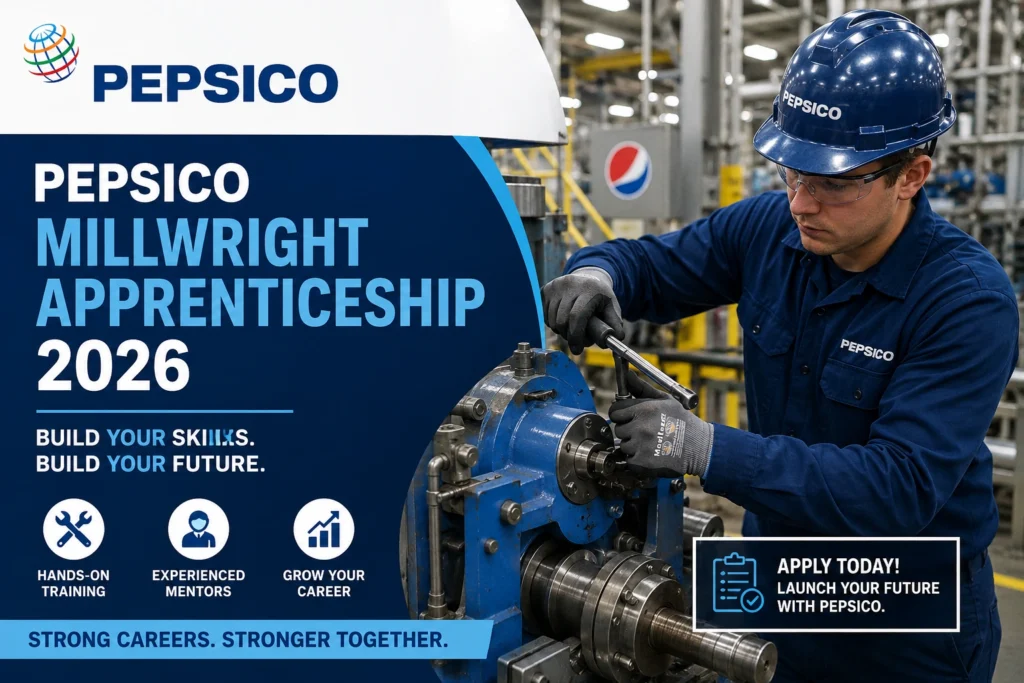

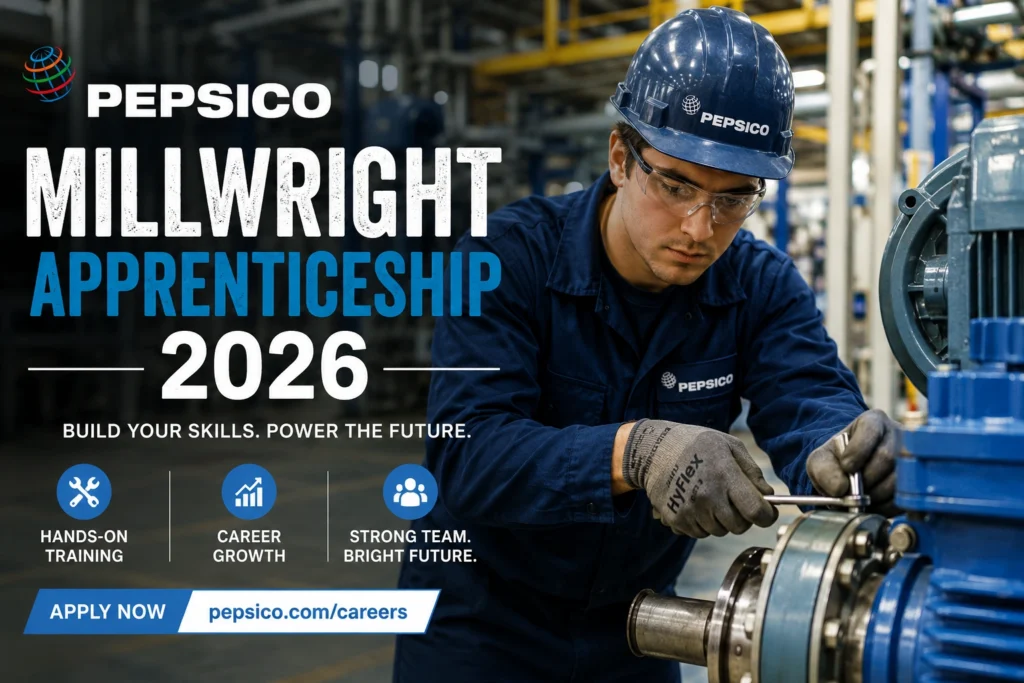
The PepsiCo Millwright Apprenticeship 2026 is quickly becoming one of the apprenticeship opportunities that many technically minded South Africans are watching closely. While the application closing date has not been specified, the opening of applications has already generated interest among school leavers, N3 engineering students, and aspiring artisans looking for practical industry training.
In today’s employment market, opportunities that combine structured learning with real workplace experience are becoming increasingly valuable. South Africa continues to face a shortage of qualified artisans across manufacturing, food production, automation, and maintenance industries. Because of this, apprenticeship programmes offered by established employers like PepsiCo attract significant attention whenever they become available.
Unlike many entry-level jobs, this apprenticeship is designed to develop practical skills over time while preparing candidates to complete a recognised trade test. For applicants in the Northern Cape and surrounding provinces, the PepsiCo Millwright Apprenticeship 2026 represents more than simply gaining work experience—it could become the foundation of a long-term engineering career.
Background: Why Apprenticeships Matter More Than Ever
Over the past several years, employers across South Africa have increasingly invested in artisan development.
Manufacturing companies have experienced rapid technological change. Production plants now rely on automated machinery, programmable logic controllers (PLCs), robotics, advanced electrical systems, and computer-controlled equipment.
These innovations improve productivity but also create demand for workers capable of maintaining sophisticated machinery.
Millwrights occupy one of the most important positions within this environment.
Rather than specialising only in electrical or mechanical work, millwrights combine both disciplines. Modern millwrights also work with electronics, industrial automation, sensors, control systems and increasingly AI-assisted industrial technologies.
For this reason, companies are actively developing new generations of artisans through structured apprenticeship programmes.
An Opportunity Based in Upington
The apprenticeship is based in Upington, Northern Cape, under reference number 458885.
Although PepsiCo has not published a closing date, interested candidates are generally encouraged to submit applications as early as possible whenever recruitment opens.
One reason these opportunities remain competitive is the company’s reputation.
PepsiCo operates one of the world’s largest food and beverage businesses, with operations that require continuous maintenance of complex manufacturing equipment. Apprentices therefore gain exposure to industrial systems that many training centres simply cannot replicate in classroom environments.
What Makes This Apprenticeship Different?
Many apprenticeships focus primarily on mechanical maintenance.
This programme appears designed around today’s industrial environment where electrical, mechanical, electronic and computer systems all work together.
The successful apprentice is expected to learn about:
- Mechanical maintenance
- Electrical systems
- Industrial electronics
- PLC programming support
- Human Machine Interfaces (HMIs)
- Industrial sensors
- Actuators
- Automated production equipment
- Robotics fundamentals
- Industrial documentation
- Workplace safety standards
This reflects how the millwright profession itself has evolved.
Twenty years ago, many factories relied on manually operated equipment.
Today’s production plants depend heavily on automation, meaning future artisans need broader technical knowledge than previous generations.
Inside the Training Programme
Like most recognised apprenticeships, the programme combines classroom learning with practical workplace experience.
Rather than learning only from textbooks, apprentices gradually develop competence while working alongside experienced technicians.
Training includes several important areas.
Installation and Maintenance
Apprentices assist experienced millwrights in installing new machinery while also performing scheduled maintenance on existing production equipment.
This provides exposure to preventative maintenance strategies that help factories avoid costly downtime.
Troubleshooting Industrial Equipment
One of the most valuable skills for any artisan is fault finding.
During training, apprentices learn how to diagnose problems involving:
- Mechanical systems
- Electrical faults
- Control circuits
- PLCs
- Sensors
- Industrial automation equipment
Learning how to identify the root cause of equipment failures becomes one of the defining skills of an experienced millwright.
Fabrication and Assembly
Modern maintenance often requires components that cannot simply be purchased immediately.
For this reason, apprentices receive exposure to:
- Machine shop tools
- Precision component manufacturing
- Welding
- Mechanical assembly
- Equipment fitting
These practical abilities remain highly transferable across many industries.
Documentation and Compliance
Technical ability alone is no longer enough.
Manufacturing companies increasingly expect artisans to maintain accurate maintenance records while following strict safety procedures.
The apprenticeship therefore includes training in documentation, reporting and compliance with workplace standards.
Continuous Learning
PepsiCo also expects apprentices to participate fully in structured learning.
Responsibilities include:
- Attending classroom sessions
- Completing assignments
- Participating in practical projects
- Receiving mentorship
- Working closely with facilitators
- Reporting learning challenges early
- Committing to the training agreement
These expectations highlight that apprenticeships involve significant commitment rather than simply reporting for work each day.
ALSO VISIT: https://www.pepsicojobs.com
Who Can Apply?
According to the available information, applicants should meet the following requirements.
They should possess:
- Grade 12 (Matric) or equivalent qualification
- N3 in Mechanical and Electrical Engineering Studies
- Minimum age of 18 years
Applicants must also:
- Be medically fit
- Be willing to work in industrial environments
- Lift between 12 kg and 25 kg where required
- Potentially complete a mechanical aptitude assessment
These requirements reflect the physically demanding and technically challenging nature of millwright work.
APPLY HERE: PepsiCo Millwright Apprenticeship 2026
ALSO APPLY FOR: Premier Millwright Apprenticeships 2026
Why Technical Qualifications Matter
One noticeable feature of this apprenticeship is the requirement for an N3 qualification covering mechanical and electrical engineering studies.
Many manufacturing employers now prefer applicants who already possess foundational engineering knowledge before beginning workplace training.
This approach benefits both employers and apprentices.
Students enter the programme with a basic understanding of engineering principles, allowing workplace mentors to focus on practical application rather than introductory theory.
Public Reaction
Among South African job seekers, apprenticeship announcements continue generating considerable discussion.
Many graduates struggle to obtain practical workplace experience after completing technical studies.
Others hold N2 or N3 qualifications but remain unable to secure companies willing to provide artisan training.
Consequently, opportunities offered by recognised employers frequently receive significant attention online.
Many aspiring artisans see programmes like this as offering:
- Industry-recognised experience
- Structured technical development
- Mentorship from experienced artisans
- Better long-term employment prospects
- Preparation for trade testing
At the same time, some applicants remain concerned about the limited number of apprenticeship positions available nationally compared to the number of qualified candidates seeking placements.
Why PepsiCo Attracts Applicants
Employer reputation often influences apprenticeship demand.
PepsiCo operates large manufacturing facilities requiring sophisticated maintenance operations.
Working within such an environment exposes apprentices to equipment commonly used across modern food manufacturing.
This experience may later prove valuable when seeking employment elsewhere within manufacturing, mining, logistics or processing industries.
Training in a production environment also develops skills that employers frequently prioritise during recruitment.
The Growing Importance of Automation
One interesting aspect of this apprenticeship is its emphasis on industrial automation.
Factories increasingly depend on:
- Smart sensors
- Computer-controlled production
- Automated packaging
- Robotics
- Data monitoring systems
- AI-supported manufacturing technologies
As these technologies continue expanding, artisan roles are evolving alongside them.
Today’s millwrights often spend as much time diagnosing control systems as they do repairing mechanical components.
This shift explains why apprenticeships increasingly combine multiple engineering disciplines.
Why This Matters Right Now
South Africa’s employment landscape continues changing rapidly.
Traditional entry-level opportunities remain limited in many sectors.
At the same time, employers consistently report shortages of qualified artisans capable of supporting modern manufacturing.
This creates an interesting contrast.
While unemployment remains high, technical occupations continue experiencing skills shortages.
Programmes like the PepsiCo Millwright Apprenticeship 2026 help bridge that gap by developing practical skills aligned with industry demand.
For young South Africans interested in engineering careers, apprenticeships offer a pathway that combines education with workplace learning rather than requiring years of experience before employment becomes possible.
The programme also reflects broader trends across industry, where employers increasingly invest in developing internal technical talent instead of relying solely on external recruitment.
Challenges Applicants Should Understand
Although apprenticeships provide valuable opportunities, they also demand commitment.
Successful apprentices typically balance:
- Workplace responsibilities
- Technical assignments
- Classroom instruction
- Practical assessments
- Continuous evaluation
Missing scheduled training sessions or neglecting learning responsibilities may affect progress through the programme.
PepsiCo specifically expects apprentices to communicate learning concerns promptly while maintaining commitment throughout the training period.
This demonstrates that employers increasingly value professionalism alongside technical competence.
Skills That Could Improve Your Chances
Although selection decisions remain entirely with PepsiCo, applicants often strengthen their profiles by demonstrating:
- Strong mathematics ability
- Basic electrical knowledge
- Mechanical problem-solving
- Computer literacy
- Good communication skills
- Reliability
- Willingness to learn
- Safety awareness
- Teamwork
Practical exposure through school workshops or technical colleges may also help candidates feel more confident during recruitment processes.
What Could Happen Next
Since no official closing date has been announced, interested candidates should monitor PepsiCo’s careers platform regularly for updates.
Once applications close, shortlisted applicants may proceed through several recruitment stages, which could include:
- Application screening
- Qualification verification
- Mechanical aptitude assessments
- Medical examinations
- Interviews
- Final selection
Successful candidates would then begin structured workplace training under experienced artisans while completing the learning requirements associated with recognised apprenticeship programmes.
Looking beyond this intake, demand for skilled millwrights is expected to remain strong as automation continues expanding throughout manufacturing.
Industries such as food production, mining, logistics, renewable energy and industrial processing increasingly require technicians capable of maintaining integrated mechanical and electrical systems.
For apprentices who successfully complete training and pass their trade tests, these developments may create broader career opportunities in the years ahead.
Final Thoughts
The PepsiCo Millwright Apprenticeship 2026 reflects the direction in which modern technical careers are moving.
Rather than focusing solely on traditional mechanical maintenance, the programme introduces apprentices to automation, electronics, industrial control systems and advanced manufacturing technologies.
For South Africans holding a Grade 12 certificate and an N3 qualification in mechanical and electrical engineering studies, this apprenticeship offers an opportunity to convert classroom learning into practical workplace experience.
Although competition is likely to be strong, structured artisan training remains one of the most respected pathways into engineering careers. As industries continue modernising, the need for adaptable, multi-skilled millwrights is unlikely to diminish anytime soon.
For applicants considering a future in industrial maintenance, automation or manufacturing, keeping a close eye on this opportunity—and applying promptly when ready—could be an important first step toward building a sustainable technical career.