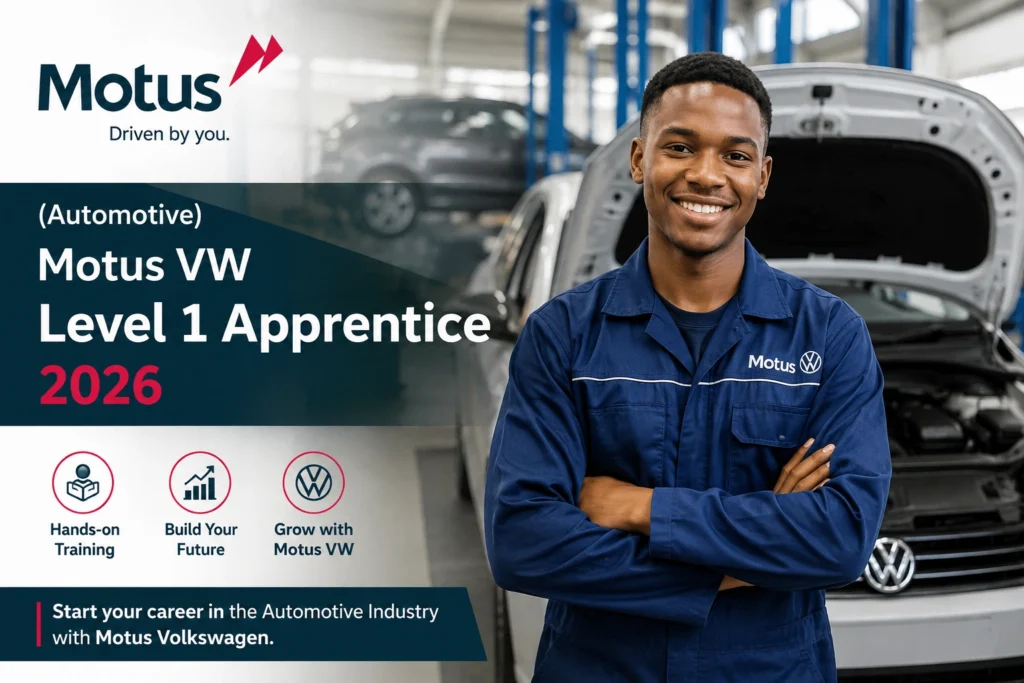

For young South Africans trying to break into the automotive industry, the hardest part is often not finding a qualification. It is finding an opportunity to turn technical knowledge into genuine workshop experience.
That is why the Automotive Motus VW Level 1 Apprentice 2026 opportunity at Motus VW Welkom is attracting attention. The vacancy is aimed at a Level 1 automotive apprentice who already has Matric with Mathematics and Physical Science, an accredited N3 qualification and a valid driver’s licence.
The closing date is 3 August 2026, leaving applicants with a short window to get their documents together and submit an application.
On paper, this may look like another entry-level vacancy. In reality, it represents something more important: a possible starting point for someone who wants to move from technical college knowledge into the professional motor industry.
And that transition is where many aspiring technicians struggle.
Why the Motus VW apprenticeship is attracting attention
Automotive careers have changed significantly. Modern technicians are no longer simply expected to identify mechanical problems by listening to an engine or inspecting components.
Vehicles increasingly depend on electronic systems, computerised diagnostics, sensors and sophisticated control modules. That means tomorrow’s technician needs a combination of mechanical understanding, technical training, diagnostic ability and practical workshop experience.
The Motus VW apprenticeship sits directly in that space.
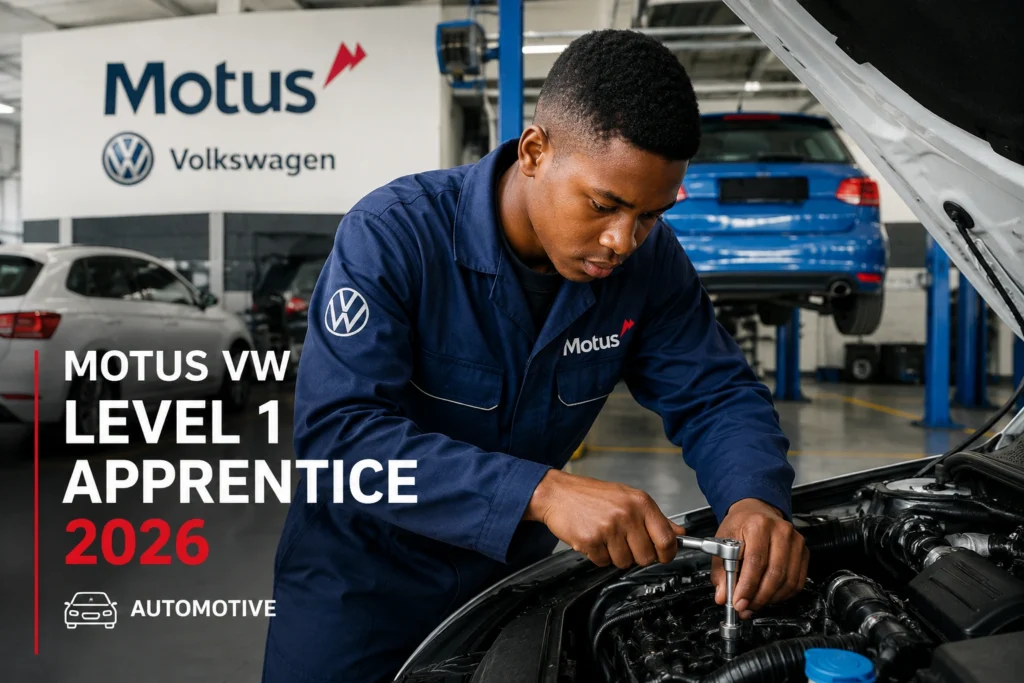
The successful candidate will work alongside qualified technicians, assist with vehicle diagnosis and repairs, learn to use professional workshop and diagnostic equipment, and participate in the training and assessments associated with the automotive trade.
For someone entering the industry, that practical exposure can be considerably different from working only in a classroom or college workshop.
The apprentice gets to see how technical knowledge is applied when an actual vehicle arrives with a real fault and a customer expects the problem to be identified and resolved.
That is where the value of an apprenticeship becomes clearer.
Background: why practical training still matters
South Africa’s vocational education system provides thousands of young people with technical knowledge every year. Yet completing a qualification does not automatically mean that an individual is ready to operate independently in a commercial workshop.
Employers need people who can work safely around vehicles, tools and machinery. They also need employees who understand workplace procedures, can communicate with senior technicians and can follow diagnostic processes accurately.
An apprenticeship helps bridge that gap.
Instead of treating theoretical education and workplace experience as competing options, the model brings them together.
For an automotive apprentice, that could mean learning about mechanical systems at training level and then seeing those principles applied to actual vehicles under supervision.
The distinction is important.
A person can understand the theory behind a vehicle system and still need considerable practice before becoming confident at diagnosing faults. The workshop environment provides that missing layer of experience.
What the Motus VW Level 1 Apprentice will actually learn
The vacancy indicates that the successful candidate will receive supervised workshop exposure rather than simply being assigned administrative duties.
Among the expected activities are assisting senior technicians with vehicle diagnosis and repairs, learning to operate diagnostic equipment and workshop tools, completing practical tasks under supervision and attending scheduled technical or level-training courses.
The apprentice will also need to prepare for the relevant apprenticeship level tests.
That means this is not simply a job where the candidate watches experienced mechanics work.
There is an educational component, an assessment component and a workplace-performance component.
The candidate will also be expected to follow workshop safety procedures, maintain an organised working environment and complete reasonable duties assigned by the employer.
For an aspiring technician, these less glamorous responsibilities matter too.
A professional workshop depends on discipline. Tools have to be handled correctly. Work areas need to remain safe. Instructions have to be followed. Vehicle faults need to be approached methodically rather than guessed at.
Those habits are part of becoming employable in the industry.
The qualifications are where many applicants need to pay attention
The Motus VW opportunity is not presented as an apprenticeship for applicants with Matric alone.
The stated requirements include:
- A Matric certificate with Mathematics and Physical Science
- An accredited N3 college certificate
- A valid and unendorsed driver’s licence
- A clear criminal record
The Mathematics and Physical Science requirement deserves particular attention.
Applicants should not simply assume that having completed Matric is sufficient. Candidates should check their actual academic records and make sure the required subjects are reflected on their certificates or results.
The N3 requirement is equally important.
Because the vacancy specifically calls for an accredited N3 qualification, applicants should make sure their documentation clearly demonstrates the qualification they are claiming.
This is one of those situations where careful preparation can matter more than sending an application quickly.
Who is likely to fit the role?
Qualifications may get an applicant through an initial screening process, but they do not tell the whole story.
A successful automotive apprentice needs to be comfortable learning from experienced people.
That means being willing to ask questions, accept correction and repeat technical procedures until they are performed correctly.
The workshop can also be physically demanding.
Candidates may spend significant periods standing, moving around vehicles, handling tools and working in environments where there is machinery, vehicle noise and other occupational hazards.
A strong candidate is therefore likely to demonstrate more than an interest in cars.
They should show discipline, reliability, problem-solving ability and a genuine willingness to develop technical skills.
Basic mechanical understanding can also be useful, particularly if it has been gained through college practical work, school projects or legitimate hands-on experience.
However, applicants should avoid exaggerating their experience.
An apprentice is expected to learn.
The point is not to convince the employer that a candidate is already a qualified technician. It is to demonstrate that the candidate has the foundation, attitude and commitment to develop into one.
Why This Matters Right Now
The timing of this vacancy makes it particularly relevant.
The application deadline is 3 August 2026, meaning interested candidates cannot afford to treat it as an opportunity to research indefinitely.
At the same time, the vacancy illustrates a wider issue facing young people entering technical careers: qualifications and employment are increasingly connected through practical experience.
An N3 certificate may provide an important technical foundation, but an apprenticeship can provide something that a certificate cannot provide on its own — exposure to professional workplace standards.
That experience can influence future employability.
It can teach a young technician how a dealership workshop functions, how jobs are allocated, how diagnostic equipment is used and how safety and quality-control requirements affect everyday work.
For someone serious about building an automotive career, those lessons can be difficult to reproduce outside an actual workplace.
The location issue applicants should not ignore
There is one unusual detail in the supplied vacancy information that deserves caution.
The main vacancy information identifies Motus VW Welkom in Welkom, Free State as the employer and location.
However, some of the accompanying description reportedly contains references to Bloemfontein, Ford Kroonstad and Motus Ford & Mazda.
Those references do not appear to align neatly with the main vacancy title.
Applicants should therefore avoid relying on copied descriptions or secondary summaries alone.
Before submitting an application, they should check the employer, dealership and location shown on the official application portal.
This is not merely a technicality.
If an applicant receives an invitation for an assessment or interview, they need to know exactly which dealership they are expected to attend.
Conflicting information is a reason to verify the original listing, not a reason to abandon the opportunity.
Public reaction: why apprenticeship vacancies generate interest
Entry-level automotive opportunities tend to attract a particular kind of attention because they offer something many job seekers struggle to obtain: a clear connection between training and a trade career.
For young people who have already invested time in technical education, an apprenticeship can feel more purposeful than applying for unrelated entry-level jobs simply to gain employment experience.
There is also a practical appeal.
Working alongside experienced technicians provides an opportunity to understand the standards expected inside a professional workshop.
But applicants should keep expectations realistic.
A dealership apprenticeship is not an automatic guarantee of becoming a qualified technician. Progress depends on completing the required training, meeting workplace standards, passing relevant assessments and satisfying the applicable trade requirements.
The opportunity is a pathway, not a shortcut.
What could make an application stronger?
The most useful approach is to make the CV easy for a recruiter to assess.
Do not bury the relevant qualifications halfway down the document.
Mathematics and Physical Science should be clearly visible in the education section. The accredited N3 qualification should be listed accurately, including the relevant subjects where appropriate.
The driver’s licence should also be clearly indicated.
Applicants with legitimate practical experience can add that information.
For example, college workshop exposure, technical projects or supervised mechanical work may help demonstrate genuine interest in automotive repair.
The important word is legitimate.
Candidates should never claim professional experience they do not have.
A concise CV that accurately explains a candidate’s training can be more credible than an inflated CV filled with vague technical terminology.
Common mistakes that could hurt applicants
One of the easiest mistakes is applying without checking the minimum requirements.
If the vacancy specifically asks for Mathematics, Physical Science and an accredited N3 qualification, candidates should not assume that another combination of subjects will automatically be accepted.
Another mistake is submitting an incomplete CV.
Applicants should check spelling, contact details, education history and qualification information before uploading the document.
They should also make sure scans or copies of certificates are readable.
A final-day application can create unnecessary risk if the portal experiences technical problems or if an applicant discovers that a required document is missing.
With the deadline falling on 3 August, early submission is the safer strategy.
APPLY HERE: Motus VW Level 1 Apprentice 2026
ALSO APPLY FOR: (Level One) Motus Kia Apprentice 2026
Salary and permanent status: what applicants should understand
The supplied vacancy information does not specify a salary or monthly apprenticeship stipend.
That means applicants should not rely on figures circulating on social media or recruitment pages unless those figures can be verified against the official vacancy or formal employment documentation.
The listing describes the opportunity as a permanent, entry-level position, but candidates should still establish the remuneration and employment conditions during the formal recruitment process.
This is another area where realistic expectations are important.
The strongest reason to pursue an automotive apprenticeship should be the combination of structured workplace learning, technical development and progression toward a trade — not an assumed salary figure.
What Could Happen Next
The immediate next step is straightforward: eligible candidates need to submit their applications before the stated 3 August 2026 deadline.
After the closing date, the employer may screen applications against the qualification and licensing requirements before moving suitable candidates into further recruitment stages.
Those stages could include assessments, interviews or technical evaluations, although applicants should wait for official communication rather than assuming a particular selection process.
Candidates who progress should be prepared to discuss why they want to enter the automotive industry.
They may also need to demonstrate how their Mathematics, Physical Science and N3 training have prepared them for technical learning.
The broader outcome could be more significant.
If the apprentice successfully progresses through the required training and assessments, the position could become the foundation of a longer automotive career rather than simply a first job.
That is ultimately what makes the vacancy worth watching.
Final assessment
The Automotive Motus VW Level 1 Apprentice 2026 opportunity is interesting precisely because it is not promising an effortless route into the motor industry.
It asks applicants to arrive with a technical foundation and then offers the chance to develop that foundation in a professional workshop environment.
For a candidate with Matric Mathematics and Physical Science, an accredited N3 qualification and a valid driver’s licence, it could be a meaningful opportunity to move from technical education into practical automotive work.
But the deadline is close, and eligibility should be taken seriously.
Applicants should verify the original vacancy, prepare their documents carefully and pay particular attention to the location information before submitting.
For those who meet the requirements, the bigger question is not simply whether this is another apprenticeship vacancy.
It is whether the candidate is ready to turn technical training into a long-term trade career.
For someone who answers yes, this Motus VW opportunity could be a useful place to start.