

Finding a first job in South Africa can be difficult even when you have a Matric certificate. Many entry-level vacancies ask for previous experience, while graduate programmes often require a diploma or degree. This leaves young jobseekers caught between having the education to start a career and not yet having the workplace experience employers want.
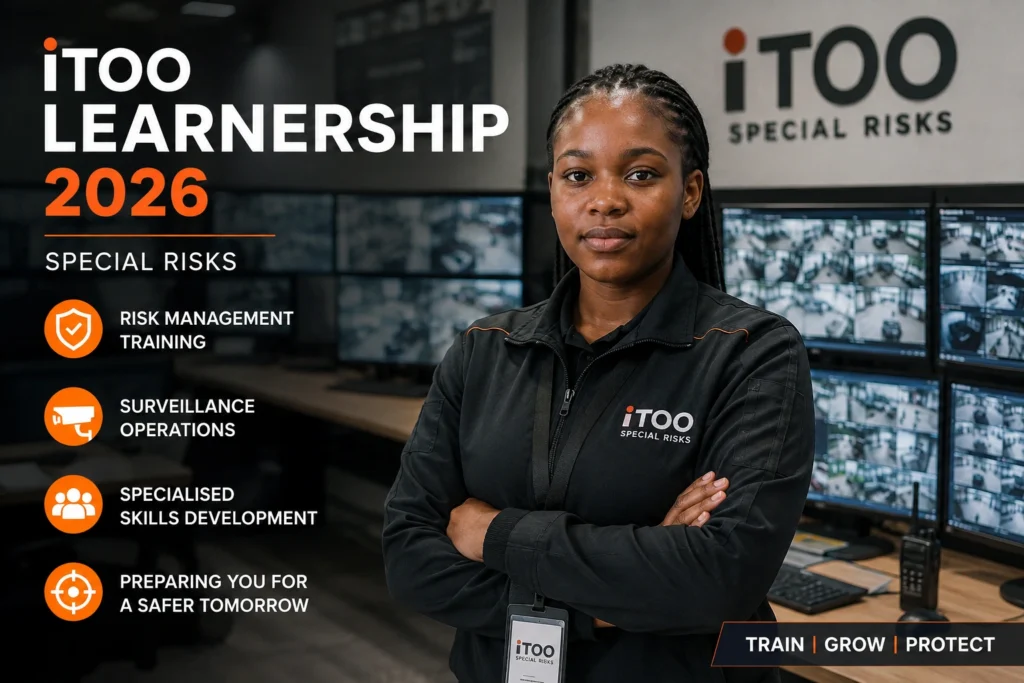
The (Special Risks) iTOO Learnership 2026 is the type of opportunity that can help bridge that gap. iTOO Special Risks operates in the specialist insurance sector, covering areas including cyber, professional risks, business risks, events and other specialised products. Its Johannesburg office is based in Parktown.
However, applicants should check the current vacancy carefully before submitting an application. The most recently verifiable iTOO learnership listing found online was for the 2025/2026 programme, which ran from October 2025 to September 2026 and closed on 29 July 2025. iTOO has historically offered learnerships and continues to discuss youth development and insurance talent development, but a new 2026 intake should be confirmed through the company’s official channels before being described as currently open.
That distinction matters because jobseekers should never assume that an old listing is still accepting applications.
What Is the (Special Risks) iTOO Learnership 2026?
The iTOO learnership is designed to introduce young South Africans to the insurance industry through a combination of formal learning and workplace exposure.
Previous iTOO learnership programmes have offered an NQF Level 5 Short-Term Insurance qualification through a SETA-accredited training provider, alongside practical experience, mentorship and workplace-readiness development. The previous programme was structured over 12 months.
This is particularly useful for people who want to enter insurance but have little or no professional experience.
Rather than simply studying insurance theory, learners can be exposed to how an insurance business operates. Depending on the placement, this may involve administration, customer service, processing, communication, compliance, documentation and other operational activities.
iTOO itself operates as a specialist insurance business rather than a conventional retail insurer. Its product portfolio includes areas such as cyber insurance, commercial crime, professional indemnity, medical malpractice, event liability, aviation and other specialist risks.
That makes the opportunity potentially valuable for someone interested in understanding the less visible side of the insurance industry.
Opportunity at a glance
| Detail | Information |
|---|---|
| Company | iTOO Special Risks |
| Sector | Specialist/commercial insurance |
| Location | Johannesburg, Gauteng |
| Typical programme duration | 12 months |
| Previous qualification | Short-Term Insurance, NQF Level 5 |
| Target applicants | Young South Africans |
| Minimum education | Grade 12/Matric |
| Employment status | Previously advertised for unemployed applicants |
| Workplace exposure | Yes |
| Stipend | Previous listings indicated a stipend |
| Current closing date | Verify the live vacancy before applying |
The exact requirements, stipend and closing date should always be checked against the latest official advertisement because programme conditions can change between intakes.
Why This Issue Matters
A qualification on its own does not always make it easy to enter the South African labour market.
Employers frequently look for communication skills, computer literacy, reliability, customer-service ability, attention to detail and workplace experience. A structured learnership can help address several of these requirements simultaneously.
The value of an insurance learnership also extends beyond obtaining a certificate. iTOO has previously described its graduate and learnership programmes as a bridge between education and working life, with practical experience, theoretical learning, mentorship, coaching and other support.
For a young person trying to build a CV, that combination can be significant.
Imagine two candidates applying for an entry-level insurance administration role. One has Matric and no workplace exposure. The other has Matric, an NQF qualification in Short-Term Insurance and 12 months of supervised workplace experience. The second candidate can potentially demonstrate not only academic knowledge but also an understanding of professional expectations.
That is why applicants should view a learnership as a career-building experience rather than simply a temporary job.
What You Could Learn During the Programme
A specialist insurance environment requires more than knowing definitions from a textbook.
Learners may encounter activities involving:
Work processing: Completing allocated tasks accurately and within required standards.
Customer service: Responding professionally to internal and external customers and helping resolve queries.
Communication: Learning how to communicate clearly with colleagues, customers, brokers and other stakeholders.
Administration: Capturing information correctly, maintaining records and following established processes.
Compliance: Understanding why insurance businesses must follow policies, procedures and regulatory requirements.
Product knowledge: Developing an understanding of insurance products and the risks they are designed to address.
Teamwork: Working with experienced employees and contributing to departmental objectives.
Professional conduct: Learning how confidentiality, integrity, punctuality and accountability operate in a professional environment.
The importance of accuracy should not be underestimated. Insurance involves policies, claims, customer information, premiums, risk information and regulatory requirements. Small administrative mistakes can have consequences, which is why attention to detail is an important employability skill.
Who Should Consider Applying?
The strongest candidate is not necessarily someone who already knows everything about insurance.
A good applicant is someone who can demonstrate a willingness to learn and work professionally.
You should consider the opportunity if you:
- Have completed Matric.
- Meet the age requirements in the live advertisement.
- Are unemployed if this is stipulated for the intake.
- Are legally eligible to work in South Africa.
- Are genuinely interested in insurance and financial services.
- Communicate confidently and professionally.
- Can work with documents and information carefully.
- Are comfortable learning new systems and procedures.
- Can work effectively as part of a team.
- Are prepared to complete both learning and workplace requirements.
Previous post-Matric study can be advantageous where the advertisement says so, but applicants should not automatically assume that a degree is mandatory if the official vacancy specifies Matric as the minimum.
Step-by-Step: How to Prepare for the iTOO Learnership
Step 1: Verify that the vacancy is genuinely open
This is the most important first step.
Step 2: Check every eligibility requirement
Before applying, compare your circumstances with the vacancy.
Check:
- Citizenship requirement
- Age requirement
- Matric requirement
- Employment status
- Previous learnership restrictions, if applicable
- Location and attendance requirements
- Any additional qualification requirements
Meeting most requirements is not the same as meeting all mandatory requirements.
Step 3: Build a focused CV
Your CV does not need to be five pages long.
For an entry-level learnership, focus on information that demonstrates your potential.
Include:
- Full name and contact details
- Education
- Matric subjects where relevant
- Post-Matric qualifications
- Computer skills
- Communication skills
- Volunteer or community experience
- Previous work exposure
- Leadership or teamwork activities
- Relevant certificates
If you have worked in retail, customer service, administration, tutoring or a community project, explain what you actually did rather than simply listing the organisation.
Step 4: Prepare your supporting documents
Have clear copies of documents requested in the advertisement.
Depending on the current application instructions, these may include:
- Updated CV
- Matric certificate
- South African ID
- Post-Matric qualification certificates
- Other relevant training certificates
APPLY HERE:iTOO Learnership 2026
Do not send unnecessary personal documents unless they are requested.
Step 5: Learn about specialist insurance
You do not need to become an insurance expert before an entry-level interview.
But you should understand the basic idea of insurance and know what makes iTOO different.
For example, iTOO’s product portfolio includes specialist areas such as cyber, aviation, medical malpractice, professional indemnity, event liability and commercial crime.
Knowing this demonstrates genuine preparation.
Step 6: Prepare for competency questions
Expect questions that could explore:
- Why do you want to work in insurance?
- Why are you interested in iTOO?
- Tell us about a time you worked in a team.
- How do you handle deadlines?
- How would you deal with an unhappy customer?
- What would you do if you made an administrative mistake?
- What are your career goals?
Use real examples from school, volunteering, community activities, part-time work or previous experience.
ALSO APPLY FOR: AgriSETA Learnerships 2026
Best Practices Experts Recommend
The strongest approach is to treat a learnership application like the beginning of your professional career.
Research the employer. Learn what iTOO does, which specialist insurance areas it operates in and why its business is different.
Demonstrate curiosity. Insurance contains technical terminology and detailed processes. Employers need people who are willing to learn.
Prioritise accuracy. Check spelling, dates, qualifications and contact information before submitting your CV.
Use professional communication. Your email address, application wording and interview behaviour all contribute to the impression you make.
Keep evidence of your applications. Save the vacancy, CV submitted and supporting documents so you know exactly what you applied for.
Apply through legitimate channels. The official company website and verified company communications should take priority over social-media forwards and WhatsApp messages.
Do not pay for recruitment. A legitimate employer should not ask you to pay a fee simply to be considered for a learnership.
Mistakes People Often Make
One of the biggest mistakes is assuming that a widely shared vacancy is automatically still open.
The previous iTOO 2025/2026 learnership is a useful example. It was advertised in July 2025 with a closing date of 29 July 2025, even though some third-party pages may continue displaying the opportunity later.
Other common mistakes include:
Submitting a generic CV: A CV written for a completely different industry may fail to demonstrate your interest in insurance.
Ignoring instructions: If the vacancy asks for specific documents, provide them in the requested format.
Exaggerating skills: Do not claim advanced Excel, insurance or administrative experience if you cannot demonstrate it.
Applying without researching iTOO: A few minutes of preparation can make your interview answers much stronger.
Focusing only on the stipend: Financial support matters, but the bigger long-term value can be the qualification, workplace experience and professional network.
Assuming the learnership guarantees permanent employment: A learnership can improve your employability, but it should not be presented as an automatic permanent job offer.
Frequently Asked Questions
Is the iTOO Learnership 2026 currently open?
The status needs to be verified against the latest official iTOO vacancy. The most recent clearly verifiable listing located during research was the 2025/2026 intake, which closed on 29 July 2025.
What qualification has iTOO offered through its learnership?
Previous iTOO programmes offered a Short-Term Insurance qualification at NQF Level 5 through a SETA-accredited training provider.
Where is iTOO based in Johannesburg?
iTOO’s Johannesburg office is at Villa Arcadia, 22 Oxford Road, Parktown, Johannesburg.
Does a learnership guarantee permanent employment?
No. A learnership provides structured training and workplace experience, but permanent employment depends on the employer’s available positions, performance and other recruitment considerations.
Final Summary: Treat the Opportunity as a Career Starting Point
The (Special Risks) iTOO Learnership 2026 could be an attractive route into South Africa’s insurance sector for someone who wants to combine formal learning with workplace exposure. iTOO operates in a specialised part of the industry, with products covering areas ranging from cyber and professional risks to events, commercial crime and aviation.
The most important practical advice, however, is to verify the current intake before publishing or applying. The information available online confirms a previous 2025/2026 iTOO learnership, but that programme had a July 2025 closing date.
If a new intake is officially listed, prepare your CV, Matric certificate and other requested documents immediately. Research iTOO, understand the basics of specialist insurance and prepare examples that demonstrate communication, teamwork, reliability and attention to detail.
For jobseekers, the real value of a programme like this is not simply the monthly stipend. It is the opportunity to develop a recognised qualification, learn professional standards and gain experience that can strengthen your CV for future insurance and financial-services roles.