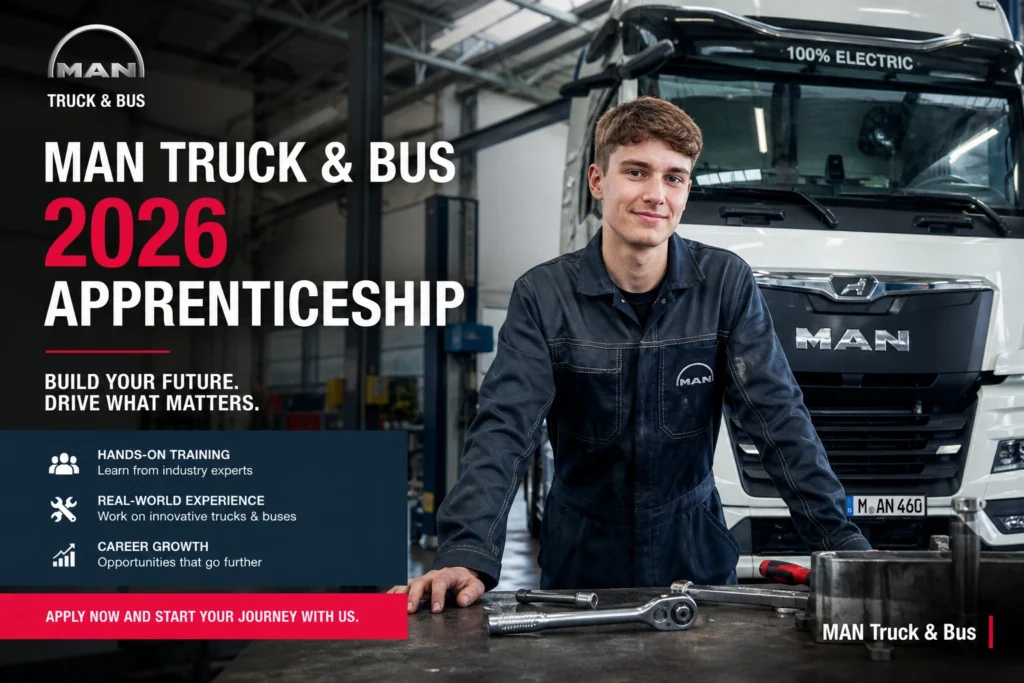

The workshop floor hums before sunrise. A line of heavy-duty trucks—dusty from long-haul routes between Gauteng and Durban—waits for inspection. A young apprentice, barely months into the trade, tightens a bolt under the watchful eye of a seasoned technician. There’s grease on his hands, pressure in the air, and something else: the quiet realisation that this is where his future is taking shape.
For many South Africans trying to break into technical careers, moments like this are hard-won. Qualifications alone rarely open doors. Experience does. And that’s precisely where the MAN Truck & Bus: 2026 Apprenticeship steps in—bridging the gap between classroom theory and real-world engineering.
At a time when youth unemployment remains stubbornly high and industries demand practical skills over paper credentials, structured apprenticeships like this are not just opportunities—they’re lifelines.
A practical pathway into a global engineering ecosystem
The appeal of MAN Automotive South Africa goes beyond its name recognition. As part of a global commercial vehicle group, the company operates at the intersection of logistics, engineering, and advanced vehicle technology. In a country where transport underpins nearly every sector—from mining to retail—the relevance of this industry cannot be overstated.
What makes this apprenticeship stand out is its dual structure. It’s not simply about learning how to fix trucks. It’s about understanding how modern transport systems function, how diagnostics are evolving, and how global standards are applied locally.
Apprentices split their time between workshop floors and technical training institutions. One day might involve troubleshooting a braking system on a heavy-duty truck; the next could be spent studying electrical schematics in a classroom. This blend ensures that learning isn’t abstract—it’s constantly tested against real-world demands.
For young people in provinces like KwaZulu-Natal or Mpumalanga, where logistics corridors are busy but opportunities can feel limited, access to such structured training is especially significant.
APPLY HERE: MAN Truck & Bus: 2026 Apprenticeship
Inside the MAN Truck & Bus: 2026 Apprenticeship trades
The 2026 intake focuses on two core trades, each aligned with critical skills shortages in South Africa’s transport sector.
The diesel mechanic apprenticeship is the backbone of the programme. Diesel engines power the country’s freight network, and keeping them operational is both a technical and economic necessity. Apprentices learn to diagnose faults, service engines, and handle complex mechanical systems—from fuel injection to drivetrain components.
On the other side is the auto electrician apprenticeship, a trade that reflects how vehicles have evolved. Today’s trucks are not just mechanical machines; they are mobile computer systems. Electrical diagnostics, CAN bus systems, and electronic control units (ECUs) are now central to vehicle performance. Apprentices in this field develop the ability to interpret wiring diagrams, test circuits, and resolve faults using advanced tools.
What’s notable is how both trades intersect. A modern technician often needs hybrid skills—mechanical awareness paired with digital literacy. MAN’s training approach quietly acknowledges this shift, preparing apprentices for a future where boundaries between trades are increasingly blurred.
Who gets in—and why competition is rising
On paper, the entry requirements seem straightforward: an N1 certificate with the relevant subjects, basic computer literacy, and the ability to communicate effectively. But in practice, selection is far more competitive.
Across South Africa, thousands of young people complete technical courses every year. Yet only a fraction secure apprenticeships. Employers like MAN are not just looking for academic results—they’re looking for indicators of reliability, curiosity, and resilience.
Candidates who stand out often share a few traits. They’ve spent time in informal workshops, even if unpaid. They can explain why they chose their trade, not just what they studied. And they understand that customer service matters, even in a technical role.
There’s also a growing emphasis on adaptability. Workshops today rely on digital diagnostics, service tracking systems, and strict compliance procedures. Being comfortable with technology is no longer optional—it’s expected.
The application journey: more than paperwork
Applying for the MAN Truck & Bus: 2026 Apprenticeship is, in many ways, a test in itself. Not because the process is complicated, but because it rewards preparation and attention to detail.
A strong application doesn’t just list qualifications—it tells a story. Why this trade? Why this company? What have you done, even informally, to build your skills?
Before submitting anything, applicants need to assemble a clean, professional CV, certified documents, and proof of qualifications. But beyond that, timing matters. Many apprenticeship intakes close early once enough applications are received, meaning late submissions rarely stand a chance.
There’s also an unspoken layer to the process: digital visibility. Many candidates find opportunities through job portals or word of mouth, but those who actively monitor company career pages tend to have an advantage.
In a competitive field, small details—like correctly naming the position you’re applying for or ensuring your documents are legible—can quietly determine whether your application moves forward or gets overlooked.
APPLY HERE: MAN Truck & Bus: 2026 Apprenticeship
Why apprenticeships matter more in 2026 than ever before
South Africa’s labour market has shifted significantly over the past decade. Traditional entry-level jobs are shrinking, while technical roles requiring specialised skills are growing. Yet the education system hasn’t fully kept pace with these changes.
This creates a paradox: companies struggle to find skilled technicians, while young people struggle to find work.
Apprenticeships like MAN’s help resolve this tension. They create a structured pipeline where training is directly aligned with industry needs. Instead of learning in isolation, apprentices are trained within the environments where their skills will be used.
There’s also a broader economic impact. A qualified diesel mechanic or auto electrician doesn’t just find employment—they contribute to keeping supply chains running. In a country heavily reliant on road transport, that role carries real weight.
Expert insight: the quiet shift toward “smart mechanics”
Industry insiders often point to a subtle but important shift happening in workshops across South Africa. The role of a mechanic is evolving into something closer to a “systems technician.”
Modern trucks are equipped with sensors, onboard computers, and telematics systems that monitor performance in real time. Diagnosing a fault is no longer just about listening for unusual sounds or inspecting visible components—it often involves interpreting digital data.
This shift has two major implications. First, apprentices who embrace technology early will have a clear advantage. Second, training programmes that integrate digital diagnostics—like those offered by MAN—are likely to produce more adaptable, future-ready technicians.
In simple terms, the mechanic of tomorrow is as comfortable with a laptop as they are with a spanner.
APPLY HERE: MAN Truck & Bus: 2026 Apprenticeship
ALSO APPLY FOR: Scania Technician Apprenticeship 2026
What you gain beyond the stipend
While the monthly allowance helps cover basic expenses, the real value of the apprenticeship lies elsewhere.
- Industry credibility: Training under a recognised global brand carries weight in the job market.
- Structured progression: Clear milestones lead toward trade test readiness.
- Mentorship: Learning directly from experienced technicians accelerates skill development.
- Career mobility: Skills gained are transferable across the broader transport and logistics sector.
For many apprentices, the programme becomes a launchpad—not just into employment, but into long-term career growth.
Frequently asked questions
1. Do I need prior workshop experience to apply?
No, but any hands-on exposure—formal or informal—can strengthen your application and show genuine interest.
2. Is the apprenticeship guaranteed to lead to a permanent job?
Not automatically. However, strong performance during the programme often improves your chances of being retained or finding work elsewhere.
3. Can I apply if I only have matric without N1?
In most cases, no. The programme requires at least an N1 qualification in relevant subjects, although a technical matric may sometimes be considered.
The bigger picture: building a career that lasts
Standing in that workshop, watching a truck roll out after a successful repair, an apprentice sees more than just a completed task. They see movement—goods delivered, businesses supported, livelihoods sustained.
That’s the often-overlooked reality of technical trades. They sit at the heart of the economy, quietly enabling everything else to function.
The MAN Truck & Bus: 2026 Apprenticeship is not a shortcut to success. It demands commitment, discipline, and a willingness to learn from the ground up. But for those who stick with it, the rewards extend far beyond a certificate.
It offers something increasingly rare in today’s job market: a clear, practical path forward.
And in a country searching for sustainable solutions to youth unemployment, that path matters more than ever.