

For many young South Africans, finding the right opportunity after matric, college or university can be confusing. You may come across a learnership, graduate programme, internship, traineeship or apprenticeship, and the advertisements can sometimes look remarkably similar.
The problem is that choosing the wrong opportunity can cost you valuable time.
A matriculant might spend weeks applying for graduate programmes that require a completed degree. Meanwhile, a university graduate might apply for learnerships without considering whether the programme will actually move their professional career forward.
This is why understanding Learnership vs Graduate Programme: What’s the Difference? matters.
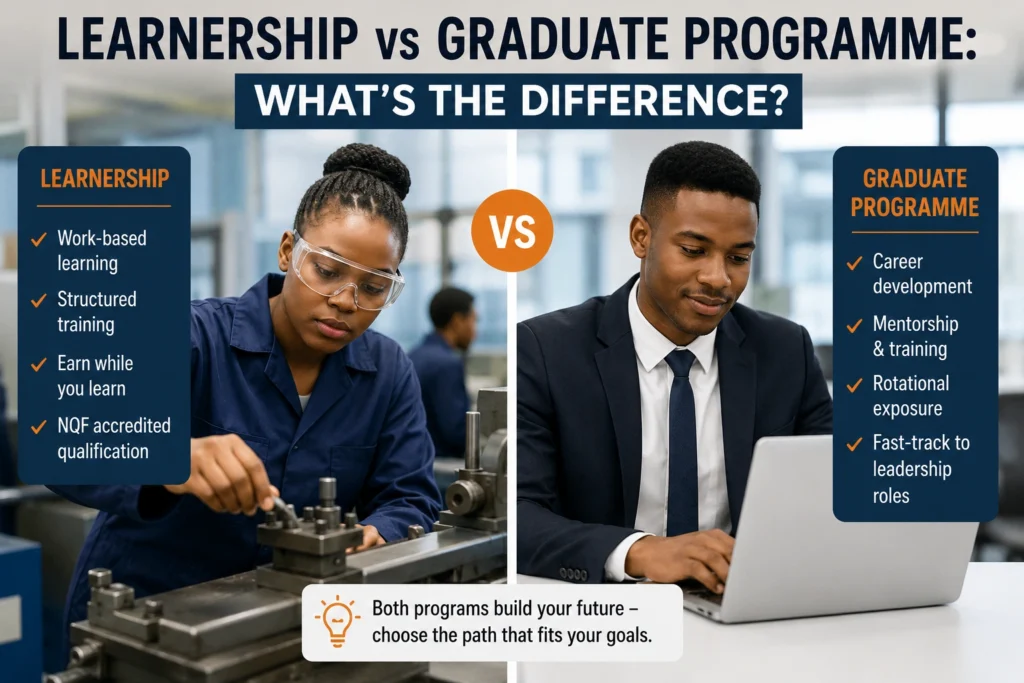
Although both can provide workplace exposure and help young people enter the labour market, they are designed for different stages of career development. A learnership generally combines structured learning with workplace experience, while a graduate programme is normally aimed at people who have already completed a tertiary qualification and need practical professional experience.
But there is more to the decision than simply asking, “Do I have a degree?”
You also need to consider the type of qualification you hold, the skills you want to develop, the career you are targeting, the programme’s duration, the financial support offered and what happens when the programme ends.
This guide breaks down those differences and explains how to decide which route makes sense for your career.
Learnership vs Graduate Programme: What’s the Difference?
At its simplest:
A learnership helps you develop occupational skills through a combination of structured learning and workplace experience, while a graduate programme usually develops an existing tertiary qualification into practical professional experience.
That distinction is important.
A learner may enter a programme with Grade 12 and leave with an occupational qualification or recognised learning credits plus workplace experience.
A graduate, on the other hand, normally enters with a diploma or degree and spends the programme applying that academic knowledge in a professional environment.
A simple example
Imagine two people:
Thabo has Grade 12 and wants to enter the banking industry. He has no formal work experience.
A banking learnership could give him structured training, workplace exposure and practical business skills.
Lerato has just completed a BCom degree and wants to become a financial analyst.
A graduate programme in finance, investment, risk or business analysis could expose her to professional systems, projects, reporting and experienced teams.
Both programmes can be valuable—but they solve different problems.
ALSO APPLY FOR: Momentum YES Learnership 2026
ALSO APPLY FOR: Discovery Learnerships 2026-2027
The Biggest Differences at a Glance
| Factor | Learnership | Graduate Programme |
|---|---|---|
| Typical applicant | Matriculants and entry-level candidates | Recent diploma/degree graduates |
| Main purpose | Build occupational skills | Develop professional workplace capability |
| Education | Often Grade 12, depending on programme | Usually diploma or degree |
| Workplace experience | Yes | Yes |
| Formal learning | Major part of programme | Usually workplace/professional development |
| Qualification | Often linked to an occupational qualification | Usually builds on an existing tertiary qualification |
| Duration | Varies | Commonly 12–36 months |
| Payment | Usually a stipend | Stipend or salary depending on employer |
| Professional career focus | Depends on occupation | Usually strong |
| Permanent employment | Not guaranteed | Not guaranteed |
| Best starting point | Developing practical occupational skills | Transitioning from tertiary education into a career |
Important: These are general patterns. Individual employers can structure programmes differently, so the actual advert always takes priority.
What Exactly Is a Learnership?
A learnership is a structured work-based learning programme that combines theoretical learning with practical workplace experience.
The idea is not simply to give someone a temporary job.
A learner is expected to learn while gaining exposure to the workplace.
Depending on the programme, this could involve classroom or structured learning alongside practical activities at a company.
For example, someone on an administration learnership could gain experience with:
- Capturing information
- Maintaining records
- Using office software
- Communicating with customers
- Preparing documents
- Following workplace procedures
- Supporting administrative teams
- Completing learning assignments
Someone on a technical learnership could have very different responsibilities.
This is why applicants should never judge a learnership purely by its title. The occupation and learning outcomes matter.
Who is a learnership best for?
A learnership may be particularly suitable if you:
- Have Grade 12.
- Have limited or no formal work experience.
- Want to enter the workplace.
- Need practical skills.
- Want structured occupational training.
- Are interested in a specific occupation.
- Meet the programme’s academic and other requirements.
Some learnerships have additional requirements involving age, employment status, specific school subjects, location or other criteria.
Always check the individual advertisement.
ALSO READ ABOUT: Fake Stipend Promises
What Is a Graduate Programme?
A graduate programme is normally designed for someone who has already completed a tertiary qualification.
Companies use graduate programmes to develop young professionals by exposing them to real business environments.
For example, an engineering graduate could rotate between:
- Engineering operations
- Maintenance
- Projects
- Quality
- Safety
- Technical services
- Production
A finance graduate might work in:
- Financial reporting
- Management accounting
- Risk
- Audit
- Treasury
- Commercial finance
- Business analysis
The graduate already has an academic foundation. The employer’s role is to help them turn that knowledge into workplace competence.
What can a graduate programme provide?
Depending on the employer, you may receive:
- Mentorship
- Structured training
- Departmental rotations
- Professional development
- Exposure to senior employees
- Practical projects
- Technical training
- Performance assessments
- Networking opportunities
- Experience with corporate systems
Some programmes can become pathways into permanent positions, but this is not automatic.
Why This Issue Matters
The difference between these programmes can affect your entire application strategy.
1. You could be applying for opportunities you cannot qualify for
If a graduate programme requires a completed degree, having matric alone will not normally satisfy the requirement.
Similarly, if you already have a degree, applying for a programme designed specifically for candidates with Grade 12 may not be the strongest use of your time.
2. Your first opportunity can shape your CV
Your first meaningful workplace experience becomes an important part of your CV.
A good programme can help you demonstrate:
- Workplace discipline
- Technical skills
- Communication
- Teamwork
- Problem-solving
- Industry knowledge
- Professional responsibility
3. The programme should fit your long-term goal
A stipend today is useful, but ask yourself:
What will this experience allow me to apply for tomorrow?
That question can prevent you from choosing an opportunity simply because it has an attractive headline.
Which One Is Better: Learnership or Graduate Programme?
Neither is automatically better.
The correct question is:
Which one is better for my current career stage?
A learnership may be the better option if you:
- Have matric but no tertiary qualification.
- Need your first workplace experience.
- Want occupational training.
- Are still deciding on a career direction.
- Want to develop practical skills.
- Meet the learnership’s specific requirements.
A graduate programme may be better if you:
- Have completed a relevant diploma or degree.
- Want to enter a professional occupation.
- Need industry experience related to your qualification.
- Want exposure to a large organisation.
- Are targeting a specific professional career.
- Meet the programme’s academic requirements.
ALSO READ ABOUT: Is a R5,000 Stipend Enough to Live on
Don’t Make Your Decision Based Only on the Stipend
This is one of the most important lessons for applicants.
Suppose you have two opportunities:
Programme A: R6,000 monthly stipend but limited relevance to your career.
Programme B: R5,000 monthly stipend but provides direct experience in the field you studied.
Programme B could potentially be more valuable for your long-term career.
That does not mean money is unimportant. Young job seekers have real financial pressures.
Instead, evaluate the total value of the opportunity.
Consider:
- Monthly stipend or salary
- Qualification gained
- Skills developed
- Workplace experience
- Mentorship
- Industry exposure
- Location and transport costs
- Programme duration
- Career relevance
- Potential opportunities after completion
A Practical Career-Stage Guide
Use this as a starting point.
| Your Situation | Opportunity to Prioritise |
| Grade 12, no experience | Learnerships |
| Grade 12 + relevant certificate | Learnerships and entry-level roles |
| TVET qualification | Learnerships, internships and relevant trainee roles |
| Diploma graduate | Graduate programmes, internships and junior roles |
| Degree graduate | Graduate programmes, internships and entry-level professional roles |
| Graduate with experience | Junior professional vacancies and targeted graduate roles |
| Skilled technical candidate | Apprenticeships, learnerships and technical trainee programmes |
This is not a rigid rule.
A particular employer may accept candidates with different qualifications, so always read the official requirements.
How to Choose the Right Programme: 7-Step Strategy
Step 1: Identify your current career stage
Before searching job boards, write down:
Highest qualification + field of study + experience + career target
For example:
Diploma in Human Resources + 6 months administration experience + HR career goal.
This makes your search much more focused.
Step 2: Separate “must-have” requirements from preferences
Create two lists.
Must-have
- Required qualification
- Required subjects
- Citizenship requirement
- Age requirement, where applicable
- Location requirement
- Employment status
- Relevant field of study
Preferences
- Higher stipend
- Preferred location
- Remote/hybrid work
- Large employer
- Specific department
Never allow a preference to make you ignore a mandatory requirement.
Step 3: Read the full advert
Don’t stop at the headline.
Check:
- Minimum requirements
- Duties
- Programme duration
- Location
- Closing date
- Application process
- Required documents
- Employment status
- Stipend/salary information
Step 4: Investigate what you will actually do
Ask:
Will I spend most of my time learning useful skills or simply performing routine tasks?
No entry-level programme will be perfect, but the experience should ideally contribute to your employability.
Step 5: Check the career relevance
For graduates, this is especially important.
A BSc Computer Science graduate should ask whether the programme develops technology-related skills.
A marketing graduate should look for exposure to marketing, communications, digital platforms, customer insights or related functions.
Step 6: Compare opportunities using a scoring system
You can score each opportunity from 1–5.
| Factor | Score |
| Career relevance | /5 |
| Skills development | /5 |
| Qualification/training | /5 |
| Workplace exposure | /5 |
| Financial value | /5 |
| Employer reputation | /5 |
| Potential career pathway | /5 |
| Total | /35 |
This turns an emotional decision into a more practical one.
Step 7: Apply strategically
Do not submit a generic CV everywhere.
Match your application to the opportunity.
ALSO READ ABOUT: Which Industries Offer the Highest Stipend
How to Build a Strong Learnership Application
If you’re applying for a learnership, your CV should make it easy for the recruiter to see that you meet the requirements.
Highlight:
- Grade 12 subjects
- Relevant certificates
- Computer literacy
- Communication skills
- Volunteer work
- Community activities
- Leadership experience
- School projects
- Relevant short courses
- Any previous work exposure
You don’t need ten years of experience.
Instead, show evidence that you are ready to learn and work.
How to Build a Strong Graduate Programme Application
Graduate applicants should make their tertiary qualification highly visible.
Your CV should clearly show:
- Qualification
- Institution
- Completion year
- Relevant modules
- Academic projects
- Work-integrated learning
- Internships
- Technical skills
- Software knowledge
- Leadership
- Volunteering
- Part-time work
For example, don’t simply write:
“Computer Science graduate.”
If relevant, demonstrate what you actually did:
“Completed a final-year software development project involving database design, testing and user requirements.”
That gives the recruiter something concrete to evaluate.
Best Practices Experts Recommend
Apply before the closing date
Don’t make the closing day your application day.
Websites can experience traffic problems, documents can fail to upload and applicants sometimes discover missing requirements too late.
Keep multiple CV versions
You could maintain:
- A general CV
- A learnership-focused CV
- A graduate CV
- A technical CV
You don’t need to rewrite everything for every application, but the most relevant information should appear prominently.
Track every application
Record:
- Company
- Programme
- Closing date
- Requirements
- Application date
- Reference number
- Contact details
- Outcome
This prevents confusion when you apply for multiple opportunities.
Verify the opportunity
Before sending sensitive documents, check whether the vacancy appears on the employer’s official careers platform or another trustworthy recruitment channel.
Be cautious when someone:
- Requests money to secure a position.
- Promises guaranteed employment.
- Requests banking details unnecessarily.
- Uses an unofficial email address.
- Pressures you to make an immediate payment.
- Claims you were selected without a proper application.
Mistakes People Often Make
Mistake 1: Applying because the stipend looks attractive
A monthly payment is important, but it should not be your only consideration.
Mistake 2: Confusing a learnership with a graduate programme
They may both involve training and workplace experience, but their target applicants and learning structures can be different.
Mistake 3: Applying without checking qualification requirements
This creates unnecessary applications and disappointment.
Mistake 4: Using the same CV for every vacancy
Recruiters need to quickly understand why your background fits their opportunity.
Mistake 5: Assuming completion guarantees a permanent job
It doesn’t.
Treat the programme as a platform for building experience and improving your chances of securing your next role.
Mistake 6: Ignoring location
A programme can look excellent until you calculate daily transport costs.
If you receive R5,000 but spend a significant portion travelling to work, your effective financial benefit is much lower.
Mistake 7: Paying recruitment scammers
Legitimate opportunities should be independently verified before you provide personal information or money.
Learnership, Graduate Programme or Internship?
There is a third option worth understanding.
An internship is generally focused on giving practical work experience in a particular field. Depending on the programme, an internship may be available to students, recent graduates or other entry-level candidates.
That means you should not assume:
Learnership = school leaver
Internship = graduate
Graduate programme = permanent job
Real programmes vary.
Always read the specific requirements.
A Quick Decision Test
If you’re still unsure, answer these questions.
Question 1:
Do I have the tertiary qualification specifically requested?
If no, prioritise opportunities for which you qualify.
Question 2:
Do I need occupational training or professional experience?
Occupational training may point towards a learnership.
Professional experience related to an existing degree or diploma may point towards a graduate programme.
Question 3:
Does this opportunity move me towards my target career?
If the answer is no, reconsider—even if the programme sounds attractive.
Question 4:
What will I have gained when the programme ends?
Look for a combination of:
- Skills
- Experience
- Qualifications
- References
- Professional networks
- Evidence of work performed
That is the real value of an entry-level programme.
Frequently Asked Questions
1. Can someone with a degree apply for a learnership?
Sometimes. Eligibility depends on the specific learnership. However, graduates should consider whether the programme provides meaningful development towards their intended career
2. Does a graduate programme guarantee permanent employment?
No. Some employers may recruit successful participants into permanent positions, but this should never be assumed unless the employer explicitly states it.
3. Which pays more, a learnership or graduate programme?
There is no universal answer. Learnerships commonly use stipends, while graduate programmes can offer stipends or salaries depending on the employer and programme. Compare the actual advertised amount rather than relying on assumptions.
4. Is a learnership better than an internship?
Not necessarily. They serve different purposes. A learnership generally combines structured learning with workplace experience, while an internship is usually focused more directly on practical workplace exposure. The best choice depends on your qualifications and career objectives.
Final Advice: Choose the Opportunity, Not Just the Job Title
The biggest lesson from Learnership vs Graduate Programme: What’s the Difference? is that there is no single route that is best for everyone.
If you’re a matriculant who needs occupational skills and workplace exposure, a learnership could be an important first step.
If you’ve completed a diploma or degree and want to turn your academic knowledge into professional experience, a graduate programme may be more appropriate.
But don’t stop at the title.
Before applying, check:
- Eligibility
- Qualification
- Learning content
- Actual duties
- Career relevance
- Programme duration
- Stipend or salary
- Location
- Employment terms
- Application method
Then ask the question that matters most:
“Will this opportunity make me more employable when it ends?”
If the answer is yes, you may have found an opportunity worth pursuing.
Your first programme does not have to determine your entire career. But it should ideally give you something valuable to carry forward—skills, experience, qualifications, confidence, professional contacts or evidence that you can perform in a real workplace.
For South African job seekers, that mindset is far more useful than simply applying for every opportunity with the word “graduate”, “learner” or “trainee” in its title.
Choose strategically, apply carefully, verify every opportunity and use each programme as a stepping stone towards the career you actually want.