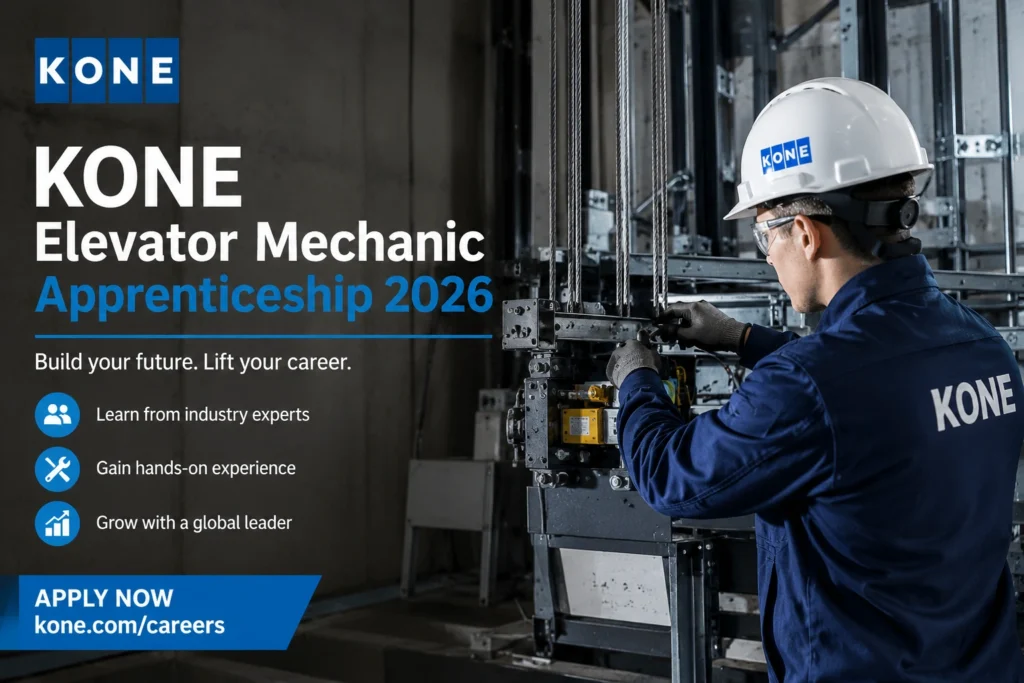

There was a time when becoming an artisan was treated as a “second option” compared to university degrees. That perception is changing fast — and nowhere is the shift more visible than in the growing attention around the kone Elevator Mechanic Apprenticeship 2026 opportunities now opening across South Africa.
The reason is simple: modern cities cannot function without vertical transport.
Every shopping mall, office tower, hospital, hotel, airport, and apartment complex depends on elevators, escalators, and moving walkways. As urban development accelerates in cities like Johannesburg, Cape Town, and Durban, companies are scrambling to find skilled lift mechanics who can install, maintain, and repair these systems.
And unlike many entry-level industries struggling with uncertainty, the lift and escalator sector sits in a rare position. It combines technical skills, automation technology, engineering, electronics, and infrastructure maintenance into a trade that remains essential regardless of economic cycles.
That is why apprenticeship programmes from global companies such as KONE, Otis, and Schindler are attracting increasing attention from young South Africans searching for stable, practical careers with long-term earning potential.
And in 2026, the competition for these opportunities could become even more intense.
Why Elevator Mechanic Apprenticeship 2026 Opportunities Are Suddenly Trending
For years, South Africa’s artisan shortage has been a major concern across engineering and technical sectors. But the elevator industry faces a particularly unique challenge.
Many experienced lift mechanics are approaching retirement age while demand for smart building infrastructure continues to rise. Companies are under pressure to replace aging technical talent while also adapting to newer technologies like predictive maintenance systems, digital diagnostics, automated monitoring, and energy-efficient lift systems.
That shift has transformed the traditional “lift mechanic” role into something far more advanced than many people realize.
Today’s technicians are expected to understand:
- Electrical systems
- Mechanical engineering
- Automation controls
- Circuit diagnostics
- Safety systems
- Smart monitoring tools
- Hydraulic and traction systems
- Building integration technology
In practical terms, this means the industry no longer wants workers who only “fix elevators.” It wants highly adaptable technical specialists.
That is exactly why apprenticeship pipelines are becoming so important.
KONE Elevators South Africa Is Positioning Itself Aggressively
Among all the companies currently active in the sector, KONE South Africa has emerged as one of the most visible players in the apprenticeship space.
The company’s 2026 intake includes structured training opportunities in Durban and Cape Town under its Apprentice – Elevators & Escalators programme.
KONE Apprenticeship Locations
- Durban
- Cape Town
Programme Structure
The apprenticeship combines classroom-based technical development with practical workplace training. Apprentices gain exposure to real installations, maintenance operations, service environments, and troubleshooting scenarios.
This matters because many young applicants struggle to gain “experience” after finishing technical studies. Apprenticeships close that gap by allowing candidates to earn while they learn.
KONE Minimum Requirements
Applicants typically need:
- Matric with Mathematics and Physical Science
OR - N2/N3 qualification in Mechanical or Electrical Engineering
Additional expectations include:
- Computer literacy
- Strong communication skills
- Teamwork ability
- Physical fitness
- Comfort working at heights
- Medical fitness
KONE also specifies that applicants should generally be 35 years old or younger.
What Apprentices Actually Learn
The training exposure is broader than many people expect.
Apprentices may work with:
- Hoisting systems
- Elevator control panels
- Counterweight systems
- Braking mechanisms
- Escalator drive systems
- Electrical fault diagnostics
- Elevator automation technology
- Preventative maintenance systems
This is one reason why qualified lift mechanics often become highly employable internationally as well.
The Industry’s Quiet Advantage: Recession Resistance
One of the biggest reasons technical careers are gaining traction in 2026 is growing uncertainty in white-collar employment markets.
Across multiple industries, graduates are facing hiring slowdowns, automation pressure, and entry-level oversaturation. But infrastructure maintenance operates differently.
Buildings still need elevators.
Hospitals still require functioning lifts.
Airports still need escalators.
Residential towers still require maintenance teams.
That ongoing demand gives lift mechanics a level of job stability many other professions currently lack.
The trade also benefits from relatively limited competition. Becoming a qualified lift mechanic takes years of structured learning, technical discipline, and practical competency. Not everyone is willing to commit to that path — which increases the value of those who do.
Why This Matters Right Now
The timing of the kone Elevator Mechanic Apprenticeship 2026 opportunities is significant for another reason: South Africa’s youth employment crisis continues to reshape career priorities.
More students are beginning to question whether traditional university routes automatically guarantee better outcomes.
Technical trades are increasingly viewed as practical, income-generating pathways with clearer employment prospects.
That broader mindset shift is creating renewed interest in:
- Apprenticeships
- Learnerships
- Artisan careers
- Engineering trades
- Industrial maintenance roles
The elevator industry sits at the intersection of all those trends.
At the same time, smart-city development across Africa is expanding demand for vertical transport systems. New malls, mixed-use developments, residential estates, logistics hubs, and office complexes all require ongoing lift maintenance.
In other words, this is not a disappearing trade.
It is evolving into a more technologically advanced one.
Otis Is Expanding Training Pipelines Too
Otis has also intensified its investment in training and skills development through partnerships and technical academy programmes.
The company reportedly hosts dozens of learners and graduates while increasing efforts to address industry shortages.
What stands out about Otis is its emphasis on long-term career development beyond apprenticeship level.
Training pathways reportedly extend into:
- Field engineering
- Operations
- Supervision
- Installations
- Project management
- Health and safety
- Technical sales
That progression matters because many young people entering apprenticeships want to know whether artisan careers offer growth potential.
The answer, increasingly, appears to be yes.
Modern lift companies are highly sophisticated engineering businesses. Experienced technicians can eventually move into leadership, project coordination, technical consulting, or operations management.
The Public Perception Around Trades Is Changing
Another fascinating development is the growing social rebranding of artisan careers.
For years, trades were often unfairly framed as lower-status alternatives to academic careers. But economic realities are reshaping that narrative globally.
Today, many technically skilled artisans earn strong incomes while avoiding some of the debt and employment bottlenecks facing degree graduates.
In South Africa especially, practical technical skills are becoming increasingly valuable.
That is one reason apprenticeship programmes from companies like KONE are attracting stronger online interest.
People are starting to recognize that careers involving engineering systems, infrastructure maintenance, and industrial technology are not “fallback jobs.”
They are highly specialized professions.
Vision Elevators Offers Another Route
While multinational companies dominate attention, local players are also participating in skills development.
Vision Elevators previously advertised a four-year training programme in Cape Town aimed at younger candidates with mechanical or electrical backgrounds.
Its recruitment process reportedly included:
- Technical testing
- HR interviews
- Departmental assessments
- Final panel interviews
Although earlier application cycles have already closed, the programme highlights how competitive the sector can become.
Applicants are not only evaluated on academic performance. Companies also look for:
- Attention to detail
- Safety awareness
- Problem-solving ability
- Teamwork
- Discipline
- Motivation to learn
Those “soft skills” matter heavily in environments where safety and technical precision are critical.
Safety Is a Bigger Factor Than Many Realize
One of the less glamorous — but very important — realities of lift mechanic work is its physical and safety-intensive nature.
This is not a desk job.
Technicians may work:
- In elevator shafts
- On scaffolding
- At heights
- Around electrical systems
- In confined technical spaces
That explains why companies emphasize medical fitness and physical readiness during recruitment.
The industry’s strict safety culture is also one reason qualified mechanics become highly respected specialists. The work carries significant responsibility because faulty systems can endanger public safety.
Alternative Route: Customer Solution Engineer Learnerships
Not every applicant fits the traditional apprenticeship profile.
Recognizing that, KONE also offers Customer Solution Engineer learnership opportunities for diploma-qualified candidates.
These programmes are aimed at applicants with:
- Diplomas or higher qualifications
- Mechanical engineering backgrounds
- Limited work experience
- Strong communication skills
The existence of these alternative pathways reflects another major industry trend: elevator companies increasingly require hybrid talent who understand both technical systems and customer-facing operations.
As buildings become smarter and more digitally integrated, technical communication skills are becoming just as valuable as mechanical ability.
APPLY HERE: KONE Elevator Mechanic Apprenticeship
What Could Happen Next
The next few years could significantly reshape the elevator mechanic profession in South Africa.
Several developments are likely to influence the sector:
1. Greater Automation
Smart elevators already use predictive analytics and remote monitoring systems. Future technicians may spend less time performing reactive repairs and more time managing data-driven maintenance systems.
2. Increased Demand for Specialized Skills
As buildings become more technologically advanced, employers may prioritize candidates with electrical, automation, and digital systems knowledge.
3. More Competitive Apprenticeships
Awareness around artisan careers is rising rapidly. That could make programmes like the kone Elevator Mechanic Apprenticeship 2026 increasingly competitive.
4. Expanded African Infrastructure Projects
Urban growth across Africa may create stronger regional demand for qualified lift technicians, installers, and maintenance specialists.
5. International Mobility
Globally recognized companies like KONE and Otis may provide long-term international career mobility for experienced technicians.
Application Advice Most Candidates Overlook
One recurring theme across apprenticeship recruitment is that many applicants underestimate how seriously employers evaluate professionalism.
A strong application is not only about qualifications.
Candidates improve their chances when they:
- Tailor their CVs properly
- Highlight technical exposure
- Show willingness to learn
- Demonstrate reliability
- Communicate clearly
- Emphasize safety awareness
Recruiters also notice preparation.
Applicants who research the company, understand the industry, and show genuine interest often stand out more than those submitting generic applications.
APPLY HERE: KONE Elevator Mechanic Apprenticeship
ALSO APPLY FOR: Retail Motor Industry (RMI) Apprenticeships
The Bigger Picture Behind the Apprenticeship Boom
Perhaps the most interesting part of the current trend is what it says about South Africa’s changing workforce priorities.
Young people are increasingly searching for careers that offer:
- Practical skills
- Stable demand
- Long-term employability
- Real earning potential
- International relevance
The elevator and escalator industry unexpectedly checks many of those boxes.
And unlike some fast-moving online career trends, this sector is tied directly to physical infrastructure — something cities will continue needing for decades.
That gives the profession unusual durability.
Final Thoughts
The growing interest around the kone Elevator Mechanic Apprenticeship 2026 is about more than just one company recruitment cycle.
It reflects a wider shift happening across technical careers in South Africa.
As economic uncertainty pushes more young people to rethink traditional career paths, artisan trades linked to infrastructure, engineering, and industrial systems are gaining renewed respect.
For applicants with mechanical curiosity, strong discipline, and a willingness to work in demanding environments, lift mechanics may offer something increasingly rare in today’s job market:
A career with both stability and progression potential.
And with major industry players continuing to invest in training pipelines, the window of opportunity for new entrants appears wide open — at least for now.