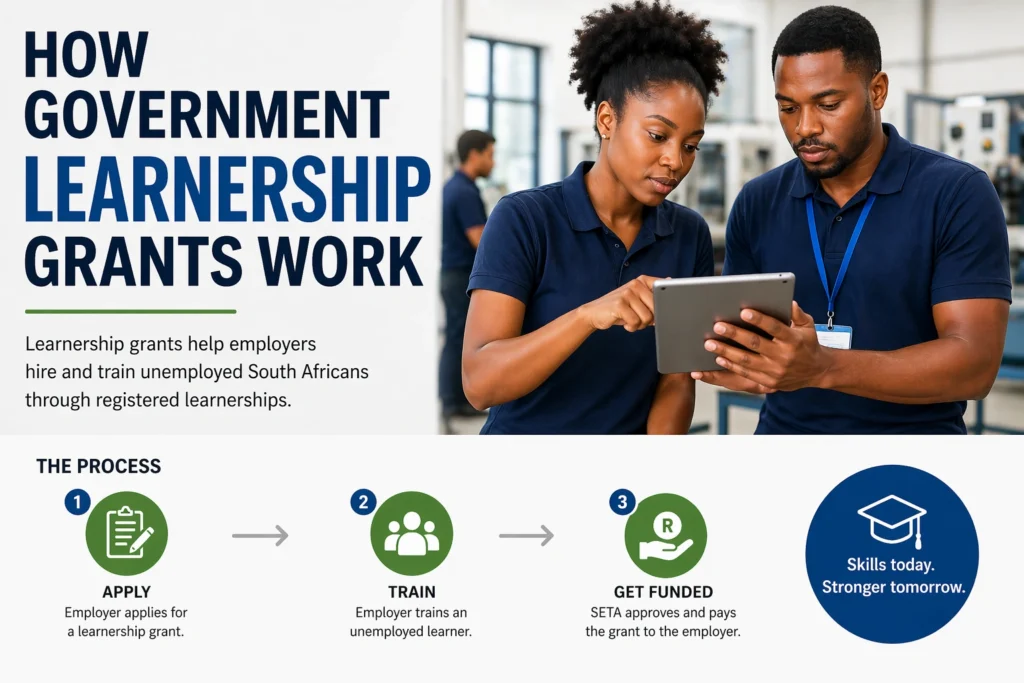

How Government Learnership Grants Work: Many people want to gain skills, get certified, and improve their chances of employment—but training costs money. For unemployed youth, recent graduates, or even workers looking to upskill, the biggest barrier is often affordability. On the other side, employers want skilled workers but struggle with training costs and risks. This is where confusion begins: people hear about government learnership grants but don’t fully understand how they work, who qualifies, or how to access them.
If you’ve ever wondered whether these grants are “free money,” who benefits, or how to actually apply, this guide breaks it all down in a clear, practical way.
What Are Government Learnership Grants?
Before diving into applications and strategies, it’s important to understand the basics.
Government learnership grants are financial incentives provided by governments (often through sector education and training authorities or similar bodies) to encourage skills development. These grants support structured learning programs that combine:
- Theoretical training (classroom-based)
- Practical workplace experience
A learnership typically leads to a nationally recognized qualification, making it more valuable than informal training.
How Government Learnership Grants Work
At their core, these grants function as a partnership between three parties:
- The Government – provides funding to encourage skills development
- Employers/Companies – host and train learners
- Learners – receive training, experience, and sometimes a stipend
Instead of giving money directly to individuals in most cases, the government usually funds training providers or employers, who then implement the program.
ALSO APPLY FOR: (CCBSA) Visual Merchandiser Learnerships 2026
ALSO APPLY FOR: Momentum Health Contact Centre Learnerships 2026
Why This Issue Matters
Understanding how government learnership grants work is more than just a financial topic—it has real-life consequences.
- For individuals: It can mean access to free or subsidized education, work experience, and better job prospects.
- For businesses: It reduces training costs and helps build a skilled workforce tailored to their needs.
- For the economy: It addresses unemployment and skills shortages simultaneously.
In countries with high youth unemployment, these grants are often one of the most effective tools for bridging the gap between education and employment. But many opportunities go unused simply because people don’t know how to access them.
Types of Government Learnership Grants
To make sense of how government learnership grants work, you need to understand the different types available.
1. Employer-Based Grants
These are the most common. Employers receive funding or tax incentives to train learners.
- Companies apply for grants
- They recruit learners
- They partner with accredited training providers
2. Sector-Based Grants
Certain industries (like construction, IT, healthcare) receive targeted funding to address skills shortages.
3. Youth and Unemployment Grants
These are specifically designed to help unemployed individuals gain skills and work experience.
4. Disability Learnership Grants
Additional funding may be available to support inclusive training programs for people with disabilities.
Step-by-Step: How to Access Learnership Grants
If you’re trying to benefit from these opportunities, here’s a practical roadmap.
Step 1: Identify Your Goal
Before applying anywhere, clarify:
- What skill or qualification do you want?
- Which industry are you targeting?
This helps you focus on relevant learnerships instead of applying randomly.
Step 2: Find Accredited Programs
Look for:
- Government training portals
- Sector training authorities
- Accredited training providers
- Company websites offering learnerships
Avoid unofficial programs that don’t lead to recognized qualifications.
Step 3: Check Eligibility Requirements
Most learnerships have criteria such as:
- Age limits (often youth-focused)
- Education level (e.g., Grade 12)
- Employment status (many require you to be unemployed)
Make sure you meet these before applying.
Step 4: Prepare Your Documents
Typical requirements include:
- CV
- Certified ID copy
- Academic certificates
- Proof of residence
Having these ready speeds up your application process.
Step 5: Apply to Multiple Opportunities
Don’t rely on a single application.
Apply broadly to increase your chances, especially in competitive sectors.
Step 6: Attend Interviews or Assessments
Some programs require:
- Aptitude tests
- Interviews
- Basic skills assessments
Preparation matters here—treat it like a real job opportunity.
Step 7: Complete the Learnership
Once accepted:
- Attend all training sessions
- Participate actively in the workplace
- Complete assessments
Completion is key to receiving your qualification.
How Employers Benefit from Learnership Grants
Understanding the employer side helps you see the full picture of how government learnership grants work.
Businesses often receive:
- Financial grants to offset training costs
- Tax incentives for each learner
- Workforce development aligned with their needs
This is why many companies actively recruit learners—it’s a strategic investment, not just charity.
Best Practices Experts Recommend
To get the most out of learnership opportunities, experts consistently suggest a few key approaches.
Be Strategic, Not Desperate
Applying to everything without direction rarely works. Focus on programs aligned with your long-term goals.
Treat Learnerships Like Jobs
Show up on time, be professional, and build relationships. Many learners are absorbed into permanent roles.
Research the Training Provider
Not all programs are equal. Choose reputable, accredited providers to ensure your qualification is recognized.
Build Skills Beyond the Curriculum
Learn additional skills like communication, teamwork, and digital literacy. These often determine employability more than technical knowledge alone.
Network During the Program
Connections made during a learnership can lead to future opportunities—even if the host company doesn’t hire you.

ALSO READ ABOUT: How to Combine NSFAS with External Bursaries
Mistakes People Often Make
Despite good intentions, many people miss out on opportunities due to avoidable errors.
Assuming It’s “Free Money”
Learnership grants are not cash handouts. They are structured programs with expectations and responsibilities.
Ignoring Application Deadlines
Many programs have strict timelines. Late applications are usually not considered.
Applying Without Meeting Requirements
This wastes time and reduces your chances elsewhere. Always check eligibility first.
Dropping Out Midway
Incomplete learnerships provide little value and can hurt your reputation with future employers.
Not Taking It Seriously
Some learners treat it casually, missing the chance to turn it into a full-time job.
Common Challenges and How to Overcome Them
Limited Opportunities in Your Area
- Apply in multiple regions if possible
- Look for remote or hybrid training options
High Competition
- Improve your CV
- Gain basic skills before applying
- Apply early
Lack of Information
- Follow official government and training platforms
- Join community groups sharing opportunities
FAQ:
1. Do learners get paid during a learnership?
In many cases, yes. Learners often receive a stipend, but it is usually modest and meant to cover basic expenses rather than serve as a full salary.
2. Can a learnership lead to a permanent job?
Yes, but it’s not guaranteed. Many employers use learnerships to identify potential employees, so strong performance can increase your chances significantly.
3. Who qualifies for government learnership grants?
Eligibility varies, but most programs target: Unemployed youth, Entry-level job seekers, and Individuals needing skills development
4. How long do learnerships last?
Typically between 6 months and 12 months, depending on the qualification and industry.
What You Should Do Next
Understanding how government learnership grants work gives you a powerful advantage in accessing education and employment opportunities.
Here’s the practical takeaway:
- Start with a clear goal – know what skill you want
- Search for accredited programs – avoid unrecognized training
- Apply widely and early – increase your chances
- Commit fully – treat it like a job, not a shortcut
- Use the experience wisely – build skills and networks
These grants are not just funding—they’re a pathway into the workforce. The people who benefit most are those who approach them with intention, discipline, and long-term thinking.
ALSO APPLY FOR: (CCBSA) Visual Merchandiser Learnerships 2026
ALSO APPLY FOR: Momentum Health Contact Centre Learnerships 2026
ALSO READ ABOUT: How to Combine NSFAS with External Bursaries