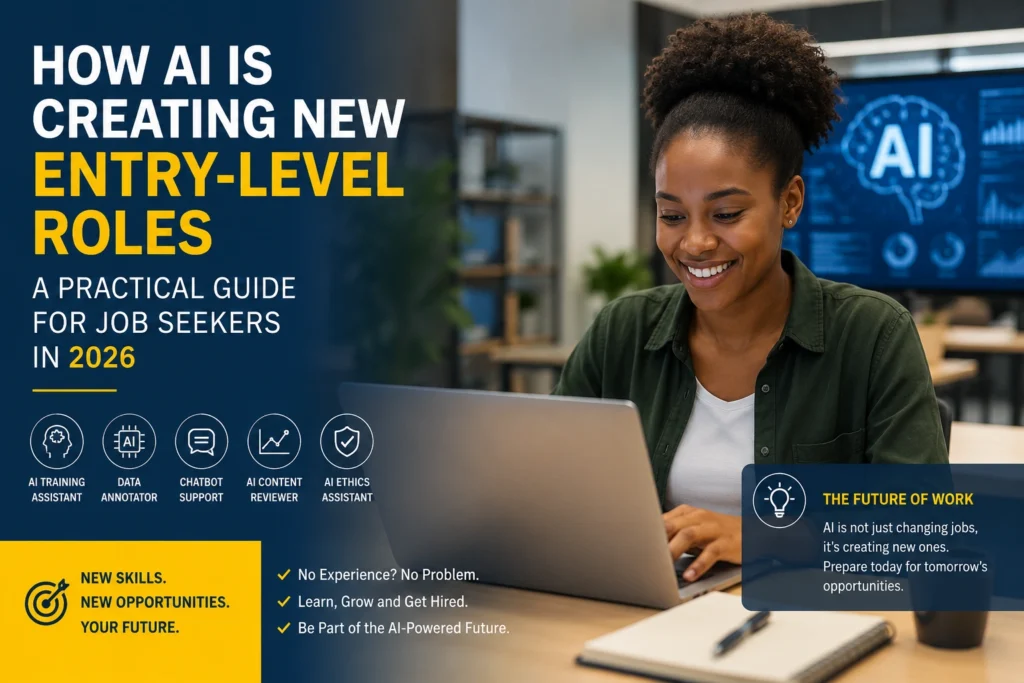

Artificial intelligence is changing the job market faster than many people expected. For students, recent graduates, and job seekers with little or no work experience, this can feel worrying. News headlines often focus on jobs being replaced by automation, leaving many people wondering whether there will still be opportunities to start a career.
The reality is more balanced than the headlines suggest. While AI is automating certain repetitive tasks, it is also creating entirely new entry-level roles that did not exist a few years ago. Companies now need people to work alongside AI systems, monitor their output, create quality data, review content, improve customer experiences, and help businesses adopt new technologies responsibly.
Understanding How AI Is Creating New Entry-Level Roles can help you prepare for opportunities that employers are actively looking to fill. Instead of competing only for traditional junior positions, job seekers who understand AI-related work may find themselves entering growing industries with valuable long-term career prospects.
This guide explains where these opportunities are coming from, the skills employers want, and practical steps you can take to position yourself for success.
What Does It Mean That AI Is Creating New Entry-Level Roles?
Artificial intelligence is best viewed as a productivity tool rather than simply a replacement for workers.
Businesses are increasingly using AI to:
- Draft documents
- Analyse data
- Answer customer questions
- Create marketing content
- Automate repetitive office work
- Improve decision-making
However, AI systems still require human oversight.
They need people who can:
- Check for errors
- Improve prompts
- Review quality
- Train AI models
- Organise information
- Handle tasks requiring human judgement
- Support customers when AI cannot solve problems
This demand has led to new junior-level jobs across technology, marketing, healthcare, education, finance, retail, logistics, customer service, and many other industries.
Instead of replacing every beginner role, AI is changing what those roles look like.
ALSO APPLY FOR: Services SETA Learnerships 2026
ALSO APPLY FOR: Peermont Summit Learnership 2026
Why This Issue Matters
Understanding How AI Is Creating New Entry-Level Roles is important because the employment market is changing quickly.
For graduates, this creates both challenges and opportunities.
Some traditional administrative work may become less common as software automates routine tasks. At the same time, businesses need employees who understand how to work effectively with AI rather than compete against it.
This shift affects:
- University graduates
- TVET college graduates
- Matriculants entering the workforce
- Career changers
- Young professionals looking for promotion opportunities
Those who develop AI-related workplace skills today are likely to remain competitive as more organisations adopt these technologies over the coming years.
How AI Is Creating New Entry-Level Roles Across Different Industries
AI is expanding opportunities in many sectors rather than only in technology companies.
Marketing and Content
Businesses increasingly use AI to generate first drafts of:
- Blog articles
- Product descriptions
- Social media posts
- Advertising copy
- Email campaigns
Entry-level workers now review AI-generated content, improve accuracy, ensure brand consistency, fact-check information, and prepare material for publication.
Rather than writing everything from scratch, many junior marketers now edit, refine, and optimise AI-assisted content.
Customer Support
Many organisations use AI chatbots to answer simple customer questions.
When more complicated issues arise, human support staff step in.
New roles include:
- AI customer support specialists
- Chat review assistants
- Conversation quality analysts
- Customer experience coordinators
These positions require communication skills more than advanced technical knowledge.
Human Resources
Recruitment teams increasingly use AI tools to organise CVs, schedule interviews, and screen applications.
Entry-level HR professionals now spend more time:
- Reviewing AI recommendations
- Conducting interviews
- Checking candidate suitability
- Improving hiring workflows
- Managing employee experiences
Human judgement remains essential throughout recruitment.
Data Annotation
One of the fastest-growing AI support jobs involves preparing data used to train AI systems.
Workers may:
- Label images
- Categorise documents
- Review speech recordings
- Verify AI predictions
- Check machine-generated outputs
Many technology companies outsource this work globally, creating remote employment opportunities.
Sales
AI now assists sales teams by identifying promising customers and preparing personalised communications.
Junior sales employees often focus on:
- Reviewing AI-generated leads
- Updating CRM systems
- Personalising outreach
- Scheduling meetings
- Following up with prospects
AI reduces repetitive work while people build customer relationships.
Education
Educational organisations increasingly use AI tools to generate learning materials.
Entry-level education assistants may help:
- Review educational content
- Check lesson quality
- Support online learners
- Organise digital resources
- Improve accessibility
Human educators remain responsible for ensuring accuracy and quality.
Healthcare Administration
Healthcare providers increasingly use AI for scheduling, documentation, and administrative support.
Entry-level administrative staff often assist by:
- Checking AI-generated records
- Managing appointments
- Organising patient information
- Supporting healthcare professionals
The technology improves efficiency but still requires careful human oversight.
Common Entry-Level AI Jobs Emerging Today
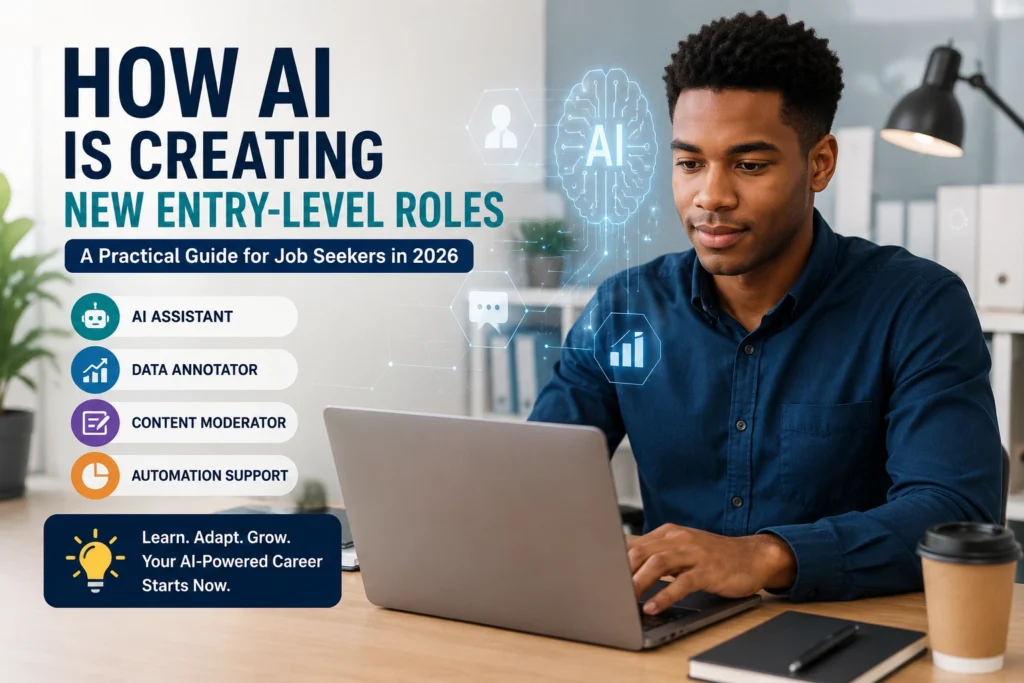
Although job titles vary between employers, some increasingly common positions include:
- AI Content Assistant
- Prompt Writer
- Prompt Tester
- AI Operations Assistant
- Data Annotation Specialist
- AI Quality Reviewer
- AI Customer Support Associate
- AI Training Assistant
- Digital Workflow Assistant
- Automation Support Coordinator
- AI Research Assistant
- Junior AI Analyst
- Knowledge Management Assistant
- AI Documentation Specialist
Many of these jobs require curiosity and willingness to learn rather than advanced programming experience.
Skills Employers Want
Many people assume AI jobs require coding.
In reality, many entry-level positions focus on practical workplace skills.
Employers increasingly value:
Communication
Workers must explain AI-generated information clearly.
Critical Thinking
Employees need to identify mistakes AI systems may produce.
Digital Literacy
Confidence using workplace software remains essential.
Problem Solving
AI cannot solve every business challenge independently.
Research Skills
Checking facts and verifying information is increasingly valuable.
Adaptability
AI tools change rapidly.
Employers prefer candidates who enjoy learning continuously.
Attention to Detail
Many AI roles involve reviewing outputs for quality and accuracy.
ALSO READ ABOUT: How the Creator Economy Is Creating New Jobs
Step-by-Step Guide to Preparing for AI Entry-Level Jobs
Step 1: Learn Basic AI Tools
Become familiar with popular AI platforms.
Practice using them for:
- Writing
- Brainstorming
- Research
- Summarising information
- Creating presentations
Understanding how these tools work builds confidence during interviews.
Step 2: Strengthen Digital Skills
Improve your knowledge of:
- Microsoft Office
- Google Workspace
- Cloud storage
- Online collaboration tools
- Spreadsheet software
- Digital communication platforms
These remain essential alongside AI.
Step 3: Complete Short Online Courses
Many reputable organisations offer introductory AI courses.
Look for topics covering:
- Responsible AI
- Prompt writing
- AI fundamentals
- Digital productivity
- Data literacy
Certificates can strengthen your CV.
Step 4: Build Small Projects
Employers appreciate practical experience.
Examples include:
- Creating AI-assisted presentations
- Designing simple workflows
- Producing sample marketing campaigns
- Building organised research documents
- Demonstrating prompt engineering skills
Even personal projects show initiative.
Step 5: Learn to Evaluate AI Output
AI sometimes produces inaccurate information.
Practice asking:
- Is this correct?
- Is it complete?
- Does it match reliable sources?
- Is the language appropriate?
Employers increasingly value this skill.
Step 6: Update Your CV
Highlight:
- Digital skills
- AI familiarity
- Online certifications
- Research abilities
- Communication experience
- Problem-solving achievements
Avoid claiming expertise you do not possess.
Step 7: Apply Beyond Technology Companies
Many industries now use AI.
Look for opportunities in:
- Retail
- Banking
- Insurance
- Government
- Healthcare
- Logistics
- Education
- Marketing
- Manufacturing
AI-related roles exist far beyond software companies.
How South African Job Seekers Can Benefit
South African employers are gradually integrating AI into everyday business operations.
Young professionals who combine traditional employability skills with AI knowledge may stand out during recruitment.
Practical ways to improve employability include:
- Completing digital skills training
- Improving written communication
- Learning spreadsheet analysis
- Building professional LinkedIn profiles
- Participating in internships
- Completing workplace readiness programmes
- Following developments in AI responsibly
For graduates entering competitive job markets, demonstrating AI awareness can complement—not replace—formal qualifications.
Best Practices Experts Recommend
Professionals working with AI consistently emphasise that success comes from combining technology with strong human skills.
Some of the most widely recommended practices include:
- Use AI to improve productivity rather than depend on it completely.
- Always verify AI-generated facts before using them professionally.
- Continue developing communication, teamwork, and critical thinking skills.
- Stay informed as AI tools evolve rapidly.
- Build a portfolio showing how you have used AI responsibly in real projects.
- Protect confidential information when using AI platforms.
- Focus on solving business problems rather than simply learning new software.
- Treat AI as a workplace assistant instead of a replacement for professional judgement.
Workers who combine technical curiosity with human decision-making are likely to remain valuable even as technology advances.
Mistakes People Often Make
Many job seekers misunderstand how AI is changing employment.
Common mistakes include:
Assuming AI Will Replace Every Job
Automation changes tasks rather than eliminating every position.
Ignoring Soft Skills
Communication and teamwork remain highly valuable.
Overestimating AI Accuracy
AI systems sometimes generate incorrect or misleading information.
Always verify important facts.
Waiting Too Long to Learn
Technology adoption is accelerating.
Learning basic AI skills now is easier than trying to catch up later.
Believing Coding Is Always Required
Many AI-related entry-level jobs focus on operations, customer support, administration, marketing, and quality assurance rather than software development.
Frequently Asked Questions
Does every AI job require programming?
No. Many entry-level AI roles focus on reviewing content, customer support, administration, quality assurance, research, and digital operations rather than coding.
Can AI help me get a job?
Yes. AI can assist with improving CVs, preparing interview questions, researching employers, and developing professional writing. However, always review and personalise AI-generated material before submitting it.
Which industries are hiring people with AI-related skills?
Marketing, finance, healthcare, education, retail, logistics, customer service, manufacturing, media, and professional services are increasingly adopting AI tools.
Should I worry that AI will eliminate entry-level jobs?
Some routine tasks may become automated, but many new positions are emerging that require people to supervise, improve, and apply AI responsibly. Developing adaptable skills is the best way to remain competitive.
Final Thoughts
Understanding How AI Is Creating New Entry-Level Roles is becoming increasingly important for anyone entering today’s workforce. Artificial intelligence is reshaping jobs rather than simply removing them, creating demand for workers who can combine digital literacy with communication, critical thinking, and sound judgement.
Instead of viewing AI as a threat, consider it a tool that can expand your opportunities. Start by learning the basics, practising with reputable AI platforms, improving your digital skills, and building practical examples of your work. Employers continue to value people who can think independently, solve problems, and use technology responsibly.
The job market will continue evolving, but those who stay curious, keep learning, and adapt to new workplace technologies will be better positioned to succeed in the years ahead.
ALSO APPLY FOR: Services SETA Learnerships 2026
ALSO APPLY FOR: Peermont Summit Learnership 2026
ALSO READ ABOUT: How the Creator Economy Is Creating New Jobs