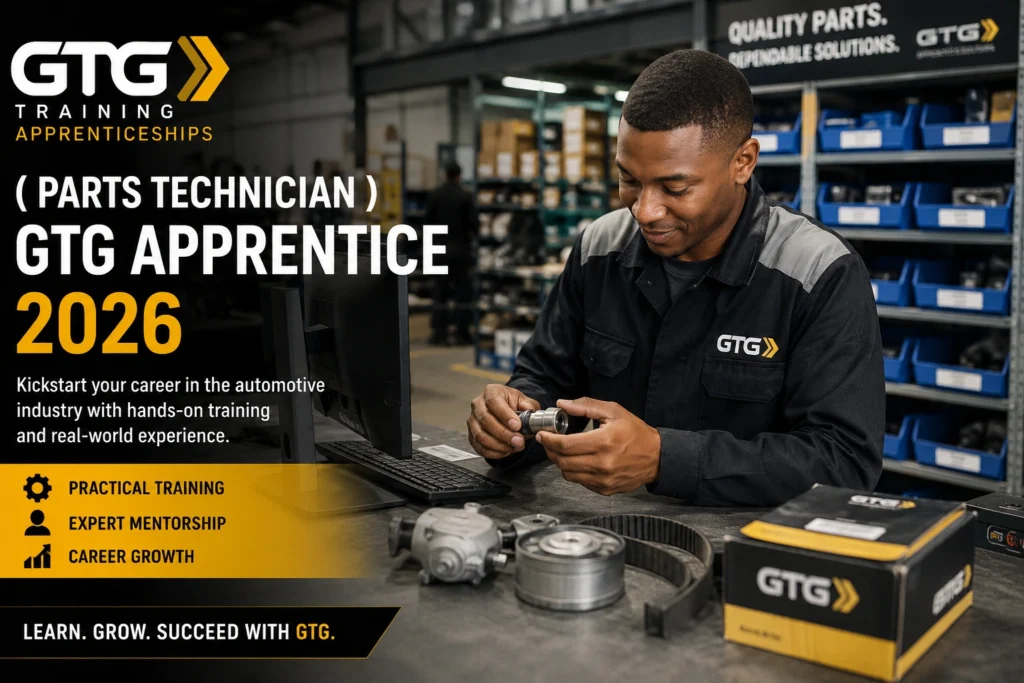

Imagine arriving at a busy automotive workshop on a Monday morning. Several vehicles are waiting for repairs, technicians are checking their job cards, and customers are expecting their cars back on time. Before some of those repairs can even begin, somebody needs to identify the correct components, check availability, order missing parts and make sure everything reaches the technician when it is needed.
That person could be a parts technician.
For school leavers and young people interested in the automotive industry, this career path is often overlooked. Many people immediately think about becoming a mechanic, auto electrician or vehicle technician. Yet modern workshops also depend heavily on people who understand vehicle components, stock systems, suppliers, customers and computerised parts catalogues.
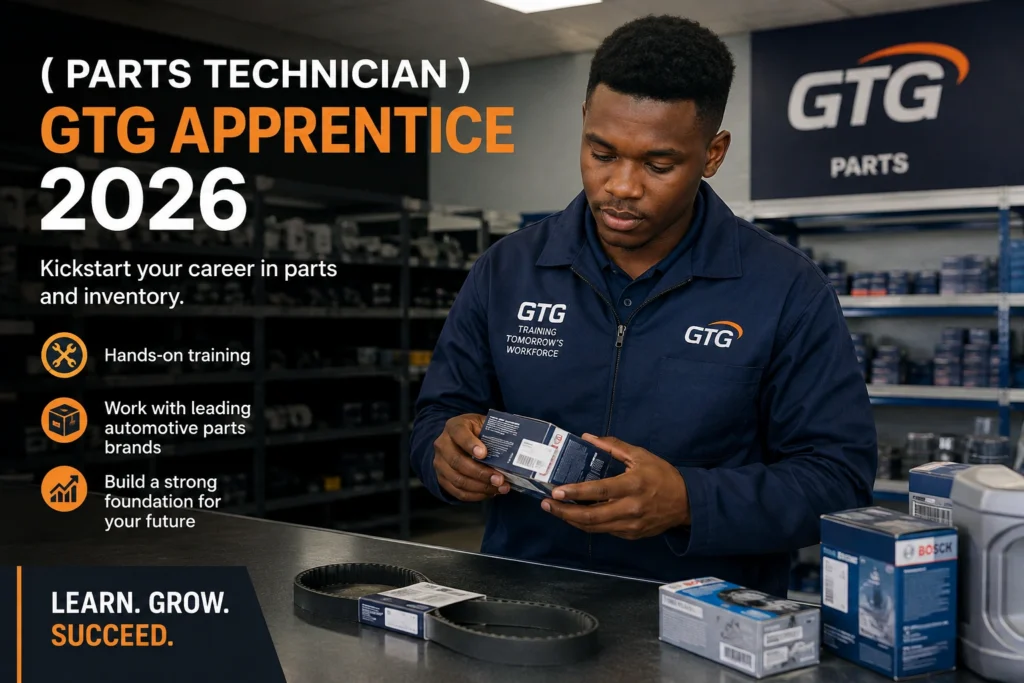
The GTG Apprentice 2026 opportunity provides an entry route into this part of the automotive industry. The Apprentice Parts Technician position combines workplace experience with structured learning, giving successful candidates the chance to develop professional skills while working towards a recognised qualification.
According to the opportunity information provided, applicants should have National 4 qualifications in English, Maths and either Administration or Computer Studies. The apprenticeship is full time, and applications are being considered as they are received.
That makes preparation particularly important. Instead of submitting a rushed CV simply because an apprenticeship is available, applicants should understand what the job involves, what employers are likely to look for and how to present their existing skills effectively.
What makes a parts technician apprenticeship different?
An apprenticeship is not simply another training course.
The important difference is that the learner develops skills in an actual working environment. Training and employment are connected, allowing an apprentice to see how the knowledge they are learning applies to everyday workshop operations.
A parts technician may eventually deal with tasks such as:
- Identifying the correct vehicle components.
- Checking parts availability and stock records.
- Using computerised systems and parts catalogues.
- Receiving and organising deliveries.
- Preparing parts for workshop technicians.
- Communicating with suppliers and customers.
- Processing orders and maintaining accurate records.
- Helping ensure repairs are not delayed because of missing components.
This means the job requires a combination of technical awareness and administrative ability.
Someone might assume that a person working in an automotive parts department needs to know every component immediately. That is not realistic for an apprentice. The more important starting qualities are curiosity, accuracy, willingness to learn and the ability to follow instructions.
The qualification requirements also provide a clue about the nature of the position. English supports communication and record keeping, Maths helps with accuracy and numerical tasks, while Administration or Computer Studies can be useful when working with digital systems and business processes.
GTG Apprentice 2026: Who should consider applying?
The opportunity is particularly relevant to candidates who are interested in vehicles but also enjoy organised, detail-focused work.
You could be a good fit if you:
- Meet the stated National 4 qualification requirements.
- Are comfortable learning new computer systems.
- Pay attention to details rather than rushing tasks.
- Enjoy finding solutions to practical problems.
- Can communicate professionally with colleagues and customers.
- Are prepared for full-time employment.
- Want to build a long-term career rather than simply find temporary work.
- Are willing to learn from experienced automotive professionals.
Previous experience in a garage can be helpful, but applicants should not assume they need years of automotive knowledge. Apprenticeships exist precisely because candidates are still developing their professional skills.
The stronger question is: Can you demonstrate that you are ready to learn and contribute?
The hidden skills that could make an applicant stand out
Meeting the minimum qualifications gets an applicant into consideration, but it does not automatically make an application competitive.
One useful way to strengthen your application is to think beyond formal qualifications.
Perhaps you have worked part time in retail. That experience can demonstrate customer service and communication. Maybe you have helped manage stock at a family business. That could demonstrate organisation and attention to detail. If you have built computers, used spreadsheets or completed school projects involving technology, those experiences can show digital confidence.
Even hobbies can sometimes demonstrate relevant characteristics when explained properly.
For example, someone who enjoys restoring vehicles may have developed patience and an interest in identifying components. Someone interested in technology may be comfortable learning unfamiliar software.
The important thing is not to turn every hobby into an exaggerated “professional skill”. Instead, explain honestly what you learned from the experience.
A simple application strategy
| Application area | What to demonstrate | Common weak approach |
|---|---|---|
| Education | Relevant National 4 subjects | Listing qualifications without context |
| Automotive interest | Genuine interest in vehicle parts and repair | Saying only “I love cars” |
| Computer skills | Familiarity with digital tools and systems | Claiming advanced skills without evidence |
| Communication | Customer or teamwork experience | Providing generic statements |
| Reliability | Attendance, responsibilities or work experience | Giving no examples |
| Motivation | Why you want this apprenticeship | Copying a standard career statement |
This is particularly important because a parts technician’s work depends on precision. A CV containing obvious spelling errors or inconsistent information can undermine an applicant’s claim that they are detail-oriented.
How to apply for the GTG Apprentice 2026 opportunity
Applicants should approach the process as carefully as they would approach their first day at work.
Step 1: Read the vacancy requirements
Start by checking the latest official vacancy information
APPLY HERE: GTG Apprentice 2026
Confirm the required qualifications, working arrangements, location, application method and any additional criteria.
Step 2: Check your eligibility
Before spending time completing the application, make sure you meet the stated academic requirements.
For this opportunity, the supplied information identifies National 4 qualifications in:
- English
- Maths
- Administration or Computer Studies
If you are unsure whether your qualification is equivalent, check the vacancy instructions or contact the relevant recruitment/training team rather than guessing.
Step 3: Prepare your CV
Your CV does not need to be packed with pages of information.
For an apprenticeship, a concise CV can be more effective if it clearly presents:
Personal profile: Two or three sentences explaining your interest in automotive parts and your willingness to learn.
Education: School, qualifications and relevant subjects.
Experience: Paid work, volunteering, work placements or other responsibilities.
Skills: Communication, organisation, computer literacy, customer service and practical problem-solving.
Interests: Relevant interests can be included if they genuinely add context.
If you have no previous employment, do not leave your CV looking empty. Include school projects, volunteering, sports responsibilities, community activities or practical experiences that demonstrate reliability and teamwork.
Step 4: Write a targeted application
Avoid submitting the same generic paragraph for every apprenticeship.
Your application should answer three basic questions:
Why automotive?
Explain what interests you about the sector.
Why parts?
Show that you understand the role involves more than physically handling components. Mention your interest in vehicle systems, organisation, customer service, stock or technical information.
Why an apprenticeship?
Explain why learning in a real workplace appeals to you.
A short, specific answer is generally stronger than a long paragraph filled with phrases such as “I am passionate, hardworking and motivated” without evidence.
Step 5: Check everything before submitting
This stage is easy to underestimate.
Check your:
- Name and contact details.
- Qualification information.
- Employment dates.
- Spelling and grammar.
- Uploaded documents.
- Answers to application questions.
Read the application once as if you were the recruiter.
Would you understand what the candidate wants to do?
Would you know why they are suitable?
Would you see evidence of reliability and willingness to learn?
If the answer is yes, submit.
ALSO APPLY FOR: Tjantjello Electrical Apprentice 2026
Why this opportunity matters beyond the first job
The biggest value of an apprenticeship is not simply getting through the recruitment process.
It is learning how to work.
A successful apprentice develops habits that can remain valuable long after the apprenticeship has finished: arriving prepared, asking questions, checking work, communicating clearly and accepting feedback.
Those habits can become as important as the qualification itself.
The automotive sector is also changing rapidly. Vehicles are becoming more technologically advanced, while workshops increasingly rely on digital ordering, inventory and diagnostic systems. Parts professionals therefore need to be comfortable working with information as well as physical components.
For someone entering the industry now, that creates an interesting career foundation.
An apprentice who begins with basic parts knowledge can gradually develop expertise in particular vehicle systems, stock management, customer service, procurement or broader automotive operations.
Expert insight: don’t underestimate the parts department
A workshop cannot function efficiently if the right components are not available at the right time.
That makes the parts department part of the repair process, not simply a storage area. A wrong order can delay a technician, increase costs and frustrate a customer.
For an apprentice, this is an important mindset shift: accuracy is a form of productivity.
Taking an extra moment to verify a component may prevent a much larger problem later.
Frequently asked questions
1. What is the GTG Apprentice 2026 programme?
It is an Apprentice Parts Technician opportunity designed to combine full-time workplace experience with structured learning in the automotive industry.
2. What qualifications do I need?
The information supplied for the vacancy states that applicants should have National 4 qualifications in English, Maths and an Administration or Computer Studies subject. Always verify the latest requirements in the official vacancy before applying.
3. Do I need to have worked in a garage before?
Not necessarily. This is an apprenticeship, so candidates are expected to be developing their professional skills. A strong applicant should demonstrate relevant qualifications, genuine interest, reliability, communication skills and a willingness to learn.
Final thoughts
The GTG Apprentice 2026 opportunity is more than an entry-level position for someone who likes cars. It offers a structured introduction to a part of the automotive industry that is essential but often overlooked.
The successful candidate will need to learn how vehicles, components, computer systems, suppliers, technicians and customers connect. That requires patience and accuracy rather than simply enthusiasm for automobiles.
For eligible applicants, the smartest approach is therefore straightforward: check the requirements, build a targeted CV, explain your motivation honestly, proofread everything and submit a complete application promptly.
An apprenticeship cannot guarantee a particular career outcome. What it can provide is something difficult to manufacture later: an opportunity to build recognised skills while gaining genuine workplace experience.
For someone serious about entering the automotive industry, that is a valuable place to start.