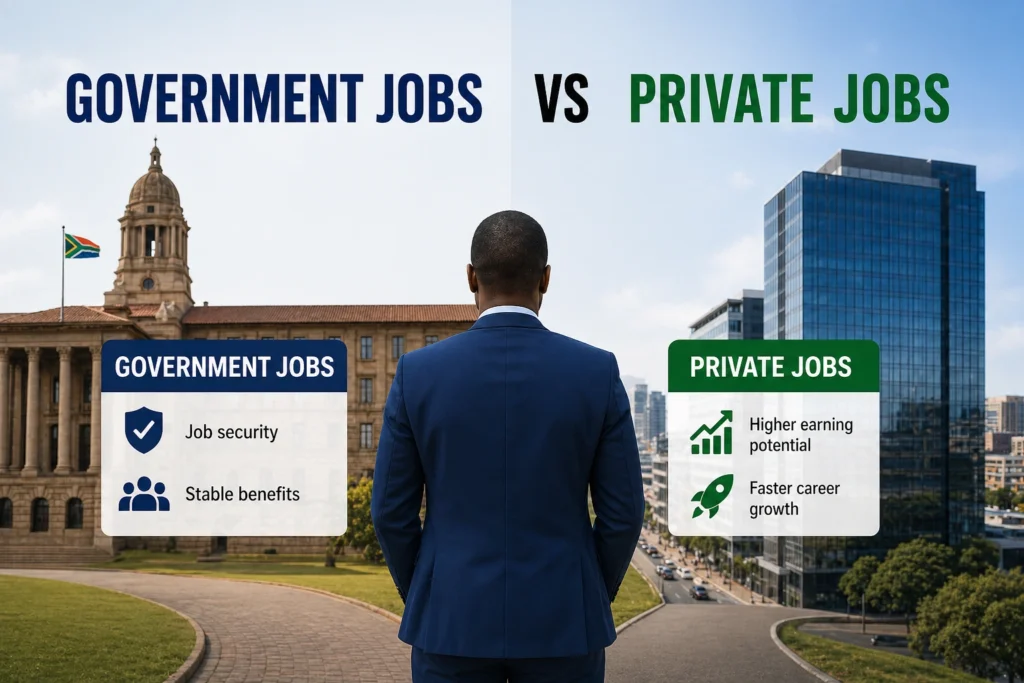

Choosing between a government job and a private sector job in South Africa isn’t just a career decision—it’s a life decision. Many job seekers struggle with this choice because both paths offer very different benefits, risks, and long-term outcomes. One promises stability but may feel slow-moving; the other offers growth but can come with uncertainty.
If you’re feeling stuck between security and opportunity, you’re not alone. This guide breaks down Government Jobs vs Private Jobs in South Africa (Pros & Cons) in a practical, real-world way so you can make a confident, informed decision.
Understanding Government Jobs vs Private Jobs in South Africa (Pros & Cons)
Before comparing them, it’s important to clearly understand what each option actually involves.
Government jobs (public sector jobs) are roles within national, provincial, or local government departments—think teachers, police officers, administrative staff, healthcare workers, and municipal employees. These jobs are funded by taxpayers and regulated by public policies.
Private sector jobs are roles in businesses owned by individuals or corporations. This includes everything from startups to large companies in industries like finance, tech, retail, mining, and manufacturing.
At a glance:
- Government = stability, structure, public service
- Private = performance-driven, flexible, profit-oriented
But the real differences go deeper.
ALSO APPLY FOR: Courier Driver Jobs in Johannesburg (2026)
ALSO APPLY FOR: 2026 Receiving Clerk Opportunity at SOLEVO Group – Pretoria
Key Pros and Cons of Government Jobs
Pros of Government Jobs
1. Job Security
Government jobs are widely known for stability. Layoffs are less common compared to the private sector, especially during economic downturns.
2. Predictable Income and Benefits
Salaries may not always be high, but they are consistent. Benefits often include:
- Pension plans
- Medical aid contributions
- Paid leave
- Housing or travel allowances (in some roles)
3. Work-Life Balance
Most government roles follow structured working hours, making it easier to maintain personal time.
4. Clear Career Structure
Promotions and salary increases often follow a defined grading system.
Cons of Government Jobs
1. Slower Career Growth
Advancement can depend on years of service rather than performance alone.
2. Bureaucracy
Decision-making processes can be slow due to layers of approval and regulations.
3. Limited Salary Growth
Compared to high-performing private sector roles, salary increases may be modest.
4. Less Innovation
Some roles may feel repetitive or less dynamic, especially in administrative departments.
Key Pros and Cons of Private Jobs
Pros of Private Jobs
1. Higher Earning Potential
Private companies often offer performance-based bonuses, commissions, and faster salary growth.
2. Faster Career Advancement
If you perform well, promotions can come quickly—sometimes within a year or two.
3. Skill Development
You’re more likely to gain diverse, marketable skills, especially in fast-moving industries.
4. Dynamic Work Environment
Private companies tend to adopt new technologies and innovative practices faster.
Cons of Private Jobs
1. Job Insecurity
Economic downturns, restructuring, or company performance can lead to layoffs.
2. Work Pressure
Long hours, tight deadlines, and performance targets are common.
3. Less Predictable Benefits
Benefits vary widely by company and may not be as comprehensive as government packages.
4. Work-Life Balance Challenges
Some industries demand extended hours, especially early in your career.
Why This Issue Matters
The choice between government and private employment directly impacts your financial stability, mental health, career growth, and long-term lifestyle.
In South Africa, where unemployment is high and economic conditions can be unpredictable, this decision becomes even more critical. A government job may provide peace of mind in uncertain times, while a private job might offer the growth needed to build wealth faster.
Your choice can affect:
- Your ability to support family
- Your stress levels and job satisfaction
- Your retirement security
- Your future career flexibility
This isn’t just about salary—it’s about aligning your career with your personal priorities and the realities of the South African job market.
ALSO READ ABOUT: How to Apply for Jobs via Email (Real Examples)
Step-by-Step Guide: How to Choose Between Government and Private Jobs
Step 1: Define Your Priorities
Ask yourself:
- Do I value stability or growth more?
- Am I comfortable with risk?
- How important is work-life balance?
If stability ranks highest → government may suit you
If growth and income matter most → private may be better
Step 2: Assess Your Personality
Your personality plays a huge role.
- Prefer structure and routine? → Government job
- Enjoy fast-paced, competitive environments? → Private job
Being honest here prevents long-term dissatisfaction.
Step 3: Evaluate Your Career Goals
Think long-term:
- Want to become a specialist or executive quickly? → Private sector
- Prefer steady progression with predictable milestones? → Government
Step 4: Consider Financial Needs
If you need immediate high income or want to build wealth quickly, private jobs often have the edge.
If you prefer steady income with long-term security, government jobs are more reliable.
Step 5: Look at Industry Trends
Some sectors in South Africa lean heavily toward one side:
- Healthcare and education → strong government presence
- Finance, IT, and marketing → dominated by private sector
Choose based on where opportunities are growing.
Step 6: Think About Job Security vs Opportunity
Ask yourself:
- Can I handle the stress of possible job loss?
- Or do I prefer knowing my job is secure?
Your answer should guide your decision more than external opinions.
Best Practices Experts Recommend
1. Don’t Choose Based on Salary Alone
A higher salary in the private sector may come with stress and instability. Look at the full picture.
2. Build Transferable Skills
Whether you choose government or private, focus on skills like communication, digital literacy, and problem-solving.
3. Keep Your Options Open
Many professionals move between sectors during their careers. Your first job doesn’t have to define your entire future.
4. Network Actively
Connections matter in both sectors—especially in South Africa’s competitive job market.
5. Continuously Upskill
The job market is evolving. Certifications, short courses, and digital skills can give you an advantage in either sector.
Mistakes People Often Make
1. Assuming Government Jobs Are Always “Easy”
Some roles—like healthcare or law enforcement—are demanding and high-pressure.
2. Chasing Private Sector Prestige Without Understanding the Pressure
High-paying jobs often come with long hours and intense competition.
3. Ignoring Long-Term Goals
Choosing based on short-term benefits can lead to regret later.
4. Overlooking Benefits Packages
Government jobs often offer strong benefits that aren’t immediately obvious but are valuable over time.
5. Not Researching the Specific Role
Not all government or private jobs are the same. Always look at the specific position, not just the sector.
FAQs:
1. Which pays more in South Africa: government or private jobs?
Private jobs generally offer higher earning potential, especially in industries like finance and technology. However, government jobs provide stable income and valuable benefits.
2. Are government jobs safer in South Africa?
Yes, government jobs are typically more secure, with lower risk of layoffs compared to private companies.
3. Can you switch from government to private sector later?
Yes, many professionals transition between sectors. However, staying updated with relevant skills is crucial to make the move successfully.
4. Which is better for work-life balance?
Government jobs usually offer better work-life balance due to structured hours, while private jobs may demand longer or irregular hours.
Final Thoughts: Making the Right Choice for You
When it comes to Government Jobs vs Private Jobs in South Africa (Pros & Cons), there is no one-size-fits-all answer.
If you value stability, predictable income, and work-life balance, government jobs are a strong choice.
If you’re driven by growth, higher income potential, and dynamic work environments, the private sector may suit you better.
The smartest approach is to align your decision with:
- Your personality
- Your financial goals
- Your tolerance for risk
- Your long-term career vision
In many cases, the best path isn’t choosing one forever—but knowing when to move between them.
ALSO APPLY FOR: Courier Driver Jobs in Johannesburg (2026)
ALSO READ ABOUT: How to Apply for Jobs via Email (Real Examples)
ALSO APPLY FOR: 2026 Receiving Clerk Opportunity at SOLEVO Group – Pretoria