

It is a familiar scene at many South African universities. A final-year Information Technology student has completed networking assignments, passed operating systems modules, and spent countless evenings troubleshooting virtual machines. Yet when graduation approaches, one question overshadows every achievement:
“Where will I get real workplace experience?”
For thousands of students, technical knowledge alone is no longer enough. Employers increasingly expect graduates to understand how enterprise technology operates in real business environments—how cloud services are managed, how cybersecurity policies are enforced, and how users are supported when systems fail.
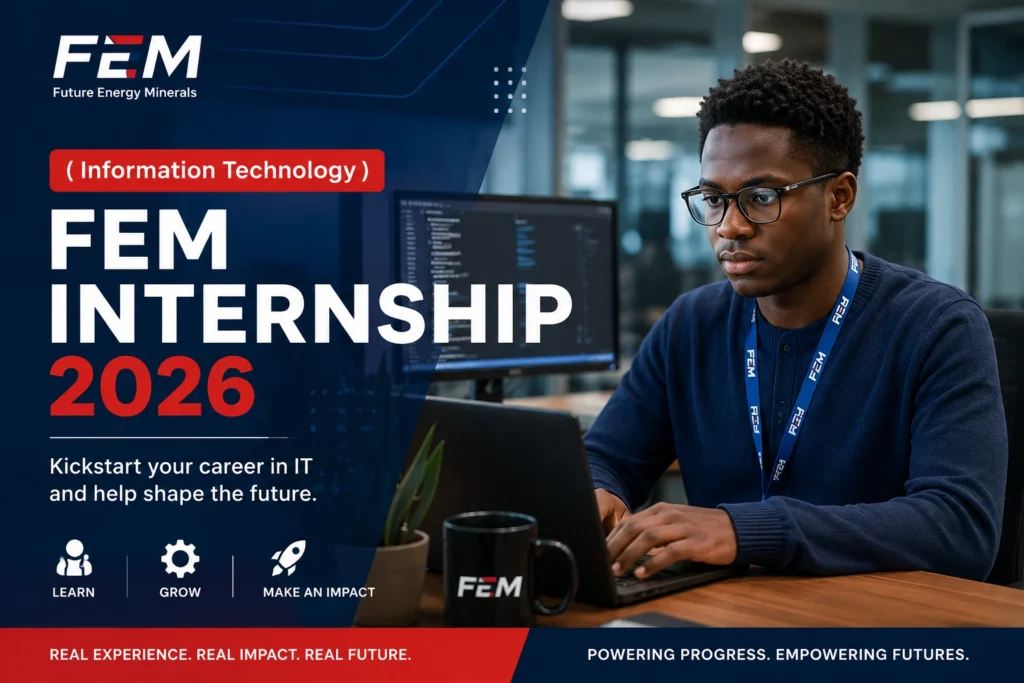
That is where the ( Information Technology ) FEM Internship 2026 becomes particularly relevant.
The 12-month programme gives students an opportunity to move beyond classroom theory into an enterprise technology department, where cloud infrastructure, identity management, cybersecurity compliance, network administration and technical support form part of everyday operations.
Based at FEM’s Johannesburg head office, the internship is especially valuable for students who require Work Integrated Learning (WIL) to complete their qualifications. Applications close on 31 July 2026, giving eligible candidates a limited window to prepare a competitive application.
Why enterprise IT experience matters more than ever
South Africa’s digital economy continues to evolve rapidly.
Across banking, insurance, healthcare, logistics and government, organisations increasingly depend on secure digital infrastructure. Businesses have migrated workloads to cloud platforms, strengthened cybersecurity measures and expanded remote work capabilities over the past few years.
These developments have quietly changed what employers expect from graduates.
Knowing how a computer works is no longer sufficient.
Employers now look for candidates who understand how technology supports entire organisations—from maintaining network connectivity to protecting sensitive business information and helping employees remain productive.
The ( Information Technology ) FEM Internship 2026 reflects this reality by exposing interns to several connected areas instead of assigning them to a single repetitive support role.
That broad exposure can make a significant difference when graduates begin applying for permanent positions.
Inside the ( Information Technology ) FEM Internship 2026
Unlike internships that focus solely on answering Service Desk calls, FEM’s programme introduces participants to multiple operational environments.
Successful candidates will work alongside experienced systems engineers and technology specialists while learning how enterprise infrastructure is maintained behind the scenes.
Training may include practical exposure to:
- Cloud infrastructure
- Network administration
- Identity and Access Management
- Cybersecurity compliance
- Systems administration
- Technical documentation
- End-user support
- Hardware troubleshooting
- Technology asset management
- Service Desk operations
- Foundational infrastructure maintenance
This variety is one of the programme’s biggest strengths.
For example, resolving a password issue might involve checking Active Directory permissions, confirming network connectivity, verifying Microsoft 365 authentication and ensuring compliance with security policies.
Rather than viewing these technologies separately, interns begin understanding how modern IT systems work together.
More than fixing computers
One misconception about entry-level IT jobs is that they revolve entirely around repairing laptops.
Enterprise technology departments are considerably more complex.
A typical working day could involve preparing new devices for employees, assisting with Microsoft 365 accounts, documenting support requests, updating hardware inventories, testing software deployments or helping senior engineers maintain network infrastructure.
Communication becomes just as important as technical ability.
Many users cannot explain technical problems using IT terminology. Interns therefore learn to ask the right questions, identify root causes and explain solutions in language that non-technical colleagues understand.
These customer-facing skills often separate outstanding IT professionals from average technicians.
Work Integrated Learning gives this programme additional value
One notable aspect of the internship is FEM’s preference for students who require Work Integrated Learning (WIL).
Many South African universities and universities of technology require workplace placement before awarding diplomas or degrees.
Finding suitable WIL opportunities, however, has become increasingly competitive.
Students frequently complete all academic requirements yet struggle to secure approved industry placements.
By prioritising WIL candidates, FEM helps bridge that gap while giving students practical exposure that aligns with academic outcomes.
Applicants who require WIL should clearly state:
- Their institution
- Qualification
- Required placement duration
- Expected graduation date
- Institutional placement requirements
Providing this information early in the CV can help recruiters understand the applicant’s circumstances immediately.
The technical foundation FEM expects
Although this internship targets students rather than experienced professionals, it is not designed for complete beginners.
Candidates should already understand several core technology concepts.
These include networking fundamentals, Windows operating systems, computer hardware, Microsoft 365 applications and basic security practices.
Knowledge of concepts such as TCP/IP, DNS, Wi-Fi connectivity and local network troubleshooting demonstrates that applicants already possess the building blocks needed to benefit from workplace training.
Experience with Linux or macOS is considered an advantage rather than a requirement.
The emphasis remains on practical understanding rather than advanced certifications.
Students who have built home labs, configured routers, installed operating systems or experimented with virtualization should include these experiences in their CVs.
Academic projects often provide stronger evidence of technical ability than generic statements such as “computer literate.”
A closer look at Identity and Access Management
One area many students overlook is Identity and Access Management (IAM).
Yet IAM has become one of the most important functions within modern organisations.
Every employee requires secure access to systems, applications and sensitive information.
Managing that access involves much more than creating usernames.
Technology teams must ensure that users receive appropriate permissions, authentication procedures are followed and accounts are disabled promptly when staff leave.
Even a small permission error could expose confidential financial or customer information.
Exposure to IAM during the internship introduces students to security governance practices that many graduates only encounter years into their careers.
For those interested in cybersecurity or systems administration, this experience can become a valuable career advantage.
Expert insight: Why broad exposure beats narrow specialisation early on
Many students believe they should specialise immediately in cybersecurity, networking or cloud computing.
In reality, employers often value graduates who first understand how enterprise environments operate as interconnected systems.
Cloud platforms depend on networking. Networking depends on security. Security depends on identity management. End-user support touches every one of these disciplines.
An internship like FEM’s allows participants to see these connections before choosing a long-term specialisation.
That wider perspective often produces stronger IT professionals because they understand how technical decisions affect entire organisations rather than isolated systems.
Small projects can become big career evidence
One overlooked benefit of internships is the opportunity to contribute to manageable operational projects.
Instead of simply observing experienced engineers, interns may assist with activities such as:
- Software deployment
- Device inventory audits
- Infrastructure documentation
- Updating standard operating procedures
- Asset management improvements
- Testing system updates
- Basic automation scripting
These projects may seem small, but they become valuable portfolio examples during future interviews.
Rather than saying, “I completed an internship,” candidates can explain exactly how they contributed to improving technology operations.
Recruiters appreciate measurable examples of initiative.
Building a CV that stands out
FEM specifically requests a detailed curriculum vitae.
This means applicants should avoid submitting a generic one-page document containing only educational history.
A stronger CV highlights practical technical experience.
Useful sections include:
- Relevant academic modules
- Networking knowledge
- Operating systems experience
- Microsoft 365 proficiency
- Technical projects
- Hardware troubleshooting
- Programming or scripting exposure
- Cloud or cybersecurity coursework
- Work Integrated Learning requirements
Students who have created home laboratories, configured virtual machines or completed online technical certifications should also mention these achievements.
Recruiters want evidence of curiosity and practical learning.
APPLY HERE: FEM Internship 2026
ALSO APPLY FOR: BHSc Internship 2026
Career opportunities beyond the internship
The technology skills developed during the internship extend far beyond one organisation.
Graduates with enterprise IT exposure may later pursue careers such as:
- Service Desk Analyst
- Desktop Support Technician
- Junior Systems Administrator
- Network Support Technician
- Infrastructure Support Technician
- Identity and Access Management Administrator
- Cloud Support Technician
- Cybersecurity Support Analyst
- Technical Consultant
- Systems Support Analyst
Many professionals eventually build upon this foundation by earning certifications in Microsoft technologies, cloud platforms, cybersecurity, networking or IT service management.
The internship therefore serves less as a final destination and more as a starting point.
Why this opportunity matters for South African graduates
Graduate unemployment remains one of South Africa’s biggest challenges.
At the same time, employers consistently report shortages of candidates with practical workplace experience.
Internships help reduce that disconnect.
Rather than expecting graduates to arrive fully experienced, programmes like this allow organisations to develop future talent while giving students meaningful exposure to real business environments.
For insurance companies such as FEM, technology has become central to daily operations.
Claims processing, customer communication, cybersecurity and digital infrastructure all depend on skilled IT professionals.
Investing in internships helps strengthen that future workforce.
Frequently Asked Questions
Who can apply for the ( Information Technology ) FEM Internship 2026?
Students currently studying toward a diploma or degree in Information Technology, Computer Science, Information Systems, Network Engineering, Cybersecurity, Cloud Computing or another closely related field.
Does FEM provide a monthly stipend?
FEM has not publicly confirmed whether the internship includes a stipend or salary. Applicants should wait for official communication during the recruitment process.
When is the application deadline?
Applications must be submitted through the official recruitment portal before the close of business on 31 July 2026.
Conclusion
The ( Information Technology ) FEM Internship 2026 represents more than another entry-level opportunity.
It reflects how modern technology careers are evolving.
Today’s employers increasingly value graduates who understand enterprise infrastructure, cybersecurity principles, cloud environments and user support as connected parts of a larger ecosystem. By combining practical exposure with mentorship from experienced technology professionals, the programme gives participants an opportunity to build confidence alongside technical competence.
For students who require Work Integrated Learning—or anyone hoping to strengthen their transition from university into industry—the internship offers meaningful experience that can shape future career opportunities. While there is no guarantee of permanent employment, the skills gained over twelve months of enterprise IT exposure can become a strong foundation for roles across systems administration, networking, cloud services and cybersecurity.
With the application deadline approaching on 31 July 2026, eligible candidates should ensure their curriculum vitae highlights practical technical knowledge, academic projects and any Work Integrated Learning requirements. In a competitive technology job market, preparation and attention to detail may prove just as important as technical ability.