
Imagine finishing your technical studies, sending application after application and still struggling to get the one thing employers keep asking for: practical experience.
That is the gap apprenticeships are designed to address.
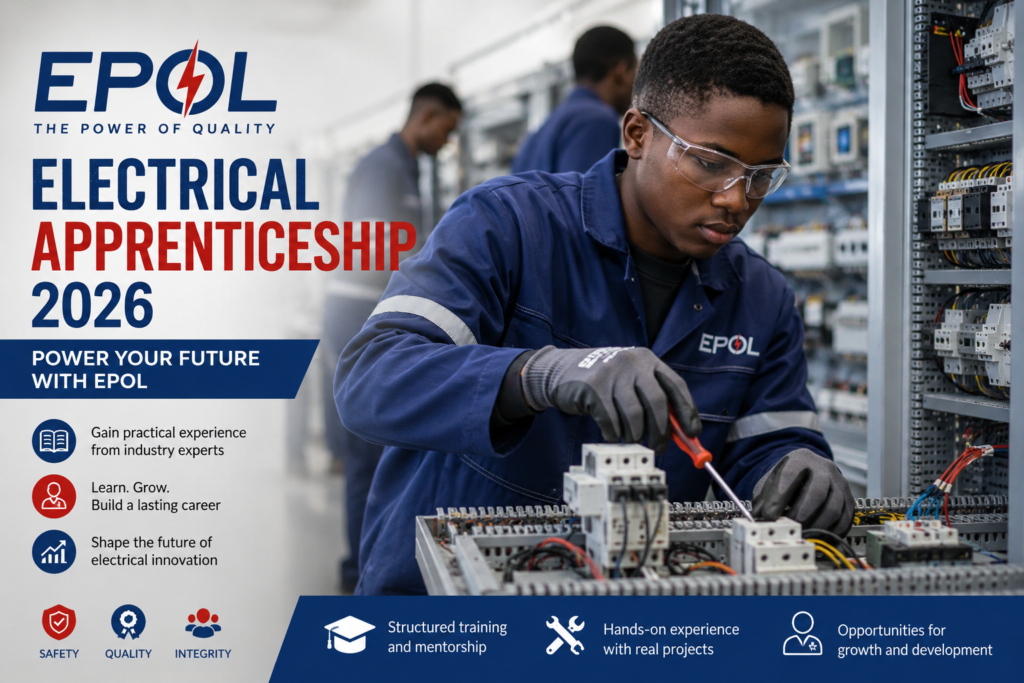
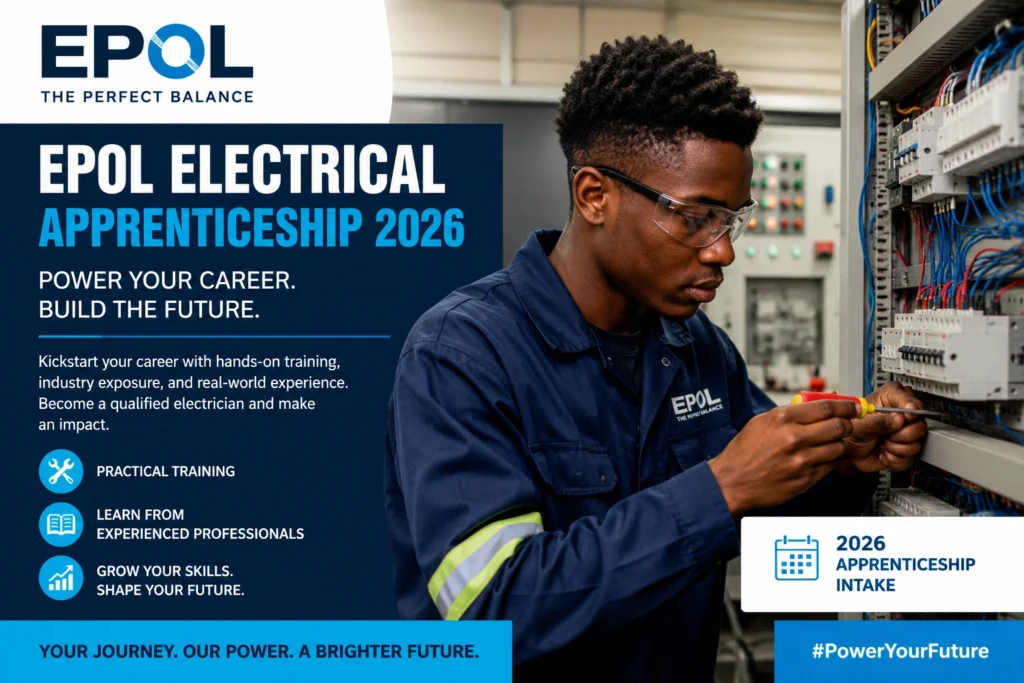
For technically minded South Africans who want to build a career in electrical maintenance, the Epol Electrical Apprenticeship 2026 could provide an important bridge between technical education and industrial work. Epol is advertising a three-year Electrical Apprenticeship in Worcester, Western Cape, aimed at unemployed youth with relevant Mathematics, Physical Science and technical qualifications. The vacancy information supplied for this opportunity lists 26 August 2026 as the closing date.
There is, however, an important detail applicants should understand: another current listing for the same Epol apprenticeship gives 31 August 2026 as the end date. Because of this discrepancy, applicants should verify the closing date on the active recruitment page before submitting.
The opportunity is worth examining closely because it is not simply another entry-level job advertisement. It is a structured three-year technical development route in an industrial environment, where electrical reliability can have a direct effect on production.
Why this Epol apprenticeship matters for young technical jobseekers
A technical qualification can teach you the principles of electrical systems, electronics and engineering. But industrial employers also need people who can apply those principles when equipment is operating, production schedules are tight and safety procedures must be followed.
That is where an apprenticeship can make a difference.
Epol’s advertised programme is intended to develop young talent in scarce and critical skills. The company’s manufacturing environment also provides an important context for electrical training: industrial facilities depend on electrical equipment, motors, controls, sensors, machinery and maintenance systems to keep production moving.
Tiger Brands, whose portfolio includes Epol, describes its broader purpose around food and essential products and highlights the importance of capability and continuous learning within its business.
For an apprentice, this means the learning opportunity is potentially much broader than textbook electrical theory.
You are learning how technical systems function inside a working business.
That experience can matter later when applying for technician, artisan, maintenance and engineering-related positions.
Opportunity at a glance
| Detail | Information |
|---|---|
| Programme | Electrical Apprenticeship |
| Duration | 3 years |
| Company | Epol |
| Location | Worcester, Western Cape |
| Target applicants | Unemployed youth with relevant technical qualifications |
| Key school subjects | Mathematics and Physical Science |
| Technical requirement | N3 with 50% in Mathematics and Physical Science |
| Higher qualification | N4 and above is advantageous |
| Closing date | 26 August 2026 listed on the supplied vacancy; other listings show 31 August |
| Work environment | Industrial/FMCG environment, including cold conditions |
The conflicting closing dates make early application especially important. Do not wait for the later date if you are ready to apply.
Who is Epol looking for?
The academic requirements give a fairly clear picture of the candidate the employer wants.
Applicants should have Grade 12 with Mathematics and Physical Science. In addition, the vacancy specifies an N3 qualification with a 50% pass rate in both Mathematics and Physical Science. N4 or a higher qualification is an advantage.
The advertised technical subjects include:
- Mathematics
- Engineering Science
- Industrial Electronics
- Electrical Technology
- Electrotechnology/Electrotechnics
This means applicants should not treat their CV as a generic job-search document.
Your technical background should be immediately visible.
If you completed N3, N4 or higher, state the qualification clearly. Include relevant subjects and results. If you have practical engineering experience, explain it rather than simply writing “engineering experience”.
The advertisement also identifies several personal and workplace qualities: attention to detail, accuracy, engineering aptitude, problem-solving ability, motivation and comfort working in a cold environment.
Those requirements are more revealing than they might initially appear.
An electrical apprentice needs to be careful. Electrical work involves safety-critical procedures, equipment and systems where rushing can create serious problems. Accuracy is therefore not just a desirable personality trait; it is part of being a reliable technical worker.
Practical experience can strengthen your application
The vacancy indicates that technical experience in an engineering field is required and that practical electrical experience in an FMCG environment is advantageous.
That does not mean candidates without years of employment should automatically give up.
Instead, think carefully about the practical experience you can legitimately demonstrate.
This could include relevant workshop exposure, technical training, electrical projects, equipment maintenance activities or other hands-on engineering experience, depending on your actual background.
The key is honesty.
Never inflate your experience simply to match a vacancy. Recruiters may test technical knowledge during screening or interviews, and inaccurate claims can damage an otherwise good application.
What could you actually learn during three years?
The precise training structure and duties should be confirmed from the official vacancy and recruitment documentation, but the nature of the role gives applicants useful clues about what industrial electrical training can involve.
A technical apprentice can expect to develop a stronger understanding of areas such as electrical equipment, fault-finding, maintenance practices, workplace safety, industrial controls and the relationship between electrical systems and production machinery.
The most valuable part may be learning how to think through a technical problem.
Suppose a machine stops operating.
A strong technician does not simply start replacing components randomly. They work methodically: understand the symptoms, consider possible causes, inspect the system, test safely, identify the fault and determine an appropriate solution.
That problem-solving mindset is transferable across many industrial environments.
This is also why the three-year duration matters. Technical competence develops through repetition. Seeing a problem once is not the same as learning how to recognise and diagnose similar problems independently.
Expert insight: treat the apprenticeship as career capital
The biggest mistake would be to view this opportunity only as a way to get your first job.
A three-year apprenticeship can become career capital if the apprentice deliberately records what they learn.
Keep track of technical systems you are trained on, areas of competence, safety training, practical tasks and qualifications achieved. Learn from experienced artisans and technicians. Ask sensible questions. Understand why maintenance procedures are performed in a particular way.
The difference between an apprentice who merely completes the programme and one who builds a professional foundation is often their attitude toward learning.
How to apply for the Epol Electrical Apprenticeship 2026
Applicants should use the official recruitment channel associated with the Epol/Tiger Brands vacancy and verify the live closing date before submitting. Tiger Brands maintains a careers section on its official website, while the vacancy has also been circulated through recruitment listings.
Because third-party listings can contain outdated information, do not rely on a social-media post or job aggregator alone.
Step 1: Check your eligibility
Before starting the application, compare your qualifications with the vacancy.
You should specifically check:
- Grade 12 with Mathematics and Physical Science.
- N3 qualification where required.
- At least 50% in N3 Mathematics and Physical Science.
- Relevant electrical/engineering subjects.
- N4 or higher, if applicable.
- Relevant technical or engineering experience.
If you clearly do not meet a mandatory requirement, do not alter your CV to make it appear that you do.
Step 2: Prepare a targeted CV
Your CV should make it easy for a recruiter to understand your technical background within a few seconds.
Put your most relevant information near the top:
Education and technical qualifications → technical subjects → practical experience → additional skills.
Avoid filling the CV with unrelated information.
If you have electrical practical experience, explain what equipment, systems or tasks you worked with.
Step 3: Prepare your supporting documents
Have clear copies of the documents requested by the recruitment system.
Depending on the application instructions, this may include your:
- South African identity document or relevant identification;
- Matric certificate;
- N3/N4 certificates;
- Academic record;
- Updated CV;
- Other supporting qualifications.
Only upload documents specifically requested by the application platform.
Step 4: Find the verified vacancy
Start with the employer’s official careers platform rather than clicking unknown links shared through WhatsApp or Facebook.
Tiger Brands provides an official website and careers-related information through its corporate platform.
Search for the Epol Electrical Apprenticeship and confirm that the vacancy details match Worcester and the three-year programme.
Step 5: Complete the application carefully
Enter your personal information exactly as it appears on your official documents.
Pay particular attention to:
- Phone number
- Email address
- Qualification information
- Employment history
- Technical subjects
- Work experience
APPLY HERE: Epol Electrical Apprenticeship 2026
A simple typing error in contact details can become a serious problem if the recruiter cannot reach you.
Step 6: Review before submitting
Do not rush the final page.
Check that your CV has been attached correctly and that your qualifications have been entered accurately.
Then submit the application and save any confirmation message, reference number or email.
ALSO APPLY FOR: Phakisa Holdings Apprentice 2026
Avoid these mistakes when applying
A strong qualification does not automatically produce a strong application.
Several avoidable mistakes can reduce your chances:
Applying without checking the technical requirements.
The N3 and subject requirements are important. Read them carefully.
Using the same CV for every job.
A generic CV can hide relevant electrical experience.
Claiming skills you cannot demonstrate.
Technical recruitment can expose exaggerated claims quickly.
Waiting until the closing date.
The published dates are already close, and different listings currently show different deadlines.
Paying someone to apply for you.
Be cautious of anyone demanding money in exchange for selection, a job offer or guaranteed placement.
Ignoring the working environment.
The vacancy specifically notes that candidates should be comfortable working in cold conditions.
Frequently asked questions
Is the Epol Electrical Apprenticeship 2026 a three-year programme?
Yes. The vacancy describes it as a three-year Electrical Apprenticeship based in Worcester.
Do I need N3?
The advertised requirements specify an N3 qualification with at least 50% in Mathematics and Physical Science. N4 and above is listed as an advantage. Candidates should therefore check their qualifications carefully before applying.
What is the closing date?
The vacancy supplied for this article states 26 August 2026, while another current recruitment listing gives 31 August 2026. Applicants should verify the deadline on the active employer/recruitment page and apply as early as possible.
Final assessment
The Epol Electrical Apprenticeship 2026 is particularly relevant to South Africans who have invested in Mathematics, Physical Science and technical studies but need structured industrial experience to move into the workplace.
Its three-year duration is one of its strongest features. Rather than treating technical development as a quick course, an apprenticeship can provide sustained exposure to workplace standards, maintenance thinking, safety procedures and industrial equipment.
But applicants should be realistic. Meeting the minimum requirements does not guarantee selection, and competition for scarce technical opportunities can be significant.
The best strategy is therefore simple: verify your eligibility, prepare a focused technical CV, submit through the legitimate recruitment channel, apply early and prepare seriously for screening.
For someone determined to build a career around electrical engineering, maintenance or industrial operations, the real value of this opportunity could extend well beyond the initial application. It is the chance to turn technical knowledge into practical competence—and practical competence is often what finally moves a young jobseeker from qualification to career.