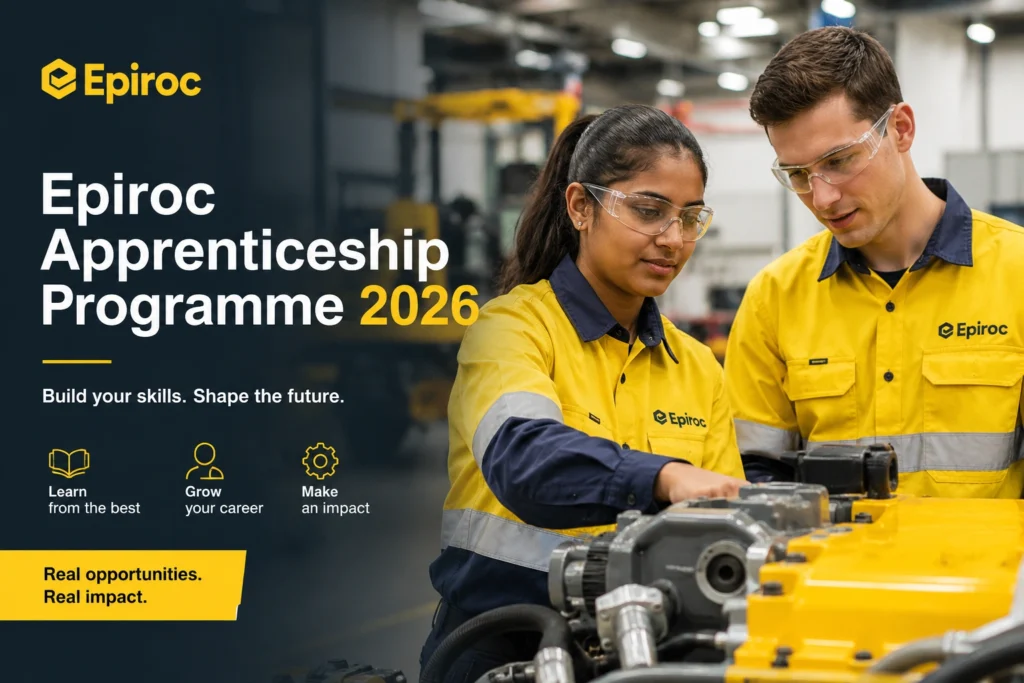

The Epiroc Apprenticeship Programme 2026 is attracting attention at a time when thousands of young South Africans are searching for practical pathways into engineering careers. With applications closing on 30 June 2026, the programme arrives during a period when technical skills are becoming increasingly valuable across mining, manufacturing, maintenance, and industrial service sectors.
What makes this opportunity stand out is not simply the availability of apprenticeship positions. It is the combination of structured training, workplace mentorship, and exposure to real industrial operations within a globally recognised equipment and service company.
As South Africa continues to face youth unemployment challenges while industries report shortages of qualified technical artisans, programmes like this are attracting growing interest from school leavers, N2 graduates, and aspiring engineers looking for a foothold in the industry.
The conversation around apprenticeships has changed significantly in recent years. Instead of being viewed as secondary to university education, many young people are beginning to see artisan development as a practical route toward long-term career stability. The Epiroc Apprenticeship Programme 2026 sits directly within that shift.
Understanding the Opportunity
Epiroc is offering apprenticeship opportunities within its Equipment and Service business area based in Krugersdorp, Gauteng.
The programme focuses on the company’s Rebuild department, where successful candidates will gain experience through hands-on learning, technical instruction, workplace coaching, and mentorship.
The available apprenticeship trades include:
- Millwright (2 positions)
- Fitter (2 positions)
- Turner Machinist (2 positions)
- Tool, Jig and Die Maker (2 positions)
While the number of available positions is limited, the programme’s appeal comes from the quality of exposure rather than the quantity of vacancies.
Participants will work under supervision while learning the practical and theoretical aspects of their chosen trade. They will also gain exposure to equipment maintenance, component rebuilding, workshop procedures, safety protocols, and engineering best practices.
For many applicants, this represents an opportunity to bridge the gap between classroom knowledge and real-world industrial experience.
How Apprenticeships Became More Important in South Africa
The renewed interest in apprenticeship programmes did not happen overnight.
Over the past decade, South Africa’s labour market has experienced a growing demand for skilled artisans. Industries ranging from mining and manufacturing to renewable energy and infrastructure development continue to require technicians who can install, maintain, repair, and optimise complex systems.
At the same time, many graduates and school leavers have struggled to secure entry-level work experience.
This has created a situation where employers need practical skills, while young people need opportunities to gain those same skills.
Apprenticeships help address that challenge.
Unlike traditional academic routes that often focus heavily on theory, apprenticeships combine learning with practical workplace exposure. Participants earn valuable experience while developing competencies that employers actively seek.
Programmes such as the Epiroc Apprenticeship Programme 2026 reflect a broader industry effort to strengthen South Africa’s technical skills pipeline.
Why Epiroc’s Name Carries Weight
One reason this apprenticeship is receiving attention is the company’s reputation within industrial and mining sectors.
Epiroc is known internationally for providing equipment, technology, and service solutions used across mining, infrastructure, and construction operations.
For aspiring artisans, training within an organisation connected to advanced industrial technologies can be particularly valuable.
Modern engineering workplaces increasingly rely on automation, precision maintenance, diagnostic systems, and specialised equipment. Exposure to these environments can provide apprentices with insights that extend beyond traditional workshop experience.
The opportunity to learn within such an environment may strengthen future employability and broaden career prospects.
Recent Developments Driving Interest
Several trends have contributed to increased attention around apprenticeship opportunities in 2026.
First, technical and vocational careers are receiving greater recognition as viable alternatives to conventional academic pathways.
Second, employers are placing increasing emphasis on demonstrable skills rather than qualifications alone.
Third, many young South Africans are becoming more aware of the earning potential associated with artisan careers.
Qualified artisans often find opportunities in sectors such as:
- Mining
- Manufacturing
- Heavy industry
- Engineering services
- Construction
- Energy production
- Infrastructure development
As these sectors continue modernising operations, the need for skilled technical professionals remains significant.
Against this backdrop, every apprenticeship announcement tends to generate substantial interest among job seekers looking for sustainable career opportunities.
What Applicants Need to Know
The programme has specific educational and technical requirements.
Applicants must possess:
- Grade 12 or National Senior Certificate
- English and at least one additional language
- Mathematics (Pure Mathematics or Technical Mathematics)
- Science
- Additional supporting subjects
Candidates with Engineering Graphics and Design or Engineering Drawing may have an advantage.
In addition, applicants need a minimum N2 qualification that includes:
- Fitting Theory
- Electrical Theory
Basic electronics knowledge may strengthen an application.
An Engineering Diploma in Mechanical or Electrical Engineering is considered beneficial but is not compulsory.
Importantly, applicants must be at least 18 years old and should be prepared to complete assessments if shortlisted.
These requirements indicate that Epiroc is looking for candidates who already possess foundational technical knowledge and are ready to build on it through workplace learning.
Public Reaction: Why Young People Are Interested
Whenever apprenticeship opportunities are announced, discussions quickly emerge across career forums, social media platforms, and educational communities.
The reaction to opportunities such as the Epiroc Apprenticeship Programme 2026 often follows a similar pattern.
Many young people see apprenticeships as offering something that traditional job advertisements frequently demand but rarely provide: a chance to gain experience while learning.
One of the biggest frustrations among entry-level job seekers is the expectation of prior experience.
Apprenticeships partially solve that problem by creating structured environments where learning and work occur simultaneously.
For many aspiring artisans, this approach feels more realistic and accessible than competing for experienced positions immediately after completing studies.
There is also growing appreciation for careers that involve practical problem-solving and hands-on technical work.
As industries evolve, these skills remain difficult to automate completely, making them attractive from a long-term career perspective.
The Skills Beyond Technical Training
An often-overlooked aspect of apprenticeship programmes is the development of workplace habits.
Technical expertise matters, but employers frequently value additional competencies such as:
- Communication skills
- Teamwork
- Reliability
- Safety awareness
- Problem-solving
- Time management
- Professional conduct
According to the programme description, apprentices will participate in reporting activities, documentation processes, and compliance-related tasks.
These experiences can help develop broader professional capabilities that remain valuable throughout a career.
In many cases, successful artisans distinguish themselves not only through technical knowledge but also through their ability to work effectively within teams and operational environments.
ALSO VISIT: https://www.epiroc.com
Why This Matters Right Now
The timing of the Epiroc Apprenticeship Programme 2026 is particularly relevant.
South Africa continues to grapple with youth unemployment, while industries simultaneously report shortages of certain technical skills.
This creates a paradox: available opportunities exist, but the workforce pipeline requires strengthening.
Apprenticeship programmes play an important role in narrowing that gap.
For young people, they provide access to practical training and industry exposure.
For employers, they contribute to future workforce development.
For the economy, they help build a pool of skilled artisans capable of supporting industrial growth and infrastructure projects.
In an environment where employability increasingly depends on both qualifications and practical experience, apprenticeship opportunities have become more significant than ever.
That is why announcements such as this tend to attract substantial attention from students, graduates, and career changers alike.
APPLY HERE: Epiroc Apprenticeship Programme 2026
ALSO APPLY FOR: Resolution Circle Millwright Apprenticeship
What Could Happen Next
Several possible outcomes could emerge from programmes like this over the coming years.
The first is stronger demand for apprenticeship placements.
As awareness grows regarding artisan career pathways, competition for available opportunities may continue increasing.
The second possibility is greater investment in technical training initiatives.
Industries facing skills shortages may expand apprenticeship programmes to strengthen talent pipelines.
A third outcome could be a broader shift in public perceptions regarding vocational careers.
For years, many learners viewed university education as the primary route to career success. Increasing visibility of successful artisans and technical professionals may encourage more balanced career decision-making.
For successful Epiroc apprentices specifically, the programme could serve as a foundation for future trade qualifications, advanced technical specialisation, supervisory roles, or broader engineering careers.
While apprenticeship completion does not guarantee long-term employment, it often provides valuable industry experience that strengthens future opportunities.
A Competitive Opportunity Worth Serious Consideration
The reality is that apprenticeship opportunities with reputable industrial employers are rarely available in large numbers.
With only eight positions available across four trades, competition for the Epiroc Apprenticeship Programme 2026 is likely to be strong.
Applicants who meet the educational requirements and possess a genuine interest in engineering should ensure their applications are complete, accurate, and submitted before the deadline.
Required documents include:
- Updated CV
- Certified South African ID copy
- Certified Grade 12 certificate
- Certified N2 qualification
- Additional engineering-related qualifications where applicable
- Supporting documents requested through the online portal
Given the short application window, interested candidates should avoid delaying preparations.
Final Thoughts
The Epiroc Apprenticeship Programme 2026 represents more than just another apprenticeship announcement. It reflects broader developments within South Africa’s technical skills landscape, where practical experience, artisan training, and workplace readiness are becoming increasingly valuable.
For young people interested in Millwright, Fitting, Turner Machining, or Tool, Jig and Die Making careers, the programme offers structured learning, mentorship, and exposure to real engineering environments.
At a time when many job seekers are looking for practical ways to enter the workforce, opportunities that combine training and industry experience continue to stand out.
Whether viewed as a stepping stone toward artisan qualification or as the beginning of a long-term engineering career, the Epiroc Apprenticeship Programme 2026 highlights the growing importance of technical skills development in South Africa’s evolving economy.
With applications closing on 30 June 2026, eligible candidates have a limited window to take advantage of an opportunity that could shape the direction of their professional future.