

For a young person leaving school in 2026, the hardest part of starting a career is often not choosing a career. It is finding an opportunity that provides genuine training, workplace exposure and a clear technical direction.
The CTP Cartons Apprentice 2027 programme offers one such route.
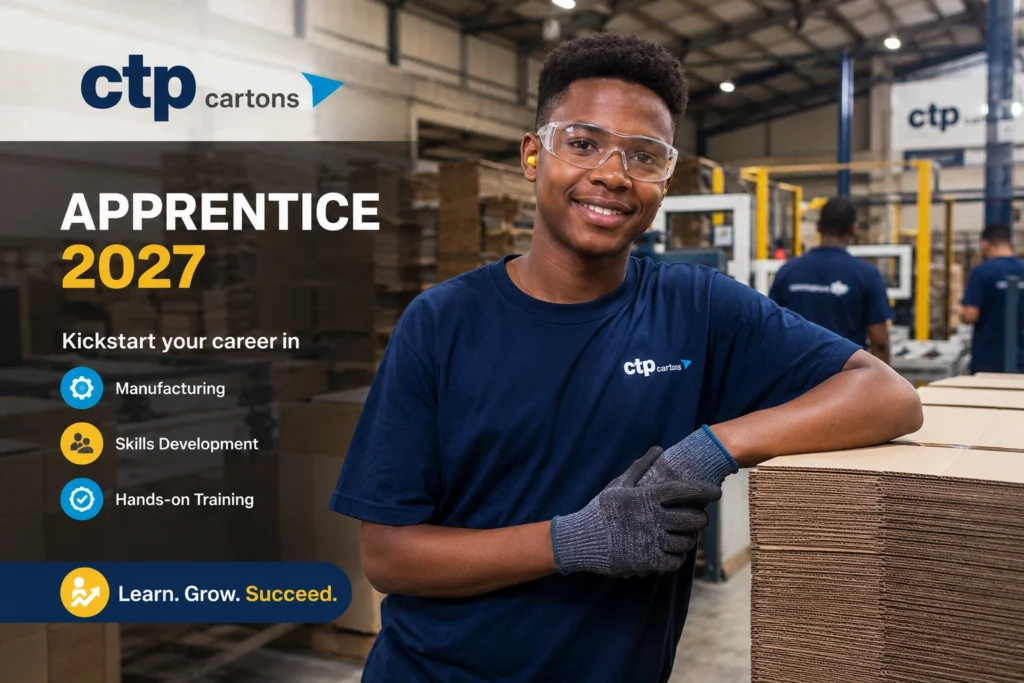
CTP Cartons & Labels is recruiting recent school leavers for a 36-month Lithography and Carton Making Apprenticeship beginning in January 2027. The training will be based at the company’s Epping factory in Cape Town, where apprentices will enter a real packaging-manufacturing environment and develop practical skills alongside industry-recognised training.
Applications close on 13 September 2026.
The opportunity is aimed at matriculants with Mathematics, Physical Science and/or technical school subjects. Applicants must also have full colour vision, be technically orientated, be willing to work shifts and attach either their Matric certificate or N3 Technical certificate. Shortlisted candidates must successfully complete medical and criminal screening.
Importantly, the employer’s listing does not state a specific apprenticeship stipend. Candidates should therefore avoid relying on salary figures published by unofficial websites.
Why the CTP Cartons Apprentice 2027 opportunity deserves attention
At first glance, printing and carton manufacturing may seem like an old-fashioned career choice in a country increasingly dominated by digital technology.
The reality is different.
Look around any supermarket, pharmacy, takeaway restaurant or household. Products still need physical packaging. Food, beverages, medicine, cosmetics, household goods and many other products depend on printed cartons and labels.
CTP Cartons & Labels specialises in folding and litho-laminated paperboard cartons and uses printing, die-cutting and finishing technologies in its manufacturing operations. Its products serve sectors including FMCG, beverages, pharmaceuticals and retail.
That makes the apprenticeship more than a traditional printing opportunity. It introduces young people to a part of the manufacturing chain where machinery, materials, colour accuracy, quality control and production discipline meet.
The 36-month period is particularly important.
A short internship might give a graduate a few months of exposure to a workplace. A three-year apprenticeship allows a school leaver to spend considerably more time developing practical competence.
For someone who wants a hands-on technical career, that difference can be substantial.
What will an apprentice actually learn?
The official vacancy does not publish a detailed daily training schedule, so applicants should not assume that every possible task is guaranteed.
However, the trade itself provides a clear indication of the environment.
Lithography involves producing printed material with controlled colour, detail and consistency. Carton making involves converting printed paperboard into finished packaging. These processes require machinery, measurements, quality checks and careful adherence to production procedures.
An apprentice can therefore expect exposure to areas such as:
- lithographic printing processes;
- carton and packaging production;
- machinery and factory equipment;
- colour recognition and print quality;
- production procedures;
- workplace health and safety;
- quality-control practices;
- teamwork in a manufacturing environment; and
- shift-based factory operations.
CTP’s recruitment information emphasises technical excellence, safety, continuous improvement and access to advanced machinery and industry training.
This is important for applicants to understand: the programme is not simply about learning how to operate a printer.
It is about learning how a manufacturing system works.
A good apprentice will gradually learn how to follow procedures, identify problems, maintain quality standards, work safely and communicate with colleagues when something goes wrong.
Those habits can remain valuable even if the apprentice later moves into another manufacturing or technical role.
Who should apply—and who should think twice?
The minimum requirements are straightforward, but the personal fit is just as important.
CTP requires matriculants to have studied Mathematics, Physical Science and/or a technical subject. Applicants must attach a Matric certificate or N3 Technical certificate. Full colour vision and willingness to work shifts are also required.
But meeting those requirements does not automatically make someone a strong candidate.
The strongest applicants are likely to be young people who genuinely enjoy understanding how things work.
Someone who liked practical school projects, technical subjects, science experiments, machinery or problem-solving may find the factory environment more comfortable than someone who only wants a conventional office job.
Applicants should also be realistic about the phrase “willing to work shifts.”
Manufacturing does not necessarily operate around normal office hours. Production schedules can require employees to work different shifts, depending on operational requirements.
Candidates should consider transport to Epping, their ability to arrive reliably and whether they are prepared for the routines of a production environment before applying.
Full colour vision should also be treated as a genuine trade requirement, rather than a minor preference. Colour accuracy is relevant to printing and quality control, so candidates who know they have difficulty distinguishing colours should carefully consider the requirement before submitting an application.
Expert insight: the real value is learning how industry works
Career insight: The biggest advantage of an apprenticeship like this is not simply the qualification at the end. It is the opportunity to develop the habits of a professional technical worker while still being trained.
Young people often leave school with theoretical knowledge but limited experience of production deadlines, workplace safety, quality standards, machinery and team responsibilities.
A structured apprenticeship helps close that gap.
CTP’s employer information also highlights skills development and ongoing training as part of its workplace environment, including opportunities for employees to develop their careers within the wider CTP group.
For a school leaver, that combination of technical learning and workplace discipline can be more useful than collecting another short course without practical exposure.
How to apply for the CTP Cartons Apprentice 2027
Step 1: Check that you meet the requirements
Before applying, confirm that you:
- have completed matric;
- studied Mathematics, Physical Science and/or a technical subject;
- have a Matric certificate or N3 Technical certificate;
- have full colour vision;
- are technically orientated;
- are willing to work shifts; and
- can attend training in Epping, Cape Town.
Do not apply simply because the programme is advertised as an apprenticeship. Read the requirements first.
Step 2: Prepare your certificate
The employer specifically requires applicants to attach their Matric certificate or N3 Technical certificate.
Make sure the document is clear and readable.
If you are scanning the certificate, check the final file before uploading it. A blurry photograph, missing page or document that cannot be opened could create an avoidable problem during screening.
Step 3: Update your CV
A recent school leaver does not need a five-page CV.
One or two pages are enough if the information is relevant.
Put your education near the top and clearly show the subjects you studied. If you completed technical projects, practical assignments, workshop activities or other relevant school activities, mention them.
For example, instead of writing:
“I am hardworking and passionate.”
Give evidence:
“Completed practical technical projects at school and developed an interest in manufacturing processes.”
Specific information gives the recruiter something useful to assess.
Step 4: Go to the official CTP recruitment portal
Open the official CTP Cartons & Labels recruitment portal and locate the vacancy titled “Apprenticeship: Lithography & Carton Making.”
This is the safest route because it takes you directly to the employer’s recruitment system.
APPLY HERE: CTP Cartons Apprentice 2027
Step 5: Complete the online application carefully
Enter your personal information exactly as it appears on your official documents.
Check your:
- name and surname;
- contact number;
- email address;
- education details;
- school subjects; and
- supporting documents.
Do not rush this section.
A mistake in an email address or telephone number could make it difficult for the employer to contact you.
Step 6: Submit before 13 September 2026
The official closing date is 13 September 2026.
Do not wait until the final evening.
Applying early gives you time to correct an incomplete application or deal with a document-upload problem.
After submitting, keep a copy of your CV and any confirmation generated by the recruitment system.
ALSO APPLY FOR: VKB Apprentice 2026
What happens if you are shortlisted?
Meeting the minimum requirements does not guarantee selection.
The official vacancy states that shortlisted candidates must successfully complete medical and criminal screening.
This means applicants should provide truthful information throughout the recruitment process.
Candidates should also prepare for the possibility of an interview or assessment. Be ready to explain:
- why you want to enter the printing and packaging industry;
- why you are interested in technical work;
- which school subjects prepared you for the apprenticeship;
- whether you understand what shift work involves; and
- why you are willing to commit to a three-year programme.
Do not memorise complicated answers.
A clear explanation of your interest in technical work can be more convincing than a collection of impressive-sounding phrases.
What about the stipend?
This is one of the areas where applicants should be cautious.
The official CTP vacancy does not publish a specific stipend or salary amount.
Therefore, candidates should not assume that a salary figure appearing on another website applies to this intake.
The employer’s official recruitment portal should be treated as the primary source for confirmed programme information.
It is also worth noting that CTP’s recruitment portal lists broader employee benefits such as retirement contributions, group risk cover, skills development, occupational health support and subsidised canteen facilities, but these are presented as employer benefits generally and should not automatically be interpreted as guaranteed apprenticeship benefits.
Five mistakes that could weaken an application
1. Applying without checking the subjects.
The programme specifically targets candidates with Mathematics, Physical Science and/or technical subjects.
2. Uploading an unreadable certificate.
Your supporting document needs to be clear.
3. Ignoring the shift requirement.
This is a manufacturing apprenticeship, not a conventional office internship.
4. Using a generic CV.
Highlight technical subjects, practical work and relevant interests.
5. Waiting for the deadline.
Technical problems are easier to solve when you apply early.
Frequently Asked Questions
Is the CTP Cartons Apprentice 2027 available to recent matriculants?
Yes. The official vacancy specifically targets recent school leavers and requires matric with Mathematics, Physical Science and/or technical subjects.
Where will the apprenticeship take place?
Training is based at CTP Cartons & Labels Epping in Cape Town, Western Cape.
When do applications close?
The official closing date is 13 September 2026, with the programme scheduled to start in January 2027.
Final assessment
The CTP Cartons Apprentice 2027 programme deserves attention from South African school leavers who want a practical technical career rather than a purely academic pathway.
Its strongest feature is the 36-month duration. Three years gives an apprentice the opportunity to develop workplace habits, technical knowledge and practical experience in a specialised manufacturing environment.
But applicants should go into the opportunity with realistic expectations.
This will require commitment, shift work, attention to detail and a willingness to start at entry level. It is not a shortcut to a job title. It is a training pathway in which the apprentice is expected to learn progressively and prove their ability in a real production environment.
For the right matriculant, however, that is precisely the attraction.
The application deadline is 13 September 2026. Prepare the certificate, strengthen the CV, check the requirements and use the official recruitment portal rather than relying on unofficial application links.
In a competitive South African youth employment market, gaining a specialised technical skill while building real factory experience can be a valuable first step. The opportunity at CTP Cartons & Labels is therefore worth serious consideration—not because it promises an easy career, but because it offers a structured way to begin building one.