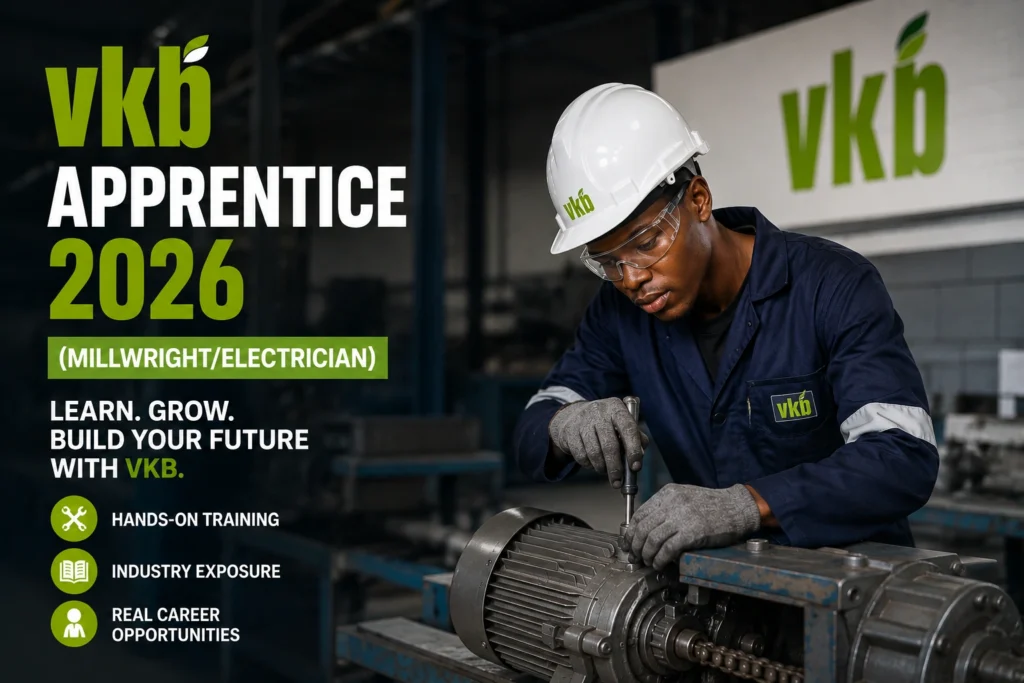

VKB Apprentice 2026: VKB Milling is recruiting candidates for a hands-on apprenticeship connected to its wheat-milling operation. The opportunity is aimed at candidates with Grade 12 or an NQF Level 4 qualification, while the recruitment information also highlights previous exposure to construction, maintenance or mechanical trades and enrolment in or completion of a pre-apprenticeship programme.
The deadline is particularly important: applications close on 17 August 2026.
For candidates considering artisan careers, this is worth examining carefully. An apprenticeship is not simply another entry-level job. It can provide supervised exposure to industrial machinery, maintenance procedures, technical problem-solving and the workplace discipline expected from developing artisans.
However, applicants should also understand what the vacancy does not confirm. The supplied information does not publish a stipend or salary, while the careers listing records the contract term as “24” without clearly identifying the unit. Applicants should verify these details through the recruitment process rather than relying on figures circulating online.
Why this apprenticeship could be valuable for an aspiring artisan
At a wheat mill, mechanical and electrical systems are part of an operating chain. Motors drive equipment, conveyors move materials, pumps perform essential functions and mechanical components need regular inspection and maintenance.
When equipment fails, production can be affected.
That makes the mill an interesting learning environment for an aspiring millwright.
The apprentice can begin to understand how preventative maintenance reduces breakdowns, how equipment is inspected, how faults are approached and why precision matters when machinery is assembled or aligned.
The supplied vacancy information indicates that apprentices will work alongside experienced artisans and receive both workplace and classroom training.
This combination is important because a developing artisan needs both technical understanding and practical judgement.
What VKB is really looking for in an applicant
The first requirement is relatively clear: candidates need Grade 12 or an equivalent NQF Level 4 qualification.
But stopping there would be a mistake.
The recruitment information specifically mentions previous exposure to construction, maintenance or mechanical trades, together with enrolment in or completion of a pre-apprenticeship programme.
This suggests that VKB is interested in candidates who have already demonstrated some commitment to practical technical work.
That does not necessarily mean applicants need a long employment history.
A young person might have gained relevant exposure through technical training, workshop activities, construction work, maintenance assistance or a pre-apprenticeship programme.
What matters is that the application makes this experience visible.
For example, instead of writing:
“I have mechanical experience.”
an applicant should explain the nature of that experience.
Did they assist with maintenance? Did they learn to use hand tools? Did they complete practical mechanical training? Did they work around machinery? Did they learn basic workplace safety?
Specific information gives a recruiter something useful to assess.
The best way to position limited experience
One of the biggest mistakes young job seekers make is believing they need to make themselves look highly experienced.
An apprenticeship is specifically a development pathway.
The candidate is expected to learn.
Therefore, do not exaggerate technical abilities.
If you have only completed basic training, say so. If you assisted a qualified worker rather than working independently, describe it accurately.
A credible application might demonstrate:
- Relevant Grade 12 or NQF Level 4 education
- Pre-apprenticeship training
- Mechanical or maintenance exposure
- Interest in millwright or electrical work
- Ability to follow instructions
- Safety awareness
- Willingness to learn
- Teamwork and communication
- Reliability and punctuality
The objective is to show readiness to learn, not pretend that you are already a qualified artisan.
What will the apprentice actually learn?
The vacancy information provides a useful indication of the practical environment.
Apprentices are expected to support qualified artisans and develop exposure to tasks involving industrial machinery.
This can include installing, assembling and dismantling machinery; conducting preventative maintenance; working around motors and conveyors; handling pumps and gearboxes; reading technical diagrams and manufacturer manuals; using hand and power tools; and using precision measuring equipment.
Machinery alignment is another important area.
An apprentice may discover that technical maintenance is often about accuracy rather than speed. Equipment has to be assembled correctly, components need to be positioned accurately and maintenance work has to be performed according to established procedures.
A responsible applicant separates what the vacancy states from what they hope the programme will eventually provide.
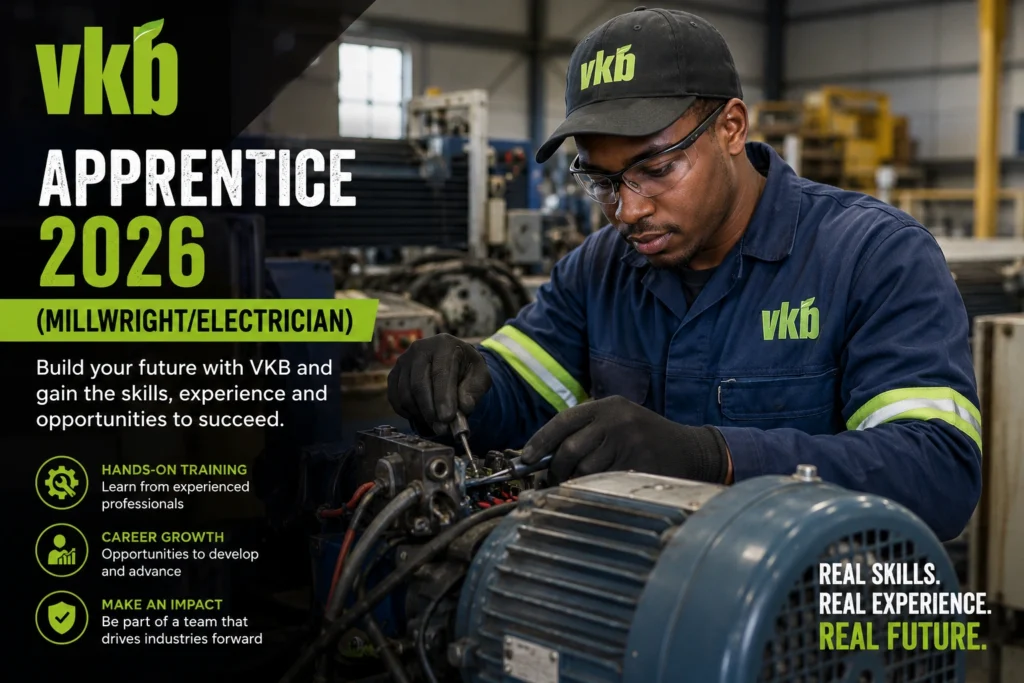
Step-by-step: How to apply for the VKB Apprentice 2026 opportunity
Because the closing date is 17 August 2026, candidates should treat the application as an immediate task rather than something to complete later.
Step 1: Confirm that you meet the basic requirements
Before opening the application form, check whether you have:
Grade 12 or NQF Level 4, together with relevant exposure to construction, maintenance or mechanical trades and pre-apprenticeship training where applicable.
If you do not have every preferred element, do not automatically assume that you should misrepresent your background. Read the official vacancy requirements carefully and apply only if you genuinely meet the stated eligibility criteria.
Step 2: Prepare your CV before entering the portal
Do not start the online application without first preparing your CV.
Your CV should make it easy for a recruiter to identify:
- Full name and current contact details
- Grade 12/NQF Level 4 qualification
- Relevant subjects or technical training
- Pre-apprenticeship programme, if completed or currently undertaken
- Construction, mechanical or maintenance experience
- Relevant practical skills
- Work or practical experience
- References where appropriate
Keep unrelated information brief.
For this particular opportunity, a CV focused on technical readiness is more useful than one filled with generic duties.
Step 3: Collect supporting information
Before submitting, have the information you may need available.
This can include your qualification details, training information, employment or practical experience details and any other documents specifically requested by the official application portal.
Do not upload documents simply because someone on social media says they are required. Follow the employer’s instructions.
Step 4: Find the official VKB careers application
Use VKB’s official recruitment/careers channel rather than an unofficial application link.
APPLY HERE VKB Apprentice 2026
Step 5: Submit before 17 August 2026
Do not deliberately wait for the deadline.
Online recruitment systems can experience technical problems, internet connectivity can fail and applicants sometimes discover at the last minute that they are missing information.
Submitting early gives you time to deal with problems.
After submission, save any confirmation message or reference number provided by the recruitment system.
ALSO APPLY FOR: Nampak Apprentices 2026
Safety and scam check for applicants
Apprenticeships attract large numbers of young job seekers, which unfortunately also creates opportunities for scammers.
A legitimate recruitment process should not require an applicant to pay money simply to be considered for employment.
Be cautious if someone:
- Guarantees selection in exchange for payment;
- Requests money for “registration”;
- Asks for sensitive financial information unnecessarily;
- Contacts you through an unofficial account and pressures you to act immediately;
- Sends an application link that does not appear to belong to VKB;
- Claims to be a recruiter but cannot provide verifiable employer information.
If something feels suspicious, stop and verify the vacancy through VKB’s official recruitment channels.
Frequently Asked Questions
1. What is the closing date?
The stated closing date is 17 August 2026. Candidates should submit early enough to avoid last-minute technical or documentation problems.
2. Do applicants need previous experience?
The recruitment information highlights previous exposure to construction, maintenance or mechanical trades and enrolment in or completion of a pre-apprenticeship programme. Applicants should therefore explain any relevant practical background clearly.
3. How much is the apprenticeship stipend?
The supplied vacancy information does not state the stipend or salary. Candidates should confirm remuneration through the official recruitment process rather than relying on unofficial advertisements.
Final assessment
For an eligible young person who wants to pursue the artisan trades, the VKB Milling opportunity deserves serious consideration.
Its strongest feature is the combination of workplace exposure and technical learning in an operational wheat-milling environment. That gives candidates an opportunity to see how mechanical and electrical maintenance functions in a real production setting.
But applicants should approach the opportunity realistically.
This is not a shortcut to becoming a qualified artisan. It is a development process. It can involve physical work, repetition, classroom learning, strict safety procedures, supervision and plenty of correction.
That is precisely what makes the opportunity potentially valuable.
Someone who enters the programme prepared to listen, learn, work safely and develop technical judgement can gain something that cannot easily be obtained from a CV alone: experience of what industrial maintenance actually looks like.