
Your first salary can change the way you think about housing.
After years of studying, looking for work or surviving on temporary income, receiving a steady monthly salary can make owning a home suddenly feel possible. You might start looking at property listings and wondering whether you should finally buy a place of your own.
Then you see the numbers.
The property you like costs far more than expected. There is a deposit to consider, a bond repayment, municipal charges, insurance, maintenance and other costs. At the same time, renting a similar property might feel expensive because you are paying every month without becoming the owner.
This leaves many young workers asking an important question:
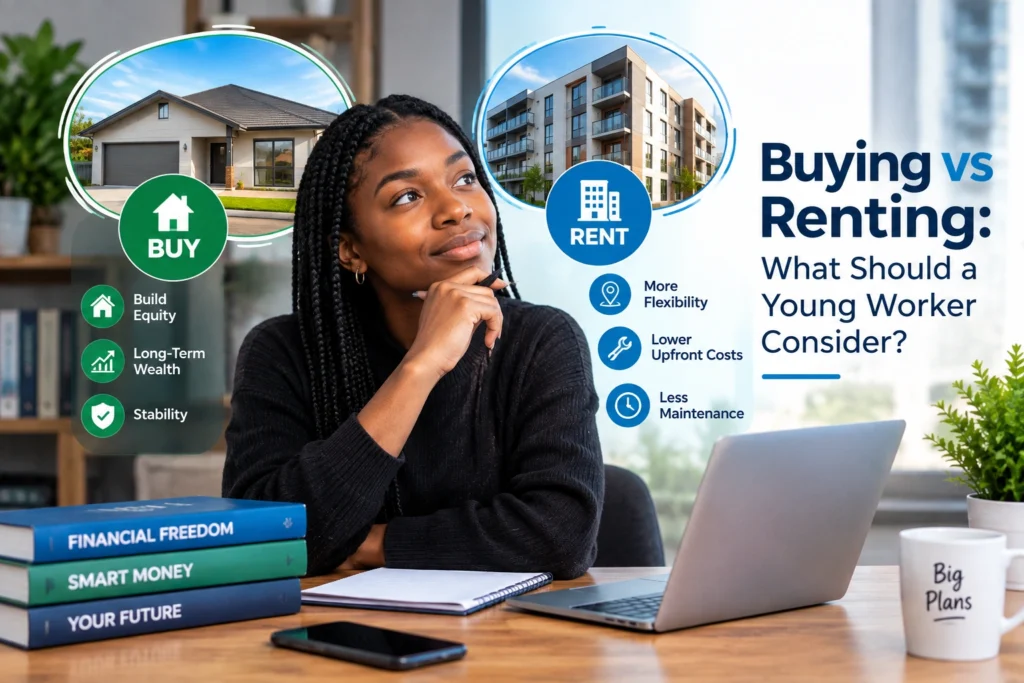
Buying vs Renting: What Should a Young Worker Consider?
The answer is more complicated than “rent is wasted money” or “buying is always better”.
For a young worker in South Africa, the better choice depends on your income, job security, savings, debt, location, career plans and how long you expect to stay in one place.
The biggest mistake is making a housing decision based on what other people are doing.
Your friend may be ready to buy. Your colleague may prefer renting. A family member may insist that property is the best investment. None of those opinions tells you what is affordable for your situation.
Before signing a lease or applying for a home loan, you need to understand what you are actually paying for.
Buying and Renting Are Two Different Financial Decisions
Renting and buying both provide a place to live, but financially they work very differently.
When you rent, you pay a landlord for the right to occupy the property. Your initial costs are generally easier to manage than purchasing a home, although you may need a deposit and other upfront payments.
Buying involves ownership, usually financed through a home loan. Your monthly repayment contributes towards paying off the loan, but the homeowner also takes responsibility for costs associated with owning the property.
A simple comparison looks like this:
| Factor | Renting | Buying |
|---|---|---|
| Upfront cost | Usually lower | Deposit and purchasing costs can be significant |
| Monthly payment | Rent | Bond repayment plus other costs |
| Property ownership | No | Yes |
| Maintenance | Often fewer major responsibilities | Owner generally carries responsibility |
| Flexibility | Generally higher | Generally lower |
| Long-term equity | No property equity | Potential to build equity |
| Property market risk | Generally limited | Owner carries property-value risk |
| Relocation | Usually easier | Can be more complicated |
| Financial commitment | Shorter-term | Often long-term |
The table reveals something important: neither option is automatically cheaper or better in every situation.
The right question is whether one fits your current financial life better than the other.
ALSO APPLY FOR: MAZIV Intern 2026-2027
ALSO APPLY FOR: Air Liquide Intern 2026
Why This Issue Matters
Housing can consume a substantial portion of a worker’s income.
If you commit too much of your salary to accommodation, you may have little left for food, transport, insurance, savings, retirement contributions, emergencies and other responsibilities.
This is particularly important for young workers because the early years of employment can involve major changes.
You might:
- Change employers.
- Move to another city.
- Start a family.
- Return to study.
- Become responsible for relatives.
- Buy a car.
- Start a business.
- Experience periods of unemployment.
- Receive a significant salary increase.
A housing decision that looks affordable today may become restrictive later.
For example, imagine a graduate earning R20,000 a month after deductions.
A property with a R9,000 monthly bond might initially seem manageable. But once rates, insurance, utilities, transport, maintenance and other expenses are included, the actual housing cost could be considerably higher.
If that worker also has a car payment, student-related debt and family responsibilities, the property could place considerable pressure on the budget.
The lesson is simple:
Don’t ask only, “Can I get the bond?” Ask, “Can I comfortably afford the entire lifestyle that comes with this property?”
ALSO READ ABOUT: From Bursary Student to Investor
Buying vs Renting: What Should a Young Worker Consider Before Deciding?
There are several questions you should answer before making the decision.
1. How stable is your income?
A permanent job does not make your income completely risk-free, but income stability is an important consideration when taking on a long-term financial commitment.
Buying may require greater caution if:
- You are on a short-term contract.
- You are still searching for permanent employment.
- Your income varies significantly.
- You are considering changing careers.
- Your industry has frequent retrenchments.
- You expect to move for employment.
Renting may offer greater flexibility while your career is still developing.
That does not mean a young worker with an unstable income should automatically rent. It means the risk of a long-term commitment needs to be taken seriously.
2. How Much Money Do You Have Saved?
Don’t look at your savings only in terms of whether you have enough for a deposit.
Ask yourself what happens after you pay the deposit.
If you have R150,000 saved and use almost everything to purchase a property, you could become a homeowner with almost no emergency cash.
That can be dangerous.
An unexpected car repair, medical bill, job interruption or major household problem could force you to borrow money.
A healthier approach is to separate your savings into different purposes:
Your financial safety buckets
- Emergency fund: money for unexpected events.
- Home deposit: money specifically intended for purchasing.
- Short-term savings: money for planned expenses.
- Long-term investments: money intended for future wealth building.
Don’t assume your deposit should consume every rand you have.
3. What Is the Property’s Total Monthly Cost?
This is perhaps the most important calculation.
A home advertised with a particular bond repayment can make the purchase look affordable.
But your real housing budget could look more like this:
| Monthly expense | Example |
|---|---|
| Bond repayment | R8,500 |
| Rates and municipal charges | R1,200 |
| Insurance | R450 |
| Levy, if applicable | R1,000 |
| Utilities | R1,500 |
| Maintenance provision | R750 |
| Illustrative total | R13,400 |
These figures are only an example, not a quote or universal estimate.
The point is that R8,500 on a bond does not necessarily mean R8,500 is your total monthly housing cost.
This is why buyers should create a realistic property budget before committing.
4. Don’t Forget the Cost of Transport
A cheap home is not necessarily a cheap home.
Suppose you find a property that costs R2,000 less per month than another option.
It looks like a bargain.
But the cheaper property requires two hours of commuting every day and significantly increases your fuel or public transport costs.
The apparent saving could disappear.
Before choosing a property or rental, calculate:
- Distance to work.
- Monthly fuel costs.
- Public transport costs.
- Parking.
- Toll expenses where applicable.
- Travel time.
- Distance to shops and essential services.
For someone early in their career, being close to employment opportunities can also have practical value.
ALSO READ ABOUT: Building a Career Timeline While Studying
5. How Long Will You Stay?
This question is often overlooked.
Buying a property generally makes more sense to investigate carefully when you expect to remain in the same area for a substantial period.
Why?
Because purchasing and eventually selling a property can involve costs and administrative complexity.
Imagine buying a home and then receiving an excellent employment opportunity in another province shortly afterwards.
You now have to decide whether to sell, rent out the property or keep it while relocating.
A renter may have more flexibility to move when the lease permits.
Before buying, ask yourself:
“If my career changed in three years, would this property still work for me?”
You don’t need to predict the future. You simply need to understand the consequences if your plans change.
6. What Happens to the Money If You Rent?
This is one of the most important parts of the debate.
People sometimes say:
“Why pay rent when you could be paying your own bond?”
But this comparison misses something.
A renter can potentially use the money they save on ownership costs to build savings or investments.
For example, if renting allows you to maintain a healthy emergency fund and consistently invest additional money, you may still be building long-term wealth.
But there is a catch.
The strategy only works if you actually save or invest the money.
If you rent a cheaper property but spend the difference on restaurants, entertainment, shopping and unnecessary debt, you haven’t necessarily created a financial advantage.
Renting should ideally be combined with a deliberate wealth-building plan.
ALSO READ ABOUT: What Is Compound Interest
A Better Way to Compare the Two Options
Instead of asking:
“Which one is better?”
Ask these questions:
If I rent:
- How much will my total monthly housing cost be?
- How much can I save each month?
- Can I invest consistently?
- How flexible will I be if I change jobs?
- What happens if rent increases?
- Do I have enough savings for emergencies?
If I buy:
- What will my complete monthly ownership cost be?
- How much cash will remain after the deposit?
- Can I afford maintenance?
- How stable is my income?
- How long am I likely to stay?
- What happens if property values fall?
- What happens if I need to relocate?
This turns an emotional decision into a financial planning exercise.
A Practical Five-Step Housing Decision
Step 1: Calculate your take-home income
Use the money that actually reaches your bank account, not your gross salary.
Then list every recurring expense.
Include:
- Food
- Transport
- Debt repayments
- Insurance
- Phone
- Internet
- Family support
- Medical costs
- Savings
- Investments
- Entertainment
What remains is the amount you can realistically allocate to housing and other goals.
Step 2: Set a comfortable housing budget
Don’t automatically spend the maximum amount a lender says you qualify for.
Leave room for unexpected expenses.
A useful affordability test is:
Could I still save money every month after paying for this home?
If your proposed housing cost leaves you with nothing at the end of the month, something needs to change.
Step 3: Compare total costs
Create two columns:
Renting
- Rent
- Utilities
- Transport
- Deposit
- Insurance
- Moving costs
- Potential rental increases
Buying
- Bond
- Deposit
- Rates
- Levies
- Insurance
- Utilities
- Maintenance
- Purchasing costs
- Interest
Then compare the numbers honestly.
ALSO READ ABOUT: How TFSAs Affect Your Tax in South Africa
Step 4: Stress-test your budget
Pretend something goes wrong.
What if:
- You lose part of your income?
- Your car needs R10,000 worth of repairs?
- Your rent increases?
- Your property needs urgent maintenance?
- Interest rates change?
- You need to move for work?
If the budget collapses under a relatively realistic emergency, reconsider the size of your commitment.
Step 5: Make the decision based on your priorities
Your housing choice should support your broader financial plan.
If buying prevents you from building an emergency fund or contributing towards important long-term goals, the property may be too expensive.
If renting gives you the flexibility to increase your income, save aggressively and invest, it may serve a useful purpose.
If buying fits your income, savings and long-term plans without putting your finances under excessive pressure, ownership may be worth exploring.
When Renting May Make More Sense
Renting can be particularly useful when flexibility is important.
Consider renting if:
- You are early in your career.
- You may relocate.
- Your income is uncertain.
- You haven’t built adequate savings.
- You have significant debt.
- You don’t know which area you want to settle in.
- You want time to improve your credit and savings position.
- You can use the difference to build investments or savings.
Renting doesn’t have to mean “giving up” on home ownership.
It can be a temporary financial strategy while you prepare for it.
When Buying May Be Worth Exploring
Buying may deserve serious consideration when:
- Your income is relatively stable.
- You have emergency savings.
- You have money available for the upfront costs.
- The property is affordable after considering all expenses.
- You expect to stay in the area for a long time.
- You understand the responsibilities of ownership.
- The purchase doesn’t prevent you from meeting other financial goals.
The key phrase is “worth exploring.”
Buying property is not automatically the correct decision simply because you have qualified for a home loan.
ALSO READ ABOUT: TFSA vs ETF vs Savings Account
Best Practices Experts Recommend
A financially responsible approach to housing should focus on resilience rather than appearances.
Keep these principles in mind:
- Budget from take-home pay.
- Don’t borrow the maximum simply because you qualify.
- Keep emergency savings after moving into the property.
- Compare the total cost, not just rent versus bond.
- Consider transport when comparing locations.
- Understand variable costs before purchasing.
- Don’t rely on future salary increases to make today’s property affordable.
- Avoid using expensive debt to furnish a new home.
- If renting, give the savings a purpose.
- Review your housing costs whenever your income changes.
One particularly useful habit is to practise the proposed housing payment before committing.
If you currently spend R7,000 on rent and believe you can afford a R10,000 total housing cost, try saving the additional R3,000 every month for several months.
If that feels comfortable, you are gathering real evidence about your budget.
If it consistently causes financial stress, you have discovered the problem before signing a long-term commitment.
Mistakes People Often Make
“Rent is throwing money away.”
Rent buys you accommodation and flexibility. It doesn’t create property equity, but that does not make it financially worthless.
“Property always goes up.”
Property values can change. Location, economic conditions, supply, demand and the broader property market can all affect prices.
“The bank approved me, so I can afford it.”
Approval is not the same as personal affordability.
“I’ll earn more next year.”
Future salary increases are uncertain. Your current budget should work with your current income.
“I’ll use all my savings for the deposit.”
This can leave you financially exposed immediately after buying.
“The cheapest property is the best option.”
Consider commuting, security, maintenance, levies, location and your quality of life.
“Everyone my age is buying.”
Financial decisions should be based on your numbers—not social pressure.
Questions to Ask Before Signing Anything
Before renting or buying, sit down and answer these questions honestly:
- How much can I afford without living from payday to payday?
- How much cash will I have left after upfront costs?
- What happens if my income stops for several months?
- Could I relocate if a better career opportunity appeared?
- Am I saving enough for retirement and emergencies?
- If I rent, what will I do with the money I am not spending on ownership?
- If I buy, can I afford maintenance and unexpected costs?
- Does this decision support my five- and ten-year financial goals?
If you cannot answer these questions, you may need more financial preparation before making the commitment.
Frequently Asked Questions
Is buying always better than renting?
No. The answer depends on affordability, location, career stability, savings, debt and how long you expect to stay. Buying can provide ownership and potential equity growth, while renting can provide flexibility and lower upfront commitment.
How much should a young worker spend on housing?
There is no single percentage that works for everyone. Your housing budget should account for your income, debt, transport, savings and other financial responsibilities. The important test is whether you can comfortably meet housing costs while continuing to build financial resilience.
Should I rent until I can afford a large deposit?
Not necessarily. A large deposit can reduce the amount borrowed, but you should not sacrifice your emergency fund simply to increase the deposit. The right balance depends on your overall financial position.
Can I build wealth without owning a home?
Yes. Wealth can be built through disciplined saving, investing, retirement contributions, business ownership and other assets. Home ownership is one possible component of a long-term financial plan, not the only one.
Final Summary: Don’t Let the Property Choose Your Financial Future
The biggest lesson from the Buying vs Renting: What Should a Young Worker Consider? debate is that the decision should start with your financial life—not with a property listing.
Buying can provide ownership and an opportunity to build equity, but it also brings a long-term financial commitment and additional costs.
Renting can provide flexibility and allow you to postpone a major commitment while your career develops. But renting works best financially when you use that flexibility to save, invest and strengthen your financial position.
For a young worker, the smartest move is often the one that gives you room to breathe.
Before making your decision:
- Calculate your real monthly income.
- Track your expenses.
- Build an emergency fund.
- Compare the full cost of renting and buying.
- Include transport in your calculation.
- Consider your career plans.
- Avoid borrowing the maximum available.
- Keep savings after paying upfront costs.
- If you rent, invest or save deliberately.
- If you buy, prepare for maintenance and unexpected expenses.
Most importantly, don’t allow social pressure to make a major financial decision for you.
A house is more than a monthly bond. A rental is more than a monthly rent payment. Both choices affect your cash flow, mobility, savings and future opportunities.
The goal isn’t simply to become a homeowner as quickly as possible. The goal is to choose housing that you can afford, sustain and live with comfortably while still moving towards your wider financial goals.
That is the approach young workers should take when considering buying vs renting.