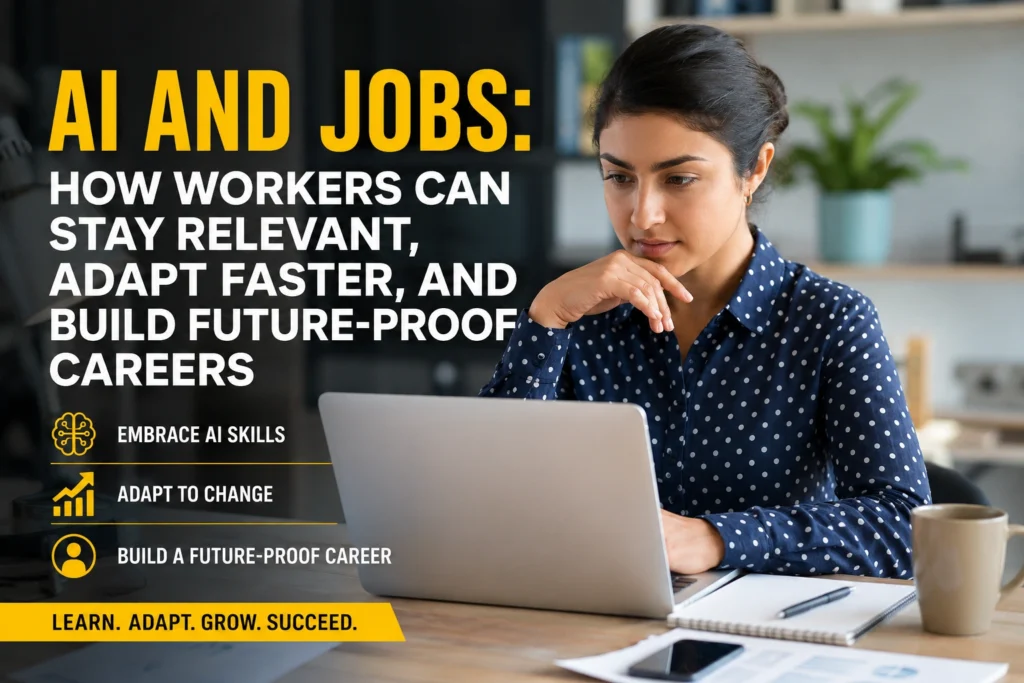

Artificial intelligence is changing work faster than many people expected. Employees worry about losing jobs, graduates wonder whether their degrees will still matter, and businesses are restructuring roles around automation tools. From customer service chatbots to AI-assisted coding, digital marketing automation, and data analysis systems, workers across industries are asking the same question: Will AI replace me?
The conversation around AI and jobs often creates fear because many people see headlines about layoffs, automation, and machines doing tasks once handled by humans. At the same time, employers increasingly expect workers to understand AI tools, adapt quickly, and deliver more productivity with fewer resources.
This creates a difficult reality for job seekers and professionals. Many people are unsure which skills still matter, how to prepare for the future, or whether their current career path remains safe.
The good news is that AI is not only eliminating work — it is also creating new opportunities, new industries, and new ways to earn income. Workers who learn how to adapt can position themselves for stronger career growth rather than being left behind.
This practical guide explains how AI and jobs are reshaping the workforce, what changes are already happening, and what workers can do right now to stay competitive.
Understanding AI and Jobs
Artificial intelligence refers to computer systems that can perform tasks usually requiring human intelligence. These systems can analyze data, recognize patterns, generate content, answer questions, automate workflows, and even make predictions.
In the workplace, AI is being used to:
- Automate repetitive tasks
- Improve customer support
- Speed up research and analysis
- Generate reports and content
- Assist with software development
- Enhance cybersecurity
- Improve hiring processes
- Support healthcare diagnostics
- Optimize logistics and supply chains
The relationship between AI and jobs is complex because AI does not affect every profession equally.
Some jobs are highly vulnerable to automation, especially roles involving repetitive digital tasks. Others are becoming more valuable because they require creativity, emotional intelligence, strategic thinking, leadership, or hands-on physical skills.
For example:
Jobs More Vulnerable to Automation
- Basic data entry
- Routine administrative work
- Simple bookkeeping
- Basic customer support
- Repetitive manufacturing tasks
Jobs Likely to Grow
- AI specialists
- Data analysts
- Cybersecurity professionals
- Skilled trades
- Healthcare professionals
- Creative strategists
- Human-centered service roles
- AI trainers and auditors
Rather than replacing all workers, AI is changing the nature of work itself.
ALSO APPLY FOR: Real Estate Learnership 2026
ALSO APPLY FOR: EnviroServ Business Administration Learnerships 2026
Why This Issue Matters
The impact of AI and jobs goes far beyond technology companies.
Workers in retail, banking, education, media, transportation, healthcare, law, and manufacturing are already seeing AI systems integrated into daily operations. Businesses are under pressure to cut costs, improve efficiency, and compete globally, which accelerates automation.
This matters because:
Workers Need New Skills Faster Than Before
Traditional career paths are changing rapidly. Skills that were valuable five years ago may no longer guarantee job security.
Entry-Level Roles Are Changing
Many beginner tasks are now automated, making it harder for inexperienced workers to gain practical exposure.
Income Inequality Could Increase
Workers who adapt to AI may benefit from higher productivity and better opportunities, while those without access to digital skills risk falling behind.
Businesses Want AI-Literate Employees
Even non-technical jobs increasingly require familiarity with AI tools, automation platforms, or digital collaboration systems.
Entire Industries Are Being Reshaped
Media, finance, customer support, logistics, and software development are already experiencing major transformation.
Understanding these changes early gives workers more time to prepare instead of reacting after jobs disappear.
How AI Is Changing the Workplace
The biggest misconception about AI is that it replaces entire professions overnight. In reality, AI often replaces tasks within jobs rather than the whole occupation.
For example:
- Journalists use AI for research assistance
- Designers use AI image-generation tools
- Accountants use automated bookkeeping systems
- Programmers use AI coding assistants
- Recruiters use AI screening tools
This means workers who combine human expertise with AI tools may become more productive and valuable.
The future workplace is likely to reward people who can:
- Work alongside AI systems
- Interpret AI-generated information
- Solve problems creatively
- Communicate effectively
- Manage people and relationships
- Make ethical decisions
- Adapt continuously
The key challenge is not simply learning technology. It is learning how to remain useful in an AI-enhanced economy.
Step-by-Step Strategies to Stay Competitive
1. Learn AI Tools Relevant to Your Industry
You do not need to become a software engineer to benefit from AI.
Start by learning tools already affecting your profession.
Examples include:
- AI writing assistants for marketing
- Automation tools for administration
- AI design platforms for creatives
- Data analysis tools for business professionals
- AI scheduling and productivity apps
The goal is practical familiarity, not mastery of advanced programming.
Workers who understand how AI improves workflows are often seen as more adaptable and efficient.
2. Focus on Human Skills AI Cannot Easily Replace
Technical knowledge matters, but human-centered abilities remain critical.
Skills likely to stay valuable include:
- Communication
- Leadership
- Negotiation
- Critical thinking
- Emotional intelligence
- Team collaboration
- Creativity
- Decision-making
AI may generate information quickly, but human judgment still matters in complex situations.
People who combine digital skills with strong interpersonal abilities often become harder to replace.
3. Build a Continuous Learning Habit
One of the biggest shifts in the era of AI and jobs is that learning can no longer stop after graduation.
Workers who stay employable typically:
- Take short online courses
- Follow industry trends
- Practice new tools regularly
- Earn certifications
- Read professional newsletters
- Join learning communities
The most adaptable workers treat learning as part of their normal career routine.
Even one hour per week of skill development can make a major long-term difference.
4. Develop Digital Literacy
Many workers struggle not because AI is too advanced, but because their general digital skills are weak.
Digital literacy includes:
- Understanding online collaboration tools
- Managing digital workflows
- Using cloud platforms
- Handling data responsibly
- Evaluating online information
- Understanding cybersecurity basics
These foundational skills support almost every modern career path.
5. Strengthen Your Professional Network
Automation changes industries quickly. Strong professional networks help workers discover opportunities earlier.
Networking can lead to:
- Job referrals
- Freelance opportunities
- Industry insights
- Mentorship
- Career advice
Useful platforms include:
- Professional associations
- Industry events
- Online communities
- Alumni networks
In a rapidly changing job market, relationships often matter as much as technical qualifications.
6. Consider Hybrid Careers
Many future jobs will combine technical and non-technical skills.
Examples include:
- AI-assisted healthcare
- Digital marketing with automation
- Data-driven education
- AI-supported legal research
- Smart manufacturing management
Hybrid careers often offer better long-term stability because they require both human expertise and technological understanding.
7. Create a Personal Brand Online
Employers increasingly search online before hiring candidates.
Building a visible professional identity can improve opportunities.
You can:
- Share insights on LinkedIn
- Create a portfolio
- Publish articles
- Showcase projects
- Participate in professional discussions
Workers who demonstrate adaptability publicly may stand out in competitive job markets.
ALSO READ ABOUT: How to Escape the ‘No Experience’ Trap
Best Practices Experts Recommend
Experts studying AI and jobs often emphasize preparation over panic.
Here are some widely recommended best practices:
Treat AI as a Tool, Not an Enemy
Workers who resist all technology changes may struggle more than those who learn to work with new systems.
Learn Practical Applications First
Focus on tools that solve real workplace problems instead of chasing every new trend.
Invest in Transferable Skills
Communication, leadership, problem-solving, and adaptability remain useful across industries.
Stay Informed About Industry Changes
Understanding how AI affects your specific sector helps you prepare strategically.
Diversify Income Sources
Freelancing, consulting, online business, or digital side projects can provide additional security.
Prioritize Lifelong Employability
Instead of relying on one job forever, focus on remaining employable across multiple environments.
Mistakes People Often Make
Many workers react to AI in ways that actually increase their career risk.
Ignoring AI Completely
Some people assume AI will not affect their profession until it is too late.
Even industries once considered safe are experiencing automation changes.
Believing Every Job Will Disappear
Fear-driven thinking can prevent people from adapting constructively.
Most industries will change rather than vanish completely.
Learning Too Broadly Without Direction
Trying to master every AI tool often leads to overwhelm.
Focus on tools directly relevant to your career goals.
Neglecting Human Skills
Technical ability alone is not enough.
Employers still value leadership, communication, and collaboration.
Waiting for Employers to Provide Training
Some companies invest heavily in employee development, but many do not.
Workers who take responsibility for their own learning often adapt faster.
Over-Relying on AI Outputs
AI systems can make errors, generate misleading information, or lack context.
Human review and judgment remain essential.
Industries Likely to See Major AI Growth
Several sectors are expected to experience significant AI-related expansion over the next decade.
Healthcare
AI-assisted diagnostics, patient monitoring, and administrative automation are growing rapidly.
Education
Adaptive learning systems and AI tutoring tools are reshaping teaching methods.
Finance
Fraud detection, automated analysis, and digital banking systems continue to expand.
Logistics and Transportation
AI improves route planning, inventory management, and supply chain optimization.
Creative Industries
Design, video editing, writing assistance, and content generation tools are becoming mainstream.
Cybersecurity
As digital threats increase, cybersecurity expertise becomes even more valuable.
Workers entering these sectors may benefit from long-term demand growth.
FAQ
Will AI replace all jobs?
No. AI is more likely to change jobs than eliminate all work entirely. Many professions will evolve, requiring workers to use AI tools alongside human expertise.
Which jobs are safest from AI?
Jobs involving emotional intelligence, leadership, complex decision-making, creativity, and physical hands-on work are generally harder to automate completely.
Do I need to learn coding to survive the AI era?
Not necessarily. While coding can help, many workers benefit simply from understanding how to use AI tools effectively within their field.
How can beginners prepare for an AI-driven job market?
Beginners should focus on digital literacy, communication skills, adaptability, practical AI tool familiarity, and continuous learning habits.
The Future of AI and Jobs
The future workplace will likely look very different from today’s environment.
Some traditional roles may shrink, while entirely new professions emerge. The workers who succeed will not necessarily be the most technical people. Instead, they may be those who:
- Adapt quickly
- Learn continuously
- Combine human and digital strengths
- Solve real problems
- Build strong professional relationships
History shows that technological change often creates disruption before new opportunities become visible.
The challenge is preparing early enough to benefit from those opportunities instead of reacting after industries shift.
Final Thoughts and Practical Advice
The conversation around AI and jobs can feel overwhelming, especially for workers worried about stability, income, or career direction. But avoiding the topic will not make the changes disappear.
The most practical approach is to prepare steadily rather than panic.
Start small:
- Learn one useful AI tool
- Improve your digital skills
- Strengthen communication abilities
- Stay informed about your industry
- Build professional connections
- Keep learning consistently
Workers who adapt gradually often build resilience over time.
AI is not simply a threat to employment. It is a major transformation of how work gets done. People who understand this shift — and respond proactively — are more likely to find opportunities, remain employable, and build stronger careers in the years ahead.
ALSO APPLY FOR: Real Estate Learnership 2026
ALSO READ ABOUT: How to Escape the ‘No Experience’ Trap
ALSO APPLY FOR: EnviroServ Business Administration Learnerships 2026