
For a newly qualified graduate, the hardest part of entering the job market is often not getting the qualification. It is getting the first employer to take a chance on you.
A graduate may have spent three or four years studying Supply Chain Management, Logistics or Procurement, completed assignments about forecasting and inventory control, and walked away with a qualification ready to be used. Yet when the search for employment begins, many vacancies ask for previous experience.
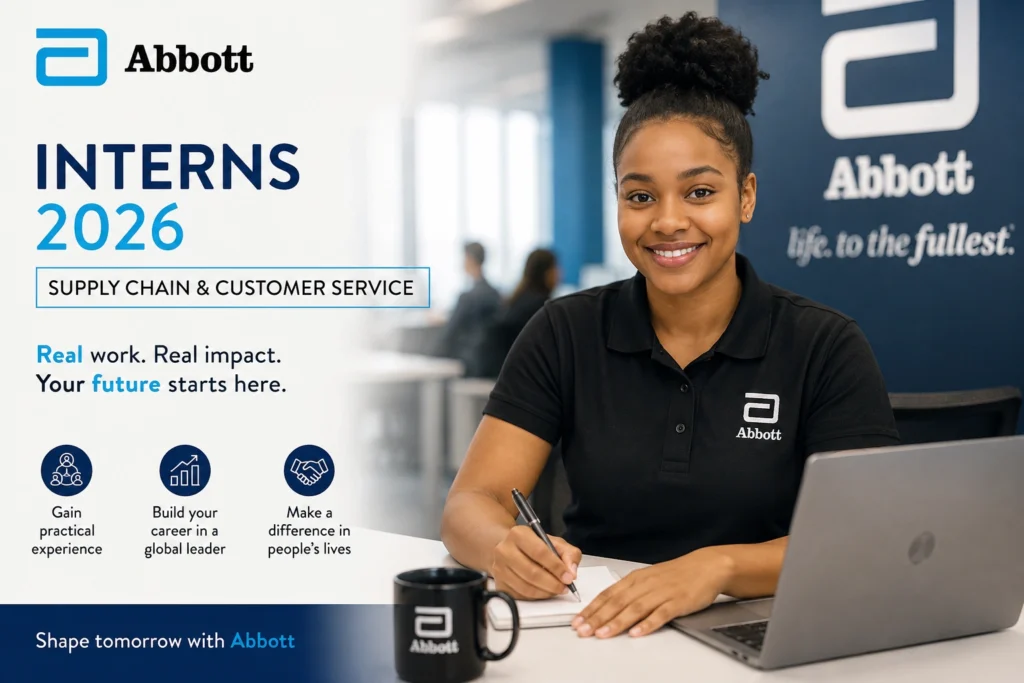
That is what makes the Supply Chain & Customer Service Abbott Interns 2026 opportunity worth a closer look.
Abbott South Africa is offering an internship in its Supply Chain and Customer Service operations in Roodepoort, Johannesburg, Gauteng. The opportunity is aimed particularly at unemployed graduates who want to move from academic knowledge into a real business environment.
The closing date is 14 August 2026, while successful candidates are expected to be available to start on 1 September 2026.
For graduates trying to establish themselves in South Africa’s competitive employment market, the value of this opportunity goes beyond simply having “intern” added to a CV. It offers exposure to several interconnected parts of business operations, including logistics, procurement, inventory management, demand planning, forecasting, order management and customer service.
Why this Abbott internship matters for graduates entering supply chain
Supply chain is sometimes described as if it were simply about moving products from one location to another. In practice, it is much broader.
A company needs to know what customers are likely to require, when products should be ordered, how much stock should be held, which suppliers can meet requirements, how orders should be processed and how products should ultimately reach the customer.
In the healthcare industry, those questions become particularly important.
Abbott operates in a sector where products and services support healthcare systems and patients. That means supply chain activities have commercial consequences, but they can also have wider operational implications. Poor forecasting, delays, inaccurate orders or weak inventory controls can create problems further down the chain.
An intern will not be expected to arrive knowing how to run an international supply chain. The purpose of an internship is different: it provides an opportunity to observe professional processes, contribute to everyday work and learn how different departments depend on one another.
For a South African graduate, that distinction matters.
A Diploma or Degree can demonstrate that someone has studied supply chain principles. Workplace exposure begins to demonstrate that the graduate can apply those principles when deadlines, customers, suppliers, systems and colleagues are all involved at the same time.
The Abbott programme therefore represents a transition point between the classroom and the workplace.
What the Supply Chain & Customer Service Abbott Interns 2026 role could expose you to
The position falls within Abbott South Africa’s Established Pharmaceutical Division (EPD) and is classified within the Supply Chain job family.
The internship is full-time and based at Abbott Place in the Johannesburg/Roodepoort area. The advertised role also indicates approximately 5% travel, although the supplied information does not specify the exact destinations or frequency.
The work environment is likely to be particularly useful for graduates because supply chain and customer service are not isolated functions.
A customer places an order. That order has to be captured and managed correctly. Inventory has to be available or planned for. Procurement and purchasing activities may need to support supply requirements. Logistics teams become involved in distribution. Internal stakeholders need accurate information.
A problem in one area can quickly affect another.
That is where an intern can begin to understand something that is difficult to learn fully from a textbook: supply chain is a connected system rather than a collection of separate departments.
From procurement to customer service: what makes this role different
One of the strongest features of this internship is the breadth of exposure described in the advertisement.
A graduate entering a narrowly defined administrative position might spend most of the internship learning one process. The Abbott opportunity, by comparison, touches several areas that can help a candidate understand the wider supply chain cycle.
Procurement and purchasing provide insight into how businesses work with suppliers and obtain what they need to operate. Supplier coordination and relationship management introduce another important dimension: supply chains depend heavily on communication and reliability between organisations.
Inventory management introduces a different challenge.
Too little stock can create shortages. Too much stock can tie up money and create inefficiencies. Finding the right balance requires accurate information, planning and attention to changing demand.
Demand planning and forecasting add another layer. Businesses cannot simply wait for customers to place every order before preparing. They need to anticipate requirements and coordinate resources accordingly.
Customer service brings the process closer to the person or organisation placing the order.
That means communication matters. An intern may learn that resolving a customer issue is not simply about answering an email or phone call. It can require checking information, understanding the order status, communicating with internal teams and making sure the customer receives a useful response.
For a graduate, this combination can be valuable because it develops both operational and interpersonal understanding.
The skills Abbott is looking for
The listed requirements suggest that Abbott is looking beyond academic qualifications.
Applicants are expected to demonstrate attention to detail, organisation, communication, analytical ability, problem-solving skills and a proactive attitude. Microsoft Office proficiency is also listed.
These requirements make sense when the nature of the work is considered.
Supply chain environments involve information. A small data-entry mistake, incorrect order detail or missed communication can potentially create additional work elsewhere. Graduates therefore need to show that they can work carefully while still responding to changing priorities.
Communication is equally important.
Someone working with customers, suppliers and internal departments cannot rely solely on technical knowledge. They need to explain information clearly, listen properly and know when an issue needs to be escalated.
For applicants preparing their CVs, this is an important lesson. Do not simply write that you are “hardworking” or “a good communicator”. Where possible, demonstrate those qualities through evidence from university projects, group assignments, volunteering, student activities or other legitimate experiences.
For example, a graduate who coordinated a group research project can demonstrate organisation and stakeholder communication. Someone who worked with spreadsheets during an academic project can explain their practical use of Microsoft Excel rather than merely listing “computer literacy”.
Those small details can make a CV more credible.
Expert insight: the real value may be the cross-functional exposure
A useful way to view this internship is as a supply-chain learning laboratory.
The biggest benefit may not be any single task assigned to the intern. It could be the opportunity to see how decisions in procurement, inventory, logistics and customer service influence one another.
This is increasingly relevant as companies operate in environments where disruptions, changing customer demand and cost pressures require closer coordination.
A graduate who understands only procurement may know how purchasing works. A graduate who understands how purchasing decisions affect inventory, customer orders, forecasting and logistics begins to see the commercial system as a whole.
That broader perspective can become useful when applying for future roles such as supply chain coordinator, demand planning assistant, procurement specialist, logistics administrator, customer service specialist or related graduate positions.
The internship is therefore not just about gaining experience for its own sake. It can help a graduate develop a clearer picture of where they fit within the supply chain profession.
Who qualifies for the Abbott internship?
The opportunity is aimed at graduates who have completed a Degree or Diploma in Supply Chain Management, Logistics, Procurement or a related field.
The qualification should be completed before the internship begins.
Another important condition is employment status. The supplied advertisement states that applicants must not currently be employed, and the programme is particularly suited to candidates with little or no formal work experience.
That makes this a more targeted opportunity than a generic graduate vacancy.
Candidates should also be able to start on 1 September 2026. Someone who cannot commit to the stated start date should carefully consider whether the programme fits their circumstances before applying.
The position is based in Roodepoort/Johannesburg, Gauteng, so applicants should also consider the practical implications of commuting or relocating if selected.

Preparing an application that does more than meet the minimum
The application process is online, and the advertised requisition number is 31158542.
Applicants are expected to provide an updated CV, academic transcript, proof of qualification or completion, and a South African ID.
Before submitting, it is worth treating the application as a professional document rather than simply uploading the first CV available.
A useful application should make it easy for the recruiter to answer three questions quickly: Does this person have the required qualification? Are they eligible for the internship? Do they appear capable of learning and contributing in a professional environment?
A CV should therefore clearly state the qualification, institution, completion status and relevant skills.
Graduates should also check the document for basic errors. Incorrect contact information, inconsistent dates, spelling mistakes and poorly formatted sections can create unnecessary doubts.
The supplied advertisement also indicates that applicants may be required to complete a video interview. This means candidates should monitor their email and application portal after submitting their application.
A video interview can feel unfamiliar, especially for someone applying for their first professional role. Preparation should focus on straightforward questions: why supply chain interests you, what you learned through your qualification, how you approach problems, how you work with other people and why you want workplace exposure.
The strongest answers do not need to sound rehearsed. They need to be specific.
APPLY HERE: Abbott Interns 2026
ALSO APPLY FOR: GE Vernova Internships 2026
Key facts at a glance
- Company: Abbott South Africa
- Programme: Supply Chain & Customer Service Internship Programme 2026
- Requisition: 31158542
- Location: Roodepoort/Johannesburg, Gauteng
- Division: EPD Established Pharma
- Work arrangement: Full-time
- Start date: 1 September 2026
- Closing date: 14 August 2026
- Travel: Approximately 5%
- Qualification: Degree or Diploma in Supply Chain Management, Logistics, Procurement or related field
- Employment status: Applicants must not currently be employed
- Experience: Ideally no formal work experience
- Remuneration: Not specified in the supplied advertisement
- Application: Online through Abbott’s careers portal
Frequently asked questions
1. What qualification do I need for the Abbott internship?
Applicants should have completed a Degree or Diploma in Supply Chain Management, Logistics, Procurement or a related field before the internship starts.
2. When does the Abbott Supply Chain & Customer Service internship close?
The stated application closing date is 14 August 2026. Applicants should avoid waiting until the final day in case they encounter technical problems or discover that additional information is required.
3. Is a stipend amount provided?
The supplied advertisement does not state a specific salary or internship stipend. It lists the remuneration as N/A, so applicants should not assume a particular amount and should confirm the details during the recruitment process if they progress
A first step, not a guaranteed career path
For graduates, an internship can sometimes be viewed simply as a temporary job to fill the gap between university and permanent employment. That undersells what good workplace exposure can provide.
The Supply Chain & Customer Service Abbott Interns 2026 opportunity offers graduates the chance to see how a multinational healthcare business coordinates purchasing, inventory, forecasting, logistics and customer-facing operations.
There is no guarantee that an internship will lead directly to permanent employment, and applicants should approach it without unrealistic expectations. What it can provide is something many graduates struggle to obtain: credible workplace experience.
For someone with a newly completed Supply Chain Management, Logistics or Procurement qualification, that experience can become the bridge between knowing the theory and demonstrating that it can be used in a real organisation.
With applications closing on 14 August 2026 and the programme scheduled to begin on 1 September, eligible unemployed graduates have a relatively short window to prepare their documents and submit a careful application.
The bigger opportunity lies in what happens after the application. If selected, the intern will enter an environment where supply chain decisions have real consequences, customers have real expectations and different teams must work together to keep operations moving.
That is precisely the kind of experience that can turn a qualification into the beginnings of a career.