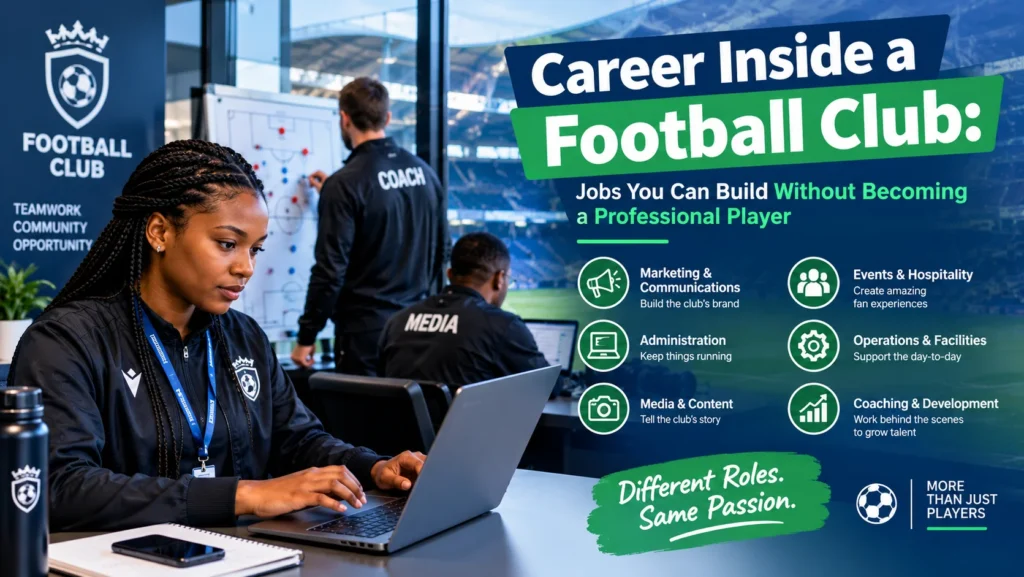

For many young South Africans, football is something they love watching, playing and discussing—but very few realise just how many people are employed behind the scenes to make a football club function.
When people think about football careers, they often picture professional players, coaches and referees. But what happens before the players walk onto the pitch? Who analyses the opposition? Who manages the club’s finances? Who produces the team’s social-media content? Who arranges travel, manages sponsors, treats injuries, maintains facilities and identifies promising young players?
These jobs are all part of the modern football industry.
A Career Inside a Football Club can therefore take many forms, and you do not necessarily have to be a former professional footballer to get started. In fact, your strongest route into football could be a skill such as accounting, information technology, journalism, marketing, sports science, administration or data analysis.
The challenge is knowing where you fit.
This guide explains the different careers that exist inside football clubs, what skills they require, how you can gain experience, what you can do if you have little or no experience, and how to turn an interest in football into a realistic career plan.
Football Clubs Are Businesses as Well as Sporting Organisations
A football club may look like a sporting organisation from the outside, but internally it operates across many professional departments.
On match day, supporters see 22 players competing on the pitch. Behind those players can be dozens—or, at larger clubs, hundreds—of people responsible for making the organisation work.
These include coaches, medical professionals, scouts, analysts, administrators, marketers, accountants, communications specialists, grounds staff, security teams and technology professionals.
This is why you should not ask only:
“What job can I get in football?”
A better question is:
“What skill can I develop that a football club needs?”
That change in thinking can completely alter your career strategy.
ALSO APPLY FOR: SARS Learnership 2026
ALSO APPLY FOR: iMas Insurance Learnerships 2026
Career Inside a Football Club: The Main Jobs You Should Know About
There is no single career path into football. Your route depends on your interests, education, experience and strengths.
| Career area | Possible jobs | What you could be doing | Useful skills |
|---|---|---|---|
| Coaching | Coach, academy coach, assistant coach | Training players and developing tactics | Coaching, communication, leadership |
| Scouting | Scout, recruitment assistant | Identifying and evaluating players | Observation, football knowledge, analysis |
| Performance | Performance analyst | Studying matches and player performance | Data, video analysis, football tactics |
| Medical | Physiotherapist, sports scientist | Player health, recovery and conditioning | Professional medical/sports qualification |
| Media | Journalist, content producer | Articles, interviews, match coverage | Writing, video, photography |
| Marketing | Marketing officer, brand coordinator | Promoting the club and campaigns | Marketing, creativity, communication |
| Commercial | Sponsorship executive, sales | Finding and managing commercial partners | Business, sales, negotiation |
| Finance | Accountant, finance administrator | Budgets, payments and financial reporting | Accounting, Excel, attention to detail |
| Administration | Club administrator, team secretary | Documents, schedules and coordination | Organisation, administration |
| Operations | Match-day or facilities coordinator | Logistics, venues and events | Planning, problem-solving |
| Technology | IT specialist, data analyst | Systems, technology and football data | IT, analytics, technical skills |
| Community | Development officer | Community and youth programmes | Communication, project management |
The table shows something important: football clubs need ordinary professional skills applied in an extraordinary sporting environment.
1. Coaching: Turning Football Knowledge Into a Profession
Coaching is one of the most visible careers in football, but becoming a professional coach requires considerably more than knowing which formation to use.
Coaches must understand:
- Player development
- Training methodology
- Match preparation
- Tactical systems
- Communication
- Leadership
- Sports psychology
- Performance evaluation
- Player management
Youth and academy coaching can be an excellent starting point for someone who wants to develop this career.
Instead of waiting for a professional club to advertise a coaching position, consider gaining experience with a local team, school or academy while working towards the appropriate coaching qualifications.
A useful starting strategy
- Learn the fundamentals of coaching.
- Investigate recognised coaching qualifications.
- Volunteer or assist at a legitimate local team.
- Keep records of your coaching experience.
- Learn how to plan training sessions.
- Study different tactical systems.
- Continue developing as both a coach and communicator.
Your first coaching opportunity does not need to be glamorous. It needs to give you meaningful experience.
2. Football Scouting: Finding the Next Talent
Every club wants talented players, but finding the right player is not as simple as watching someone score several goals.
Scouts evaluate players from a broader perspective.
Depending on the position, they may consider:
- Technical ability
- Pace and physical attributes
- Tactical intelligence
- Decision-making
- Consistency
- Work rate
- Position-specific qualities
- Age and development potential
- Ability to fit a particular playing system
Modern scouting also increasingly involves data and video.
This creates an interesting opportunity for young people who enjoy both football and analysis.
How to practise scouting
You do not have to wait for a club to hire you.
Choose a local match and prepare a player report.
Include:
- Player position
- Age category
- Strengths
- Weaknesses
- Technical assessment
- Tactical assessment
- Physical observations
- Development areas
- Overall recommendation
Do this consistently and you begin creating a portfolio that demonstrates how you think.
3. Performance Analysis and Football Data
Football has become increasingly data-driven.
Performance analysts help coaches understand matches by studying video, statistics and tactical patterns.
They may investigate questions such as:
- Where does the team lose possession?
- How does the opposition build attacks?
- Which areas of the pitch are being exploited?
- How effective are set pieces?
- How often does a team create chances from particular situations?
- How does a player’s performance change during a match?
This career can suit someone who enjoys numbers, technology and football.
Skills worth developing
Start with basic tools before moving into advanced analytics.
Learn:
- Excel or Google Sheets
- Statistics
- Data presentation
- Video analysis
- Basic data visualisation
- Football terminology
- Tactical analysis
Later, programming and more advanced analytical tools can become valuable.
The important point is that you should be able to explain what the numbers mean rather than simply produce numbers.
ALSO READ ABOUT: Careers Behind Major Sporting Events
4. Sports Science, Fitness and Player Welfare
Professional football places enormous physical demands on players.
As a result, clubs require qualified professionals who help players prepare, recover and remain healthy.
Potential careers include:
- Physiotherapist
- Biokineticist
- Sports scientist
- Strength and conditioning specialist
- Sports doctor
- Nutrition professional
- Sports psychologist
These are specialist careers, so the correct academic and professional pathway matters.
If this is the direction you want to take, investigate the qualification requirements for the exact profession before enrolling.
Important advice
Do not choose a course simply because it sounds connected to football.
Ask:
What job does this qualification allow me to pursue?
That question can save you considerable time and money.
5. Media, Journalism and Content Creation
Football supporters increasingly consume their favourite teams through their phones.
A club may need people to create:
- Match reports
- Interviews
- Social-media posts
- Videos
- Graphics
- Photography
- Website articles
- Press releases
- Podcasts
- Behind-the-scenes content
This creates one of the most accessible entry points for people who want to start building experience independently.
You do not necessarily need to wait for a club job.
You can begin by covering local football.
Build your portfolio
For example, you could:
- Photograph local matches.
- Write match reports.
- Interview coaches with permission.
- Create tactical explainers.
- Produce short football videos.
- Start a football-focused website or social-media page.
- Design sample social-media campaigns.
Your portfolio should demonstrate quality.
Ten strong pieces of work can be more useful than dozens of unfinished ideas.
6. Marketing and Sponsorship: The Business Behind the Badge
Football clubs need money to operate.
Sponsors, ticket sales, merchandise, partnerships, advertising and commercial activities can all contribute to a club’s income.
This creates opportunities for people with backgrounds in:
- Marketing
- Business management
- Sales
- Public relations
- Advertising
- Digital marketing
- Brand management
A marketing professional working for a football club needs to understand more than football.
They need to understand supporters and businesses.
For example, a club may want to increase attendance at matches. A marketing employee could help design a campaign aimed at families, students or local supporters.
That is a business problem—not simply a football problem.
ALSO READ ABOUT: Building a Career Timeline While Studying
7. Finance: Football Needs Accountants Too
Football clubs handle money every day.
Someone needs to manage budgets, payments, financial records, salaries, procurement and reporting.
This means accounting and finance professionals can build careers in football without ever stepping onto a football pitch.
Possible roles include:
- Finance administrator
- Bookkeeper
- Accountant
- Payroll administrator
- Financial analyst
- Finance manager
If you are studying accounting, do not assume your only opportunities are banks, accounting firms or large corporations.
Sport also needs financial professionals.
8. Administration and Operations
The less glamorous jobs can sometimes be the most important.
Someone has to organise:
- Training schedules
- Travel arrangements
- Documents
- Meetings
- Fixtures
- Accommodation
- Equipment
- Match-day logistics
- Communication between departments
Administrative professionals can therefore play a major role in keeping a club organised.
This path can suit people who are detail-oriented, reliable and comfortable working with schedules and documentation.
Strong skills in Microsoft Office, communication, record keeping and organisation can be valuable.
Why This Issue Matters
Many young people make the mistake of thinking that a football career must begin at a famous professional club.
That can create unnecessary frustration.
Professional clubs often attract experienced applicants, while smaller clubs, academies, schools and community organisations may provide more realistic starting points.
There is another important issue: football passion does not automatically equal employability.
Thousands of people love football.
Far fewer can:
- Analyse performance professionally.
- Produce high-quality video.
- Manage finances.
- Build a marketing campaign.
- Analyse data.
- Treat sports injuries.
- Manage an academy.
- Organise a major event.
The goal is therefore to become someone who can solve a problem for a football organisation.
That is where your value comes from.

ALSO READ ABOUT: What Is Job Shadowing
How to Start Your Football Career When You Have No Experience
Step 1: Pick One Career Direction
Do not try to become a coach, scout, journalist, marketer and analyst simultaneously.
Choose one primary direction.
For example:
Football + writing
or
Football + data
or
Football + business
or
Football + technology
or
Football + sports science
Your combination becomes your professional identity.
Step 2: Learn the Required Skills
Research job advertisements for the role you want.
Look for qualifications and recurring skills.
Create two lists:
Skills I already have
- Communication
- Writing
- Excel
- Photography
- Administration
Skills I need
- Video analysis
- Sports data
- Coaching qualification
- Advanced Excel
- Football-specific knowledge
Then work through the second list systematically.
Step 3: Gain Experience Locally
Your first opportunity could come from:
- Amateur football
- School football
- University football
- Local academies
- Community programmes
- Regional competitions
- Sports organisations
The objective is not simply to add a name to your CV.
You want to learn how football organisations actually work.
Step 4: Build Evidence of Your Ability
Create work that an employer can see.
For example:
Aspiring scout
Create player assessment reports.
Aspiring analyst
Create tactical and statistical match analyses.
Aspiring journalist
Publish football articles and interviews.
Aspiring photographer
Build a sports photography portfolio.
Aspiring marketer
Create sample campaigns for a fictional football club.
Aspiring data analyst
Build a football statistics dashboard.
This is particularly useful when you have little formal employment experience.
Step 5: Network Without Begging for a Job
Networking should be about learning and building professional relationships.
When you meet someone working in football, ask useful questions such as:
- How did you enter the industry?
- Which skills are most valuable in your department?
- What do beginners usually get wrong?
- What experience would make a candidate more competitive?
- Which qualifications are genuinely useful?
Good networking can help you understand the industry before you apply.
ALSO READ ABOUT: The Careers Behind Mobile Networks
A Practical 12-Month Football Career Roadmap
| Period | Main goal | What to do |
|---|---|---|
| Months 1–2 | Choose a career | Research football roles and identify your strongest area |
| Months 3–4 | Develop skills | Complete relevant learning and practise regularly |
| Months 5–6 | Get practical experience | Approach local clubs, academies or teams |
| Months 7–8 | Build portfolio | Produce several high-quality projects |
| Months 9–10 | Network | Attend events and connect professionally |
| Months 11–12 | Apply | Target clubs, academies, sports organisations and related employers |
This approach is more realistic than simply sending hundreds of applications and hoping somebody responds.
Best Practices Experts Recommend
Combine football knowledge with another skill
This is one of the strongest strategies for entering the industry.
Think of yourself as:
Football + Skill
rather than simply:
Football fan
For example:
- Football + accounting
- Football + journalism
- Football + IT
- Football + marketing
- Football + data
- Football + sports science
Keep your CV evidence-based
Instead of writing:
“I am passionate about football.”
Show what you have done.
For example:
- Produced 20 match reports.
- Analysed 15 matches.
- Managed social-media content for a local team.
- Assisted with youth training sessions.
- Created a football data project.
Evidence makes your application more credible.
Learn from smaller organisations
Working with a smaller team can expose you to several responsibilities at once.
You might help with content, administration and match-day operations.
That broad experience can become valuable later.
Protect your reputation
Football is a relationship-driven industry.
Be professional when communicating with clubs, players, coaches and supporters.
Avoid behaviour online that could damage your future opportunities.
Mistakes People Often Make
Mistake 1: Believing talent on the pitch is the only route
You can work in football without being an elite player.
Mistake 2: Studying without understanding the career outcome
Always connect your qualification to a realistic job.
Mistake 3: Waiting for a vacancy before gaining experience
Start building your portfolio now.
Mistake 4: Only targeting famous clubs
Your first experience could come from a small academy or community organisation.
Mistake 5: Having a generic CV
Tailor your CV to the department and role.
Mistake 6: Paying for a guaranteed football opportunity
Be cautious of anyone promising a job, trial or placement in exchange for money. Verify opportunities through legitimate organisational channels.
Mistake 7: Ignoring transferable skills
Communication, Excel, administration, project management and digital skills can all be useful in football.
Frequently Asked Questions
Can I have a Career Inside a Football Club without being a professional player?
Yes. Clubs require professionals across finance, marketing, media, administration, IT, medical services, scouting, performance analysis, operations and other departments.
Which qualification is best for working in football?
There is no universal qualification. The best choice depends on your target career. An aspiring physiotherapist needs a different pathway from an aspiring sports journalist, accountant or data analyst.
How can I get football experience if I have never worked for a club?
Start locally. Volunteer or seek practical experience with legitimate football teams, academies, schools, community programmes or sports organisations. You can also create independent projects to demonstrate your abilities.
Are football careers only available in major cities?
No. Football exists at professional, semi-professional, amateur, school, university and community levels. Opportunities may also exist in sports media, technology, events and commercial organisations that support football.
Final Takeaway
A Career Inside a Football Club is not limited to the people wearing boots on match day.
Behind every team is an ecosystem of professionals working together to develop players, analyse performances, manage money, communicate with supporters, attract sponsors, maintain facilities and keep the organisation running.
That means there may be a place for you even if you are not a professional footballer.
The smartest approach is to stop thinking about football as one career and start thinking about it as an industry.
Choose a skill.
Develop it properly.
Gain practical experience.
Build a portfolio.
Learn how football organisations operate.
Network professionally.
Then apply for opportunities where your skills solve a genuine need.
If you are still studying, you do not need to wait until graduation. If you are unemployed, you do not need to wait for a perfect vacancy. And if you have no football connections, you can begin by building evidence of your ability through local teams and independent projects.
Your passion for football can be the starting point—but your skills, experience and professionalism are what can turn that passion into a career.