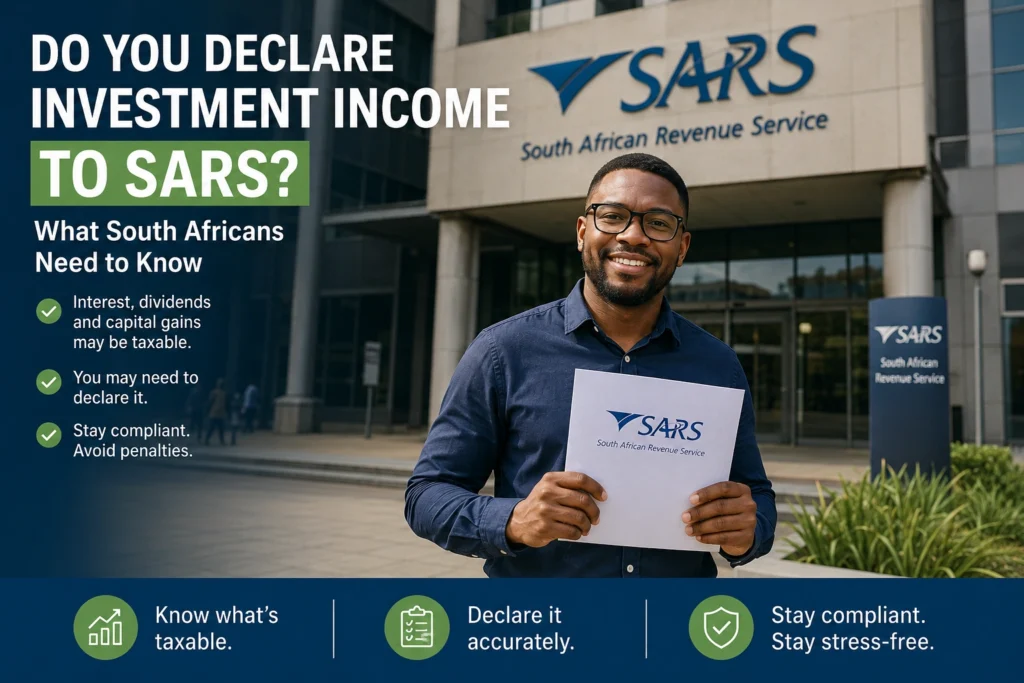

If you earn a salary, you may think your employer’s IRP5 contains everything SARS needs to know about your finances. But what happens when you also earn interest from a bank account, receive dividends from shares, invest through a unit trust platform or sell investments at a profit?
This is where many taxpayers become uncertain.
Do you declare investment income to SARS?
In most cases, yes. Investment income that is relevant to your tax return must be declared, even when SARS has already received information about it from your bank, investment company or another financial institution.
However, there is an important distinction that often gets overlooked:
Declaring an amount does not necessarily mean you will pay tax on the entire amount—or even pay additional tax at all.
Different types of investment returns have different tax rules. Interest can qualify for an annual exemption, South African dividends are generally subject to dividends tax rather than normal income tax, foreign dividends can be taxable, and qualifying Tax-Free Investments receive special tax treatment.
SARS has also increased the amount of third-party information that is pre-populated on individual tax returns. For Filing Season 2026, some investment information may already appear on your ITR12. But taxpayers are still responsible for checking that the return is complete and accurate.
So, if you have investments, the safest approach is not to ask only, “Will SARS tax me?”
The better question is:
“What investment income do I need to declare, how is it taxed, and what records do I need to keep?”
The Difference Between Declaring Investment Income and Paying Tax
This is the most important concept to understand.
When you declare investment income, you are telling SARS what you received or what happened during the relevant tax year.
SARS then applies the tax rules to determine whether the amount is:
- Taxable
- Exempt
- Subject to dividends tax
- Subject to capital gains tax
- Partly exempt
- Subject to another specific tax treatment
For example, imagine you earned R8,000 in interest during the year.
You should not simply think:
“I earned R8,000, therefore I owe SARS tax on R8,000.”
The applicable interest exemption may mean that the amount does not result in additional normal income tax.
This is why deliberately leaving investment income off your return can be a mistake. The correct tax treatment should be determined after the income has been properly declared.
ALSO APPLY FOR:Senwes Learnership 2026-2027
ALSO APPLY FOR:Old Mutual Amathuba Learnership 2026
What Counts as Investment Income?
Investment income can take several forms.
Depending on your circumstances, it can include:
- Interest earned from bank accounts
- Interest from fixed deposits
- Foreign interest
- Dividends
- Foreign dividends
- Certain REIT distributions
- Income from rental property
- Income from certain financial instruments
- Proceeds or gains from disposing of investments
- Other investment-related amounts required by the ITR12
SARS’s ITR12 guidance specifically provides for investment income such as local interest, foreign interest, foreign dividends, certain REIT distributions and Tax-Free Investments.
Quick reference table
| Investment or return | Does it need attention on your tax return? | Possible tax treatment |
|---|---|---|
| Bank interest | Yes | May qualify for interest exemption |
| Fixed-deposit interest | Yes | Generally taxable, subject to applicable exemptions |
| South African dividends | Yes, where applicable | Generally dividends tax rather than normal income tax |
| Foreign dividends | Yes | May be subject to South African normal tax |
| Foreign interest | Yes | Generally taxable, subject to applicable rules |
| Selling shares | Yes, if applicable | May result in capital gain or loss |
| Tax-Free Investment | Yes, where applicable | Qualifying returns are generally tax-free |
| Rental investment | Yes | Generally taxable after applicable deductions |
| REIT distributions | Yes, depending on nature | Specific tax rules apply |
The table is a guide rather than a substitute for calculating your individual tax position.
Do You Declare Investment Income to SARS?
Yes, generally you do.
SARS receives third-party information from financial institutions, and investment income can be pre-populated on your ITR12. SARS explains that taxpayers can also add investment information that was not pre-populated.
This means there are two common situations.
Situation 1: SARS has already populated the investment
You open your ITR12 and see interest from your bank.
Your job is to:
- Check the institution.
- Check the amount.
- Compare it with your tax certificate.
- Confirm that the information belongs to you.
- Correct or add information if necessary.
Situation 2: Your investment is missing
Don’t assume that the investment does not need to be declared.
SARS says taxpayers can use the “Add” function in the investment-income section to enter investment information that has not been pre-populated.
That distinction is becoming increasingly important because SARS is relying more heavily on third-party data.
ALSO READ ABOUT: How PAYE Works in South Africa
Why This Issue Matters
Investment income may look small, but ignoring it can create unnecessary tax problems.
SARS may already have the information
Your financial institution may have submitted third-party information to SARS.
SARS currently receives different IT3 data types from institutions, including investment-related certificates.
If your return says nothing while SARS’s records show investment income, the discrepancy can require explanation.
Your tax return is your responsibility
Pre-population makes filing easier, but it does not transfer responsibility for the accuracy of your return to your bank or SARS.
SARS’s 2026 guidance emphasises the increased use of pre-populated third-party information and the importance of checking that information.
You could miss an exemption
Ironically, failing to declare investment income can sometimes work against you.
If you correctly declare qualifying interest, the relevant exemption can be applied when your tax liability is calculated.
The goal should therefore be:
Declare correctly → apply the correct tax treatment → pay the correct amount.
Not:
Don’t declare → hope SARS doesn’t notice.
Interest Income: One of the Biggest Areas of Confusion
Interest is particularly important because many ordinary South Africans earn it without thinking of themselves as “investors”.
You could earn interest from:
- A savings account
- A notice deposit
- A fixed deposit
- A money-market account
- Certain bonds or investments
- Other interest-bearing instruments
For the 2026/27 tax year, SARS provides an annual exemption for South African-source interest of:
- R23,800 for individuals under 65
- R34,500 for individuals aged 65 and older
The exemption is an important tax calculation feature—it should not be interpreted as permission to simply leave the interest off your return.
Example
Suppose Thabo is 35 and earns:
- R320,000 salary
- R12,000 bank interest
The R12,000 interest is below the applicable annual interest exemption.
That does not mean Thabo should ignore his bank certificate.
He should still review and declare the relevant investment information so that SARS can apply the appropriate treatment.
ALSO READ ABOUT: Understanding Taxes
What About Dividends?
Dividends can be confusing because they don’t work in exactly the same way as interest.
For South African companies, dividends received by individuals are generally exempt from normal income tax, while dividends tax is generally withheld at 20% by the company paying the dividend or another responsible party.
That means an investor should not automatically treat a South African dividend as ordinary salary or interest.
Keep your dividend statements and tax certificates and check how the amount has been reflected in your return.
Foreign dividends are different
This becomes particularly important if you invest in overseas companies.
Foreign dividends can be subject to South African tax under different rules. SARS’s ITR12 guidance includes specific fields for gross foreign dividends and foreign tax credits.
Therefore, someone investing in US, UK or other international shares should not assume that the tax treatment is identical to South African shares.
What Happens If You Sell Shares?
Buying shares and selling shares are not necessarily treated the same way.
If you sell an investment, the transaction may have capital gains tax consequences.
For example:
You buy shares for R50,000.
Later, you sell them for R75,000.
The difference is potentially a R25,000 capital gain, before taking into account the applicable rules, allowable costs, exclusions and other calculations.
You should therefore retain records showing:
- Purchase price
- Date of purchase
- Date of sale
- Sale proceeds
- Relevant transaction costs
- Investment statements
- Any other documentation needed to establish the base cost
SARS’s ITR12 guidance specifically asks whether a taxpayer disposed of capital assets attracting a capital gain or loss, including crypto assets.
Don’t make this common mistake
Selling an investment and immediately reinvesting the money does not automatically mean there was no taxable event.
The disposal itself can be relevant.
Tax-Free Investments: Don’t Confuse “Tax-Free” With “Ignore It”
A qualifying Tax-Free Investment has a special tax advantage.
The investment is designed so that qualifying returns can be exempt from:
- Normal income tax
- Dividends tax
- Capital gains tax
But you should still keep your Tax-Free Investment documentation and answer the relevant questions on your tax return.
SARS’s ITR12 process specifically asks taxpayers whether they had transactions involving Tax-Free Investments during the year of assessment.
This is a good example of why “tax-free” and “not relevant to SARS” are not the same thing.

ALSO READ ABOUT: TFSA vs ETF vs Savings Account
A Simple Investment Tax Checklist Before Filing
Before submitting your tax return, go through this checklist.
Investment checklist
☐ List every bank and investment account you used during the tax year.
☐ Download all available tax certificates.
☐ Check your IT3(b) certificates.
☐ Check dividend information.
☐ Check foreign investment statements.
☐ Check whether you sold shares, ETFs, unit trusts or other investments.
☐ Check your Tax-Free Investment information.
☐ Review the investment information SARS has pre-populated.
☐ Look for missing institutions.
☐ Investigate amounts that don’t match your records.
☐ Keep supporting documents safely.
SARS says taxpayers should have relevant supporting documents available when completing the return and retain them for at least five years in case SARS requires access to them.
How to Declare Investment Income to SARS: Step-by-Step
Step 1: Gather your documents
Don’t begin by guessing numbers.
Get your:
- IT3(b)
- Dividend certificates
- IT3(c), where applicable
- Tax-Free Investment documentation
- Investment statements
- Share transaction records
- Foreign investment statements
- Other relevant tax certificates
Step 2: Log into SARS eFiling
Use your SARS eFiling profile and open the relevant ITR12 for the tax year.
SARS also allows individuals to submit an ITR12 using the MobiApp or through assistance at a SARS branch.
Step 3: Review pre-populated information
Investment income may already be displayed.
Don’t automatically accept every number.
Compare it with your own documentation.
Step 4: Add missing investments
If an applicable investment isn’t displayed, use the relevant “Add” function and enter the required information.
SARS specifically provides for manually adding investment income that was not received through third-party pre-population.
Step 5: Check disposals
If you sold investments during the year, investigate whether a capital gain or loss needs to be declared.
Step 6: Review the final calculation
Look at the resulting assessment rather than focusing only on individual investment amounts.
Your final tax liability depends on your broader tax position.
Step 7: Keep your records
Don’t delete your investment documents immediately after filing.
Keep them in an organised folder for the required retention period.
ALSO READ ABOUT: What Is a TFSA?
A Better Way to Organise Your Investment Tax Records
One practical improvement can make future tax seasons much easier.
Create a folder for each tax year.
For example:
2026 Tax Year
Inside it, create:
- 01 Bank Interest
- 02 Dividends
- 03 Shares and ETFs
- 04 Foreign Investments
- 05 Tax-Free Investments
- 06 SARS Returns
- 07 Assessments
- 08 Supporting Documents
This means you don’t have to search through dozens of emails when SARS asks you to explain an amount.
It also makes it easier to identify missing certificates before you submit your return.
Best Practices Experts Recommend
1. Don’t wait until the last week
Investment records can take time to reconcile, particularly if you have multiple platforms.
2. Compare certificates with SARS
The best practice is not simply to copy information from SARS or your investment provider.
Compare both.
3. Keep local and foreign investments separate
Foreign investment taxation can involve additional considerations, including foreign tax credits and exchange-rate calculations.
4. Keep evidence of your share purchases
This is especially important for CGT.
Without reliable records, determining the correct base cost can become difficult.
5. Review auto-assessments carefully
An automatic assessment is not an invitation to stop checking your tax affairs.
SARS has specifically advised taxpayers to review information received from third parties before accepting an assessment.
6. Ask for professional help when your situation is complicated
A tax practitioner may be worthwhile if you have:
- Large investment portfolios
- Frequent share trading
- Offshore investments
- Multiple currencies
- Trust investments
- Complex capital gains
- Several years of missing information
- Uncertainty about tax residency
ALSO READ ABOUT: ETF vs Unit Trust
Mistakes People Often Make
Mistake 1: “SARS already knows, so I don’t have to declare it.”
Wrong approach.
Pre-population is designed to make filing easier. It doesn’t remove your responsibility to ensure your return is correct.
Mistake 2: “My interest is below the exemption, so I can leave it out.”
The exemption affects the tax calculation. It should not be confused with a blanket exemption from declaring relevant information.
Mistake 3: Forgetting old investment accounts
A bank account you barely use can still generate interest.
Review all accounts rather than just your primary bank account.
Mistake 4: Ignoring investment sales
Selling shares, ETFs or unit trusts can have tax implications even if you immediately reinvest the proceeds.
Mistake 5: Treating foreign investments like South African investments
Foreign interest and dividends can have different tax consequences.
Mistake 6: Losing purchase records
This can become a serious problem when calculating capital gains.
Mistake 7: Assuming “tax-free” means “SARS doesn’t need to know”
Qualifying Tax-Free Investments receive special treatment, but the relevant information should still be handled correctly on your return.
What If Your Investment Income Is Missing From Your SARS Return?
Don’t immediately assume something is wrong.
First check:
- Whether the investment provider submitted the information.
- Whether the certificate relates to the correct tax year.
- Whether the investment is registered under the correct taxpayer details.
- Whether the information has been pre-populated elsewhere.
- Whether you need to add it manually.
SARS has stated that if investment income is not pre-populated, taxpayers can add the institution and relevant amount themselves.
If the amount is materially incorrect, contact the relevant investment provider first where appropriate and keep evidence of your attempt to resolve the discrepancy.
What If SARS’s Amount Is Different From Your Certificate?
Don’t simply choose the lower number.
Instead:
Certificate → SARS return → supporting statement → explanation
Work out why the difference exists.
Possible reasons include:
- Multiple accounts
- Incorrect third-party reporting
- Information relating to a different period
- Investment information allocated between spouses
- A correction submitted by the financial institution
- Different types of investment income being displayed separately
SARS’s systems can use third-party data in preparing returns, including investment information.
If you cannot reconcile a significant discrepancy, professional tax assistance may be sensible.
Filing Season 2026: Important Dates
For the 2026 Filing Season, SARS lists these key dates:
| Taxpayer category | 2026 filing deadline |
|---|---|
| Non-provisional individuals | 23 October 2026 |
| Provisional taxpayers | 22 January 2027 |
| Trusts | 22 January 2027 |
SARS’s 2026 Filing Season information confirms these deadlines and notes that more information, including investment income, is being pre-populated on returns.
Don’t wait until the deadline if your investment affairs are complicated.
Frequently Asked Questions
Do you declare investment income to SARS?
Generally, yes. Relevant investment income should be properly reflected on your tax return. SARS may already have some information from your financial institution, but you remain responsible for checking the return and adding missing information
If my interest is below the exemption, do I still need to declare it?
You should not confuse the interest exemption with whether information must be declared. The correct approach is to provide the relevant information and allow the applicable tax rules and exemption to be taken into account.
Do I declare dividends on my tax return?
Dividends have specific tax rules. South African dividends received by individuals are generally exempt from normal income tax, with dividends tax generally withheld at 20%. Foreign dividends can be treated differently and may be subject to South African normal tax.
What happens if I forgot to declare investment income?
Don’t ignore it. Determine which tax year is affected, identify the type and amount of investment income, review your SARS assessment and establish whether the omission changed your tax liability. For significant or complicated omissions, consider consulting a registered tax practitioner.
Final Takeaway: Declare First, Then Determine the Tax
The answer to “Do you declare investment income to SARS?” is generally yes.
But the more important lesson is that declaring investment income and paying tax on investment income are two different things.
Your tax treatment depends on what you earned and how the investment was structured.
The key categories to understand are:
- Interest: may qualify for an annual exemption.
- South African dividends: generally subject to dividends tax rather than normal income tax.
- Foreign dividends: may be taxable under South African rules.
- Investment disposals: may create capital gains tax consequences.
- Tax-Free Investments: qualifying returns receive special tax treatment.
- Rental and other investment income: may be taxable under the applicable rules.
For Filing Season 2026, SARS is making greater use of pre-populated third-party information, including investment data. That makes filing more convenient—but it also makes it increasingly important to check what SARS already knows against your own records.
The practical rule to remember
Don’t hide investment income. Don’t automatically assume every investment return is taxable either.
Instead:
Find it → document it → declare it → check the tax treatment → keep the records.
If you have only a savings account and a small investment portfolio, this process may be relatively straightforward. If you have foreign investments, frequent share transactions, trusts or substantial capital gains, the calculation can become considerably more complicated.
When in doubt, use your tax certificates as your starting point and seek professional advice where the numbers or circumstances are complex.
That approach is far safer than guessing—and it can help you avoid unnecessary SARS queries, incorrect returns and unpleasant surprises after filing.