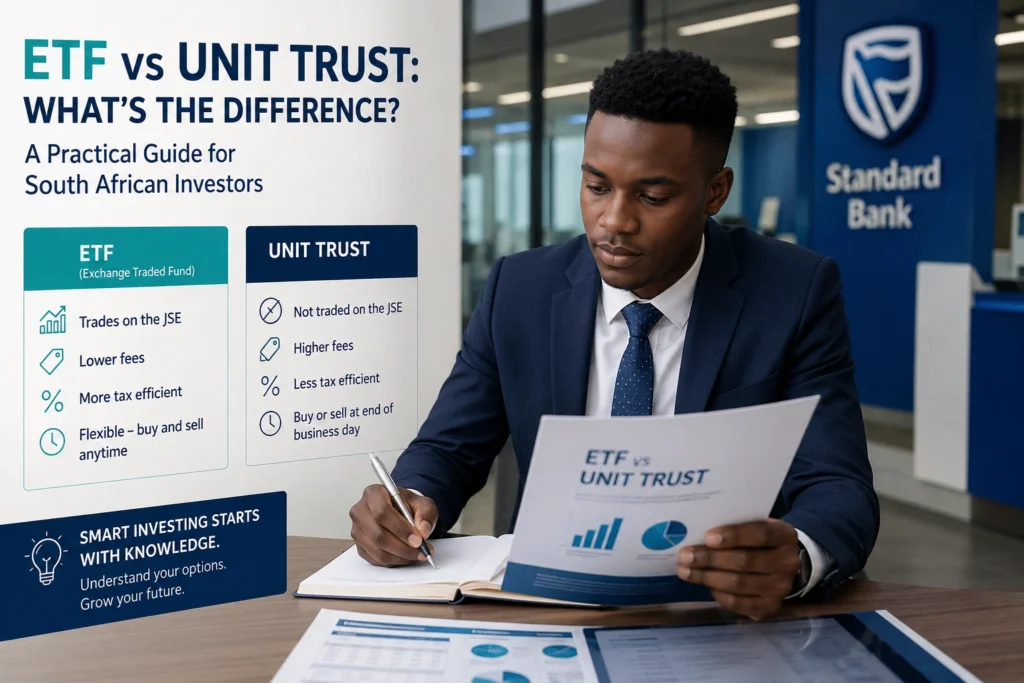

Choosing an investment can be surprisingly difficult when two products appear to do almost the same thing. You may hear about ETFs (exchange-traded funds) and unit trusts when researching ways to invest for retirement, build wealth or save for a long-term goal. Both can give you access to a basket of assets rather than requiring you to pick individual shares, but they work differently in important ways.
For South African investors, the decision is not simply about choosing the product with the lowest fee. Trading costs, tax, investment strategy, liquidity, platform charges and your own investing behaviour can all influence the outcome.
So, ETF vs Unit Trust: What’s the Difference? The simplest answer is that an ETF trades on a stock exchange during the trading day, while a unit trust is generally bought or sold through an investment platform or management company at a price based on its underlying portfolio’s valuation. But there is much more to the decision.
This guide explains the differences in practical terms and shows how to decide which option may be more appropriate for your circumstances.
What Is an ETF?
An exchange-traded fund (ETF) is an investment fund that trades on a stock exchange in much the same way as a listed share.
When you buy an ETF, you are buying units in a fund that may hold dozens, hundreds or even thousands of underlying investments. Depending on the ETF, these could include South African shares, global shares, bonds, property securities, commodities or a combination of assets.
Many ETFs are designed to track an index.
For example, an ETF could aim to follow the performance of a particular share-market index. Instead of buying every company in that index individually, an investor can buy one ETF that provides exposure to the group.
This makes ETFs attractive to investors looking for diversification without having to select individual securities themselves.
One important feature is that ETFs can generally be bought and sold throughout the trading day at market prices. The price can move above or below the fund’s underlying value because of market demand and supply.
ALSO APPLY FOR: (AIB) Interns 2026
ALSO APPLY FOR: (CIPC) Graduate Intern 2026
What Is a Unit Trust?
A unit trust is also a pooled investment. Money from multiple investors is combined and managed according to the fund’s investment mandate.
The fund manager may invest in shares, bonds, cash, property or other assets depending on the objective of the fund.
Unlike an ETF, a traditional unit trust is not normally traded on an exchange throughout the day. Investors typically submit an instruction to buy or sell units through a platform or fund manager. Transactions are generally processed using the fund’s applicable valuation price.
Unit trusts can be actively managed or passively managed.
An actively managed fund gives the portfolio manager discretion to select investments with the goal of achieving a particular objective. A passive unit trust, by contrast, may attempt to track an index or benchmark.
This distinction is important because comparing an ETF with a unit trust based only on the product label can be misleading. Some ETFs are actively managed, while some unit trusts are passive.
ALSO READ ABOUT: TFSA vs ETF vs Savings Account
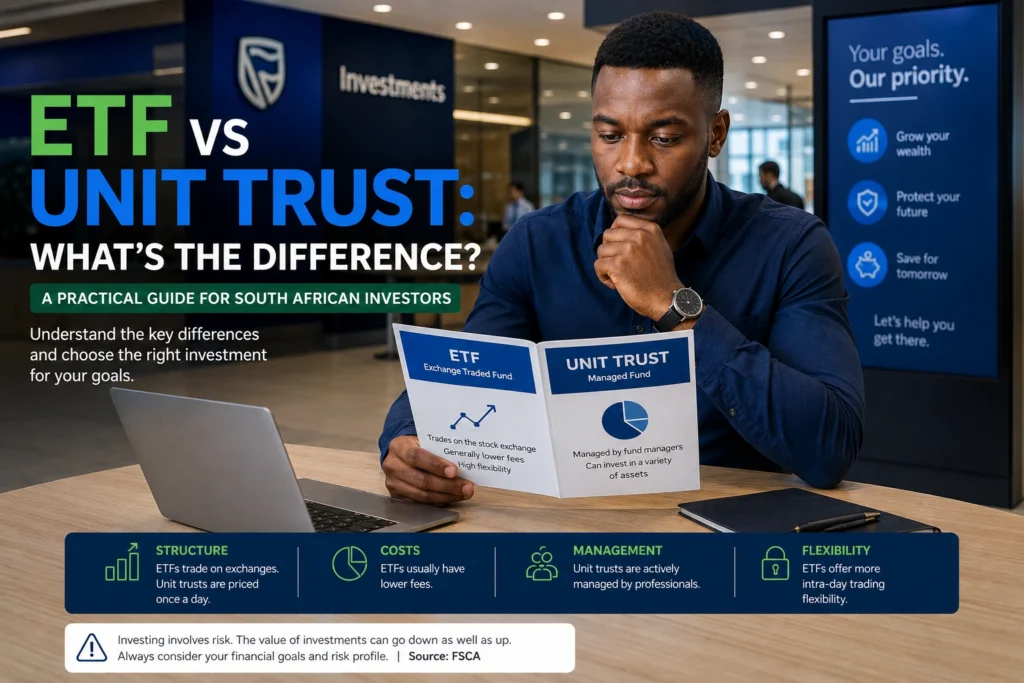
ETF vs Unit Trust: What’s the Difference?
The easiest way to understand the choice is to compare how each investment works.
| Feature | ETF | Unit Trust |
|---|---|---|
| How it trades | Bought and sold on an exchange | Usually bought/sold through a fund platform or manager |
| Pricing | Market price during trading hours | Usually based on fund valuation |
| Management | Passive or active, depending on fund | Passive or active |
| Diversification | Usually diversified | Usually diversified |
| Trading flexibility | High during market hours | Transactions processed according to fund rules |
| Costs | Often low, but brokerage and platform costs may apply | Management and platform fees may apply |
| Investment minimum | Depends on provider/platform | Depends on fund/platform |
| Suitable for | Investors wanting flexibility and diversification | Investors wanting professionally managed pooled investments |
The table shows why neither product automatically wins.
An investor who makes small, frequent purchases may experience costs differently from someone making occasional large investments. Similarly, an investor who wants a professional manager to make active investment decisions may have different priorities from someone who wants a low-cost index-tracking strategy.
Why This Issue Matters
The choice between an ETF and a unit trust can affect the amount of money you ultimately accumulate.
Suppose two investments have similar underlying portfolios but different total costs. Over a short period, the difference may appear insignificant. Over several decades, however, recurring costs can reduce the amount of capital that remains invested and compounding.
Your behaviour matters too.
An ETF’s ability to trade throughout the day can be useful, but it can also encourage investors to react to short-term market movements. A person who constantly buys and sells because prices are moving may undermine a long-term investment strategy.
A unit trust can sometimes feel less like a trading instrument because transactions are processed through an investment platform, but investors can still make emotional decisions about when to enter or exit.
The most important question is therefore not simply, “Which one is cheaper?”
It is:
Which investment structure helps me achieve my objective while keeping costs, risk and unnecessary behaviour under control?
Key Differences You Should Understand
1. How You Buy and Sell
ETFs are traded on an exchange. During market hours, the ETF has a quoted market price, and you can place an order through a broker or investment platform.
Unit trusts generally work differently. You invest directly into the fund through a platform or manager, and your transaction is processed according to the fund’s dealing arrangements.
For someone who wants intraday trading flexibility, an ETF may be more convenient.
For someone focused purely on long-term investing, this feature may not matter much.
2. Fees and Costs
Costs deserve careful attention.
An ETF may have a relatively low annual management cost, particularly when it tracks an index. However, investors should also consider brokerage, bid-offer spreads and platform charges.
Unit trusts can have management fees and other costs. Actively managed funds may cost more than passive funds because of the additional investment-management activity involved.
Instead of comparing only the advertised management fee, look at the total cost of ownership.
A slightly more expensive investment could still be reasonable if it provides a service or investment approach that you genuinely need.
3. Active vs Passive Management
This is one of the biggest distinctions investors should understand.
A passive fund attempts to follow an index or benchmark rather than regularly trying to outperform it.
An actively managed fund uses a manager or investment team to select investments according to a strategy.
ETFs are often associated with passive investing, but this is not universally true.
Unit trusts are often associated with active management, but passive unit trusts also exist.
Therefore, always investigate the actual fund mandate instead of assuming the strategy from the product type.
4. Liquidity
Because ETFs trade on an exchange, they can generally be bought and sold during trading hours.
However, an important point is that not every ETF has the same level of trading activity. A fund with limited trading volume may have a wider spread between its buying and selling prices.
Unit trusts do not rely on stock-exchange trading in the same way. Their transactions are processed according to the fund’s dealing terms.
Liquidity should therefore be considered alongside your investment horizon.
5. Tax
Tax can materially affect your investment return.
In South Africa, the tax treatment of an investment depends on factors such as the investment structure, distributions, your circumstances and how long you hold the investment.
Capital gains tax and tax on income distributions may be relevant outside tax-advantaged structures.
Investors should not choose an ETF or unit trust solely because they assume one is automatically “tax-free” or more tax efficient.
If you are unsure about the tax consequences, consider obtaining advice from a qualified South African tax professional.
ALSO READ ABOUT: What Is a TFSA
How to Choose Between an ETF and Unit Trust
Step 1: Define the Goal
Start with the purpose of the investment.
Are you investing for retirement, a house deposit, your child’s education or general long-term wealth creation?
The answer affects your investment horizon and appropriate level of risk.
Step 2: Decide How Much Risk You Can Accept
Do not select a fund simply because its historical return looks attractive.
A fund heavily exposed to shares can experience substantial short-term declines.
Ask yourself how you would react if your investment temporarily fell by 20% or more.
If you would panic and sell, your investment strategy may not match your risk tolerance.
Step 3: Compare the Underlying Portfolio
Look beyond the name.
Two funds may both be described as “global equity” investments but have different benchmarks, regions, currencies, holdings and strategies.
Check:
- What assets does the fund hold?
- Which index or benchmark does it follow?
- Is it actively or passively managed?
- How diversified is it?
- Is it exposed to South Africa or international markets?
- Does it distribute income or reinvest it?
Step 4: Compare Total Costs
Look at the fund’s annual management cost and other applicable charges.
For ETFs, consider trading costs and the bid-offer spread.
For unit trusts, examine management fees, platform charges and any applicable transaction or administration costs.
Do not assume the lowest headline fee automatically produces the best investment.
Step 5: Consider Your Investment Behaviour
If you are disciplined and invest regularly without reacting to every market headline, either structure could potentially work.
If having the ability to trade during the day encourages you to speculate, an ETF’s trading flexibility could become a disadvantage.
The best investment is often the one you can stick with.
ALSO READ ABOUT: Understanding Taxes
Best Practices Experts Recommend
A sensible long-term approach starts with diversification rather than trying to predict which investment will perform best next year.
Before investing, read the fund’s official documents and understand its mandate, fees, risks and benchmark.
Invest regularly where appropriate rather than constantly attempting to time the market.
Review your portfolio periodically instead of checking it compulsively.
Also consider the role of tax-advantaged accounts. In South Africa, a Tax-Free Savings Account (TFSA) can be useful for eligible long-term investing, although contribution limits and withdrawal rules need to be understood. The investment products available inside the account still matter.
Another useful practice is to compare funds based on the same category. Comparing a global equity ETF with a conservative income unit trust purely because both are “investments” does not tell you much.
Risk, objective and underlying assets should come first.
Mistakes People Often Make
Choosing Based Only on Past Returns
A fund that performed exceptionally well recently may not repeat that performance.
Past performance is not a guarantee of future returns.
Ignoring Total Costs
Investors sometimes compare only annual management fees while overlooking brokerage, spreads, platform fees or other expenses.
Confusing an ETF With a Single Share
An ETF is a fund, not necessarily a single company investment. Its value depends on the portfolio of assets it represents.
Trying to Time the Market
Having the ability to trade an ETF throughout the day does not mean you need to trade frequently.
Ignoring Currency Exposure
International investments can introduce foreign-currency exposure. Your rand return can therefore be affected by movements between the rand and the relevant foreign currency, in addition to movements in the underlying assets.
Investing Without an Emergency Fund
Long-term investments should generally not be treated as your emergency cash reserve. If you need money urgently, being forced to sell a volatile investment at an unfavourable time can damage your financial plan.
Frequently Asked Questions
Is an ETF better than a unit trust?
Not automatically. The better choice depends on your objective, costs, risk tolerance, preferred investment strategy and how you behave as an investor.
Are ETFs cheaper than unit trusts?
ETFs are often associated with lower fees, particularly passive index-tracking ETFs, but this is not guaranteed. Compare the total costs of the specific investments rather than relying on the product label.
Can I lose money in an ETF or unit trust?
Yes. Both can lose value. The level of risk depends on the underlying investments. An equity fund, for example, can experience significant market declines.
Should a beginner choose an ETF or unit trust?
A beginner should first understand diversification, investment risk, fees, tax and time horizon. Either product can be appropriate depending on the fund selected and the investor’s circumstances.
Final Thoughts: Which One Should You Choose?
The ETF vs Unit Trust: What’s the Difference? debate becomes much easier when you stop looking for a universal winner.
ETFs can provide convenient, diversified market exposure with exchange-based trading and often competitive costs. Unit trusts can provide access to professionally managed portfolios and a wide range of active and passive investment strategies.
The right choice depends on what you are trying to achieve.
Before investing, define your goal, establish your time horizon, assess your risk tolerance, compare the underlying investments and calculate the total costs. Then choose a product that you can hold consistently rather than one that simply looks attractive because of recent performance.
For many long-term investors, consistency, diversification and keeping unnecessary costs under control are more important than finding the “perfect” fund.
Practical takeaway: Don’t ask only, “ETF or unit trust?” Ask, “What am I investing for, what risks am I accepting, what am I paying, and can I stick to this strategy for the long term?” Those questions will usually lead to a much better investment decision.
ALSO APPLY FOR: (AIB) Interns 2026
ALS READ ABOUT: Reading a Payslip
ALSO APPLY FOR: (CIPC) Graduate Intern 2026