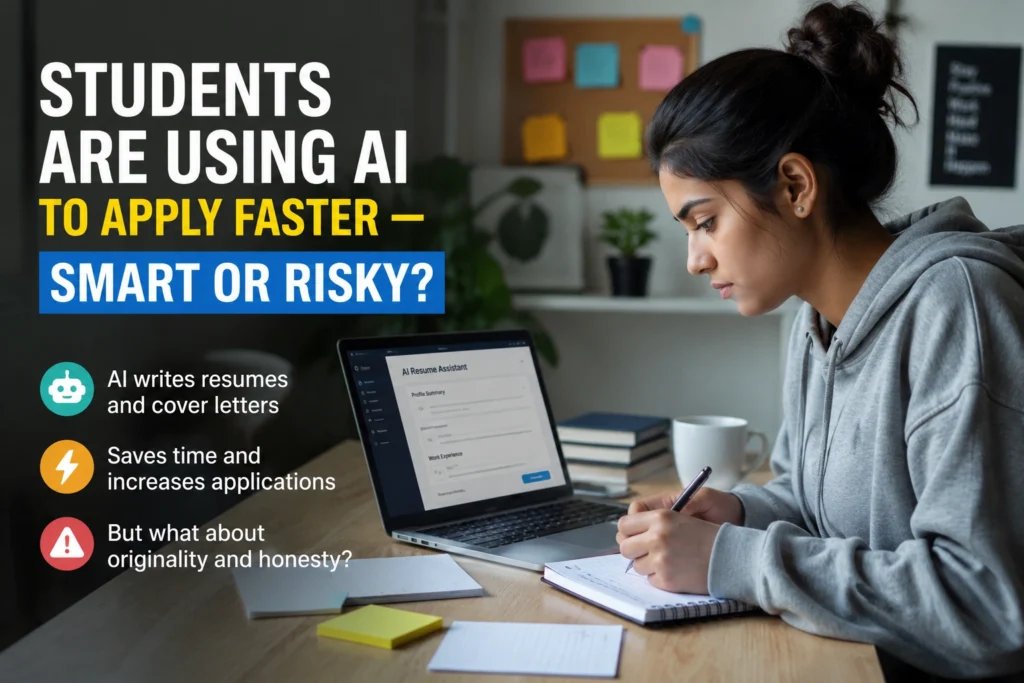

Students today face intense pressure when applying for internships, bursaries, learnerships, scholarships, university placements, and part-time jobs. Many applications require CVs, cover letters, motivational essays, online assessments, and multiple supporting documents — often with tight deadlines and fierce competition.
To save time, thousands of students are now turning to artificial intelligence tools like ChatGPT, Grammarly, and Canva to speed up the process. AI can help rewrite CVs, draft cover letters, improve grammar, and even answer application questions within minutes.
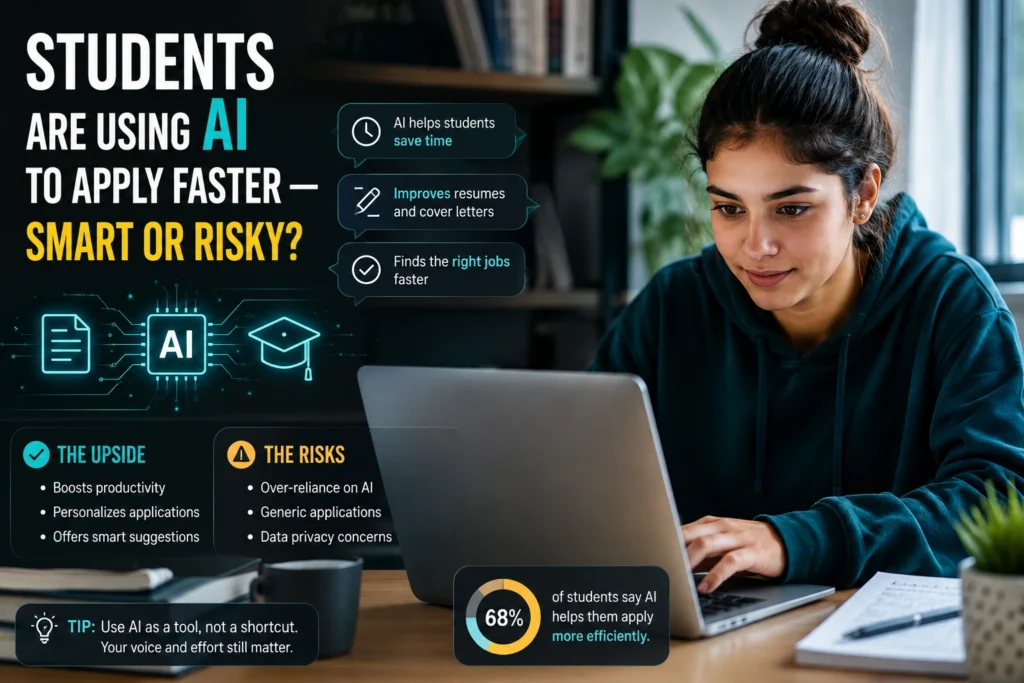
But this trend raises an important question: Students Are Using AI to Apply Faster — Smart or Risky?
The answer is not simple. AI can absolutely make applications more efficient and professional. At the same time, relying too heavily on automation can create serious problems, including generic applications, inaccurate information, and even disqualification in some cases.
This guide explains how students are using AI, where it genuinely helps, where the risks appear, and how to use these tools responsibly without damaging your opportunities.
What Does It Mean When Students Use AI for Applications?
Artificial intelligence tools can generate text, organize information, and suggest improvements based on prompts from users. Students commonly use AI for:
- Writing CVs and resumes
- Creating cover letters
- Drafting motivational letters
- Preparing scholarship essays
- Improving grammar and spelling
- Summarizing qualifications
- Practicing interview questions
- Generating LinkedIn profile descriptions
- Tailoring applications to job descriptions
For example, a student applying for a retail learnership might paste the job description into an AI chatbot and ask it to create a matching cover letter. Another student may upload a rough CV and ask AI to make it look more professional.
This is why the discussion around Students Are Using AI to Apply Faster — Smart or Risky? has become so relevant in education and recruitment circles.
ALSO APPLY FOR: Premier Millwright Apprenticeship 2026
ALSO APPLY FOR: Eskom’s Engineering Apprenticeship 2026
Why Students Are Turning to AI
1. Application Volumes Are Overwhelming
Many students apply for dozens of opportunities at once. Manually writing every cover letter can take hours. AI dramatically reduces that workload.
2. Not Everyone Has Strong Writing Skills
Some applicants understand the job requirements but struggle to express themselves clearly in English. AI tools can improve sentence structure and professionalism.
3. Competition Is Increasing
Students know employers often use Applicant Tracking Systems (ATS) to scan CVs. AI tools can help optimize wording and keywords.
4. AI Tools Are Easily Accessible
Most students already use free or low-cost platforms online. AI assistance is now only a few clicks away.
Why This Issue Matters
The debate around Students Are Using AI to Apply Faster — Smart or Risky? matters because it affects both opportunity and fairness.
On one side, AI can help students who lack career guidance, editing support, or professional networks. It levels the playing field for applicants who may not have access to expensive career coaches or university support services.
On the other side, recruiters are becoming increasingly aware of AI-generated applications. Some employers now report receiving large numbers of nearly identical cover letters written by chatbots. This makes it harder to identify genuine candidates.
There are also ethical concerns. If students submit AI-generated information that exaggerates experience or includes false skills, employers may see this as dishonesty.
The real-world impact is significant:
- Students may gain faster access to opportunities
- Recruiters may struggle to identify authentic talent
- Universities may change policies around AI use
- Employers may introduce stricter screening methods
- Digital literacy becomes more important than ever
AI is not just changing how students apply — it is changing how organizations evaluate applicants.
Smart Ways Students Can Use AI Responsibly
AI works best when used as a support tool rather than a replacement for personal effort.
Step 1: Start With Your Own Information
Before using AI, gather:
- Your real qualifications
- Work experience
- Volunteer history
- Skills
- Achievements
- Career goals
Never ask AI to invent experience you do not have.
A strong application still depends on authentic information.
Step 2: Use AI to Improve Clarity
AI is most useful for:
- Correcting grammar
- Improving sentence flow
- Organizing content
- Making writing more concise
For example, instead of submitting a poorly structured paragraph, students can ask AI to make it clearer and more professional.
That is a smart use of technology.
Step 3: Personalize Every Application
One major mistake students make is sending the same AI-generated application everywhere.
Recruiters can often detect generic writing.
Instead:
- Mention the company name
- Refer to the specific role
- Explain why you are interested
- Connect your experience to the opportunity
Customization matters far more than perfect wording.
Step 4: Fact-Check Everything
AI sometimes generates inaccurate information, fake achievements, or incorrect formatting.
Always review:
- Dates
- Qualifications
- Contact details
- Company names
- Skills listed
- References
Never assume AI is automatically correct.
Step 5: Keep Your Personal Voice
Applications should still sound human.
If the language becomes overly formal, robotic, or unrealistic for your experience level, recruiters may become suspicious.
Edit AI-generated content so it reflects how you naturally communicate.
The Risks of Overusing AI
While AI offers advantages, relying on it too heavily creates real dangers.
Generic Applications
Recruiters increasingly complain that many applications now sound identical.
Phrases like:
- “I am highly motivated”
- “I possess strong communication skills”
- “I am passionate about growth opportunities”
appear repeatedly in AI-generated submissions.
Generic applications often fail to stand out.
False Confidence
AI can make weak applications look polished on the surface. But if students cannot explain their own CV during interviews, problems quickly appear.
Some recruiters now ask unexpected follow-up questions specifically to test authenticity.
Ethical Concerns
Certain universities and employers may view fully AI-generated essays or personal statements as misconduct.
Students should always understand the rules of the institution or employer they are applying to.
Using AI for editing is usually different from using AI to completely replace original work.
Privacy Risks
Students sometimes paste personal information into AI tools without understanding data risks.
Avoid sharing:
- ID numbers
- Banking details
- Passwords
- Confidential academic records
Use trusted platforms and review privacy policies.
ALSO READ ABOUT: Young South Africans Are Finding Jobs in a New Way
Best Practices Experts Recommend
Career advisors and recruitment specialists increasingly suggest balanced AI usage rather than complete avoidance.
Here are the best practices experts recommend:
Use AI as an Assistant, Not a Substitute
Think of AI like a spellchecker or brainstorming partner — not the applicant itself.
Your experiences, goals, and personality should remain central.
Focus on Quality Over Quantity
Applying to 100 jobs with weak AI-generated applications is usually less effective than sending 10 well-targeted applications.
Employers value relevance and authenticity.
Learn the Basics of Professional Writing
Students should still understand:
- CV structure
- Interview etiquette
- Cover letter formatting
- Professional communication
Depending entirely on AI can weaken long-term career skills.
Prepare for Interviews Independently
Even if AI helped write the application, students must personally understand every detail included.
Interview performance still depends on real preparation.
Combine AI With Human Feedback
Whenever possible:
- Ask lecturers to review applications
- Use university career services
- Get feedback from mentors
- Compare AI suggestions with real-world advice
Human judgment remains valuable.
Mistakes People Often Make
Many students unknowingly reduce their chances by misusing AI tools.
Copying AI Responses Without Editing
Raw AI output often sounds unnatural or repetitive.
Applications should always be reviewed and personalized.
Exaggerating Skills
Some students allow AI to add advanced skills they do not actually possess.
This can create serious embarrassment during interviews or assessments.
Ignoring Job Requirements
AI-generated applications may miss important instructions.
For example:
- Required document formats
- Word counts
- Specific questions
- Portfolio requests
Always read the original application carefully.
Using AI for Everything
Students who rely on AI for every sentence may stop developing their own communication skills.
That becomes risky in interviews, presentations, and future workplace situations.
Sending Applications Too Quickly
Because AI speeds up writing, students may rush submissions without proper review.
Speed should never replace accuracy.
How Recruiters Are Responding
Recruiters are adapting quickly to the rise of AI-assisted applications.
Some companies now:
- Use AI-detection systems
- Add live assessments
- Conduct more video interviews
- Ask practical problem-solving questions
- Focus more on authenticity and communication
Interestingly, many employers do not completely oppose AI usage. Some even expect candidates to understand modern technology tools.
What matters most is transparency, honesty, and genuine competence.
The future likely belongs to students who know how to combine AI efficiency with authentic human skills.
Students Are Using AI to Apply Faster — Smart or Risky? The Balanced Answer
The reality is that AI itself is neither completely good nor completely bad.
It becomes risky when students:
- Depend on it blindly
- Submit inaccurate information
- Replace genuine effort entirely
- Lose their own voice
But it becomes smart when students:
- Use it to improve clarity
- Save time responsibly
- Learn professional communication
- Organize applications more effectively
Technology is now part of the modern application process. The key challenge is learning how to use it wisely.
Frequently Asked Questions
Is it wrong to use AI for CV writing?
Not necessarily. Many students use AI to improve formatting, grammar, and structure. Problems arise when AI generates false information or completely replaces personal input.
Can employers detect AI-generated applications?
Sometimes. Recruiters often notice repetitive language, overly polished writing, or generic phrasing. Some organizations also use AI-detection tools, although these are not always reliable.
Should students mention they used AI?
Usually, students do not need to disclose basic editing assistance. However, honesty matters. If an application includes AI-generated claims that are inaccurate, that can become a serious issue.
Does using AI improve chances of getting hired?
AI can improve presentation and save time, but it does not guarantee success. Employers still care about real skills, experience, communication ability, and interview performance.
Final Thoughts
The conversation around Students Are Using AI to Apply Faster — Smart or Risky? will continue growing as technology becomes more common in education and recruitment.
For students, the smartest approach is balance.
Use AI to:
- Improve writing
- Organize ideas
- Save time
- Practice interview questions
- Strengthen applications
But avoid:
- Overdependence
- Fake information
- Generic applications
- Blind copying
The strongest applications still come from genuine experiences, clear goals, and thoughtful effort.
AI may help students move faster, but authenticity remains the factor that truly builds trust and opportunity.
ALSO APPLY FOR: Premier Millwright Apprenticeship 2026
ALSO APPLY FOR: Eskom’s Engineering Apprenticeship 2026
ALSO READ ABOUT: Young South Africans Are Finding Jobs in a New Way