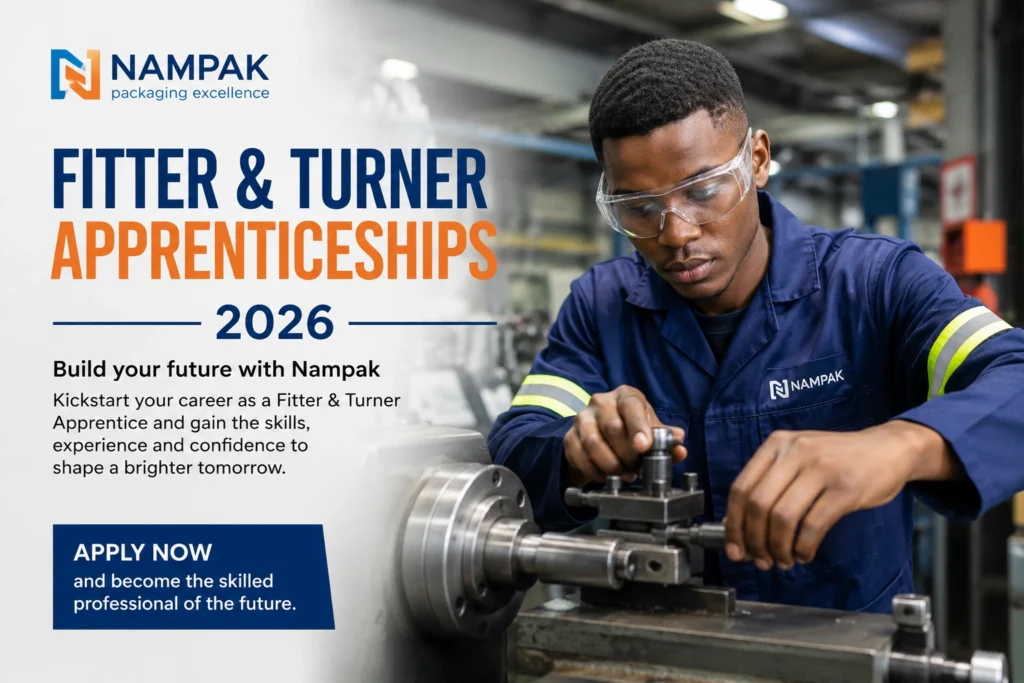

For thousands of young South Africans searching for a way into the country’s struggling job market, artisan training has suddenly become one of the most talked-about career paths again. And right now, the Nampak Fitter & Turner Apprenticeships 2026 are gaining major attention online for exactly that reason.
At a time when graduate unemployment remains painfully high and many school leavers are questioning whether traditional university routes still guarantee stable careers, manufacturing apprenticeships are being viewed differently. They are no longer seen as “backup options.” Instead, they are increasingly becoming strategic career moves into industries that continue to need technical skills.
That is why Nampak’s latest apprenticeship intake is attracting interest far beyond Springs, Gauteng.
The programme offers six apprenticeship positions at Nampak Metals, giving successful applicants a chance to gain practical engineering experience while working toward a recognised trade qualification. In an economy where experience is often the biggest barrier to employment, opportunities that combine structured learning with real industrial exposure are becoming highly competitive.
And this announcement arrives at a moment when South Africa’s manufacturing sector is under pressure to rebuild technical capacity.
A Manufacturing Industry Searching for Skills Again
South Africa’s engineering and manufacturing sectors have faced years of uncertainty. Factory closures, electricity disruptions, weak economic growth, and declining industrial output have all contributed to reduced confidence in the sector.
But underneath those challenges, another issue has been quietly growing: a shortage of qualified artisans.
Companies across manufacturing, mining, packaging, logistics, and infrastructure increasingly report difficulty finding experienced fitters, millwrights, welders, and electricians. Many older artisans are retiring, while fewer young people are entering technical trades at the rate industries need.
That skills gap is one reason programmes like the Nampak Fitter & Turner Apprenticeships 2026 matter more than they may have a decade ago.
Rather than simply hiring already-qualified tradespeople, companies are once again investing in training pipelines. Apprenticeships are becoming a long-term survival strategy for industrial businesses that need technically skilled workers to keep production lines operating efficiently.
For unemployed youth, this creates an unusual opportunity: industries that once demanded experience are now helping create it.
What the Nampak Apprenticeship Offers
The apprenticeship programme is hosted at Nampak Metals in Springs, Gauteng, one of the company’s major industrial operations.
Successful candidates will complete structured theoretical modules while receiving practical workplace exposure in industrial maintenance and production support. Apprentices will work toward the Fitter & Turner trade through Trade Theory 1, 2, and 3, combined with hands-on technical training.
The programme focuses on developing skills that remain critical inside manufacturing environments, including:
- Mechanical maintenance
- Equipment installation
- Fault finding and troubleshooting
- Reading technical drawings
- Production support
- Quality checks and compliance
- Industrial safety procedures
The company says apprentices will also be expected to develop problem-solving abilities while learning how production environments operate under real manufacturing pressures.
Unlike short-term training workshops that offer certificates without meaningful workplace experience, apprenticeships immerse learners inside operational environments where downtime, efficiency, and safety directly affect business performance.
That practical exposure is often what employers value most later.
Why Fitter & Turner Trades Still Matter
In an era dominated by conversations about AI, digital jobs, and automation, some people assume traditional trades are fading away.
The reality inside manufacturing is more complicated.
Automation still requires skilled technicians to maintain machinery, install systems, and troubleshoot mechanical failures. Factories cannot run without artisans capable of repairing and optimising equipment.
A Fitter & Turner typically works with machinery components, maintenance systems, mechanical fitting, and precision engineering tasks. These skills remain central to industries ranging from automotive manufacturing to mining operations.
In South Africa especially, technical trades continue to offer relatively stronger employment stability compared to many oversaturated office-based fields.
This is one reason artisan careers are slowly regaining respect among younger job seekers and parents alike.
For years, university degrees dominated career conversations. But rising graduate unemployment has shifted perceptions. Many young people now see skilled trades as more practical, employable, and financially sustainable.
The Bigger Shift Happening in South African Youth Employment
The popularity of apprenticeship programmes also reflects broader frustrations in the labour market.
Many unemployed youth face a familiar cycle:
- Employers demand experience
- Graduates cannot get experience without employment
- Entry-level roles are limited
- Competition continues increasing
Apprenticeships partly break that cycle because they combine employment-based learning with qualifications.
Instead of studying first and hoping for workplace exposure later, apprentices gain both simultaneously.
This model has become increasingly attractive in South Africa’s current economic climate.
Technical and Vocational Education and Training (TVET) pathways are also receiving renewed national attention as government and industry attempt to address youth unemployment more aggressively.
Programmes linked to recognised trades are especially important because they create clearer career progression routes compared to some short skills courses that lack industry recognition.
Minimum Requirements and What They Reveal
Applicants for the Nampak Fitter & Turner Apprenticeships 2026 must hold a minimum N3 Mechanical Engineering qualification with Mathematics and Physical Science.
The requirements also include:
- Basic mechanical understanding
- Ability to interpret technical drawings
- Computer literacy
- Communication skills
- Teamwork abilities
- Willingness to work shifts and overtime
On paper, these may look like standard requirements. But they also reflect how industrial workplaces are evolving.
Modern artisans increasingly need both technical and operational skills. Factories today rely heavily on systems, documentation, quality control processes, and safety compliance. Technical ability alone is no longer enough.
Employers want adaptable workers who can function inside highly regulated production environments.
This is why interpersonal skills and initiative are now frequently included in technical apprenticeship advertisements.
Public Reaction Online Has Been Strong
Since the apprenticeship announcement began circulating online, reactions across youth employment platforms and community pages have been notably positive.
Part of the excitement comes from the reputation associated with established manufacturing companies. Large industrial employers still carry credibility because they offer exposure to real operational environments rather than purely classroom-based learning.
Another reason for the strong reaction is timing.
South Africa continues to see intense competition for learnerships, internships, and apprenticeships. Opportunities connected to engineering trades often receive especially high interest because they are viewed as pathways into more stable long-term careers.
Many online discussions around the programme focus on two recurring themes:
1. Scarcity of Artisan Opportunities
Young people frequently complain that artisan opportunities are difficult to access without connections or prior workplace exposure.
When recognised companies openly advertise apprenticeship programmes, interest spikes quickly.
2. Desire for Practical Careers
There is also growing fatigue around qualifications that do not translate into employment.
Many job seekers increasingly prioritise programmes that provide:
- Workplace experience
- Industry-recognised training
- Technical exposure
- Real employability outcomes
The Nampak programme aligns strongly with those priorities.
Why This Matters Right Now
The Nampak Fitter & Turner Apprenticeships 2026 matter for reasons that go beyond six available positions.
They reflect a wider shift happening across South Africa’s economy and labour market.
First, they highlight the growing importance of artisan development in industries facing technical skills shortages.
Second, they reinforce the idea that vocational and technical pathways are becoming economically valuable again.
Third, they show that manufacturing companies are still investing in long-term workforce development despite broader economic uncertainty.
This matters because youth unemployment remains one of South Africa’s biggest structural challenges. Every apprenticeship programme may seem small individually, but collectively these initiatives play a significant role in rebuilding employability pipelines.
There is also a psychological aspect.
Many young South Africans feel locked out of meaningful economic participation. Opportunities linked to recognised industries can restore a sense of possibility, especially for candidates who already hold technical qualifications but lack workplace exposure.
The programme also arrives during ongoing debates about whether South Africa’s education system adequately prepares young people for actual labour market demands.
Technical apprenticeships sit at the centre of that conversation because they connect training directly to industry application.
The Industrial Environment Apprentices Should Expect
One important reality often overlooked in public discussions is that manufacturing apprenticeships are demanding.
Industrial production environments operate under strict safety, efficiency, and performance expectations. Apprentices entering these spaces will likely encounter:
- Shift work
- Fast-paced operations
- Mechanical troubleshooting pressure
- Safety compliance demands
- Production deadlines
- Physically demanding conditions
But this intensity is also part of what makes apprenticeships valuable.
Unlike simulated training environments, real factories expose learners to operational realities that shape professional discipline and technical confidence.
For many artisans, these early years become the foundation of their careers.
The Long-Term Career Potential
A qualified Fitter & Turner can potentially work across multiple sectors, including:
- Manufacturing
- Mining
- Packaging
- Petrochemicals
- Logistics
- Automotive production
- Energy infrastructure
That flexibility matters in an uncertain economy.
Trade qualifications often provide stronger mobility across industries compared to some narrowly specialised qualifications.
Experienced artisans may later move into:
- Supervisory positions
- Maintenance planning
- Technical specialist roles
- Contracting work
- Entrepreneurship
- Engineering support functions
This broader career mobility is one reason technical trades continue attracting interest despite changing economic trends.
What Could Happen Next
The growing visibility of programmes like the Nampak Fitter & Turner Apprenticeships 2026 could signal several important developments ahead.
More Companies May Expand Artisan Training
If industries continue struggling to recruit experienced artisans, more employers may increase apprenticeship intakes instead of relying only on external recruitment.
Competition Could Intensify
As awareness grows around the employability value of technical trades, apprenticeship applications will likely become even more competitive.
Candidates with strong Mathematics, Physical Science, and practical aptitude may hold increasing advantages.
TVET Pathways Could Gain More Respect
South Africa may continue seeing gradual shifts away from the idea that university education is the only route to career success.
Technical qualifications tied to industry demand could gain stronger social and economic recognition.
Manufacturing Skills Could Become Strategically Important Again
As infrastructure, industrial recovery, and energy projects expand over time, artisan shortages may become even more significant nationally.
That could increase long-term demand for qualified technical workers.
ALSO VISIT: https://www.nampak.com
Application Details
Candidates interested in applying for the apprenticeship must submit applications via email.
Applications should be sent to:
Recruitment.Springs@nampak.com
Programme Details
- Programme: Fitter & Turner Apprenticeship
- Company: Nampak
- Location: Springs
- Positions Available: 2
- Closing Date: 20 May 2026
Late applications may not be considered.
ALSO APPLY FOR: EASTC Engineering Apprenticeships 2026
Final Thoughts
The conversation around youth employment in South Africa is changing.
For years, attention focused heavily on degrees, white-collar careers, and corporate office pathways. But economic realities are reshaping those assumptions. Increasingly, practical technical skills are becoming some of the most valuable assets in the labour market.
The Nampak Fitter & Turner Apprenticeships 2026 represent more than another apprenticeship advertisement. They reflect a deeper shift toward skills-based employability, industrial capability, and long-term workforce development.
For candidates with mechanical engineering backgrounds and genuine interest in technical trades, this opportunity could become an important career starting point at a time when meaningful workplace access remains difficult to secure.