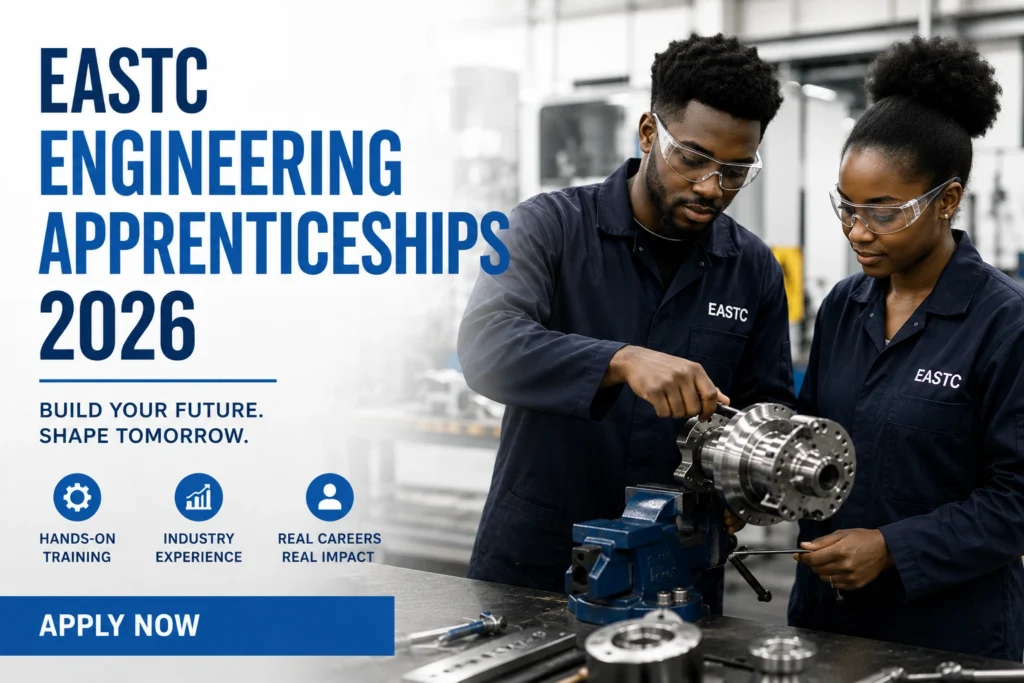

The conversation around artisan careers in South Africa has changed dramatically over the past few years. University degrees are no longer viewed as the only route to stability, especially as unemployment among graduates continues to dominate national debate. That shift is one reason why the EASTC Engineering Apprenticeships 2026 programme is suddenly attracting serious attention online.
For many young South Africans, especially those searching daily through internship portals, WhatsApp groups and community job pages, apprenticeship opportunities have become more than just training programmes. They are increasingly seen as one of the few realistic entry points into the economy.
And this latest opportunity from EASTC arrives at a moment when demand for technical skills is climbing again across infrastructure, maintenance, energy, refrigeration, fabrication and industrial services.
The programme may look modest at first glance — a three-year apprenticeship with a monthly stipend of R3,000 in Kempton Park — but the bigger story is what it represents. South Africa’s artisan economy is quietly rebuilding itself, and programmes like this are becoming part of a larger national trend.
A New Wave of Interest in Skilled Trades
For years, artisan careers were often overlooked by school leavers who were encouraged to pursue university pathways instead. But economic reality has reshaped perceptions.
Trades such as welding, plumbing, refrigeration and boiler making are now being discussed differently. They are increasingly associated with practical employability, entrepreneurship and infrastructure development rather than “backup career options.”
That change did not happen overnight.
Load-shedding, infrastructure repairs, industrial maintenance demands and construction-sector recovery have all exposed a shortage of technical skills. Businesses across multiple industries have repeatedly raised concerns about the declining number of qualified artisans entering the workforce.
As a result, apprenticeship programmes have started regaining relevance.
The EASTC Engineering Apprenticeships 2026 announcement fits directly into this environment. It speaks to a growing appetite for skills that produce immediate workplace value.
What the EASTC Apprenticeship Programme Offers
According to the programme announcement, EASTC is recruiting unemployed youth for a structured three-year multi-trade engineering apprenticeship based in Kempton Park.
The available trades include:
- Air Conditioning and Refrigeration
- Rigging
- Plumbing
- Boiler Making
- Welding
Successful applicants will receive practical workplace exposure alongside technical development. Participants will also receive a monthly stipend of R3,000 during the programme.
Importantly, the apprenticeship is focused on hands-on industry training rather than purely classroom-based learning. That distinction matters because many employers increasingly prioritize practical competence and workplace readiness.
The closing date for applications is 29 May 2026, and applicants are required to hand-deliver their CVs to EASTC’s Kempton Park address.
That old-school application method has also sparked conversation online.
The Return of Hand-Delivered Applications
One of the more surprising aspects of the programme is that applications cannot be emailed. Candidates must physically submit their CVs.
At first glance, that may sound outdated in an era dominated by online recruitment systems. But in many South African training environments, hand-delivered applications remain common for artisan and trade programmes.
There are several possible reasons for this.
Some organizations use manual submissions to manage high application volumes. Others prefer local accessibility or want to verify applicant seriousness. In some cases, training providers still rely heavily on physical recruitment systems.
Public reaction to this requirement has been mixed.
Some young people on social platforms praised the approach because it gives applicants without stable internet access a fair chance. Others argued that transport costs and travel logistics create additional barriers for unemployed youth.
That tension reflects a broader issue within South Africa’s employment landscape: accessibility.
Even applying for opportunities often requires money for printing, taxis, data bundles and certified documents — expenses many unemployed applicants struggle to afford.
Why Artisan Careers Are Trending Again
Part of the growing interest in the EASTC Engineering Apprenticeships 2026 programme comes from changing economic realities.
South Africa’s youth unemployment crisis has forced many people to rethink what career success looks like.
The traditional formula — school, university, office job — has become increasingly uncertain. Meanwhile, technical skills are proving more adaptable in sectors where physical infrastructure still matters.
Welding, refrigeration and plumbing are especially interesting because they can lead to both formal employment and self-employment opportunities.
A qualified welder might work in manufacturing today and operate a private fabrication business tomorrow.
A refrigeration technician could eventually service commercial cooling systems for restaurants, retailers or warehouses.
Plumbing skills remain consistently valuable because maintenance and water infrastructure issues never fully disappear.
This versatility is one reason apprenticeship programmes now generate strong engagement on career-focused platforms.
Young people are not only searching for jobs anymore. Many are searching for sustainable skills.
The Bigger Story Behind Apprenticeships in South Africa
The EASTC programme is part of a wider national effort to revive technical and vocational pathways.
For years, policymakers, training authorities and industry groups warned about the country’s artisan shortage. Retiring technicians were not being replaced quickly enough, and training pipelines weakened.
At the same time, university overcrowding and graduate unemployment intensified pressure on the broader education system.
This created renewed interest in apprenticeships, TVET colleges and occupational training.
The idea is straightforward: economic growth requires practical skills, not only academic qualifications.
Infrastructure projects need welders.
Factories need riggers.
Construction companies need plumbers.
Industrial plants need refrigeration technicians.
Without a functioning artisan pipeline, even ambitious development plans struggle to succeed.
That is why programmes like the EASTC Engineering Apprenticeships 2026 carry significance beyond the individual opportunity itself.
They represent part of a long-term skills recovery process.
Public Reaction: Hope Mixed With Frustration
Online reaction to apprenticeship opportunities often follows a familiar pattern.
There is excitement because opportunities are scarce.
But there is also frustration because competition is intense.
Many applicants know thousands of people may apply for only a limited number of positions. Others worry about stipend levels, transport costs and placement uncertainty after training.
The R3,000 monthly stipend attached to the EASTC programme has already sparked discussion.
For some applicants, the stipend is viewed positively because it provides at least some financial support during training.
Others argue that inflation and commuting costs make survival difficult on that amount, especially in Gauteng.
Both perspectives are valid.
Apprenticeships occupy a complicated space between education and employment. Participants are learning while also contributing labour. Balancing affordability and training costs is a challenge many organizations continue to face.
Still, despite concerns, demand for artisan opportunities remains extremely high.
That alone says something important about the current state of the job market.
Why This Matters Right Now
The timing of the EASTC Engineering Apprenticeships 2026 programme matters because South Africa is at a crossroads in how it approaches youth employment.
There is growing recognition that economic inclusion cannot depend solely on university expansion.
Technical training pathways are becoming central to conversations about employability, infrastructure renewal and industrial growth.
At the same time, artificial intelligence and automation are reshaping global labour markets. Interestingly, many hands-on artisan trades remain difficult to automate fully.
A robot may assist with industrial production, but skilled technicians are still needed for installation, diagnostics, repairs and field operations.
That makes engineering trades more resilient than some purely administrative careers.
There is also a psychological dimension.
Many young South Africans are exhausted by endless job applications that lead nowhere. Apprenticeships offer something different: a visible pathway toward competency and certification.
Instead of simply searching for work, participants are actively building a trade identity.
That shift can be powerful.
How to Apply
Applications must be submitted by hand delivery.
Hand Delivery Address:
Duduzile Twala
61 Northrand Road
Kempton Park
Important: No email applications will be accepted.
Applicants should submit their CVs by hand before the closing date.
ALSO APPLY FOR: ROUTE Apprenticeship 2026
The Gauteng Advantage
The programme’s location in Gauteng is another factor contributing to interest.
Gauteng remains South Africa’s industrial and economic hub, with strong concentrations of logistics, manufacturing, aviation support services and engineering-related businesses.
Kempton Park itself sits near major industrial activity zones and transport infrastructure.
For apprentices, geographic positioning matters.
Training near industrial clusters can improve exposure to real workplace environments and potentially expand future employment networks.
While completion of an apprenticeship never guarantees permanent employment, location can influence post-training opportunities.
Being trained in an active economic corridor may create stronger pathways into the labour market.

ALSO VISIT: https://eastc.co.za
A Shift in Youth Career Thinking
One of the most interesting developments in recent years is how younger South Africans increasingly discuss careers online.
The language has changed.
Instead of focusing only on prestigious job titles, many conversations now revolve around “scarce skills,” “income streams,” “side hustles,” and “practical qualifications.”
There is greater awareness that financial survival may depend on flexibility.
An artisan qualification fits naturally into that mindset because technical skills can often move across industries.
A qualified boiler maker might work in mining, energy, construction or manufacturing.
A welder may move between formal contracts and freelance projects.
This adaptability makes artisan careers attractive during periods of economic instability.
The EASTC programme enters the conversation at exactly the moment when many young people are reconsidering what kind of career future actually feels realistic.
The Challenge Nobody Talks About Enough
While apprenticeship opportunities are important, there is another side to the discussion that often receives less attention.
Completion rates and long-term support matter just as much as recruitment.
South Africa has historically struggled with fragmented transitions between training and stable employment. Some apprentices finish programmes but still battle to secure consistent work experience afterward.
This raises larger questions:
- Are enough employers prepared to absorb newly qualified artisans?
- Is industry investment growing fast enough?
- Will infrastructure expansion create sustained demand?
These questions do not diminish the value of programmes like EASTC’s. Instead, they highlight why apprenticeship ecosystems must continue evolving beyond recruitment announcements alone.
Training is only the first stage.
Career sustainability is the real long-term goal.
What Could Happen Next
The success of initiatives like the EASTC Engineering Apprenticeships 2026 programme could influence how more organizations approach youth development in coming years.
If industry demand for artisans continues rising, South Africa may see:
- More employer-led apprenticeship programmes
- Expanded partnerships with TVET colleges
- Increased government support for technical skills pipelines
- Greater investment in trade certification systems
- Stronger emphasis on workplace-integrated learning
There is also growing possibility that artisan careers will gain broader cultural prestige again.
For decades, many societies treated white-collar careers as inherently superior to technical trades. Economic shifts are now challenging that assumption globally.
Practical engineering skills are becoming strategically important once more.
In South Africa specifically, infrastructure maintenance and energy-sector modernization could significantly increase long-term artisan demand.
That means today’s apprentices may eventually enter a labour market very different from the one many unemployed graduates currently face.
Final Thoughts
The EASTC Engineering Apprenticeships 2026 programme is more than another recruitment notice circulating online.
It reflects a larger transformation happening in South Africa’s employment conversation.
Young people are increasingly searching for careers that offer practical skills, economic resilience and realistic entry points into the workforce. Apprenticeships provide one of the clearest pathways toward that goal.
At the same time, the programme also highlights ongoing challenges around accessibility, training quality, stipend adequacy and long-term employment outcomes.
Both realities exist simultaneously.
There is hope in opportunities like this, but also pressure. Thousands of applicants are competing for chances to build stable futures in an uncertain economy.
That is precisely why apprenticeship programmes continue generating such strong public attention.
In a country where opportunity can often feel distant, technical training pathways still represent something tangible: the possibility of learning a skill that society genuinely needs.