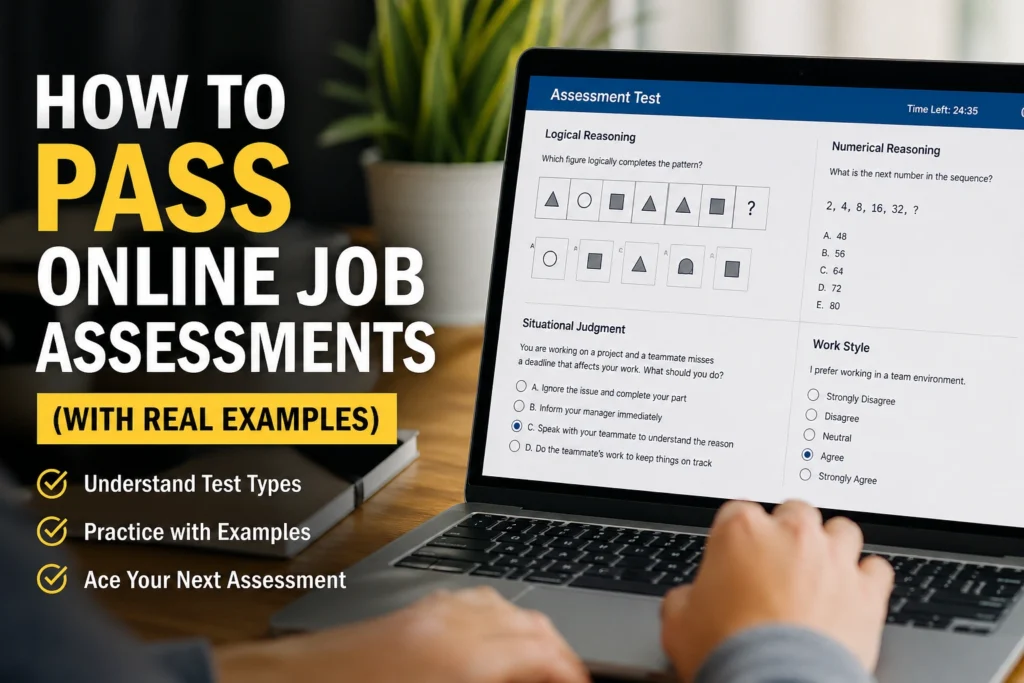

Landing a job today often means clearing a hurdle that didn’t exist a decade ago: online job assessments. Whether it’s a personality test, a timed aptitude exam, or a technical challenge, these assessments can quietly determine whether your application moves forward—or disappears without explanation.
Many candidates feel stuck. You might be qualified, experienced, and even a great cultural fit, yet still get filtered out because of one poorly handled test. The frustration is real: unclear expectations, strict time limits, and unfamiliar question formats make even strong applicants second-guess themselves.
This guide breaks down how to pass online job assessments (with real examples) so you can approach them with confidence, strategy, and clarity instead of guesswork.
Understanding Online Job Assessments
Before jumping into strategies, it’s important to understand what these assessments actually measure.
Online job assessments are designed to evaluate more than just knowledge. Employers use them to screen for:
- Cognitive ability (logic, reasoning, problem-solving)
- Technical skills (coding, spreadsheets, writing)
- Behavioral traits (personality, decision-making style)
- Situational judgment (how you handle real work scenarios)
Common types include:
- Aptitude tests (numerical, verbal, logical reasoning)
- Personality questionnaires
- Situational judgment tests (SJTs)
- Technical or job-specific tasks
- Game-based assessments
Key insight: These tests are not just about “right answers”—they’re about fit, consistency, and performance under pressure.
ALSO APPLY FOR: FlySafair Graduate Internships 2026
ALSO APPLY FOR: ASSITEJ South Africa Internship 2026
Why This Issue Matters
Failing an online assessment doesn’t just cost you one job—it can block access to entire hiring pipelines.
Here’s the real-world impact:
- Early elimination: Many companies automatically reject candidates who score below a threshold.
- Invisible competition: You’re often competing against hundreds of applicants filtered purely by test performance.
- Missed opportunities: Even highly qualified candidates lose out due to poor test strategy, not lack of ability.
- Repeated failure cycles: Without feedback, candidates repeat the same mistakes across multiple applications.
In short, mastering how to pass online job assessments (with real examples) isn’t optional anymore—it’s a core job search skill.
Step-by-Step: How to Pass Online Job Assessments (With Real Examples)
1. Understand the Test Format Before You Begin
Most candidates jump straight into assessments without preparation. That’s a mistake.
What to do instead:
- Read instructions carefully
- Look for practice questions
- Identify time limits and scoring patterns
Real example:
A candidate applying for a finance role rushed into a numerical reasoning test and ran out of time. On a second attempt (with another company), they practiced similar questions beforehand and improved speed—passing the test comfortably.
Takeaway: Familiarity reduces panic and improves performance.
2. Practice Under Real Conditions
Practicing casually is not enough. You need to simulate the actual pressure.
How to practice effectively:
- Use a timer
- Avoid distractions
- Work through full-length tests
Real example:
A graduate applying for consulting roles practiced logical reasoning tests daily for a week under timed conditions. Initially scoring 60%, they improved to 85%—high enough to pass screening thresholds.
Why it works: Timed repetition builds both accuracy and speed.
3. Learn the Patterns Behind Questions
Most aptitude and reasoning tests follow predictable structures.
For example:
- Numerical tests often focus on percentages, ratios, and data interpretation
- Logical tests use sequences, patterns, or shape rotations
- Verbal tests assess comprehension and inference—not just vocabulary
Real example:
In a logical reasoning test, a candidate noticed sequences often followed alternating patterns (e.g., +2, -1). Recognizing this quickly helped them solve questions in seconds instead of minutes.
Takeaway: You’re not solving random puzzles—you’re spotting patterns.
4. Manage Your Time Strategically
Time pressure is one of the biggest challenges.
Smart strategies:
- Skip difficult questions and return later
- Don’t aim for perfection—aim for efficiency
- Watch the clock but don’t panic
Real example:
A software developer failed an assessment by spending too long on one coding question. On their next attempt, they skipped complex parts first and completed easier tasks—raising their overall score.
Key idea: Completing more questions often matters more than perfect answers.
5. Approach Personality Tests with Consistency
Personality tests don’t have “correct” answers—but they do have consistent profiles employers look for.
Tips:
- Answer honestly but professionally
- Stay consistent across similar questions
- Avoid extreme contradictions
Real example:
A candidate answered “I enjoy teamwork” in one question and “I prefer working alone” in another. This inconsistency flagged their profile as unreliable.
Better approach: Align your answers with the role. For example:
- Customer-facing role → emphasize communication and collaboration
- Analytical role → highlight focus and independence
6. Think Like the Employer in Situational Tests
Situational judgment tests (SJTs) present workplace scenarios and ask how you would respond.
What employers look for:
- Professionalism
- Teamwork
- Ethical decision-making
- Problem-solving ability
Real example:
Scenario: A colleague misses a deadline.
- Weak answer: Ignore it or blame them
- Strong answer: Offer support and communicate with the team
Winning mindset: Choose responses that show accountability, communication, and balance.
7. Prepare for Technical Assessments
For technical roles, preparation must be specific.
Strategies:
- Review core concepts
- Practice real-world problems
- Use platforms similar to the test format
Real example:
A data analyst candidate practiced Excel-based tests (pivot tables, formulas) before applying. When the actual assessment included similar tasks, they completed it confidently.
8. Optimize Your Test Environment
This is often overlooked—but it matters.
Checklist:
- Stable internet connection
- Quiet environment
- Fully charged device
- No interruptions
Real example:
A candidate lost connection during a timed test and couldn’t resume—resulting in automatic failure.
ALSO READ ABOUT: Government Jobs vs Private Jobs in South Africa (Pros & Cons)
Best Practices Experts Recommend
Professionals in recruitment and career coaching consistently emphasize these principles:
1. Treat assessments like interviews
They’re not “just tests”—they’re decisive filters.
2. Prepare in advance, not after failing
Most candidates only practice after rejection. Start earlier.
3. Focus on accuracy first, then speed
Speed improves naturally with familiarity.
4. Maintain mental stamina
Some assessments last over an hour. Stay focused and pace yourself.
5. Reflect after every test
Even without feedback, note what felt difficult and improve for next time.
Mistakes People Often Make
Even strong candidates fall into these traps:
1. Going in blind
Not knowing the test type or format.
2. Overthinking personality questions
Trying to “game” the test instead of staying consistent.
3. Poor time management
Spending too long on a single question.
4. Ignoring instructions
Missing key details about scoring or navigation.
5. Practicing the wrong material
Studying unrelated content instead of test-specific questions.
6. Taking the test in a distracting environment
Noise, interruptions, or multitasking hurt performance.
FAQs:
1. Can you fail an online job assessment even if you’re qualified?
Yes. Many candidates are rejected due to poor test performance, not lack of experience. Preparation is crucial.
2. Are online job assessments difficult?
They can be challenging, especially under time pressure. However, most follow predictable patterns that improve with practice.
3. How many times can I take an assessment?
It depends on the company. Some allow retakes after a waiting period, while others don’t.
4. Should I guess if I don’t know the answer?
If there’s no penalty for wrong answers, guessing is often better than leaving questions blank.
Final Thoughts: Turning Assessments Into Opportunities
Online assessments can feel like barriers—but they’re also opportunities to stand out early in the hiring process.
To master how to pass online job assessments (with real examples), focus on three things:
- Preparation: Know the format and practice regularly
- Strategy: Manage time and recognize patterns
- Mindset: Stay calm, consistent, and focused
Instead of approaching assessments with anxiety, treat them as a skill you can improve. With the right preparation and awareness, you won’t just pass—you’ll outperform a large portion of candidates who underestimate their importance.
ALSO APPLY FOR: FlySafair Graduate Internships 2026
ALSO APPLY FOR: ASSITEJ South Africa Internship 2026
ALSO READ ABOUT: Government Jobs vs Private Jobs in South Africa (Pros & Cons)