

Electrum’s Winter Internship 2026: At a time when financial technology is rapidly reshaping how economies function, the Electrum Winter Internship 2026 arrives as more than just a short-term student programme—it represents a critical bridge between academic theory and industry relevance. As South Africa continues to expand its digital payments ecosystem and fintech infrastructure, the demand for technically skilled graduates with real-world experience is accelerating.
For university students in Computer Science, Engineering, Mathematics, and Physics, the challenge has never been access to knowledge—but rather access to meaningful, hands-on exposure. This is where structured internship programmes like Electrum’s stand out. They don’t just prepare students for jobs; they immerse them in the systems, constraints, and innovations that define modern financial services.
Running from 29 June to 24 July 2026, this paid, in-office internship offers a concentrated but impactful experience. Yet beyond the surface-level appeal, it reflects deeper shifts in how talent is identified, developed, and integrated into South Africa’s growing fintech sector.
Understanding the Rise of FinTech Internships in South Africa
The emergence of programmes like the Electrum Winter Internship 2026 must be viewed within the broader evolution of South Africa’s fintech landscape. Over the past decade, digital banking, mobile payments, and API-driven financial systems have transformed how consumers and businesses interact with money.
Companies like Electrum operate at the heart of this transformation, building payment solutions that power banks, retailers, and mobile platforms. Their systems handle millions of transactions, often invisibly, yet critically.
This growth has created a paradox: while universities produce thousands of graduates each year, fintech companies often struggle to find candidates who can immediately contribute to production environments. The missing link is practical experience.
Internships are increasingly being used to solve this gap. Rather than treating graduates as blank slates, companies are investing earlier—identifying high-potential students and exposing them to real systems before they even graduate.
In this context, the Electrum programme is not just an opportunity; it is part of a broader industry strategy to future-proof talent pipelines.
APPLY HERE: Electrum’s Winter Internship 2026
Why the Electrum Winter Internship 2026 Stands Out
Not all internships are created equal. Many remain observational, offering limited engagement with real work. The Electrum Winter Internship 2026, however, is structured around immersion and contribution.
Interns are not isolated from core operations. Instead, they participate in the full lifecycle of real projects—from design and development to testing and iteration. This approach aligns with modern software engineering practices, where learning happens through doing rather than passive observation.
Several factors distinguish this programme:
1. Real-world system exposure
Interns engage with live fintech infrastructure, gaining insight into transaction systems, reliability engineering, and scalability challenges.
2. Focus on Java and object-oriented design
By prioritizing Java proficiency and object-oriented programming, Electrum ensures interns are working within widely used enterprise frameworks. This is particularly relevant in fintech, where stability and maintainability are critical.
3. Mentorship from industry practitioners
Unlike academic supervision, mentorship here comes from engineers actively solving production problems. This shortens the learning curve significantly.
4. Paid participation
Compensation signals that interns are expected to contribute value—not just observe. It also improves accessibility, enabling students from diverse backgrounds to participate.
These elements combine to create a high-impact learning environment that mirrors entry-level professional roles.
Skills Development: Bridging Academic Knowledge and Industry Needs
One of the defining features of the Electrum Winter Internship 2026 is its emphasis on translating academic knowledge into applied skills.
University programmes often focus heavily on theoretical constructs—algorithms, computational models, and mathematical proofs. While essential, these do not always prepare students for the complexity of production systems.
At Electrum, interns are expected to:
- Apply object-oriented programming principles in real codebases
- Collaborate within team-based development environments
- Solve customer-facing problems, not abstract exercises
- Work within constraints such as deadlines, system limitations, and stakeholder expectations
This shift from theory to application is critical. For example, understanding object-oriented design in theory differs significantly from maintaining a large-scale codebase where decisions impact performance, scalability, and user experience.
Moreover, the programme emphasizes soft skills—communication, teamwork, and adaptability. In fintech environments, where cross-functional collaboration is common, these competencies are often as important as technical ability.
The Role of FinTech Internships in Career Acceleration
Internships like the Electrum Winter Internship 2026 are increasingly functioning as career accelerators rather than optional experiences.
Several trends support this shift:
Early talent identification
Companies are moving recruitment earlier in the talent pipeline, often converting top-performing interns into full-time hires.
Portfolio-based hiring
Employers increasingly value demonstrable project experience over academic results alone. Internship exposure provides tangible evidence of capability.
Shortened onboarding cycles
Graduates with internship experience require less training, making them more attractive to employers.
In the fintech sector specifically, where systems are complex and highly regulated, prior exposure can significantly reduce the risk associated with hiring entry-level candidates.
For students, this means that participating in a programme like Electrum’s can meaningfully alter their career trajectory. Instead of entering the job market as generalists, they emerge with domain-specific experience in financial technology.
APPLY HERE: Electrum’s Winter Internship 2026
ALSO APPLY FOR: Midvaal Local Municipality Fire Fighter Internships 2026
Culture, Autonomy, and the Modern Tech Workplace
Another critical dimension of the Electrum Winter Internship 2026 is its emphasis on workplace culture.
The programme highlights several cultural principles:
- Transparency in strategy and decision-making
- Autonomy in managing tasks and contributing ideas
- Collaborative team structures designed for impact
- A people-first approach that prioritizes growth and well-being
These elements reflect broader trends in the global tech industry, where rigid hierarchies are being replaced by agile, team-driven environments.
For interns, exposure to such a culture can be transformative. It shapes expectations about what a healthy, productive workplace looks like and influences future career decisions.
Importantly, this also prepares students for the realities of modern software development—where self-direction, continuous learning, and adaptability are essential.
Access and Eligibility: Who Gets In—and Why It Matters
The eligibility criteria for the Electrum Winter Internship 2026 are deliberately selective:
- 3rd-year or Honours students
- Minimum average of 65%
- Experience with Java
- Understanding of object-oriented programming
While these requirements ensure a baseline level of competence, they also raise important questions about access.
On one hand, high standards maintain programme quality and ensure that interns can meaningfully contribute. On the other, they may exclude capable students who lack access to resources or exposure.
However, the inclusion of personal projects as a qualifying factor is significant. It signals a shift toward recognizing self-driven learning, which is increasingly important in technology fields.
Students who build their own applications, contribute to open-source projects, or experiment with coding outside formal coursework can strengthen their applications—even if their academic background is not perfect.
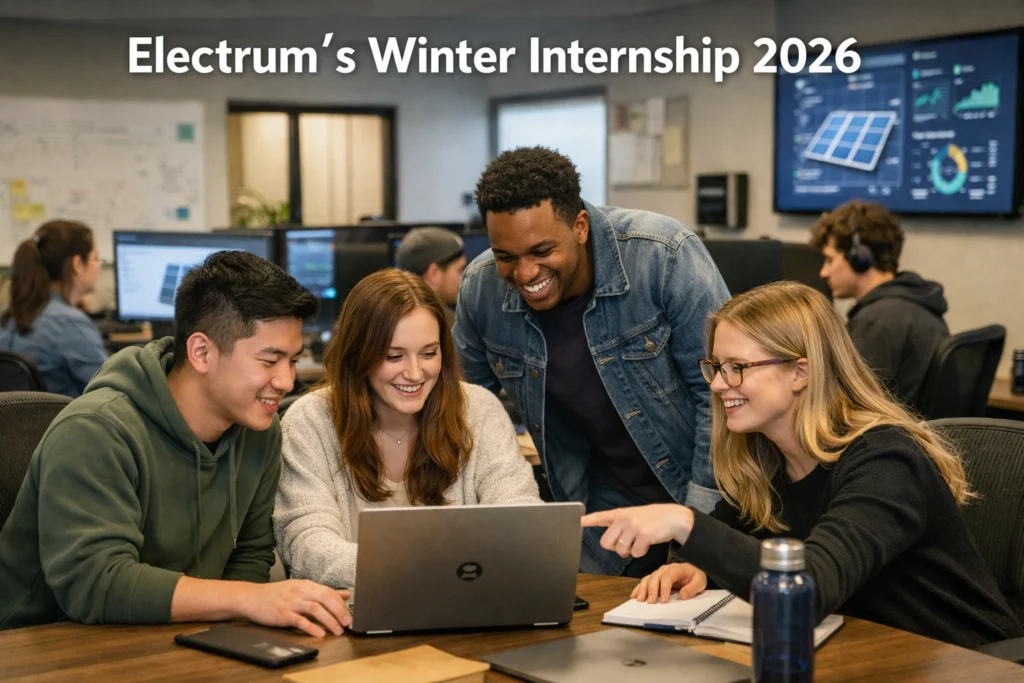
APPLY HERE: Electrum’s Winter Internship 2026
Strategic Importance for South Africa’s Digital Economy
Beyond individual career benefits, programmes like the Electrum Winter Internship 2026 have broader economic implications.
South Africa’s digital economy depends heavily on:
- Secure and efficient payment systems
- Scalable financial infrastructure
- Skilled software engineers and developers
By investing in early-stage talent development, fintech companies contribute to national capacity building. They help ensure that the country can compete globally in financial technology innovation.
This is particularly important as digital financial services expand into underserved areas, requiring solutions that are both scalable and locally relevant.
Internships, therefore, are not just educational tools—they are strategic investments in the country’s technological future.
What This Means Going Forward
The Electrum Winter Internship 2026 reflects a broader shift in how careers in technology are built. The traditional pathway—complete a degree, then seek employment—is being replaced by a more integrated model where education and industry experience overlap.
Looking ahead, several developments are likely:
Increased competition for high-quality internships
As awareness grows, more students will compete for limited spots, raising the bar for entry.
Greater emphasis on practical skills
Academic performance will remain important, but demonstrable experience will become a key differentiator.
Expansion of fintech talent pipelines
More companies may adopt similar programmes to secure early access to skilled candidates.
Stronger alignment between universities and industry
Curricula may increasingly incorporate practical components aligned with industry needs.
For students, the implication is clear: waiting until graduation to gain experience is no longer sufficient. Early engagement with industry—through internships, projects, and self-directed learning—is becoming essential.
Final Analysis
The Electrum Winter Internship 2026 is more than a four-week programme—it is a microcosm of how the tech and fintech industries are evolving. It addresses a fundamental gap between academic learning and professional readiness, while also contributing to the broader development of South Africa’s digital economy.
Its emphasis on real-world projects, mentorship, and collaborative culture positions it as a high-value opportunity for students who are serious about entering the fintech space.
For those who meet the criteria, the message is straightforward: this is not just an internship to consider—it is a strategic step toward long-term career relevance in one of the fastest-growing sectors of the global economy.
APPLY HERE: Electrum’s Winter Internship 2026
ALSO APPLY FOR: Midvaal Local Municipality Fire Fighter Internships 2026