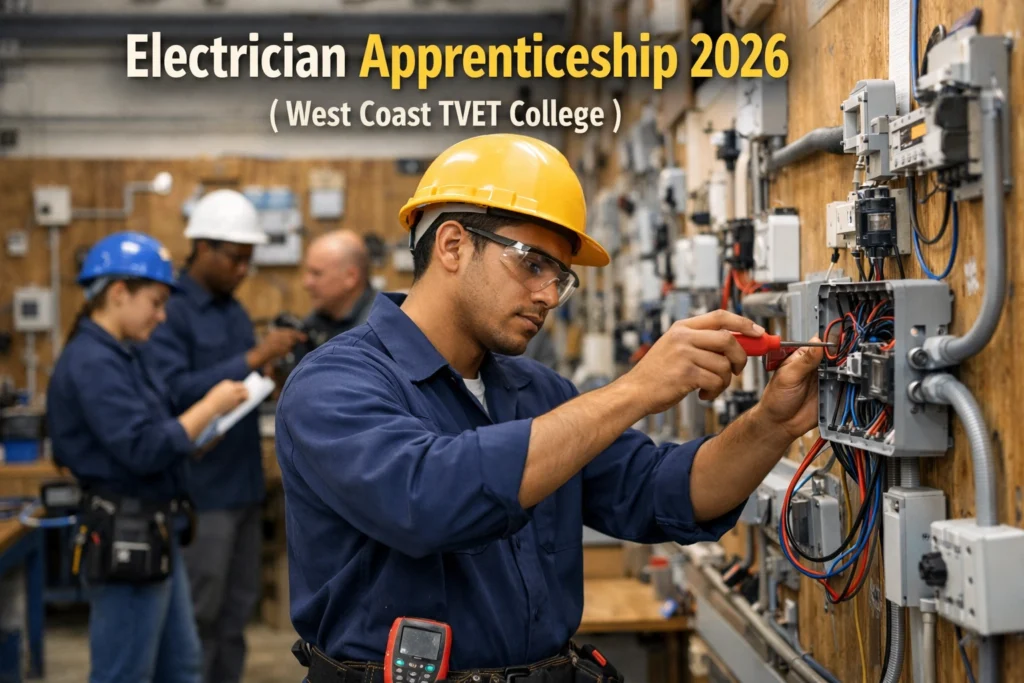

South Africa’s skills economy is shifting—and quietly, one of the most talked-about opportunities right now is the Electrician Apprenticeship 2026 at West Coast TVET College.
It’s not because of flashy marketing or massive intake numbers. In fact, it’s the opposite: only five positions are available. That scarcity, combined with a low entry barrier and strong career prospects, is exactly why this programme is suddenly trending among young job seekers and education observers.
At a time when unemployment remains stubbornly high and traditional academic pathways don’t guarantee jobs, opportunities like this are becoming more than just training programmes—they’re entry points into stable, technical careers.
A Quiet Opportunity With Loud Implications
On paper, the programme seems straightforward:
- Programme: Occupational Certificate: Electrician (Year 1)
- Institution: West Coast TVET College
- Campus: Vredenburg
- Funding Partner: FoodBev SETA
- Minimum Requirement: Grade 9
- Monthly Stipend: R3 000
- Start Date: 04 May 2026
- Closing Date: 17 April 2026
- Available Positions: 5
But beneath these details lies something much bigger: a model of accessible, skills-first education that challenges the idea that matric is the only gateway to opportunity.
This is not just another apprenticeship. It represents a strategic response to South Africa’s artisan shortage—and a glimpse into how future training programmes may be structured.
APPLY HERE: Electrician Apprenticeship 2026
How We Got Here: The Rise of Skills-Based Pathways
Over the past decade, South Africa has faced a growing mismatch between education and employment. Universities produce graduates, yet industries—especially technical sectors—continue to report shortages of skilled artisans.
Electricians, in particular, are in high demand across:
- Construction and infrastructure projects
- Manufacturing and industrial plants
- Renewable energy installations
- Municipal and utility services
Government and industry stakeholders have increasingly turned to TVET colleges and SETA-funded programmes to bridge this gap.
FoodBev SETA’s involvement in this programme signals a broader trend: sector-based investment in practical skills training. Instead of waiting for universities to adapt, industries are actively funding pipelines of job-ready talent.
And West Coast TVET College’s Vredenburg Campus is now part of that pipeline.
What Makes This Apprenticeship Different?
Several factors set this Electrician Apprenticeship 2026 apart from typical entry-level programmes.
1. Low Barrier to Entry
Requiring only Grade 9, the programme opens doors for thousands of young people who might otherwise be excluded from formal training opportunities.
This is significant in a country where many learners drop out before completing matric—not due to lack of ability, but due to financial or social constraints.
2. Earn While You Learn
The R3 000 monthly stipend may not seem like much, but it plays a crucial role.
For many applicants, it covers:
- Transport to training sites
- Daily meals
- Basic study materials
In practical terms, it removes one of the biggest barriers to education: the cost of participation.
3. Structured Career Pathway
This is not a once-off short course. It’s the first year of a nationally recognised electrician qualification pathway.
That means successful learners don’t just gain skills—they begin a journey toward becoming fully qualified artisans.
The Catch: Only Five Spots
Here’s where the story shifts from opportunity to competition.
With just five available positions, the programme becomes highly selective. This isn’t a mass intake—it’s a targeted investment in a small group of candidates.
From a policy perspective, this raises important questions:
- Are small intakes more effective for quality training?
- Or do they limit access in a country with massive demand?
For applicants, however, the takeaway is simple: every detail matters.
Incomplete applications, outdated documents, or unclear uploads could mean missing out entirely.
Public Reaction: Hope Meets Frustration
Online discussions around the programme reflect a mix of excitement and concern.
Optimism
Many young South Africans see this as a rare second chance—especially those without matric.
The idea that a Grade 9 qualification can lead to a technical career is both empowering and practical.
Skepticism
At the same time, the limited intake has sparked frustration.
Five positions in a country with millions of unemployed youth raises concerns about scale and accessibility.
Some observers argue that while programmes like this are valuable, they need to be replicated and expanded nationwide to make a meaningful impact.
Application Pressure: A Digital Bottleneck
Another emerging issue is the online application process.
While digital applications improve efficiency, they also introduce challenges:
- Limited internet access in rural areas
- Technical issues close to deadlines
- Lack of guidance for first-time applicants
This has led to increased advice circulating among applicants:
- Apply early
- Double-check document certification (must be under 3 months old)
- Ensure files are clear and readable
- Use active contact details
In a high-stakes, low-capacity programme, administrative accuracy becomes a competitive advantage.
Steps to Apply
- Visit the West Coast TVET College website
- Navigate to the student application section
- Upload all required documents
- Confirm and submit your application
- Monitor your phone and email for feedback
APPLY HERE: Electrician Apprenticeship 2026
ALSO APPLY FOR: Howden (Chart Industries) Apprenticeships 2026
Why This Matters Right Now
The timing of the Electrician Apprenticeship 2026 is not случай.
South Africa is currently navigating several overlapping challenges:
1. Youth Unemployment Crisis
With youth unemployment rates remaining extremely high, practical training opportunities are more critical than ever.
2. Energy and Infrastructure Demand
The country’s ongoing energy challenges have increased the need for qualified electricians, particularly in:
- Solar installations
- Grid maintenance
- Infrastructure upgrades
3. Shift Toward Skills Economy
There’s a growing recognition that degrees alone are not enough.
Skills-based careers—especially in trades—are gaining renewed respect and importance.
This apprenticeship sits at the intersection of all three trends, making it highly relevant in 2026.
The Real Value: Beyond the Stipend
It’s easy to focus on the R3 000 monthly stipend, but the true value of this programme lies elsewhere.
Career Stability
Electricians are among the most consistently employable professionals in the country.
Entrepreneurship Potential
Many qualified electricians go on to:
- Start their own contracting businesses
- Work independently on residential and commercial projects
Global Mobility
Electrical skills are internationally transferable, opening doors beyond South Africa.
In other words, this is not just a training opportunity—it’s a long-term economic strategy for individuals.
What Could Happen Next
Looking ahead, several possible developments could shape the future of programmes like this.
Expansion of Similar Programmes
If successful, we may see:
- Increased funding from SETAs
- More TVET colleges offering similar apprenticeships
- Larger intake numbers
Greater Focus on Renewable Energy Training
As South Africa invests more in green energy, electrician training could increasingly include:
- Solar panel installation
- Battery storage systems
- Smart grid technologies
Policy Shifts Toward Skills Development
Government may continue prioritising:
- Artisan training
- Work-integrated learning
- Industry partnerships
This could lead to a broader transformation of the education-to-employment pipeline.
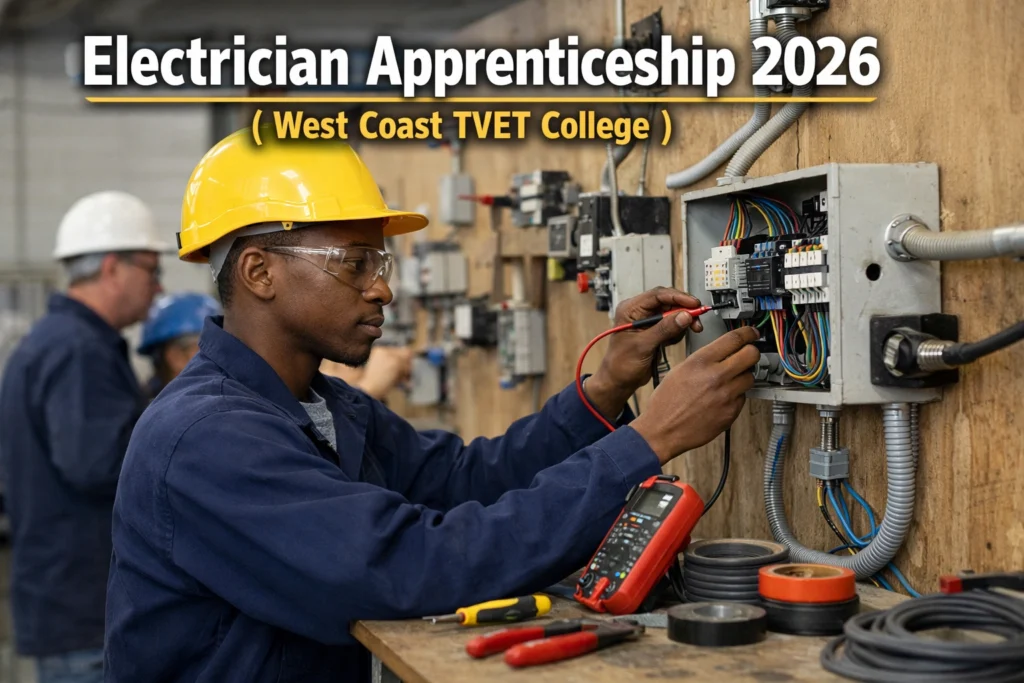
APPLY HERE: Electrician Apprenticeship 2026
A Strategic Opportunity for Applicants
For those considering applying, this is not just about submitting documents—it’s about positioning yourself strategically.
Strong applicants typically:
- Submit clean, well-organised documentation
- Highlight any practical or technical interests in their CV
- Apply early to avoid system issues
Given the competition, even small details can make a significant difference.
The Bigger Picture: Small Programme, Big Signal
While the Electrician Apprenticeship 2026 at West Coast TVET College may seem limited in scale, it sends a powerful message:
The future of work in South Africa is becoming more skills-driven, practical, and accessible.
Programmes like this challenge outdated assumptions about education and success. They show that:
- You don’t always need matric to build a career
- Technical skills can lead to financial independence
- Small opportunities can have life-changing impact
Final Thoughts
In a crowded landscape of internships, learnerships, and job listings, the Electrician Apprenticeship 2026 stands out—not because it offers the most positions, but because it offers a clear, structured pathway into a high-demand career.
Yes, the competition is intense. Yes, the intake is small.
But for the five candidates who secure a place, this could be the beginning of a stable, rewarding, and future-proof profession.
And for everyone else, it’s a reminder of where the real opportunities may lie: in the skilled trades that keep the country running.
APPLY HERE: Electrician Apprenticeship 2026
ALSO APPLY FOR: Howden (Chart Industries) Apprenticeships 2026