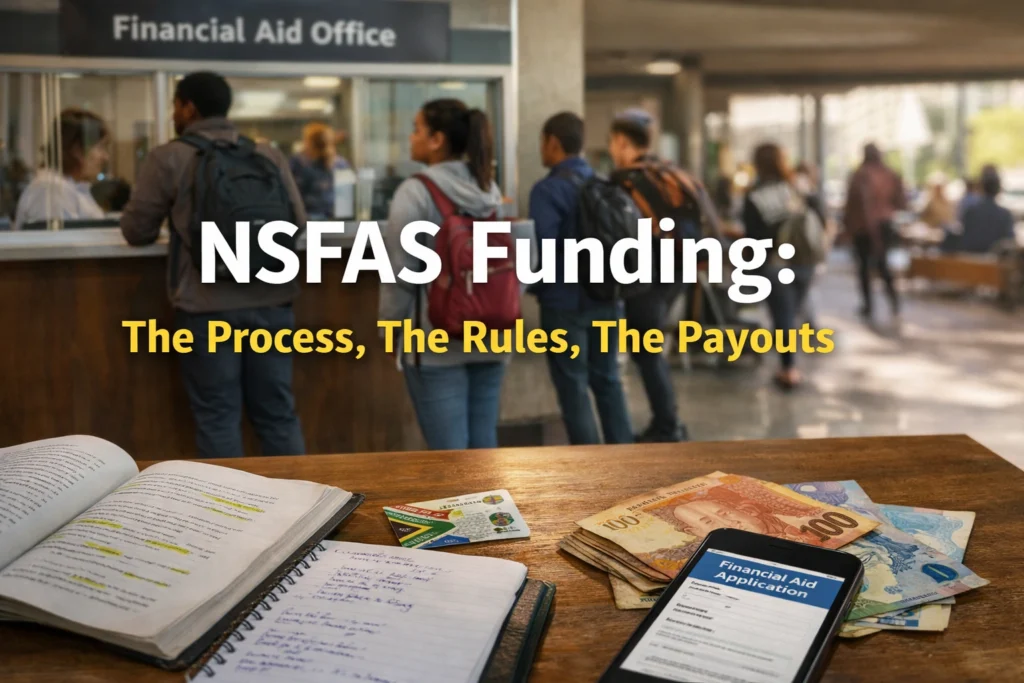

It’s just after 6 a.m. in a crowded student residence in Johannesburg. Thando sits on the edge of her bed, refreshing her phone for the fifth time. The message hasn’t changed: “Allowance payment pending.”
Around her, the morning routine continues—someone boiling water for instant coffee, another student ironing a shirt for class—but for Thando, everything feels paused. Rent is due. Transport money is gone. Lectures start in an hour. And until that NSFAS payment reflects, none of those things quite work.
For hundreds of thousands of South African students, this is not an unusual morning. It’s part of a system that has opened doors to higher education—but also introduced a new kind of uncertainty.
Understanding NSFAS Funding: The Process, The Rules, The Payouts is no longer just helpful—it’s essential for navigating student life in South Africa today.
From Application to Approval: How the Process Really Works
At its core, the National Student Financial Aid Scheme (NSFAS) exists to bridge inequality. It was designed to ensure that students from low- and middle-income households can access tertiary education without the burden of upfront costs.
But the process is far from simple.
Applications typically open months before the academic year begins. Students submit personal information, academic records, and household income details. Behind the scenes, NSFAS runs verification checks—cross-referencing data with government departments to confirm eligibility.
On paper, the process seems straightforward. In practice, delays often creep in.
Students frequently encounter “pending” statuses for weeks, sometimes months. Missing documents, system errors, or mismatched data can stall approval. For first-year students especially, this waiting period can determine whether they even arrive on campus.
What many don’t realise is that NSFAS is not just approving funding—it’s coordinating with universities and TVET colleges, aligning registration data, and confirming academic admission before releasing funds.
That coordination is where things often slow down.
And yet, despite its imperfections, the system has scaled dramatically. Millions of students have been funded over the past decade. Without NSFAS, access to universities for many would simply not exist.
ALSO APPLY FOR: BBD’s Bursary 2026
ALSO READ ABOUT: Career Planning After Matric
The Rules That Shape Student Lives
If the process determines who gets funded, the rules determine who stays funded.
NSFAS is not an unconditional grant. It comes with strict academic and administrative requirements, and these rules quietly shape how students move through their studies.
The most critical rule is academic performance.
Students must pass a certain percentage of their modules each year—usually around 50% or more, depending on the institution. Falling below that threshold can mean losing funding altogether.
This creates a high-stakes environment.
For students balancing financial pressure, family responsibilities, and academic demands, the margin for error is thin. One difficult semester can have consequences far beyond grades—it can end a student’s entire educational pathway.
There are also funding limits.
NSFAS typically covers the minimum duration of a qualification plus an additional year. Beyond that, students are expected to fund themselves. This rule encourages timely completion but can disadvantage those who need more time due to personal or academic challenges.
Then there are behavioural and administrative rules—registration deadlines, course changes, and institutional compliance requirements.
Missing a registration window or switching courses without proper approval can disrupt funding.
In other words, NSFAS doesn’t just pay for education. It enforces a structure around it.
ALSO APPLY FOR: Sasol Bursaries 2027
NSFAS Funding: The Process, The Rules, The Payouts Explained
If the process gets you in and the rules keep you there, the payouts determine how you live day to day.
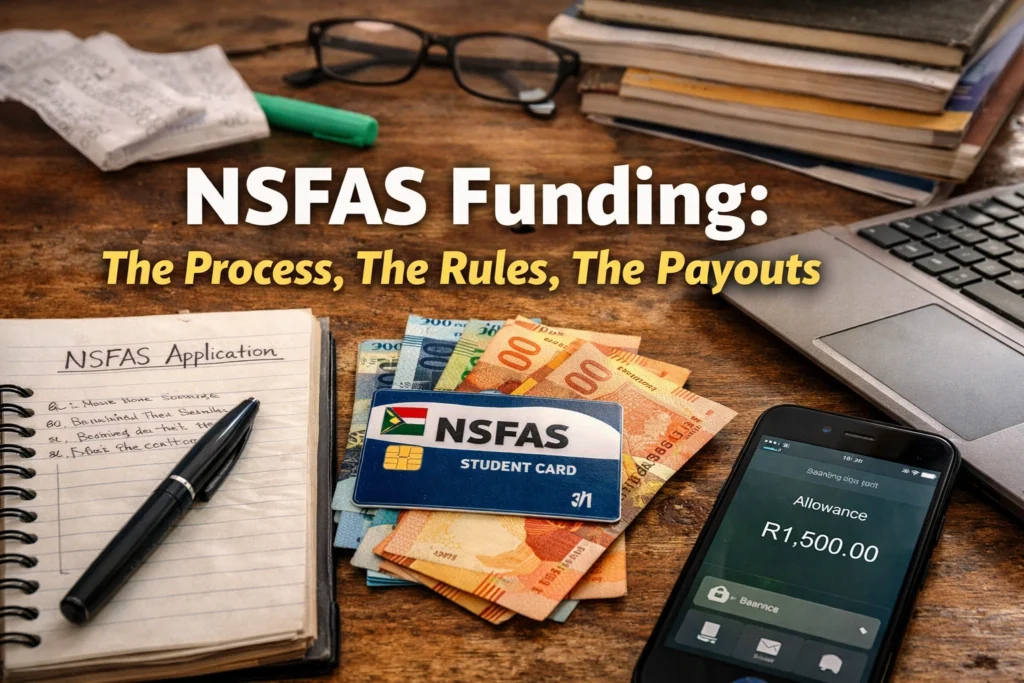
NSFAS funding is not a single payment. It’s a package of allowances designed to cover different aspects of student life:
- Tuition fees (paid directly to institutions)
- Accommodation allowances
- Transport allowances (for students living off-campus)
- Living allowances for daily expenses
- Learning material allowances
On paper, this looks comprehensive. In reality, the experience varies widely depending on the institution and payment system.
Some universities manage allowances internally. Others rely on third-party payment platforms. In recent years, NSFAS has shifted toward direct payments to students via bank accounts or digital wallets—a move aimed at improving transparency but one that has introduced new logistical challenges.
Payment delays are the most common issue.
Students often report waiting weeks into the semester before receiving their first allowance. By then, they may have already borrowed money, skipped meals, or missed classes due to lack of transport.
Another challenge is inconsistency.
Not all students receive the same amount. Allowances differ based on accommodation type, location, and institutional agreements. A student in a metropolitan university may receive a different package compared to one in a rural TVET college.
This creates a sense of inequality within a system designed to reduce inequality.
And yet, for many students, even delayed funding is better than none at all. NSFAS remains the difference between studying and not studying.
Why NSFAS Matters More Than Ever in 2026
South Africa’s economic landscape has shifted significantly in recent years. Youth unemployment remains high, and the cost of living continues to rise.
In this context, higher education is often seen as one of the few pathways to economic mobility.
NSFAS sits at the centre of that pathway.
The demand for funding has increased sharply. Each year, more students apply, more institutions rely on NSFAS-supported enrolments, and more families depend on the scheme to make education possible.
At the same time, public scrutiny has intensified.
Concerns about mismanagement, delayed payments, and system inefficiencies have sparked debates about sustainability. Can NSFAS continue to support growing demand without compromising service delivery?
The answer is still unfolding.
What is clear, however, is that NSFAS is no longer just a financial aid scheme. It’s a structural pillar of South Africa’s education system.
ALSO APPLY FOR: BBD’s Bursary 2026
ALSO APPLY FOR: Sasol Bursaries 2027
Expert Insight: The Hidden Trade-Off Behind Access
One of the less discussed aspects of NSFAS is the trade-off between access and stability.
Expanding access to education requires scale—more students, more funding, more administration. But scale introduces complexity, and complexity can lead to delays, errors, and inconsistencies.
In policy terms, this is a classic tension.
Should the system prioritise reaching as many students as possible, even if service delivery becomes uneven? Or should it focus on efficiency and reliability, even if that limits access?
NSFAS has largely chosen the first path.
The result is a system that opens doors widely—but doesn’t always guarantee a smooth journey once students walk through them.
For policymakers, the challenge moving forward is not just expanding funding, but improving the experience of being funded.
The Student Reality Behind the Numbers
It’s easy to talk about NSFAS in terms of budgets and policies. But on campus, the reality is far more personal.
Students plan their lives around payment dates. They share groceries, split transport costs, and rely on informal support networks when funding is delayed.
There’s also a psychological dimension.
Uncertainty around payments can affect concentration, attendance, and overall well-being. When students don’t know when their next allowance will arrive, it becomes harder to focus on lectures or assignments.
Yet, resilience is a defining feature of the NSFAS generation.
Students adapt. They find ways to navigate the system, support each other, and keep moving forward despite challenges.
In many ways, NSFAS funding doesn’t just shape education—it shapes a generation’s experience of adulthood.
Frequently Asked Questions
1. How long does NSFAS take to approve funding?
Approval timelines vary, but it can take several weeks to months depending on application volume and verification processes. Early application improves your chances of timely approval.
2. What happens if I fail modules while funded by NSFAS?
You may risk losing funding if you do not meet the required academic performance threshold. However, policies can vary slightly by institution.
3. When are NSFAS allowances paid?
Allowances are typically paid monthly, but delays can occur, especially at the start of the academic year or during system transitions.
The Bigger Picture: More Than Just Funding
Back in that Johannesburg residence, Thando finally sees the notification she’s been waiting for. The payment has come through.
It’s a small moment—but one that changes everything. She can get to class. She can buy food. She can continue.
That’s the real impact of NSFAS.
Beyond policies and processes, it’s about continuity—the ability for students to keep going, even when the odds are stacked against them.
NSFAS Funding: The Process, The Rules, The Payouts is not a perfect system. It has gaps, inconsistencies, and growing pains. But it also represents one of the most significant investments in educational access in South Africa’s history.
The challenge now is not just to maintain it, but to refine it—to ensure that access is matched by reliability, and opportunity is matched by support.
Because for students like Thando, funding is not just financial. It’s foundational.
ALSO APPLY FOR: BBD’s Bursary 2026
ALSO APPLY FOR: Sasol Bursaries 2027
ALSO READ ABOUT: Career Planning After Matric