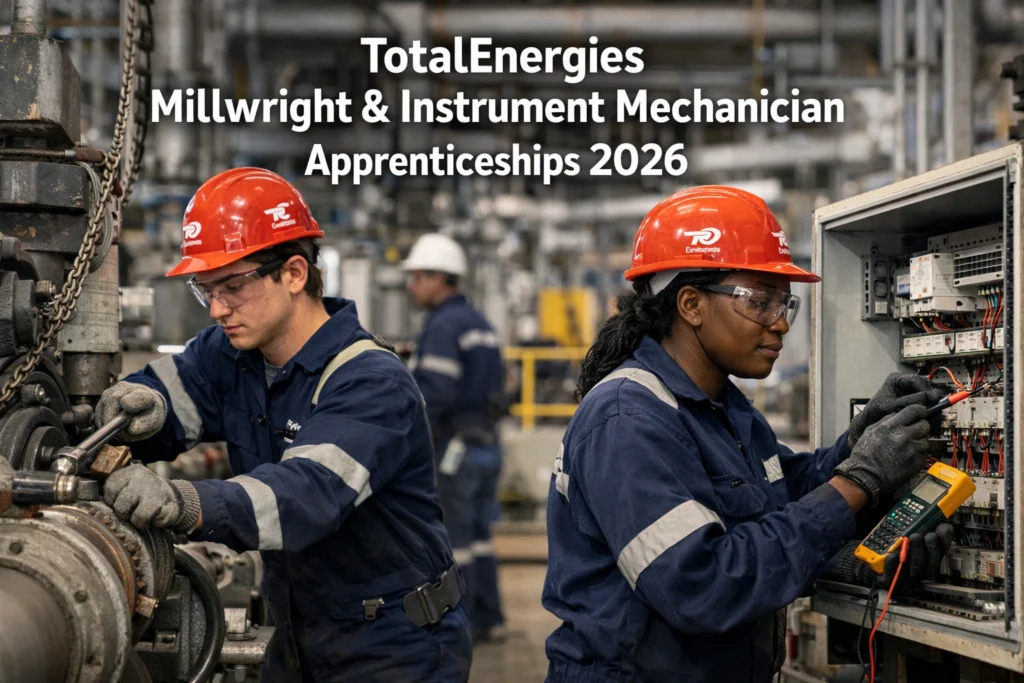

There’s a reason the TotalEnergies Millwright & Instrument Mechanician Apprenticeships 2026 are suddenly dominating job feeds, WhatsApp groups, and career portals across South Africa this week.
It’s not just another apprenticeship drop.
It’s the timing.
At a moment when thousands of young South Africans are searching for stable, skill-based career paths—and when the country is facing a growing shortage of qualified artisans—this announcement from TotalEnergies has landed with unusual weight.
And if you look closely, it says a lot more about the state of work, education, and opportunity in 2026 than it does about one programme.
A New Wave of Apprenticeships — But With Higher Stakes
Over the past few days, a pattern has emerged.
Major employers—from Transnet to private engineering firms—have started releasing apprenticeship and internship opportunities almost simultaneously. The TotalEnergies Millwright & Instrument Mechanician Apprenticeships 2026, based in Durban, are part of that surge.
But what sets this one apart is where it happens: inside a working industrial facility—the Lubricants Manufacturing Plant (LMP) located at Wharfside and Causeway Road.
That detail matters.
Because unlike purely classroom-based training or short-term internships, this programme places candidates directly inside the operational core of an energy company. It’s where theory meets machinery, and where mistakes have real consequences.
For many applicants, that’s exactly what makes it appealing.
APPLY HERE
TotalEnergies Apprenticeships 2026
Instrument Mechanician Apprenticeship:
What the Programme Actually Offers (Beyond the Brochure)
On paper, the structure is straightforward:
- Hands-on training in a real plant environment
- Exposure to experienced maintenance teams
- Formal technical learning alongside practical work
- Completion of logbooks, assessments, and trade-related competencies
But beneath that structure is something deeper: a pipeline into the artisan economy.
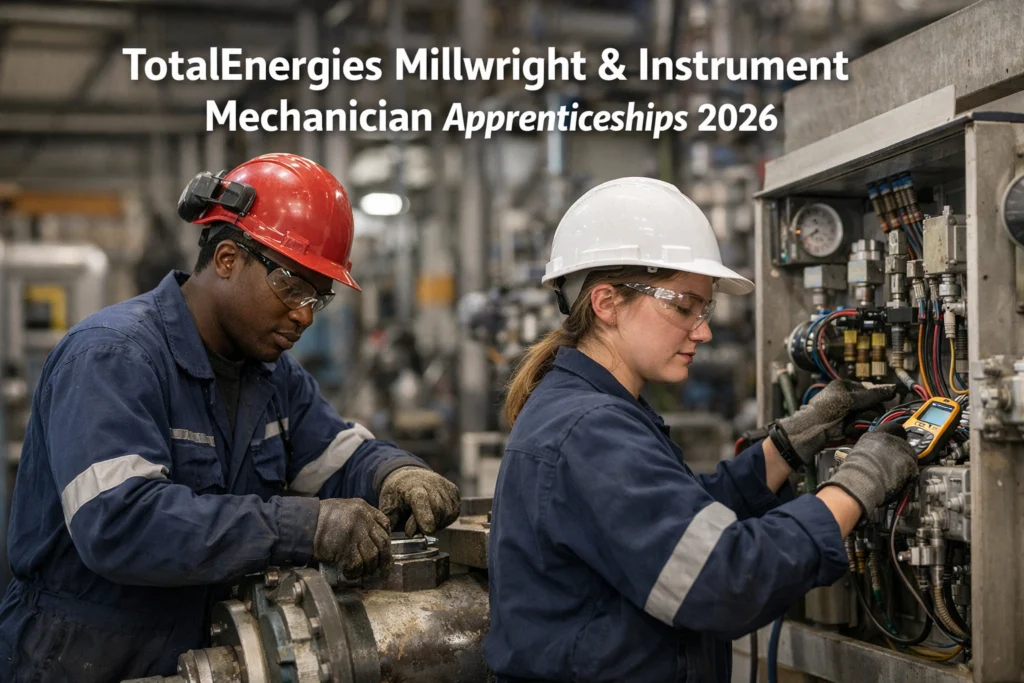
The Millwright Apprenticeship blends mechanical and electrical systems—essentially training multi-skilled technicians who can troubleshoot complex machinery.
The Instrument Mechanician Apprenticeship, on the other hand, focuses on control systems, sensors, and automation—skills that are increasingly critical as industries move toward smarter, more digitised operations.
These are not entry-level “job shadowing” roles.
They are foundational career pathways.
ALSO APPLY FOR: Chart Industries Apprenticeship 2026
The Bigger Context: South Africa’s Artisan Gap
To understand why this programme is attracting attention, you have to look at what’s happening nationally.
South Africa has been dealing with a persistent shortage of skilled artisans—millwrights, electricians, instrument technicians—for years. Infrastructure demands, industrial expansion, and maintenance backlogs have all increased the need for technical expertise.
Yet the supply pipeline hasn’t kept up.
Many young people leave school without access to quality technical training. Others pursue degrees that don’t translate easily into employment.
Apprenticeships like this one sit at the intersection of those challenges.
They offer:
- A structured alternative to university
- Direct access to industry experience
- A clearer path to employment
And crucially, they align with what employers actually need.
Inside the Work: Not for Everyone
There’s a tendency to romanticise apprenticeships—but the reality is far more demanding.
The TotalEnergies programme makes that clear.
Candidates must be:
- Physically fit
- Willing to work at heights (on tanks and platforms)
- Comfortable in confined spaces
- Prepared for shift work and overtime
This isn’t an office job.
It’s industrial work—sometimes dirty, often physically demanding, and always safety-critical.
Apprentices are expected to follow strict HSSEQ (Health, Safety, Security, Environment, and Quality) standards, wear PPE at all times, and actively report hazards.
In other words, they are treated like professionals from day one.
For the right candidate, that’s empowering.
For others, it can be a shock.
Why Durban Matters More Than You Think
The location—Durban—is not just a logistical detail.
As one of South Africa’s key port cities, Durban plays a central role in manufacturing, logistics, and energy distribution.
Training in this environment offers exposure to:
- High-volume industrial operations
- Supply chain dynamics
- Real-world engineering challenges
It also places apprentices in a region where technical skills are in constant demand.
That geographic advantage could influence employment outcomes long after the programme ends.
Public Reaction: Excitement, Pressure, and Skepticism
Online, the reaction has been immediate.
Across platforms, three dominant sentiments are emerging:
1. Excitement
Many young people see this as a rare opportunity to gain real engineering experience without needing a university degree.
There’s a growing awareness that artisan careers can be both stable and financially rewarding.
2. Pressure
With limited spots and high demand, competition is expected to be intense.
Applicants are already sharing tips on how to prepare CVs, certify documents, and improve their chances.
3. Skepticism
Some voices remain cautious.
Questions are being raised about:
- How many positions are actually available
- Whether apprentices transition into permanent roles
- The long-term career trajectory after completion
These concerns aren’t new—but they reflect a broader uncertainty about employment pathways in South Africa.
The Fine Print: Requirements That Shape Who Gets In
The entry criteria seem accessible—but they also act as filters.
Applicants need:
- Matric with Mathematics and Physical Science
or - N3–N6 Engineering qualifications (Mechanical or Electrical/Electronic)
Plus:
- Supporting documents (CV, ID, academic records, proof of residence)
- Physical readiness for industrial work
On the surface, that opens the door to many.
In reality, it still excludes a large portion of youth who lack strong maths and science backgrounds.
This highlights a deeper issue: access to technical careers often starts long before applications open.
Why This Matters Right Now
The TotalEnergies Millwright & Instrument Mechanician Apprenticeships 2026 arrive at a critical moment.
South Africa is facing:
- High youth unemployment
- Growing demand for technical skills
- Increased focus on vocational training
At the same time, there’s a shift in how young people think about careers.
University is no longer the only “respectable” path.
Artisan trades—once overlooked—are gaining recognition as viable, even strategic, choices.
This programme reflects that shift.
It’s not just about filling positions.
It’s about redefining what opportunity looks like in a changing economy.
Instrument Mechanician Apprenticeship:
What Makes This Programme Stand Out
Not all apprenticeships are created equal.
Several factors give this one an edge:
Global Company Exposure
Working under TotalEnergies provides insight into international standards, systems, and practices.
Real Industrial Environment
Training happens inside a functioning plant—not a simulated setting.
Dual Learning Model
The combination of theory and hands-on work strengthens skill retention and practical competence.
Industry-Relevant Skills
Millwright and instrumentation skills are directly aligned with market demand.
These elements increase the likelihood that participants leave with not just experience—but employable expertise.
What Could Happen Next
Looking ahead, several outcomes are possible.
1. Increased Competition Across Apprenticeships
As more young people recognize the value of artisan careers, demand for similar programmes is likely to rise.
2. Expansion of Industry-Led Training
Companies may invest more in apprenticeships to address skill shortages internally.
3. Greater Policy Focus on Vocational Pathways
Government and institutions could strengthen support for technical education.
4. Changing Career Narratives
We may see a cultural shift where becoming a qualified artisan is viewed as equal—or even preferable—to traditional degree paths.
5. Pressure on Programme Transparency
As demand grows, applicants will expect clearer communication about selection processes and outcomes.
The Quiet Reality: Opportunity vs Access
For all its promise, this programme also highlights a tension.
Opportunities like this exist.
But access remains uneven.
Not everyone has:
- The required academic background
- Awareness of application processes
- Resources to prepare competitive submissions
Bridging that gap will require more than individual programmes.
It will require systemic change.
Final Thoughts: More Than Just an Apprenticeship
The TotalEnergies Millwright & Instrument Mechanician Apprenticeships 2026 are not just another listing on a job board.
They represent:
- A shift toward skills-based careers
- A response to real industry needs
- A glimpse into the future of work in South Africa
For some, it will be a life-changing opportunity.
For others, it’s a reminder of how competitive—and complex—the path to employment has become.
Either way, the attention this programme is receiving tells a bigger story.
One where practical skills, real-world experience, and adaptability are becoming the new currency of opportunity.
TotalEnergies Apprenticeships 2026
Instrument Mechanician Apprenticeship:
ALSO APPLY FOR: Chart Industries Apprenticeship 2026