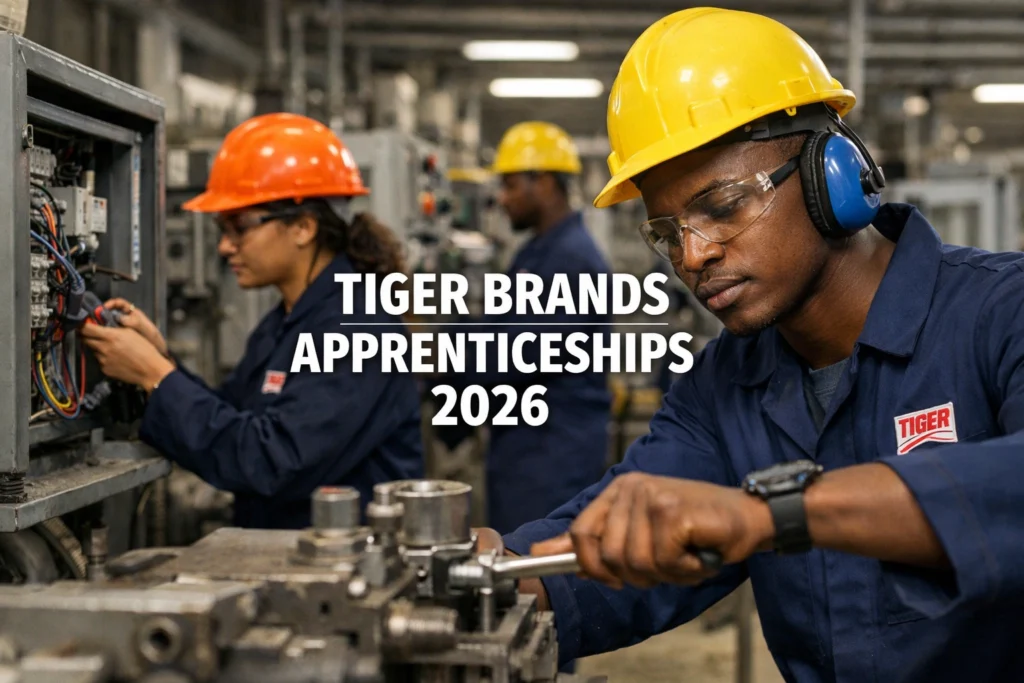

Tiger Brands Apprenticeships 2026: South Africa’s persistent youth unemployment crisis continues to collide with a paradox: while millions of young people struggle to find work, industries—particularly manufacturing—face an ongoing shortage of skilled technical artisans. It is within this tension that programmes like the Tiger Brands Apprentices initiative become especially significant.
Tiger Brands, one of the country’s most established food manufacturing companies, is offering 20 apprenticeship opportunities across three critical trades: Millwright, Instrumentation Technician, and Electrician. On the surface, this may appear to be just another training opportunity. But viewed through an analytical lens, it represents something more profound—a structured pipeline into scarce skills, a test of industry-led training models, and a potential blueprint for bridging South Africa’s skills gap.
This article unpacks the deeper implications of the Tiger Brands Apprentices programme, examining its role in workforce development, the strategic importance of the trades involved, and what it signals for the future of technical careers in South Africa.
Understanding the Context: Why Apprenticeships Matter More Than Ever
South Africa’s labour market has undergone significant transformation over the past decade. While sectors like finance and services have expanded, traditional industries such as manufacturing have experienced both decline and reinvention. Automation, digitisation, and global competition have reshaped how factories operate.
Yet one constant remains: the demand for skilled artisans.
Millwrights, electricians, and instrumentation technicians are foundational to industrial productivity. Without them, machinery fails, production halts, and efficiency drops. Despite this, the country produces fewer qualified artisans than industry requires—a gap that has persisted for years.
This is where structured apprenticeships like the Tiger Brands Apprentices programme become essential. Unlike short-term learnerships, apprenticeships offer long-term, immersive training that combines theory with real-world application over four to five years. This duration is not incidental—it reflects the complexity and depth required to master technical trades.
In many ways, the programme aligns with broader national priorities: reducing youth unemployment, strengthening technical education pathways, and revitalising the manufacturing sector.
The Strategic Value of the Tiger Brands Apprentices Programme
The Tiger Brands Apprentices initiative is not simply about filling vacancies—it is about building capability within a high-performance manufacturing ecosystem.
1. Integration of Training and Production
One of the defining features of this programme is its dual structure: formal technical training in Gauteng combined with on-the-job experience in a live manufacturing environment.
This approach addresses a long-standing issue in South Africa’s education system—graduates often lack practical exposure. By embedding apprentices directly into production settings, Tiger Brands ensures that learning is contextual, immediate, and relevant.
Participants don’t just learn how machines work; they understand how those machines impact production targets, quality control, and operational efficiency.
2. Alignment with Industry Standards
The programme emphasizes safety, operational discipline, and technical precision. These are not optional extras—they are core competencies in manufacturing.
By training apprentices within a company known for high standards, the programme effectively raises the benchmark for what qualified artisans should be able to do. This has a ripple effect across the industry, as trained artisans carry these standards into future roles.
3. Long-Term Talent Pipeline Development
Rather than hiring already-qualified artisans—who are often scarce and expensive—Tiger Brands is investing in developing its own talent pipeline.
This strategy offers multiple advantages:
- Greater control over skill development
- Stronger alignment with company processes
- Higher employee retention rates
From a business perspective, this is both a cost-effective and sustainable approach to workforce planning.
APPLY HERE: Tiger Brands Apprenticeships 2026
ALSO APPLY FOR: Remote Care Space Apprentice (Learner Technician)-2026
Why These Trades Matter: Millwright, Instrumentation, and Electrical Skills
The choice of trades within the Tiger Brands Apprentices programme is deliberate. Each represents a critical component of modern manufacturing systems.
Millwright: The Backbone of Industrial Maintenance
Millwrights are multi-skilled artisans who combine mechanical and electrical expertise. In a manufacturing environment, they are responsible for installing, maintaining, and repairing machinery.
As factories become more automated, the role of the millwright becomes even more complex. Today’s millwright must understand not only mechanical systems but also programmable logic controllers (PLCs) and digital interfaces.
This makes millwrights among the most versatile—and in-demand—artisans in the country.
Instrumentation Technician: The Rise of Precision and Automation
Instrumentation technicians focus on the systems that measure and control industrial processes. In food manufacturing, this includes monitoring temperature, pressure, flow rates, and other variables critical to product quality.
With the increasing adoption of Industry 4.0 technologies, this trade is becoming more important. Data-driven production relies heavily on accurate instrumentation, making these technicians central to modern operations.
Electrician: The Foundation of Operational Continuity
Electricians ensure that all electrical systems within a facility function safely and efficiently. From power distribution to fault diagnosis, their work underpins every aspect of production.
In a high-volume manufacturing environment, even a minor electrical failure can result in significant downtime. Skilled electricians are therefore essential for maintaining productivity and minimizing losses.
The Candidate Profile: What the Requirements Reveal
The eligibility criteria for the Tiger Brands Apprentices programme offer insight into the type of candidate the company is targeting.
Technical Readiness
Applicants must hold an N6 qualification with strong performance in Mathematics, Physical Science, Engineering Drawings, and Trade Theory. This requirement signals that the programme is not introductory—it builds on existing technical knowledge.
A minimum average of 65% further reinforces the expectation of academic competence. This is not just about passing; it’s about demonstrating the ability to handle complex material.
Adaptability and Work Ethic
The requirement to work shifts, overtime, and public holidays reflects the realities of manufacturing. Production does not stop, and neither can the workforce.
Similarly, the willingness to travel and attend training in Gauteng highlights the need for flexibility. Apprentices must be prepared to step outside their comfort zones.
Soft Skills and Attitude
While technical ability is crucial, the programme also values problem-solving, collaboration, and reliability. These attributes often determine long-term success more than technical skills alone.
In essence, the ideal candidate is not just technically capable but also adaptable, disciplined, and motivated to grow.
Learning Through Immersion: The Role of Mentorship and Assessment
One of the most powerful aspects of the Tiger Brands Apprentices programme is its emphasis on mentorship.
Apprentices work alongside experienced technicians and artisans, gaining insights that cannot be taught in a classroom. This transfer of tacit knowledge—practical know-how developed over years—is what transforms a trainee into a competent artisan.
Regular technical assessments ensure that progress is measurable and consistent. This structured evaluation process serves two purposes:
- It maintains high standards
- It provides feedback for continuous improvement
Over four to five years, this combination of mentorship and assessment creates a robust learning environment that prepares apprentices for real-world challenges.
APPLY HERE: Tiger Brands Apprenticeships 2026
Tiger Brands Apprentices and the Broader Economic Landscape
The significance of the Tiger Brands Apprentices programme extends beyond individual participants.
Addressing the Skills Shortage
South Africa’s shortage of artisans has been widely documented. Programmes like this directly contribute to closing that gap.
Each qualified artisan adds value not only to their employer but also to the broader economy. Skilled workers increase productivity, reduce downtime, and support industrial growth.
Supporting Industrial Competitiveness
Manufacturing remains a key driver of economic development. However, global competition requires local industries to operate efficiently and innovate continuously.
By investing in skills development, companies like Tiger Brands enhance their competitiveness while contributing to national economic resilience.
Creating Pathways for Youth Employment
For young people aged 18 to 29, apprenticeships offer a viable alternative to traditional academic routes. They provide:
- Practical experience
- Income opportunities (in many cases)
- Clear career progression
In a country where youth unemployment remains high, these pathways are invaluable.
What Success Looks Like in Practice
Success within the Tiger Brands Apprentices programme is defined by more than just completing the training.
It involves:
- Demonstrating consistent technical improvement
- Applying knowledge effectively in real-world scenarios
- Adhering to safety and operational standards
- Collaborating within production teams
Ultimately, the goal is to produce artisans who are not only qualified but also capable of contributing meaningfully from day one.
What This Means Going Forward
The Tiger Brands Apprentices initiative offers several important signals about the future of work and skills development in South Africa.
First, it highlights a shift toward employer-driven training models. Companies are increasingly taking responsibility for developing their own talent rather than relying solely on external institutions.
Second, it underscores the growing importance of technical careers. As automation and technology reshape industries, demand for skilled artisans is likely to increase rather than decline.
Third, it suggests that long-term, structured programmes are more effective than short-term interventions. The depth of training provided over four to five years cannot be replicated in shorter formats.
Looking ahead, the success of initiatives like this could encourage more companies to invest in similar programmes. This would not only benefit individual participants but also strengthen the country’s overall skills base.
A Strategic Opportunity for the Right Candidates
The Tiger Brands Apprentices programme is not an easy path. It requires commitment, discipline, and resilience over several years. But for those who meet the requirements and embrace the challenge, it offers a powerful opportunity.
In a labour market defined by uncertainty, technical skills provide a degree of stability and mobility. Qualified artisans are needed across industries, making this a career path with long-term potential.
For young South Africans with the right qualifications and mindset, this programme represents more than just training—it is a gateway into a skilled profession and a meaningful role within the country’s industrial future.
APPLY HERE: Tiger Brands Apprenticeships 2026
ALSO APPLY FOR: Remote Care Space Apprentice (Learner Technician)-2026