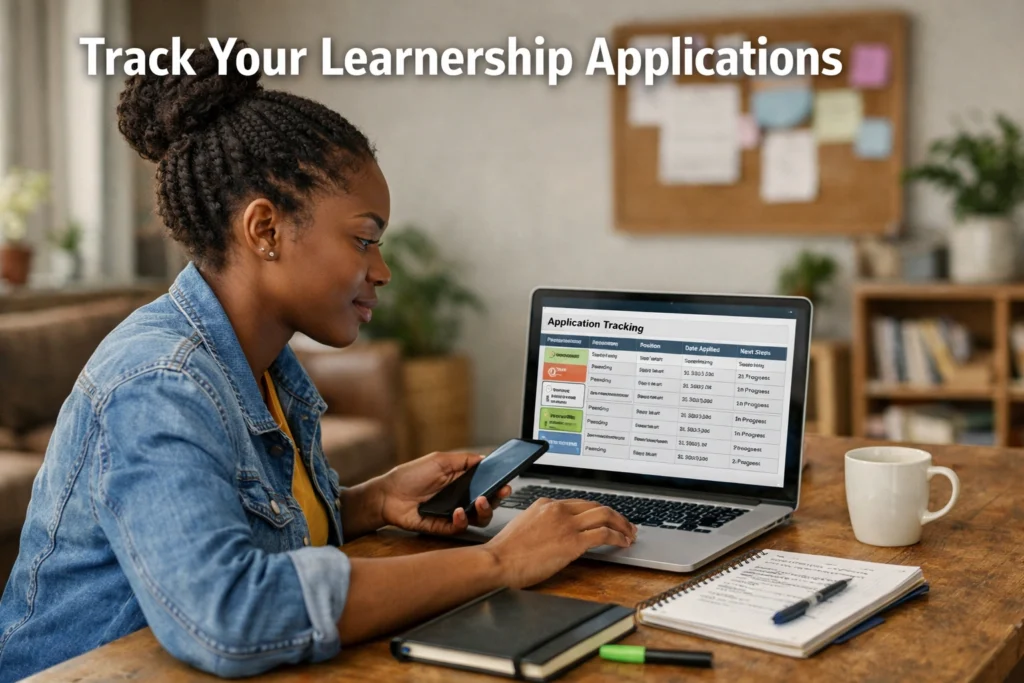

Track Your Learnership Applications: It’s a Tuesday morning in Johannesburg. Thabo sits at a crowded taxi rank, scrolling through his phone, refreshing his email for the fifth time in ten minutes. Two weeks ago, he applied for three learnerships—one in logistics, another in retail, and a third with a manufacturing company in Germiston. Now, like many young South Africans trying to break into the job market, he’s stuck in a familiar cycle: uncertainty, silence, and second-guessing.
“Did I apply correctly? Did I miss something? Should I follow up—or just wait?”
This quiet anxiety is rarely discussed, but it’s one of the most frustrating parts of the learnership journey. Applying is only half the battle. The real challenge lies in staying organised, tracking progress, and keeping your momentum alive while opportunities slowly unfold.
Understanding How to Track Your Learnership Applications isn’t just about admin—it’s about control, clarity, and resilience in a competitive environment.
Why Tracking Your Applications Is More Important Than You Think
In South Africa’s current job climate, learnerships have become a vital entry point into the workforce. Government departments, SETAs, and private companies offer thousands of opportunities every year—but they also receive tens of thousands of applications.
This creates a simple but harsh reality:
If you’re not tracking your applications, you’re likely losing opportunities without even realising it.
Many applicants rely on memory or scattered WhatsApp messages to keep track. Over time, details blur. Deadlines pass. Follow-ups are forgotten. And when an employer calls back, some candidates struggle to even remember which position they applied for.
Tracking is not just about staying organised—it signals seriousness. It helps you:
- Respond quickly when contacted
- Prepare properly for interviews
- Identify patterns in rejections or silence
- Stay motivated instead of feeling lost
In a system where competition is high and communication is often delayed, organisation becomes your advantage.
ALSO APPLY FOR: HEINEKEN Learnerships 2026
ALSO APPLY FOR: Fidelity Services Group Installation Learnership Opportunity 2026
The Real Challenge: Silence and Uncertainty
One of the most difficult aspects of learnership applications is the waiting period.
Unlike formal job processes, many learnership programmes do not provide regular updates. You might apply through a website, email, or even hand-delivered forms—and then hear nothing for weeks or months.
This silence creates emotional fatigue. Some applicants assume rejection too early and stop applying. Others forget where they applied and miss important responses.
Tracking your applications helps you navigate this uncertainty with structure instead of stress.
How to Track Your Learnership Applications Effectively
At its core, tracking is about creating a system that works for you—not something complicated, but something consistent.
The most effective approach is surprisingly simple: build your own personal tracking system.
Start with a basic tracking sheet
You don’t need advanced software. A notebook, spreadsheet, or even your phone notes app can work. What matters is capturing key details every time you apply.
Include:
- Company or organisation name
- Position or learnership title
- Application date
- Closing date
- Method of application (email, website, walk-in)
- Contact details (if available)
- Status (applied, shortlisted, rejected, no response)
This becomes your personal dashboard—a clear overview of your efforts.
Use your email as a tracking tool
Most applications involve email confirmations or attachments. Instead of letting your inbox become cluttered:
- Create a folder called “Learnership Applications”
- Move every application email into that folder
- Flag important messages for follow-up
This way, you always have a record—even months later.
Set follow-up reminders
A common mistake is either following up too soon or not at all.
A good rule:
Set a reminder 2–3 weeks after applying if no response has been received.
This doesn’t guarantee feedback, but it shows initiative and keeps your application active in your mind.
ALSO READ ABOUT: Top Industries Offering Learnerships in South Africa
When Tracking Becomes Strategy, Not Just Admin
Once you start tracking consistently, something interesting happens—you begin to see patterns.
You may notice that:
- Certain industries respond faster than others
- Some companies frequently repost the same learnerships
- Your applications improve over time
- You tend to apply more during certain periods
This is where tracking shifts from being a simple task to a strategic tool.
Instead of applying randomly, you begin to refine your approach.
For example, if you see that logistics companies respond more frequently than retail ones, you might prioritise similar opportunities. If you notice repeated silence from a certain platform, you might switch to another.
Tracking transforms your approach from passive to intentional.
The Emotional Side: Staying Motivated While Waiting
Let’s be honest—tracking won’t eliminate rejection or silence. But it does something equally important: it keeps you grounded.
When you can see that you’ve applied to 15 opportunities in one month, it changes your mindset. You’re no longer “stuck”—you’re actively working toward something.
This is especially important in communities where unemployment is high, and opportunities feel distant. In cities like Johannesburg, Durban, or Cape Town, competition can be intense, and waiting can feel endless.
Tracking gives you proof of effort.
It turns invisible work into visible progress.
Common Mistakes People Make When Tracking Applications
Even when people try to stay organised, a few habits can reduce effectiveness.
Here’s what to avoid:
- Relying on memory instead of writing things down
- Tracking only some applications, not all
- Failing to update statuses regularly
- Ignoring follow-ups completely
- Overcomplicating the system until it becomes unsustainable
The best system is one you actually use. Consistency beats perfection.

ALSO APPLY FOR: HEINEKEN Learnerships 2026
ALSO APPLY FOR: Fidelity Services Group Installation Learnership Opportunity 2026
Expert Insight: Why Tracking Matters in a Competitive Youth Job Market
From a labour market perspective, tracking your applications reflects a deeper shift in how young people engage with opportunities.
In today’s economy, particularly in South Africa, the transition from education to employment is no longer linear. Learnerships, internships, and short-term programmes have become stepping stones rather than final destinations.
This means applicants must manage multiple opportunities simultaneously—often without formal guidance.
Tracking applications is, in essence, a form of self-management. It builds skills that go beyond job searching:
- Personal organisation
- Time management
- Professional communication
- Strategic thinking
These are the same skills employers look for later in the workplace.
In other words, how you manage your applications today can shape how you perform in your career tomorrow.
A Practical System You Can Start Today
If you’re unsure where to begin, keep it simple and realistic.
Try this:
- Create a single document or notebook
- Record every application immediately after submitting
- Check and update your list twice a week
- Set reminders for follow-ups
- Review your progress at the end of each month
This small routine can completely change your experience.
Frequently Asked Questions
1. How long should I wait before following up on a learnership application?
It’s best to wait at least 2–3 weeks after the closing date. If no response comes, a polite follow-up email or call can show initiative without seeming impatient.
2. What should I do if I lose track of where I applied?
Start fresh by creating a tracking system immediately. Go through your email history to recover past applications and rebuild your list.
3. Does tracking really improve my chances of getting selected?
While it doesn’t directly influence selection, it improves your preparedness, response time, and professionalism—all of which can make a difference when opportunities arise.
The Bigger Picture: Turning Effort Into Opportunity
At first glance, tracking your learnership applications might seem like a small administrative habit. But in reality, it’s something much bigger.
It’s about taking control in a system that often feels unpredictable.
It’s about staying focused when responses are delayed.
And most importantly, it’s about recognising that every application is part of a larger journey—not just a single outcome.
For thousands of young South Africans navigating the transition into the workforce, the difference between feeling stuck and moving forward often comes down to structure.
Thabo, sitting at that taxi rank, doesn’t need more luck. He needs clarity.
And sometimes, clarity starts with something as simple as writing things down.
ALSO READ ABOUT: Top Industries Offering Learnerships in South Africa