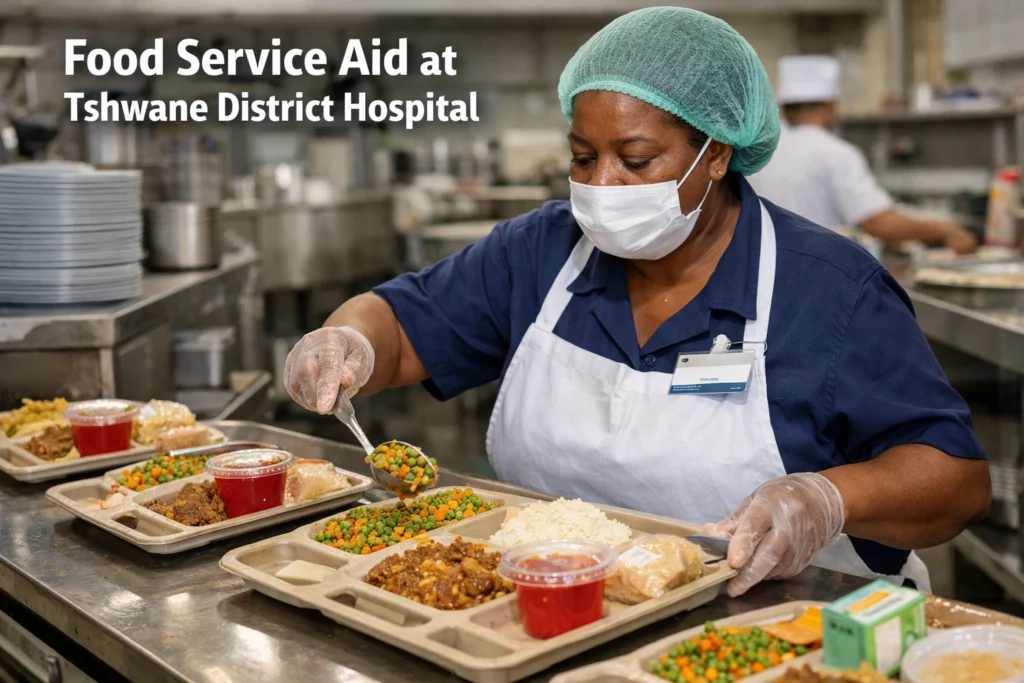

Food Service Aid: At 5:30 a.m., before the first ward rounds begin, the kitchen at Tshwane District Hospital is already alive. Stainless steel counters are wiped down, trays are lined up, and the smell of porridge slowly fills the room. Patients upstairs may never see the people preparing their meals, but their recovery depends on this quiet, consistent work.
This is where the role of a Food Service Aid becomes more than just a job title. It becomes part of the daily rhythm of care—ensuring that every patient receives safe, nutritious meals on time, in an environment where hygiene and precision matter just as much as compassion.
With the Gauteng Department of Health now recruiting for this position, the opportunity speaks not only to job seekers looking for entry-level work, but also to a broader reality: healthcare systems rely heavily on roles that often go unnoticed.
A Practical Entry Into Public Healthcare
In South Africa, access to employment remains one of the most pressing challenges, particularly for individuals with limited formal qualifications. Roles like Food Service Aid offer a rare and practical entry point into the public sector.
At a minimum, candidates need ABET Level 4 (approximately Grade 9), making the position accessible to many who are often excluded from formal employment pathways. But accessibility doesn’t mean simplicity. The expectations are clear: discipline, reliability, and a strong understanding of hygiene practices.
This is especially relevant in a healthcare setting, where food is not just about nutrition—it is part of treatment. A patient recovering from surgery, for example, may require carefully portioned meals, while others depend on strict dietary controls. A mistake in food handling is not just inconvenient—it can be dangerous.
The advertised salary of R138,486 per annum plus benefits reflects the public sector’s structured pay scale, but the real value lies in stability and experience. For many, this role becomes a stepping stone toward long-term employment within the health system.
What the Job Actually Looks Like Day-to-Day
It’s easy to underestimate the scope of a Food Service Aid’s responsibilities. In reality, the role combines physical work, attention to detail, and teamwork in a fast-paced environment.
A typical day may include:
- Preparing basic meals such as breakfast items
- Portioning food according to strict dietary guidelines
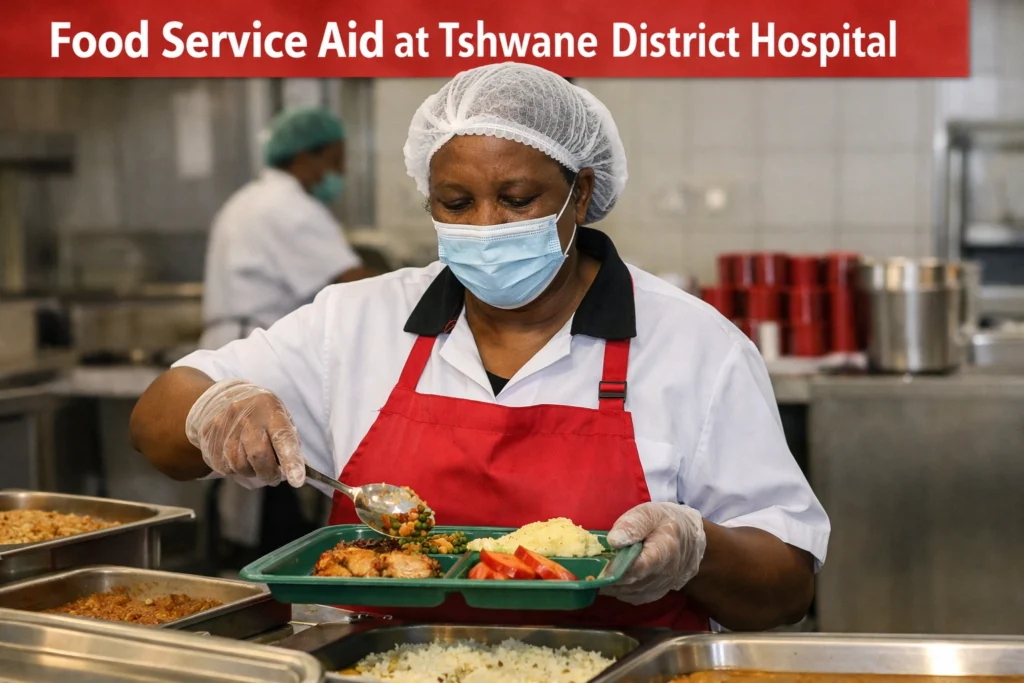
- Delivering meals to different wards
- Cleaning kitchen areas and maintaining hygiene standards
- Handling and storing food supplies safely
- Assisting with special hospital functions or events
Beyond these tasks, there is a constant emphasis on infection prevention and control. Hospitals are high-risk environments, and food service staff play a direct role in limiting contamination.
The physical nature of the work is also significant. Carrying heavy crates, working long shifts, and staying on your feet for extended periods are part of the routine. It’s not glamorous—but it is essential.
Why the Food Service Aid Role Matters More Than It Seems
Healthcare discussions often focus on doctors and nurses, but the system is only as strong as its support services. Food service is one of the most critical yet overlooked components.
At institutions like Tshwane District Hospital, thousands of meals are served weekly. Each tray delivered represents coordination between dietitians, kitchen staff, and ward personnel.
Poor nutrition or unsafe food handling can delay recovery, increase infection risk, and extend hospital stays. In that sense, a Food Service Aid contributes directly to patient outcomes.
There’s also a cultural dimension. Food in hospitals isn’t just about calories—it’s about comfort. For patients far from home, a warm, well-prepared meal can offer a sense of dignity and care.
The Application Process: Simplicity with Strict Rules
Applying for a public sector job in South Africa is straightforward—but only if you follow the rules precisely. The process for this Food Service Aid position reflects broader government hiring standards.
Candidates must apply online via the official e-recruitment system and submit:
- A fully completed and signed Z83 application form
- A detailed, up-to-date CV
No additional documents are required at this stage, a policy aligned with guidelines from the Department of Public Service and Administration to reduce administrative barriers.
However, the simplicity is deceptive. Many applications are rejected due to small errors—missing signatures, incomplete fields, or inconsistent information between the CV and Z83 form.
The reference number (refs/042675) must also be correctly used, ensuring the application is matched to the right vacancy.
With the deadline set for 26 March 2026, timing is critical. Late submissions are automatically excluded.
APPLY HERE: Gauteng E-Recruitment Portal
ALSO APPLY FOR: Medical Officer
Expert Insight: What This Role Reveals About South Africa’s Labour Market
There is a broader story behind roles like Food Service Aid—one that reflects both opportunity and constraint.
Entry-level public service jobs have become increasingly competitive, often attracting hundreds of applicants for a single post. This demand highlights the gap between available jobs and the number of people seeking stable employment.
At the same time, the emphasis on basic qualifications like ABET Level 4 shows a deliberate effort by government departments to widen access. It’s a recognition that economic inclusion must start somewhere.
But there’s a deeper implication: these roles are not just about employment—they are about skills development and social mobility. For many workers, a position in hospital food services can lead to further training, internal promotions, or transitions into other support roles.
In that sense, the Food Service Aid role is both an endpoint for some and a starting point for others.
Personal Qualities That Make the Difference
While the technical requirements are minimal, the personal expectations are not. Employers are increasingly looking for candidates who bring the right attitude to the workplace.
Key traits include:
- Reliability: Hospitals operate on strict schedules
- Teamwork: Coordination with kitchen and ward staff is essential
- Communication: Clear interaction with colleagues and supervisors
- Adaptability: Willingness to work shifts, weekends, and holidays
- Professionalism: Respect for patients and workplace standards
These qualities align with the Batho Pele principles, a framework guiding public service delivery in South Africa. At its core, Batho Pele emphasizes putting people first—a philosophy that extends even to roles behind the scenes.
Local Context: Why Jobs Like This Matter Now
In Gauteng, and particularly in urban centres like Pretoria and Johannesburg, unemployment remains a persistent issue. Entry-level opportunities in government institutions provide not just income, but also structure and experience.
Hospitals, unlike many private employers, offer relatively stable employment conditions. This stability is especially valuable in uncertain economic times, where short-term or informal work dominates.
There is also a growing focus on improving healthcare infrastructure and service delivery. As patient numbers increase, the demand for support staff—including food service workers—continues to rise.
In this context, the Food Service Aid role is part of a larger system responding to both public health needs and economic pressures.
Frequently Asked Questions
1. Do I need prior experience to apply for a Food Service Aid position?
No formal experience is required, but knowledge of hygiene, food safety, or basic cooking is considered an advantage.
2. Will I need to work weekends or night shifts?
Yes. The role requires flexibility, including shifts, weekends, and public holidays, depending on the hospital schedule.
3. Are qualifications required when applying?
No. Only a completed Z83 form and CV are needed initially. Certified documents are requested only if you are shortlisted.
Conclusion: A Small Role with a Larger Impact
It’s easy to overlook jobs that operate behind the scenes, especially in complex environments like hospitals. But roles like Food Service Aid are foundational. They ensure that systems function, patients are cared for, and standards are maintained.
At Tshwane District Hospital, this position offers more than just employment. It offers a chance to be part of a broader mission—supporting healthcare delivery in a way that is practical, immediate, and meaningful.
For those willing to take on the responsibility, the opportunity is real. And with the application deadline approaching, it’s a reminder that sometimes the most impactful careers begin in the most unexpected places.
APPLY HERE: Gauteng E-Recruitment Portal
ALSO APPLY FOR: Medical Officer