

Understanding how to apply for learnerships in South Africa has become more critical than ever in 2026. With youth unemployment remaining persistently high and competition for entry-level opportunities intensifying, learnerships have evolved from “nice-to-have” options into essential pathways for economic participation.
The February 2026 shifts in digital content visibility—particularly Google Discover’s increased emphasis on experience-driven, authoritative, and context-rich content—mirror broader changes in the job market itself. Employers are no longer just looking for qualifications; they are prioritising practical skills, workplace exposure, and adaptability. Learnerships sit at the intersection of these demands.
At the same time, application processes have grown more structured, more competitive, and in many cases, more opaque. Many applicants fail not because they lack potential, but because they misunderstand how the system works. This guide offers an analytical breakdown of how to approach learnership applications strategically, rather than blindly.
The Learnership Ecosystem: Understanding the System Before Applying
Before diving into how to apply for learnerships in South Africa, it’s important to understand the structure behind them.
Learnerships are governed by the Sector Education and Training Authorities (SETAs), which are responsible for skills development across industries. These bodies partner with employers, training providers, and government institutions to deliver programmes that combine:
- Theoretical training (often through accredited providers)
- Workplace experience (with host employers)
- Nationally recognised qualifications
This dual structure is what makes learnerships uniquely valuable—but also more complex to access.
Key Insight
One of the most overlooked realities is that SETAs do not always directly advertise opportunities. Instead, employers, municipalities, and training providers act as intermediaries. This decentralisation creates fragmentation in how opportunities are communicated.
For applicants, this means:
- There is no single “master list” of learnerships
- Opportunities appear across multiple platforms and timelines
- Missing one channel can mean missing an opportunity entirely
In short, applying successfully requires understanding the ecosystem—not just responding to adverts.
Where Opportunities Actually Come From (And Why People Miss Them)
A major barrier in mastering how to apply for learnerships in South Africa is knowing where to look.
Most applicants rely heavily on popular job portals or social media posts. While these channels are useful, they only capture a fraction of available opportunities.
Primary Sources of Learnerships
- Corporate Career Portals
Large companies often publish learnerships directly on their websites. These opportunities may never appear on external platforms. - SETA Websites and Notices
SETAs periodically release calls for applications, but these are often buried in PDF notices or updates sections. - Government Platforms and Municipal Notices
Local municipalities frequently offer learnerships tied to regional development initiatives. - Training Providers
Accredited institutions sometimes recruit learners directly for programmes linked to employer partnerships. - Educational Institutions and TVET Colleges
These often serve as pipelines for learnership placements.
Analytical Observation
Many applicants fail because they operate reactively—waiting for opportunities to “trend” online. In reality, successful applicants behave more like researchers:
- They monitor multiple sources consistently
- They anticipate recruitment cycles (often aligned with financial years)
- They apply early, not just widely
The difference is subtle but decisive.
The Application Process: More Strategic Than It Appears
At face value, applying for a learnership may seem straightforward: submit documents, wait for feedback. However, a closer look reveals a more nuanced process.
Core Requirements
Most learnership applications require:
- A detailed CV
- Certified copies of qualifications
- ID document
- Proof of residence (sometimes)
- A motivational statement or application form
But beyond these basics lies a deeper layer of evaluation.
What Employers Are Really Assessing
Employers use learnerships as talent pipelines, not just training programmes. This shifts their focus toward:
- Reliability and work ethic
- Basic communication skills
- Alignment with company culture
- Long-term employability potential
Key Insight
The biggest misconception about how to apply for learnerships in South Africa is that academic performance is the primary factor. In reality, presentation and positioning often matter more.
For example:
- A well-structured CV with clear, relevant information can outperform a stronger academic record presented poorly.
- A concise, authentic motivation letter can differentiate candidates with similar qualifications.
Practical Implication
Applicants should approach the process less like a student submitting an assignment and more like a candidate pitching themselves for a role.
The Role of Digital Literacy in 2026 Applications
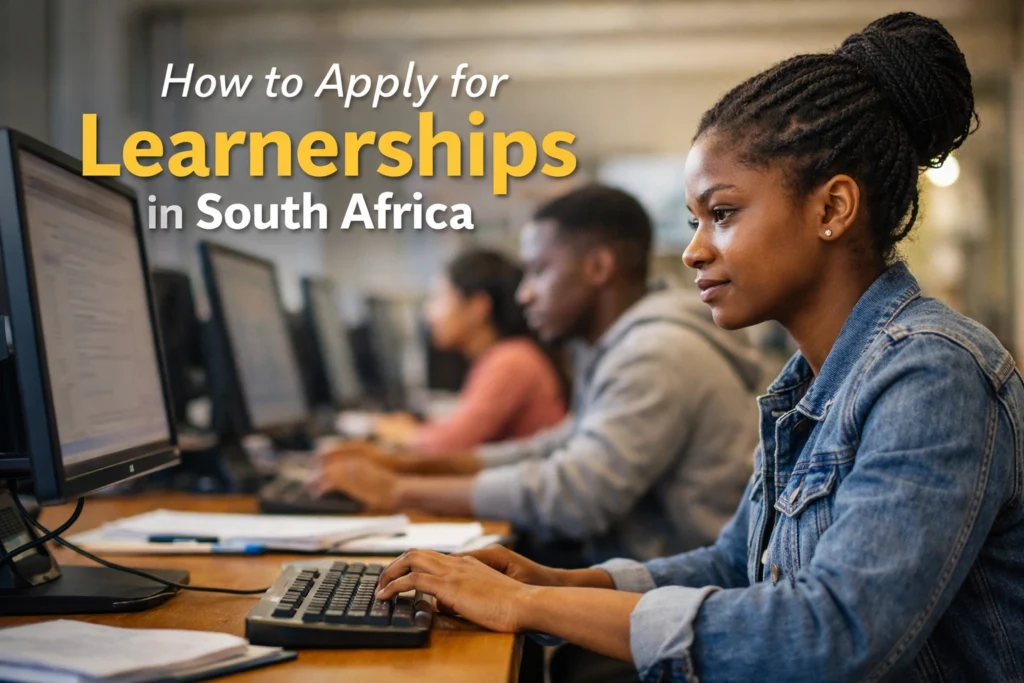
One of the most significant shifts in recent years is the digitisation of application processes.
In 2026, a growing number of learnership applications are:
- Submitted through online portals
- Filtered using automated systems
- Reviewed in high volumes within short timeframes
Why This Matters
Digital literacy is no longer optional. It directly affects application success in several ways:
- Formatting and File Quality
Poorly scanned documents or incorrectly named files can lead to automatic rejection. - Online Application Forms
Many applicants make errors due to misunderstanding form requirements or rushing submissions. - Email Communication
Professional email etiquette can influence how applications are perceived.
APPLY FOR: Sun International Go Gaming Learnership 2026
APPLY FOR: NECSA Generic Management Learnerships 2026
APPLY FOR: HEINEKEN Packaging Operations Learnerships 2026
Analytical Insight
There is an emerging “hidden barrier” in learnership access: digital competence inequality. Applicants who understand how to navigate online systems have a measurable advantage.
This creates a paradox:
- Learnerships aim to improve employability
- But accessing them increasingly requires employability skills
Strategic Takeaway
Improving basic digital skills—document preparation, file management, online navigation—is one of the most effective ways to improve application outcomes.
Common Mistakes That Undermine Applications
Understanding how to apply for learnerships in South Africa also requires identifying what not to do.
Frequent Pitfalls
1. Generic Applications
Submitting the same CV and motivation letter to multiple opportunities without tailoring.
2. Ignoring Minimum Requirements
Applying without meeting basic criteria wastes time and reduces credibility.
3. Late Submissions
Many programmes close applications once quotas are reached, even before official deadlines.
4. Incomplete Documentation
Missing certified copies or incorrect formats can disqualify applicants instantly.
5. Lack of Follow-Up Awareness
Applicants often fail to monitor communication channels after submission.
Deeper Analysis
These mistakes are not random—they reflect a broader issue: lack of process awareness.
Applicants often treat learnership applications as low-stakes opportunities, when in reality they are highly competitive selection processes.
Example Scenario
Two candidates with similar qualifications apply:
- Candidate A submits early, with a tailored CV and clear motivation
- Candidate B submits late, with generic documents
Even if Candidate B has slightly better academic results, Candidate A is more likely to progress.
The margin of difference is often procedural, not academic.
APPLY FOR: Sun International Go Gaming Learnership 2026
APPLY FOR: NECSA Generic Management Learnerships 2026
APPLY FOR: HEINEKEN Packaging Operations Learnerships 2026
Equity, Access, and the Realities of Competition
Learnerships are designed to promote inclusivity and skills development, particularly for unemployed youth. However, the reality is more complex.
Structural Factors Influencing Access
- Geographic location: Urban applicants often have more access to information and opportunities
- Education quality: Schooling disparities affect readiness
- Access to internet and devices: Limits ability to apply effectively
Employment Equity Considerations
Many learnerships align with South Africa’s employment equity policies, which aim to address historical imbalances. While this promotes fairness, it also introduces additional layers of competition and selection criteria.
Analytical Perspective
Rather than viewing the system as purely merit-based or purely constrained, it is more accurate to see it as multi-layered:
- Skills and qualifications matter
- Representation goals matter
- Practical readiness matters
Understanding this complexity helps applicants position themselves more effectively.
What This Means Going Forward
The future of how to apply for learnerships in South Africa is likely to become even more structured, digital, and competitive.
Emerging Trends
1. Increased Digitisation
Application systems will continue to move online, with greater use of automated filtering.
2. Stronger Employer Involvement
Companies will use learnerships more strategically to build talent pipelines.
3. Skills-Based Selection
Soft skills, adaptability, and digital literacy will become more important than formal qualifications alone.
4. Greater Transparency (Gradually)
There is growing pressure for clearer communication around selection processes, though progress may be uneven.
Implications for Applicants
- Preparation must start earlier
- Applications must be more targeted
- Skills development must be continuous
Strategic Outlook
Success will increasingly depend on how well applicants understand the system, not just how qualified they are.
Those who treat learnership applications as structured processes—requiring research, preparation, and strategic thinking—will have a clear advantage.
Conclusion
Learning how to apply for learnerships in South Africa is not simply about submitting documents—it is about navigating a complex, evolving system.
From understanding the decentralised nature of opportunities to recognising the importance of digital literacy and strategic positioning, the process demands more than basic effort. It requires insight.
As the labour market continues to shift, learnerships will remain one of the most important entry points into employment. But access will increasingly favour those who approach the process with clarity, discipline, and awareness.
In a competitive environment, the difference between success and failure is rarely luck. More often, it is understanding how the system works—and using that understanding effectively.
APPLY FOR: NECSA Generic Management Learnerships 2026
APPLY FOR: Sun International Go Gaming Learnership 2026