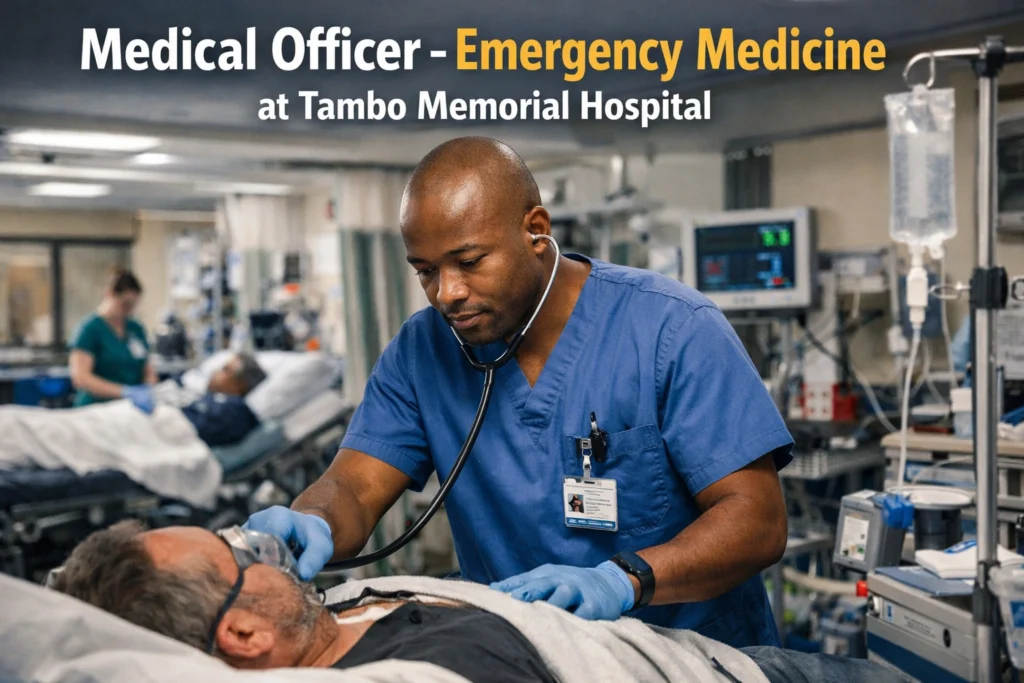

Medical Officer: The demand for skilled emergency care professionals is intensifying across South Africa, and few roles capture this urgency more clearly than the Medical Officer – Emergency Medicine position at Tambo Memorial Hospital. With a competitive package exceeding R1 million annually and a deadline set for 26 March 2026, this vacancy is more than a job listing—it is a window into broader shifts shaping public healthcare, workforce planning, and emergency medicine as a discipline.
For any aspiring or early-career Medical Officer, this opportunity reflects both the growing complexity of emergency departments and the expectations placed on clinicians operating within them. Understanding what this role represents—and what it demands—offers valuable insight into where emergency medicine in South Africa is headed.
The Strategic Importance of Emergency Medicine in Gauteng
Emergency departments sit at the frontline of healthcare systems, and in a province like Gauteng—South Africa’s economic hub—the pressure is particularly intense. Facilities such as Tambo Memorial Hospital serve densely populated communities, often acting as both primary and tertiary access points for patients.
In recent years, emergency medicine has evolved from a reactive service to a highly structured, protocol-driven specialty. This shift is driven by several factors:
- Rising trauma cases linked to urbanization and road accidents
- Increased burden of non-communicable diseases presenting acutely
- Ongoing strain from infectious diseases and public health challenges
- Patient overflow due to limited access to primary care
Within this environment, a Medical Officer is no longer simply a clinician delivering care. They are coordinators of complex systems, decision-makers under pressure, and key contributors to patient flow efficiency.
The advertised role explicitly reflects this evolution by emphasizing clinical coordination, policy implementation, and staff supervision—responsibilities that extend far beyond bedside care.
What the Role Demands: Beyond Clinical Competence
At first glance, the minimum requirements—an MBChB degree, HPCSA registration, and six months of post-registration experience—may seem standard. However, the inclusion of additional qualifications such as DIPPEC or FCEM Part 1 signals a deeper expectation: specialization readiness.
A Medical Officer entering this role is expected to:
- Navigate high-acuity cases with limited supervision
- Apply structured emergency protocols
- Contribute to departmental efficiency and governance
- Support junior staff and interns in real-time clinical settings
This reflects a broader trend in healthcare: early-career doctors are being required to take on advanced responsibilities sooner than before.
The emphasis on emergency medicine credentials like DIPPEC highlights the increasing formalization of the field. Emergency care is no longer seen as a generalist extension—it is a discipline requiring targeted training, rapid decision-making skills, and procedural competence.
Workforce Pressures and Why This Role Exists Now
The timing of this vacancy is not incidental. South Africa’s public healthcare system continues to face workforce shortages, particularly in high-demand specialties like emergency medicine.
Several structural issues contribute to this:
- Migration of healthcare professionals to the private sector or overseas
- Burnout among public sector doctors
- Uneven distribution of medical staff across provinces
- Growing patient volumes without proportional infrastructure expansion
As a result, hospitals like Tambo Memorial Hospital are increasingly reliant on adaptable, multi-skilled Medical Officers who can operate across clinical, administrative, and academic domains.
The requirement for commuted overtime further reflects this reality. It indicates that extended working hours are not an exception but an integrated part of the role—highlighting both the demands and the resilience expected of candidates.
The Hidden Value: Academic and Career Development Opportunities
While the clinical workload is significant, this role offers substantial long-term value for career progression. One of the most overlooked aspects of the position is its strong academic component.
The responsibilities include:
- Training medical interns and junior doctors
- Participating in hospital and cluster academic activities
- Engaging with policy implementation and clinical governance
For a Medical Officer, these elements are critical stepping stones toward specialization. Exposure to teaching and structured learning environments builds competencies required for registrar positions and specialist training programs.
Moreover, working in a high-volume emergency department accelerates clinical exposure. Doctors gain experience with a wide range of cases—from trauma to acute medical emergencies—within a relatively short period.
This combination of service delivery and academic engagement positions the role as a career accelerator rather than just a job placement.
Application Process: A Reflection of Public Sector Reform
The structured online application process through the Gauteng Professional Job Centre highlights ongoing efforts to modernize public sector recruitment.
Key procedural requirements include:
- Submission of the new Z83 form
- A detailed, chronologically structured CV
- Alignment between application documents
Apply via Gauteng Professional Job Centre
ALSO APPLY FOR: Nursing Assistant
These requirements are not merely administrative. They reflect a shift toward accountability and standardization in hiring practices.
For applicants, this means that attention to detail is critical. A strong Medical Officer candidate must not only demonstrate clinical competence but also administrative precision.
The exclusion of certified documents at the initial stage—aligned with recent DPSA guidelines—streamlines the process but places greater emphasis on the accuracy of submitted information.
The Broader Implications for Healthcare Delivery
Roles like this one have implications that extend beyond individual career paths. They directly influence the quality and efficiency of healthcare delivery.
When a Medical Officer effectively coordinates services, supervises staff, and adheres to clinical standards, the impact is measurable:
- Reduced patient waiting times
- Improved clinical outcomes
- Enhanced staff performance and morale
- Better compliance with healthcare protocols
Conversely, staffing gaps or underqualified placements can lead to system inefficiencies and compromised care.
This is why the selection process is rigorous and why the role includes provisions for practical assessments and verification checks. The stakes are high—not just for the institution, but for the communities it serves.
What This Means Going Forward
The Medical Officer – Emergency Medicine position at Tambo Memorial Hospital is indicative of several long-term trends in South African healthcare.
First, emergency medicine will continue to grow as a specialized field, requiring formal qualifications and structured training pathways. Generalist roles are gradually giving way to more defined clinical disciplines.
Second, early-career doctors will increasingly be expected to take on leadership and coordination responsibilities. The traditional progression from junior doctor to senior clinician is becoming more compressed.
Third, public sector hospitals will continue to play a central role in training and developing healthcare professionals. Despite resource constraints, they remain critical environments for clinical exposure and skills development.
Finally, recruitment processes will become more standardized and digitized, placing greater emphasis on transparency and efficiency.
For aspiring candidates, this means that preparation must go beyond meeting minimum requirements. Building relevant experience, pursuing additional qualifications, and understanding the operational realities of emergency departments will be key differentiators.
Frequently Asked Questions (FAQs)
Q1: What is DIPPEC?
A: DIPPEC stands for Diploma in Primary Emergency Care – a recognised qualification in emergency medicine
Q2: What is FCEM Part 1?
A: FCEM Part 1 is the first part of the Fellowship of the College of Emergency Medicine of South Africa .
Q3: I have 5 months of experience as a Medical Officer. Can I apply
A: The requirement is minimum six months. Applications with less than 6 months may not be considered .
Q4: What is commuted overtime?
A: Commuted overtime is a fixed overtime arrangement for medical practitioners in public service .
Q5: Do I need to submit certified copies with my application?
A: No. According to DPSA Circular 19 of 2022, applicants are not required to submit copies of qualifications with the initial application. Only submit a fully completed Z83 and a detailed CV. Certified copies are required only if shortlisted .
A Defining Opportunity for the Modern Medical Officer
The vacancy at Tambo Memorial Hospital represents more than a well-compensated position—it reflects the evolving identity of the Medical Officer in South Africa’s healthcare system.
It is a role defined by complexity, responsibility, and opportunity. Candidates who succeed will not only deliver critical care but also shape the systems within which that care is delivered.
With the application deadline of 26 March 2026 fast approaching, prospective applicants should approach this opportunity with both urgency and strategic intent. For those ready to step into the demands of emergency medicine, this position offers a pathway to meaningful impact and professional growth.