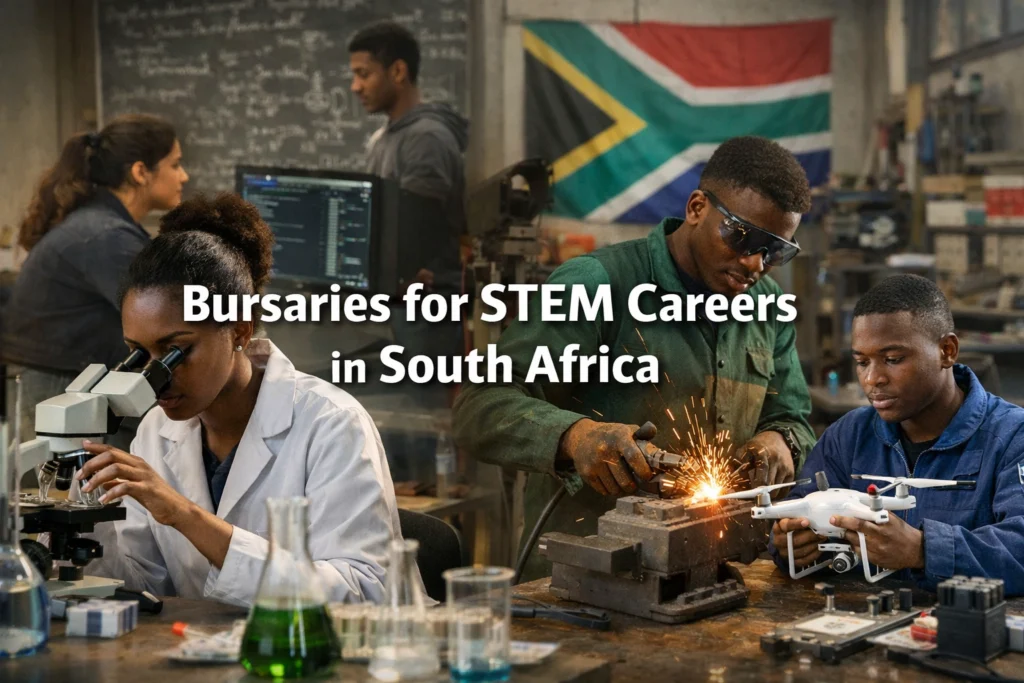

Bursaries for STEM Careers in South Africa: Search trends don’t spike without a reason—and right now, Bursaries for STEM Careers in South Africa are quietly becoming one of the most searched and discussed education topics in the country.
It’s not just students scrambling for funding. It’s employers, policymakers, and universities all converging on a single question: how do we build a future-ready workforce in a country facing both high youth unemployment and critical skills shortages?
Something is shifting—and fast.
From renewed government investment to private-sector funding and global pressure to strengthen innovation ecosystems, STEM bursaries are no longer just financial aid. They are becoming strategic tools shaping South Africa’s economic future.
ALSO APPLY FOR: Mezzanine Bursary Programme 2026
ALSO READ ABOUT: Write a Winning Bursary Application
ALSO APPLY FOR: SAIIPL Bursaries 2026
A Growing Crisis—and an Opportunity
For years, South Africa has faced a paradox. On one hand, the country produces thousands of graduates annually. On the other, industries like engineering, data science, and renewable energy report persistent skills shortages.
Organizations such as National Student Financial Aid Scheme (NSFAS) have long supported students from disadvantaged backgrounds. But historically, funding hasn’t always aligned with high-demand STEM fields—or at least not at the scale required.
At the same time, global trends have intensified the need for STEM expertise:
- The rise of artificial intelligence and automation
- Expansion of green energy projects
- Digital transformation across industries
- Increased demand for cybersecurity and data analytics
In South Africa, these pressures are compounded by infrastructure development goals and the urgent need to modernize sectors like mining, manufacturing, and healthcare.
The result? A growing realization that bursaries are not just social support—they are economic investments.
How We Got Here
To understand why Bursaries for STEM Careers in South Africa are trending now, you have to look at how the landscape has evolved over the past decade.
1. The Shift Toward Skills-Based Funding
Government and corporate funders have gradually moved away from general bursaries toward targeted funding models. Instead of funding “any degree,” bursaries now prioritize:
- Engineering (civil, mechanical, electrical)
- Information technology and data science
- Health sciences
- Environmental and renewable energy studies
Institutions like Department of Higher Education and Training have played a key role in aligning education funding with national development plans.
2. Private Sector Steps In
Major companies—particularly in mining, banking, and telecommunications—have expanded bursary programmes to secure future talent pipelines.
Companies increasingly view bursaries as long-term recruitment strategies, offering:
- Full tuition coverage
- Accommodation and living stipends
- Guaranteed internships or employment
This shift has made STEM bursaries more competitive—and more attractive.
3. Post-Pandemic Economic Reset
After COVID-19 disrupted education and employment globally, South Africa saw a renewed push to invest in resilient, future-proof industries.
STEM careers became central to that vision.
Recent Developments Driving the Buzz
Over the past 12–18 months, several developments have pushed STEM bursaries into the spotlight.
Increased Funding Announcements
Both government and private institutions have announced expanded bursary intakes, particularly in:
- Renewable energy engineering
- Artificial intelligence and machine learning
- Health technology
- Infrastructure development
This aligns with South Africa’s broader energy transition and digital economy strategies.
Focus on Inclusivity
There’s also a noticeable emphasis on broadening access.
Bursary programmes are increasingly targeting:
- Students from rural areas
- Women in STEM fields
- First-generation university students
This reflects both social equity goals and the need to expand the talent pool.
University Partnerships
Top institutions such as University of Cape Town and University of the Witwatersrand are collaborating with industry partners to design bursary-linked programmes that combine:
- Academic training
- Workplace exposure
- Research opportunities
The result is a more integrated pipeline from education to employment.
ALSO APPLY FOR: Mezzanine Bursary Programme 2026
ALSO READ ABOUT: Write a Winning Bursary Application
ALSO APPLY FOR: SAIIPL Bursaries 2026
Public Reaction: Hope Meets Skepticism
As interest in Bursaries for STEM Careers in South Africa grows, public reaction has been mixed—but engaged.
The Optimism
Many students and families see this as a long-overdue opportunity.
Social media discussions and student forums highlight:
- Relief at increased funding availability
- Excitement about career prospects in tech and engineering
- Recognition that STEM careers offer higher earning potential
For many, bursaries represent a pathway out of poverty.
The Concerns
At the same time, some concerns continue to surface:
- Limited number of bursaries relative to demand
- High academic requirements excluding some capable students
- Lack of awareness in rural communities
- Questions about job placement after graduation
There’s also criticism that funding often favors students who are already relatively well-prepared academically, leaving behind those who need foundational support.
The Bigger Picture: Economic Strategy in Disguise
What makes this moment particularly interesting is that STEM bursaries are no longer just about education.
They are increasingly part of a national economic strategy.
South Africa’s long-term growth depends on:
- Infrastructure development
- Energy stability
- Digital transformation
- Innovation-driven industries
Without skilled professionals in STEM fields, these goals become difficult—if not impossible—to achieve.
This is why bursary programmes are being expanded, refined, and closely aligned with industry needs.
Why This Matters Right Now
The urgency surrounding Bursaries for STEM Careers in South Africa is not accidental—it reflects deeper structural challenges and opportunities.
Youth Unemployment Crisis
South Africa’s youth unemployment rate remains one of the highest globally.
STEM bursaries offer a targeted solution by:
- Funding education in high-demand fields
- Linking students directly to employment pathways
- Reducing the mismatch between skills and jobs
Global Competition for Talent
Countries around the world are investing heavily in STEM education.
South Africa risks falling behind if it cannot produce enough skilled graduates.
Bursaries are one of the fastest ways to scale talent development.
The Energy Transition
With ongoing electricity challenges and a shift toward renewable energy, the demand for engineers and technical experts is rising rapidly.
Without a strong pipeline of STEM graduates, progress in this area could stall.
Digital Transformation
From banking to healthcare, digital systems are becoming central to daily operations.
This creates demand for:
- Software developers
- Data analysts
- Cybersecurity specialists
Bursaries help ensure that South Africa can meet these needs locally rather than relying on imported skills.
What Could Happen Next
Looking ahead, the trajectory of Bursaries for STEM Careers in South Africa suggests several possible developments.
1. More Competitive Selection Processes
As demand increases, bursaries are likely to become even more competitive.
We may see:
- Higher academic thresholds
- More emphasis on extracurricular achievements
- Increased use of aptitude testing
2. Expansion into Emerging Fields
Future bursary programmes will likely focus on cutting-edge areas such as:
- Artificial intelligence
- Robotics
- Climate science
- Biotechnology
This reflects global trends and local priorities.
3. Greater Industry Integration
Bursaries may increasingly include:
- Mandatory internships
- Work-integrated learning
- Employment contracts
This could strengthen the link between education and employment outcomes.
4. Digital Access Platforms
Expect more centralized platforms where students can:
- Discover bursaries
- Apply online
- Track application status
Improved accessibility could address awareness gaps.
5. Pressure for Broader Access
Public demand may push funders to:
- Lower barriers to entry
- Provide bridging programmes
- Expand funding for foundational STEM education
This could make bursaries more inclusive over time.
Frequently Asked Questions (FAQs
Q1: What are STEM bursaries?
A: STEM bursaries are financial awards specifically for students pursuing degrees in Science, Technology, Engineering, and Mathematics. These bursaries are often funded by government, private companies, or industry bodies to address skills shortages in high-demand fields .
Q2: Why are STEM bursaries suddenly so popular?
A: Several factors have converged: increased government funding for scarce skills, private sector investment in talent pipelines, South Africa’s energy transition, digital transformation across industries, and a renewed focus on building a future-ready workforce .
Q3: Do I need to work for the company after receiving a bursary?
A: Many corporate bursaries include a work-back obligation, requiring you to work for the sponsoring company for a period equal to the duration of funding . Government and SETA bursaries may have different requirements – always read the terms carefully .
Q4: Can I apply for a STEM bursary if I’m already receiving NSFAS?
A: Yes, but you must disclose all funding in your application. Some bursaries allow dual funding, while others require exclusivity . Check the specific terms of each bursary .
Q5: What is the minimum academic requirement for STEM bursaries?
A: Most require a minimum average of 60–75%, depending on the bursary and field . Highly competitive bursaries may require 70% or higher .
The Hidden Challenge: Preparation Gap
While funding is increasing, a critical issue remains largely unresolved—the preparation gap.
Many students, particularly from under-resourced schools, struggle with:
- Mathematics and science fundamentals
- Access to quality teaching
- Exposure to STEM careers
Without addressing this, bursaries alone cannot solve the problem.
This is where collaboration between schools, universities, and funders becomes essential.
ALSO APPLY FOR: Mezzanine Bursary Programme 2026
ALSO READ ABOUT: Write a Winning Bursary Application
ALSO APPLY FOR: SAIIPL Bursaries 2026
A Turning Point for Students—and the Country
What makes this moment significant is that it represents a potential turning point.
If managed effectively, the expansion of Bursaries for STEM Careers in South Africa could:
- Reduce unemployment
- Strengthen key industries
- Drive innovation
- Improve social mobility
But if gaps in access and preparation persist, the impact may be limited.
Final Thoughts
The surge in attention around STEM bursaries is not just another education trend—it’s a signal of deeper transformation.
South Africa is at a crossroads.
Investing in STEM education through bursaries is one of the clearest strategies for building a more resilient, competitive, and inclusive economy.
For students, the message is clear: opportunities are growing—but so is the competition.
For policymakers and funders, the challenge is equally clear: expand access, improve preparation, and ensure that bursaries translate into real-world outcomes.
The stakes are high—but so is the potential.