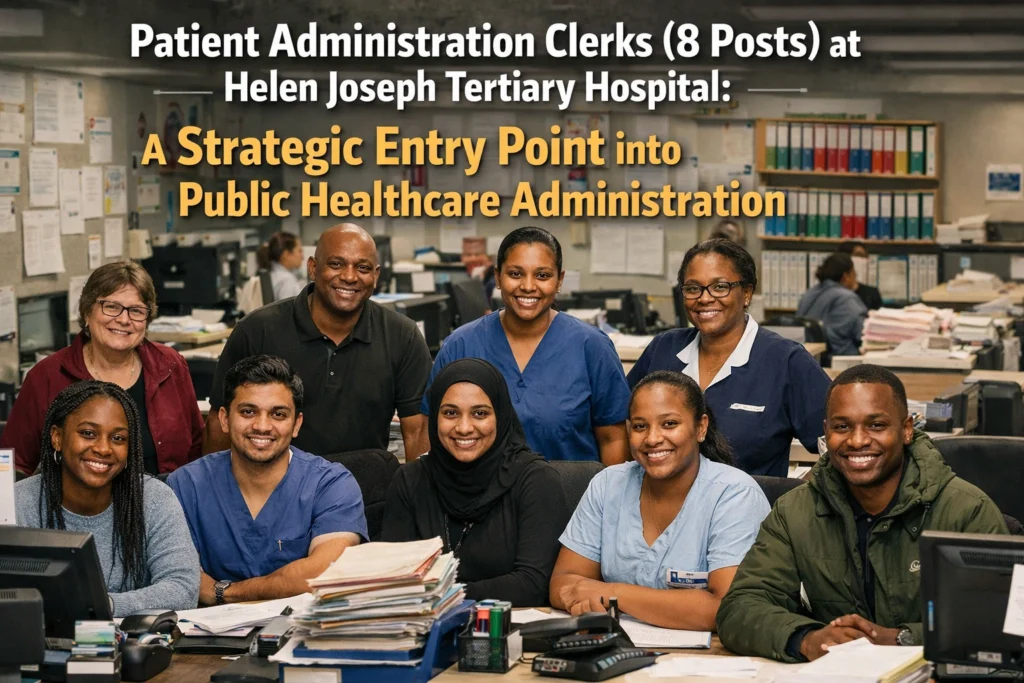

The Patient Administration Clerks (8 Posts) at Helen Joseph Tertiary Hospital comes at a critical moment for South Africa’s public healthcare system. As hospitals continue to balance increasing patient volumes with limited resources, the role of administrative personnel has become more strategically important than ever. While clinical staff often receive the spotlight, it is the efficiency of systems, records, and patient flow—managed largely by clerks—that determines whether care delivery succeeds or falters.
This opportunity, offered by the Gauteng Department of Health, reflects a broader shift toward strengthening operational capacity in hospitals. For job seekers with a Grade 12 qualification, it also represents one of the most accessible pathways into stable public sector employment, with long-term career potential.
Apply via Gauteng E-Recruitment Portal
ALSO APPLY FOR: ICT Supervisor (Desktop Support Management)
The Growing Importance of Administrative Roles in Healthcare
Healthcare systems are often evaluated based on clinical outcomes, but behind every successful diagnosis or treatment lies a robust administrative framework. The Patient Administration Clerks (8 Posts) at Helen Joseph Tertiary Hospital highlight how essential non-clinical roles have become in modern healthcare.
Administrative clerks ensure that patient records are accurate, accessible, and secure. In a high-volume tertiary hospital like Helen Joseph, even minor inefficiencies—such as misplaced files or incorrect data entries—can delay treatment, compromise patient safety, and increase operational costs.
Globally, healthcare systems are investing more in administrative infrastructure. South Africa is no exception. With ongoing reforms and digitisation efforts, the demand for individuals who can manage data, coordinate patient movement, and maintain compliance with legal frameworks is steadily increasing.
This role is therefore not just clerical—it is foundational to the functioning of the healthcare ecosystem.
Why This Opportunity Stands Out in the 2026 Job Market
In a competitive job market where youth unemployment remains high, entry-level government positions are highly sought after. The Patient Administration Clerks (8 Posts) at Helen Joseph Tertiary Hospital offer several advantages that distinguish them from private-sector alternatives.
Firstly, the salary package of R228,321 per annum, combined with public service benefits, provides financial stability that is often unavailable in entry-level private roles. Secondly, the position offers exposure to structured systems such as the Hospital Information System (SAP HIS), which can significantly enhance an individual’s professional profile.
Apply via Gauteng E-Recruitment Portal
Another key factor is job security. Public sector roles are generally less volatile than private-sector positions, especially in uncertain economic conditions. For many applicants, this stability is a major draw.
Additionally, the emphasis on internal rotation and shift work suggests opportunities for skills diversification. Employees are not confined to a single function but gain experience across multiple aspects of patient administration—an important factor for long-term career growth.
Skills Demand: More Than Just Basic Administration
At first glance, the requirements for the Patient Administration Clerks (8 Posts) at Helen Joseph Tertiary Hospital may appear straightforward: a Grade 12 certificate and computer literacy. However, a closer analysis reveals a more complex skill set.
The inclusion of Batho Pele principles signals the importance of service delivery ethics. These principles—focused on transparency, accountability, and putting people first—are central to public sector operations in South Africa. Candidates must therefore demonstrate not only technical competence but also a service-oriented mindset.
Knowledge of policies such as the Uniform Patient Fee Schedule (UPFS) and the Promotion of Access to Information Act (PAIA) further elevates the role. Clerks are expected to operate within legal and regulatory frameworks, ensuring compliance while handling sensitive patient data.
Moreover, responsibilities such as tracking patient movement, managing downtime procedures, and assisting with medico-legal documentation (e.g., J88 forms) require attention to detail and the ability to work under pressure. These are not routine tasks; they demand critical thinking and adaptability.
In essence, the role blends administrative efficiency with legal awareness and interpersonal skills—making it far more sophisticated than traditional clerical work.
Digitisation and the Evolution of Hospital Administration
One of the most significant aspects of the Patient Administration Clerks (8 Posts) at Helen Joseph Tertiary Hospital is the emphasis on digital systems, particularly SAP (HIS). This reflects a broader trend toward digitisation in healthcare.
Electronic health records (EHRs) are transforming how patient information is stored, accessed, and analysed. For clerks, this means transitioning from paper-based systems to digital platforms that require both technical proficiency and data accuracy.
The mention of “downtime tools” and registers also highlights the hybrid nature of current systems. While hospitals are moving toward full digitisation, contingency processes remain essential to ensure continuity during system failures.
This dual-system environment creates a unique learning opportunity. Clerks gain experience in both traditional and digital workflows, positioning them well for future roles in health informatics or data management.
As South Africa continues to invest in digital health infrastructure, individuals with hands-on experience in systems like SAP (HIS) will be in high demand.
Compliance, Accountability, and Risk Management
Another critical dimension of the Patient Administration Clerks (8 Posts) at Helen Joseph Tertiary Hospital is the strong focus on compliance and accountability. Public healthcare institutions operate under strict regulatory oversight, and administrative staff play a key role in maintaining standards.
Tasks such as safekeeping and disposing of patient files in accordance with the National Archives Act are not merely procedural—they are legal obligations. Failure to comply can result in serious consequences, including legal action and reputational damage for the institution.
Similarly, assisting stakeholders like the South African Police Service (SAPS) with J88 forms places clerks at the intersection of healthcare and the justice system. Accuracy and confidentiality are paramount in such cases.
The recruitment process itself reflects this emphasis on accountability. Candidates must undergo rigorous checks, including identity verification, criminal record screening, and credit checks. This ensures that only individuals with integrity and reliability are entrusted with sensitive responsibilities.
Barriers and Opportunities in the Application Process
While the opportunity is attractive, the application process for the Patient Administration Clerks (8 Posts) at Helen Joseph Tertiary Hospital introduces certain barriers that applicants must navigate carefully.
The requirement for a fully completed and signed new Z83 form, aligned with a detailed CV, often trips up candidates. Many applications are rejected due to incomplete forms or inconsistencies between documents.
The shift to online-only applications also reflects a broader digital transition in recruitment. While this improves efficiency, it may disadvantage individuals with limited access to technology or digital literacy.
However, these barriers also create a filtering mechanism. Candidates who pay attention to detail, follow instructions precisely, and prepare their documents thoroughly are more likely to succeed.
From an analytical perspective, the application process itself serves as an early test of the competencies required for the role—organisation, accuracy, and adherence to procedures.
What This Means Going Forward
The availability of Patient Administration Clerks (8 Posts) at Helen Joseph Tertiary Hospital signals a deeper transformation within South Africa’s public healthcare system. Administrative roles are no longer peripheral—they are central to improving efficiency, accountability, and patient outcomes.
Looking ahead, several trends are likely to shape the future of this profession:
- Increased digitisation will require continuous upskilling in health information systems.
- Greater regulatory oversight will elevate the importance of compliance knowledge.
- Integration of services will expand the scope of administrative roles beyond traditional boundaries.
- Career mobility within the public sector will reward individuals who gain diverse experience early on.
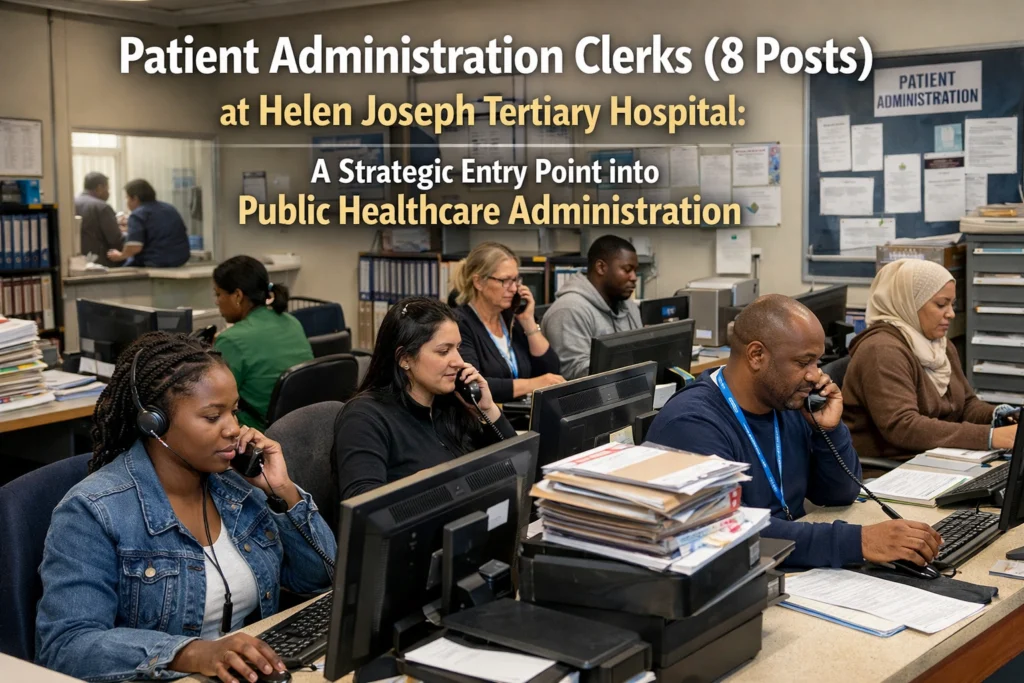
Patient Administration Clerks
For job seekers, this means that entry-level roles like this one are not endpoints but stepping stones. With the right approach, a Patient Administration Clerk position can lead to careers in hospital management, health informatics, or policy development.
For the healthcare system, investing in administrative capacity is a strategic move. Efficient record management, accurate data capture, and effective patient coordination are essential for delivering quality care in a resource-constrained environment.