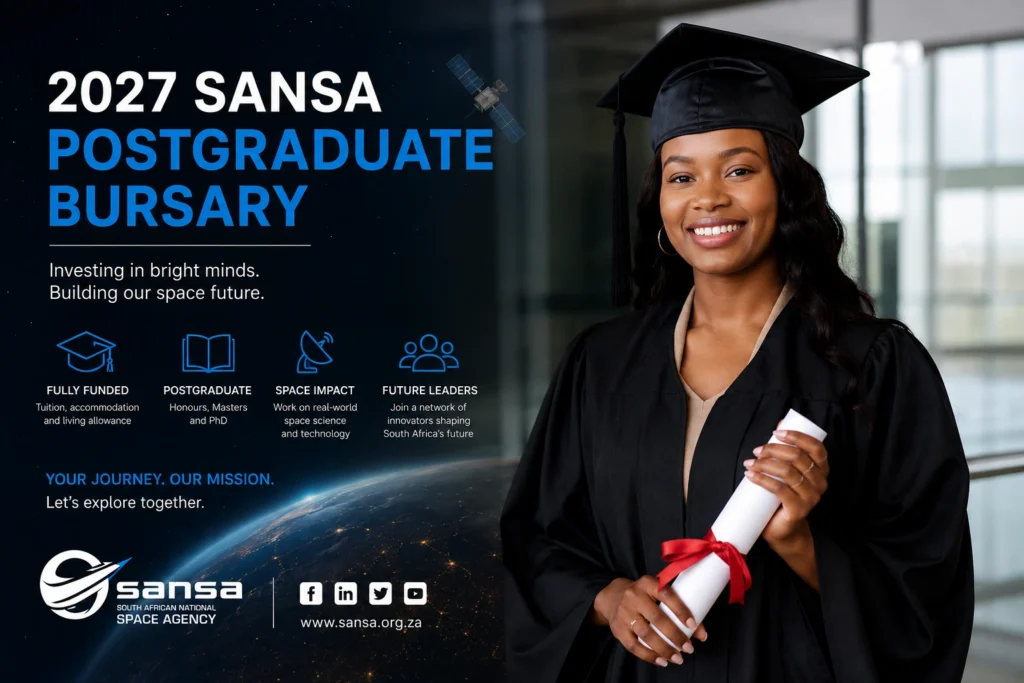

If you’re a science or engineering student in South Africa dreaming about satellites, space data, or cutting-edge research, The 2027 SANSA Postgraduate Bursary could be one of the most important opportunities you’ll ever come across. It’s not just about funding your studies—it’s about becoming part of a national effort to grow South Africa’s presence in the global space industry.
Offered by the South African National Space Agency, this bursary is designed to support high-performing postgraduate students who want to build careers in space science, engineering, and data-driven innovation.
With space technology playing a growing role in everything from weather forecasting to disaster management and agriculture, this opportunity is more relevant than ever.
What You Should Know First
Before diving into the details, here’s the core idea:
- The 2027 SANSA Postgraduate Bursary funds postgraduate studies (Honours to PhD) in space-related fields.
- It supports STEM disciplines aligned with national space priorities.
- Funding is generous and can cover most academic expenses.
- Selection is based on academic performance, research relevance, and financial need.
- Applications open in May 2026 and close on 30 September 2026.
In short: if your studies can contribute to South Africa’s space capabilities, this bursary is built for you.
APPLY HERE: 2027 SANSA Postgraduate Bursary
Why This Bursary Matters in Today’s World
Space is no longer just about astronauts and rockets. Today, it powers real-world systems:
- GPS navigation
- Climate monitoring
- Disaster response
- Telecommunications
South Africa is positioning itself as a leader in Africa’s space sector, and SANSA is at the center of that mission. By funding postgraduate students, SANSA is investing in the next generation of scientists, engineers, and innovators.
This means your research could directly impact how the country manages water resources, tracks climate change, or improves communication infrastructure.
Fields of Study: Where Your Interests Fit In
The bursary supports a wide range of disciplines. Let’s break them down in simple terms.
1. Earth Observation (EO)
This field focuses on studying Earth using satellite data.
What you might do:
- Analyse satellite images of drought-affected areas
- Monitor crop health for agriculture
- Track ocean changes
Key areas include:
- Remote sensing
- Geographic Information Systems (GIS)
- Environmental science
Example:
A student might use satellite data to detect illegal mining activity in remote regions.
2. Space Science
This is the “pure science” behind space systems.
What you might study:
- Solar storms and their impact on Earth
- The ionosphere and radio signals
- Space weather forecasting
Why it matters:
Solar activity can disrupt power grids and communication systems—understanding it helps prevent major failures.
3. Engineering & Technology
This is where theory becomes real-world systems.
Disciplines include:
- Electrical and electronic engineering
- Aerospace engineering
- Mechanical and mechatronic engineering
- Software and systems engineering
Example:
Designing antennas that allow satellites to communicate with Earth stations.
4. Cross-Disciplinary Fields
These areas support all SANSA activities.
Includes:
- Data science
- Computer science
- Physics
- Mathematics
Real-world use case:
Processing massive satellite datasets using machine learning to predict weather patterns.
Who Can Apply? Understanding Eligibility
To qualify for The 2027 SANSA Postgraduate Bursary, you must meet specific criteria.
Basic Requirements
- Must be a South African citizen
- Must be 32 years or younger
- Must have at least 65% academic average
- Must study in a relevant field aligned with SANSA
Additional Considerations
- Financial need plays a role
- Your research topic must be relevant
- Strong academic references help
Tip:
Even if you meet the minimum requirements, strong motivation and a clear research focus can significantly improve your chances.

APPLY HERE: 2027 SANSA Postgraduate Bursary
Funding Explained: What You Actually Get
The bursary provides substantial financial support depending on your level of study.
Funding Breakdown
- Honours: R85,000 – R100,000 (1 year)
- Master’s: R100,000 – R120,000 per year (up to 2 years)
- PhD: R130,000 – R140,000 per year (up to 3 years)
What This Covers
Typically includes:
- Tuition fees
- Study materials
- Living expenses
Important Detail
Funding is renewed annually based on performance, not guaranteed for the full duration.
Step-by-Step: How the Application Works
Applying can feel overwhelming, so here’s a simplified process.
Step 1: Prepare Your Documents
You’ll need:
- Academic transcripts
- Certified South African ID
- Proof of funding history (e.g., NSFAS)
- Research proposal (for Master’s/PhD)
- Academic reference/testimonial
Tip:
Keep all files in PDF format and under 2MB.
Step 2: Develop a Strong Research Proposal
This is one of the most important parts.
Keep it:
- Clear
- Focused
- Relevant to SANSA priorities
Example:
Instead of “studying climate change,” focus on
“Using satellite data to monitor drought trends in South Africa.”
Step 3: Apply Online
Applications are submitted through the SANSA Fundisa portal via the official SANSA website.
- Opens: May 2026
- Closes: 30 September 2026
APPLY HERE: 2027 SANSA Postgraduate Bursary
No application fee is required.
Step 4: Wait for Evaluation
Applications are reviewed based on:
- Academic merit
- Research relevance
- Financial need
Shortlisted candidates may be contacted for further steps.
ALSO APPLY FOR: Digby Wells Environmental Bursary 2026
Common Misunderstandings About The 2027 SANSA Postgraduate Bursary
“It’s only for astronauts”
Not true. Most funded students work in data science, engineering, or environmental research—not space travel.
“Only top universities are accepted”
You can study at any accredited South African university, as long as your research aligns with SANSA.
“You need perfect marks”
A minimum of 65% is required, but strong motivation and a relevant research proposal matter just as much.
“It covers everything automatically”
Funding is generous, but continued support depends on your academic performance each year.
Best Practices to Strengthen Your Application
1. Align Your Research Clearly
Make sure your topic directly connects to SANSA’s mission.
2. Get a Strong Supervisor
A supportive academic mentor can strengthen your proposal.
3. Apply Early
Avoid last-minute technical issues or missing documents.
4. Keep Documents Professional
Ensure everything is certified, clear, and well-organised.
Key Takeaways
- The 2027 SANSA Postgraduate Bursary supports postgraduate STEM students in South Africa.
- It focuses on space science, engineering, and Earth observation.
- Funding is substantial and can cover most study costs.
- Applications open in May 2026 and close 30 September 2026.
- A strong research proposal is critical for success.
Frequently Asked Questions (FAQs)
1. Can I apply if I’m still completing my undergraduate degree?
Yes. As long as you will be accepted into a postgraduate programme, you can apply.
2. Can I hold another bursary at the same time?
Yes, but total funding cannot exceed SANSA’s limits. You may receive a top-up instead.
3. What happens if my marks drop?
Funding renewal depends on academic performance. Poor results may lead to cancellation.
4. Is work experience required?
No, but research experience or academic projects can strengthen your application.
Final Thoughts: Why You Should Act Now
The space industry in South Africa is growing rapidly, and opportunities like The 2027 SANSA Postgraduate Bursary are designed to bring talented students into this high-impact field.
If you have strong academic results, a passion for science or engineering, and a desire to contribute to something bigger than yourself, this is your moment.
Start preparing your documents, think carefully about your research direction, and be ready when applications open. Opportunities like this don’t just fund your education—they shape your future.
APPLY HERE: 2027 SANSA Postgraduate Bursary
ALSO APPLY FOR: Digby Wells Environmental Bursary 2026