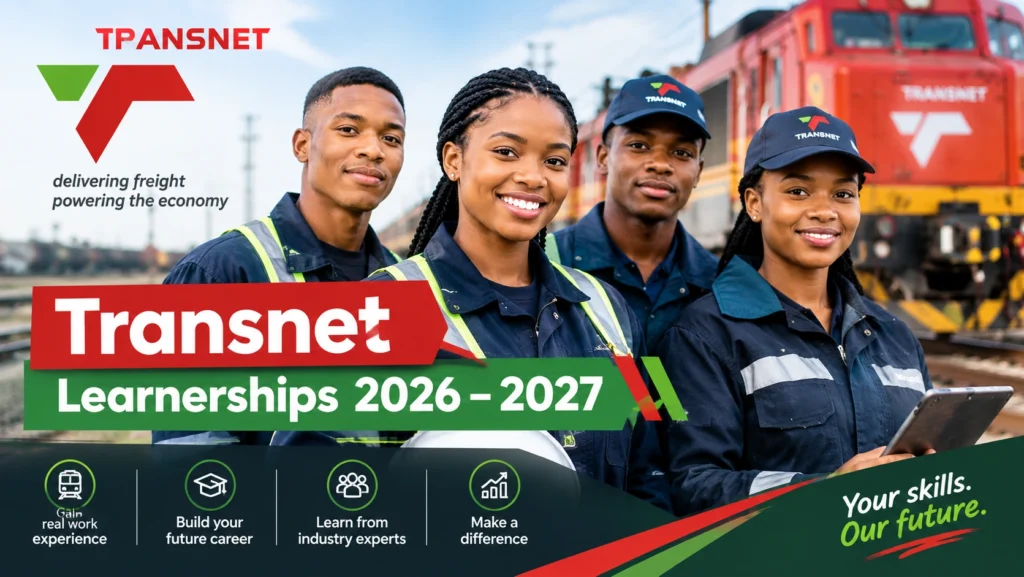

For many South African engineering students, completing the academic part of a qualification is only half the journey. The bigger challenge often comes afterwards: finding a workplace where you can gain supervised practical experience, apply what you learned and build evidence that you can function in a professional engineering environment.
That is where the latest Transnet Learnerships 2026-2027 opportunity could be valuable for eligible candidates.
Transnet is offering a 12-month Work Integrated Learning (WIL) placement for engineering students under its Work Integrated Learner – Technical programme. The opportunity is aimed at South African applicants between the ages of 18 and 35 who have completed the required Bachelor of Engineering Technology studies or S4–S5 theoretical coursework.
The placement areas listed are Durban and Johannesburg, while the vacancy carries reference number req5789. Applications are scheduled to close on 9 September 2026.
One important point for applicants is that this should not simply be viewed as another job application. It is a structured workplace-learning opportunity designed to help students bridge the gap between academic theory and practical industry experience.
And because the vacancy specifically asks for supporting academic documentation and a recent confirmation letter from an institution, preparing the application correctly could be just as important as meeting the academic requirements.
What Is the Transnet 12-Month Work Integrated Learning Programme?
The programme is a workplace-learning opportunity for qualifying engineering students who need practical exposure after completing specified theoretical coursework.
Instead of spending another year focused only on classroom-based learning, successful candidates can gain experience inside a professional transport and logistics environment.
The advertised position is:
- Programme: Work Integrated Learner – Technical
- Company: Transnet
- Operating division: Transnet Corporate Centre
- Employee group: Trainee
- Duration: 12 months
- Locations: Durban and Johannesburg
- Minimum academic level: Bachelor of Engineering Technology or completed S4–S5 theoretical coursework
- Age: 18 to 35
- Citizenship: South African
- Reference: req5789
- Closing date: 9 September 2026
- Stipend: No amount stated in the supplied vacancy information
Although people may search for this opportunity under Transnet learnerships, the description is more specifically a Work Integrated Learning placement. That distinction matters because WIL is normally focused on giving students practical workplace exposure linked to their academic programme.
What Could You Gain From the Programme?
A qualification gives you academic knowledge, but employers also want evidence that you can use that knowledge in a real working environment.
A 12-month placement can provide an opportunity to develop that missing practical layer.
Successful participants may receive exposure to areas such as:
- Practical technical work
- Workplace safety procedures
- Professional communication
- Problem-solving
- Analytical thinking
- Team-based projects
- Technical reporting
- Workplace discipline
- Organisational systems and procedures
- Professional conduct and accountability
The value of the programme is therefore not simply having “Transnet” on your CV.
The more important benefit is being able to explain what you actually learned and contributed during the placement.
For example, a candidate who can eventually demonstrate experience with technical documentation, workplace procedures, engineering-related problem-solving and professional reporting may have a stronger story to tell future employers than someone whose CV only lists academic subjects.
Why This Issue Matters
The transition from tertiary education into employment can be difficult because many entry-level positions ask for some form of experience.
This creates a frustrating situation for young graduates and students: you need experience to get a job, but you need a job to get experience.
Work Integrated Learning programmes help address part of that problem.
For an engineering student, practical exposure can help connect concepts learned during studies with the realities of working in a large organisation.
It can also help you understand things that textbooks cannot fully teach, such as:
- How technical teams communicate
- How workplace deadlines are managed
- Why safety procedures must be followed
- How technical information is documented
- How engineers collaborate with other departments
- How workplace decisions are made
- What professional accountability looks like
That is why applicants should approach the opportunity as a learning and career-building experience rather than simply a temporary placement.
Who Should Consider Applying?
The opportunity is particularly relevant to South African engineering students or recent students who have completed the academic component specified in the vacancy.
Before applying, check that you can satisfy the core requirements.
Basic eligibility checklist
You should confirm that you:
- Are a South African citizen.
- Are between 18 and 35 years old.
- Have completed the required Bachelor of Engineering Technology level of study or the required S4–S5 theoretical coursework.
- Can provide the requested academic documentation.
- Can obtain a recent confirmation letter from your educational institution.
- Are prepared for a 12-month workplace-learning commitment.
- Are willing and able to work in the relevant placement location, including Durban or Johannesburg where applicable.
Meeting the minimum requirements does not guarantee selection.
A large employer can receive many applications for a limited number of placements, meaning applicants need to make sure their documents are accurate, complete and easy to assess.
Why Applicants Could Be Disqualified
One of the biggest mistakes candidates make is concentrating on the qualification while ignoring the administrative requirements.
A strong academic record will not necessarily rescue an application containing missing or unacceptable documents.
Potential problems include:
- Applying after the closing date.
- Not meeting the required academic level.
- Submitting uncertified documents when certification is required.
- Providing outdated academic documentation.
- Failing to provide the requested institutional confirmation letter.
- Entering incorrect personal information.
- Uploading documents that cannot be opened or read.
- Applying without checking the reference number.
- Assuming that a CV alone is sufficient.
- Applying for the wrong vacancy or programme.
Applicants should therefore treat the documentation stage as part of the selection process.

How to Apply for the Transnet Opportunity
If you meet the requirements, do not leave the application until the final day.
Step 1: Confirm your eligibility
Start by comparing your academic status against the advertised requirement.
APPLY HERE: Transnet Learnerships 2026-2027
Do not assume that being an engineering student automatically makes you eligible. The vacancy specifically refers to a Bachelor of Engineering Technology or completed S4–S5 theoretical coursework.
If you are unsure whether your particular qualification meets the requirement, check your academic records and institutional information before submitting.
Step 2: Prepare your academic documents
Gather the documents requested in the vacancy.
Where certification is required, make sure your copies meet the stated requirements.
Check every page before uploading or submitting it.
Your name should be consistent across your documents, and documents should be clear enough for the recruitment team to read.
Step 3: Request the institutional confirmation letter
This requirement deserves special attention.
The vacancy calls for a recent confirmation letter from the applicant’s institution.
Do not wait until the last minute to request this letter.
Contact the relevant student administration, faculty office, department or WIL coordinator as early as possible and ask what process your institution uses for issuing confirmation letters.
Step 4: Update your CV
Your CV should be short, professional and relevant.
For an engineering WIL application, consider highlighting:
- Qualification and institution
- Current academic status
- Relevant engineering subjects
- Technical projects
- Practical coursework
- Computer or technical skills
- Academic achievements
- Previous workplace exposure
- Team projects
- Communication and report-writing experience
Avoid filling your CV with unrelated information.
Step 5: Check the vacancy reference
The reference number for this opportunity is req5789.
Use the correct vacancy when completing the application. Reference numbers can help distinguish one recruitment opportunity from another, particularly when an organisation advertises several positions simultaneously.
Step 6: Submit before 9 September 2026
The supplied vacancy information gives 9 September 2026 as the closing date.
Do not treat the deadline as a target submission time.
Technical problems, missing documents, slow internet connections or difficulty obtaining institutional paperwork can all create unnecessary pressure.
Aim to complete your application well before the deadline.
Step 7: Keep evidence of your application
After submitting, save any confirmation page, reference number, email confirmation or other evidence showing that your application was successfully submitted.
Also keep copies of the documents you uploaded.
This will make it easier to respond if the recruitment team contacts you later.
ALSO APPLY FOR: VKB Group Learnership 2026-2027
Best Practices Experts Recommend
A good WIL application should answer a simple question: Why should this organisation believe that you are ready to learn and contribute in a professional environment?
You can improve your application by following these principles:
1. Make your academic status obvious.
Do not force the recruiter to search through your CV to determine what you studied or whether you have completed the required coursework.
2. Connect your studies to practical work.
Mention projects, laboratory work, technical assignments or other activities that demonstrate how you apply engineering concepts.
3. Take documentation seriously.
Certified documents and institutional confirmation are not minor details. If they are requested, prepare them carefully.
4. Demonstrate workplace readiness.
Reliability, communication, teamwork, safety awareness and willingness to learn are important qualities in a workplace-learning environment.
5. Proofread everything.
A simple spelling error in your contact details could create unnecessary problems.
6. Keep copies of everything.
Your application, CV and supporting documents should be stored somewhere safe.
Mistakes People Often Make
Even eligible candidates can weaken their chances through avoidable mistakes.
Applying simply because the company is well known
Transnet is a major organisation, but brand recognition should not replace eligibility checking. Read the requirements carefully first.
Confusing WIL with a permanent job
This is a 12-month workplace-learning opportunity. Applicants should understand the nature of the programme before applying.
Ignoring the institutional letter
If the vacancy requests a recent confirmation letter, start obtaining it immediately rather than assuming it can be added later.
Submitting unclear documents
Blurry scans, incomplete pages and poorly named files can make an otherwise strong application harder to assess.
Waiting until the closing date
Last-minute applications are risky. A missing document discovered on 9 September may be impossible to correct in time.
Inflating your skills
Do not claim technical skills you do not possess. A WIL programme is intended to develop practical competence, so honesty about your current ability is important.
A Simple Application Preparation Checklist
Before submitting your application, ask yourself:
| Check | What to confirm |
|---|---|
| Citizenship | Am I a South African citizen? |
| Age | Am I between 18 and 35? |
| Qualification | Do I meet the stated engineering academic requirement? |
| Academic documents | Are the required documents available and properly certified? |
| Institutional letter | Do I have the recent confirmation letter requested? |
| CV | Is my CV updated and relevant to engineering/WIL? |
| Location | Can I reasonably undertake the placement in the relevant location? |
| Reference | Am I applying against req5789? |
| Deadline | Will my application be submitted before 9 September 2026? |
| Records | Have I saved copies of my application and documents? |
Frequently Asked Questions
1. Is this a Transnet learnership?
The opportunity may appear in searches for Transnet Learnerships 2026-2027, but the supplied vacancy describes it specifically as a 12-month Work Integrated Learner – Technical programme. It is designed to provide practical workplace exposure to qualifying engineering students.
2. Who can apply?
The opportunity is aimed at South African citizens aged 18 to 35 who meet the stated academic requirement, namely a Bachelor of Engineering Technology or completed S4–S5 theoretical coursework.
3. Where is the programme based?
The listed placement areas are Durban and Johannesburg. Applicants should consider the location requirement before applying.
4. How much is the stipend?
The supplied vacancy information does not state a stipend amount. Applicants should not rely on unofficial websites or social-media posts claiming a specific payment unless the amount is confirmed by Transnet in official programme information.
Final Summary
The Transnet Learnerships 2026-2027 opportunity is worth considering if you are an eligible South African engineering student who needs structured workplace experience.
The biggest advantage is the opportunity to move beyond theory and gain exposure to a professional transport and logistics environment over 12 months. However, applicants should approach the opportunity realistically. Selection is not guaranteed, and meeting the basic requirements is only the starting point.
Your immediate priorities should be:
- Confirm that your qualification and academic status meet the requirement.
- Prepare the required certified academic documents.
- Request the recent confirmation letter from your institution.
- Update your engineering-focused CV.
- Check the vacancy reference: req5789.
- Confirm that you can undertake the placement in the relevant location.
- Submit your application before 9 September 2026.
- Keep proof of submission and copies of your documents.
Most importantly, do not wait until the closing date to discover that one of your documents is missing.
For engineering students trying to turn academic knowledge into meaningful workplace experience, a structured 12-month WIL placement can be an important career-building step. Prepare carefully, follow the vacancy requirements exactly and make your application easy for a recruiter to understand and assess.