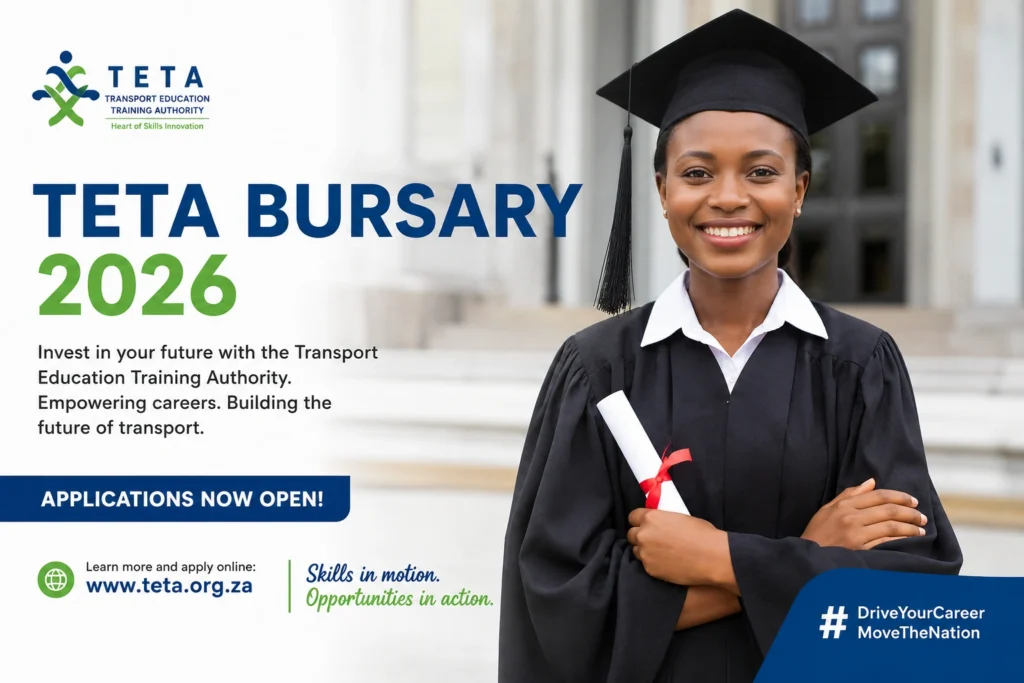

The Transport Education Training Authority (TETA) Bursary 2026 is an important funding opportunity for unemployed South African learners who want to build careers in the country’s growing transport sector. Whether your interest lies in aviation, logistics, engineering, maritime studies, information technology, or diving, this bursary can help cover the financial barriers that often prevent students from pursuing higher education.
For many young South Africans, the cost of tuition, accommodation, transport, books, and meals makes tertiary education difficult to access. The TETA bursary aims to address this challenge by investing in skills that are essential for the future of the transport industry.
This guide explains how the bursary works, who qualifies, which fields of study are covered, and what applicants should prepare before submitting an application.
What You Should Know First
The Transport Education Training Authority (TETA) Bursary 2026 is designed specifically for unemployed South Africans aged 18 to 35 who wish to study transport-related qualifications at accredited institutions.
Key facts include:
- Available for the 2026 academic year
- Supports studies at universities, TVET colleges, aviation schools, and diving institutions
- Covers major study-related expenses
- Focuses on transport sector skills development
- Requires a household income below R350,000 annually
- Applicants must achieve at least 50% average academic performance
The primary goal is to help develop skilled professionals who can contribute to South Africa’s transport, logistics, maritime, aviation, and engineering industries.
Understanding TETA and Its Role
Before applying, it helps to understand what TETA actually does.
The Transport Education Training Authority (TETA) is responsible for supporting skills development within South Africa’s transport sector. Its work focuses on ensuring that industries such as logistics, freight, maritime transport, aviation, rail, road transport, and related sectors have access to qualified professionals.
One of the ways TETA achieves this is through bursary funding.
Instead of simply providing financial aid, TETA strategically invests in qualifications that address industry skills shortages and support economic growth.
This means students who receive funding are often studying in areas where there is a real demand for skilled workers.
Why the TETA Bursary Matters
South Africa’s transport industry is one of the most important sectors of the economy.
Every day, goods move through ports, airports, rail systems, trucking networks, and distribution centres. These systems rely on trained professionals to operate safely and efficiently.
Without sufficient skilled workers, industries can experience:
- Operational delays
- Higher costs
- Safety risks
- Reduced competitiveness
- Slower economic growth
The TETA bursary helps solve these challenges by supporting students who are preparing for careers in critical transport-related occupations.
For students, the benefits are equally significant:
- Reduced financial pressure
- Access to quality education
- Improved career opportunities
- Industry-relevant qualifications
- Better employability after graduation
What Expenses Does the Bursary Cover?
One of the strongest features of the programme is the comprehensive financial support provided to successful applicants.
Tuition Fees
Tuition is usually the largest educational expense. The bursary assists with approved academic fees charged by the institution.
Accommodation
Students studying away from home often struggle with housing costs.
The bursary may cover:
- On-campus residences
- Approved off-campus accommodation
Transport Costs
Transport assistance may be provided where applicable, helping students travel between their accommodation and place of study.
Prescribed Books
Textbooks, manuals, and required learning materials can be expensive. The bursary helps cover these essential academic resources.
Meals
Food costs are often overlooked when budgeting for higher education. The inclusion of meal support helps students focus on their studies without worrying about daily living expenses.
Who Can Apply?
The eligibility criteria are designed to ensure that funding reaches deserving students who need financial assistance and who are pursuing qualifications aligned with transport-sector priorities.
Applicants must:
Be South African Citizens
Only South African citizens are eligible to apply.
Be Between 18 and 35 Years Old
The programme targets young people entering the workforce and building long-term careers.
Be Unemployed
The bursary is specifically intended for unemployed learners.
Be in Grade 12 or Have Completed Matric
Both current Grade 12 learners and matriculants may apply, provided they meet the academic requirements.
Be Accepted or Registered at an Accredited Institution
Applicants must have proof of acceptance or registration from:
- Universities
- TVET colleges
- Aviation schools
- Diving institutions
Achieve at Least 50% Academic Performance
A minimum overall average of 50% is required.
Meet the Household Income Requirement
Total household income must be less than R350,000 per year.
This requirement helps prioritize students from lower-income households.
Eligible Fields of Study Under the Transport Education Training Authority (TETA) Bursary 2026
The bursary covers a wide range of qualifications linked to the transport industry.
Engineering Qualifications
Engineering remains one of the most sought-after skills categories in transport.
Examples include:
- Electrical Engineering
- Mechanical Engineering
- Marine Engineering
- Aeronautical Engineering
- Mechatronics Engineering
These disciplines support infrastructure development, maintenance, and technological innovation.
Transport and Logistics Programmes
South Africa’s economy relies heavily on efficient movement of goods and services.
Supported qualifications include:
- Supply Chain Management
- Freight Forwarding
- Customs Compliance
- Transport Economics
- Road Transport Management
- Maritime Transport Management
Graduates often work in logistics companies, ports, distribution centres, and transport planning environments.
Aviation Studies
The aviation industry requires highly trained professionals and specialized qualifications.
Eligible programmes include:
- Private Pilot Licence (PPL)
- Commercial Pilot Licence (CPL)
- Airline Transport Pilot Licence (ATPL)
- Flight Instructor Ratings
- Instrument Ratings
These qualifications prepare students for careers in commercial aviation and related sectors.
Maritime and Nautical Studies
South Africa’s extensive coastline creates demand for maritime expertise.
Students pursuing maritime qualifications may find opportunities in:
- Shipping
- Port operations
- Marine transport
- Navigation
- Vessel management
Information Technology and Cybersecurity
Modern transport systems depend on digital infrastructure.
Supported studies may include:
- Information Technology
- Cybersecurity
- Network Systems
- Transport Technology Solutions
As transport becomes increasingly digital, these skills continue to grow in importance.
Artificial Intelligence and Data Analytics
Data-driven decision-making is transforming logistics and transport operations.
Relevant fields include:
- Artificial Intelligence
- Data Analytics
- Business Intelligence
- Predictive Modelling
Professionals in these areas help organizations improve efficiency and reduce costs.
Finance and Accounting
Transport organizations require strong financial management.
Students studying:
- Accounting
- Financial Management
- Auditing
- Cost Management
may also qualify under approved programmes.
Environmental and Safety Management
Sustainability and safety are increasingly important within the transport industry.
Relevant qualifications include:
- Environmental Science
- Safety Management
- Risk Management
- Occupational Health and Safety
These professionals help organizations comply with regulations while protecting people and the environment.
Diving Programmes
The bursary also supports specialized diving qualifications such as:
- Class II Diving
- Class III Diving
- Class IV Diving
These certifications can lead to careers in underwater inspection, maintenance, construction, and marine operations.

Step-by-Step Guide to Applying
Understanding the application process can improve your chances of submitting a successful application.
Step 1: Confirm Your Eligibility
Review all eligibility requirements carefully before starting.
Make sure you meet:
- Age requirements
- Academic requirements
- Income requirements
- Citizenship requirements
Step 2: Secure Admission
Obtain acceptance or registration at an accredited institution.
Without proof of admission, your application may not be considered.
Step 3: Gather Required Documents
Prepare every required document before beginning the online application.
This helps prevent delays and incomplete submissions.
Step 4: Certify Documents
Ensure certified copies are not older than three months.
Outdated certification dates can result in application problems.
Step 5: Complete the Online Application
Follow all instructions carefully and upload the requested documents.
APPLY HERE: (TETA) Bursary 2026
Double-check every section before submission.
Step 6: Submit Only One Application Per Qualification
One of the most important rules is avoiding duplicate submissions.
Multiple applications for the same qualification may lead to disqualification.
ALSO APPLY FOR: Guvon Academy Bursaries 2026
Required Supporting Documents Explained
Applicants must upload certified supporting documents.
These typically include:
Personal Identification
- Certified copy of South African ID
Academic Records
- Matric certificate, or
- Latest academic results
Proof of Admission
- Acceptance letter
- Registration confirmation
Parent or Guardian Documents
- Certified copies of IDs
- Proof of income
- Recent payslips or affidavits
Additional Documents for Aviation Students
Where applicable:
- Valid aviation licences
- Relevant certification documents
Additional Documents for Diving Students
Applicants may need:
- Medical examination results
- Diving-related certifications
Private Institution Requirements
Students studying at private institutions may need proof that the institution is properly accredited.
Common Misunderstandings About Transport Education Training Authority (TETA) Bursary 2026
Many students misunderstand certain aspects of the programme.
Misunderstanding 1: Only University Students Can Apply
This is incorrect.
The bursary also supports eligible students attending TVET colleges, aviation schools, and diving institutions.
Misunderstanding 2: Only Engineering Students Qualify
Engineering is important, but it is not the only field supported.
Logistics, IT, cybersecurity, finance, AI, maritime studies, and other programmes may also qualify.
Misunderstanding 3: Applicants Must Already Be Studying
Not necessarily.
Current Grade 12 learners may apply if they meet the requirements and secure admission.
Misunderstanding 4: Household Income Is Not Important
Income is a key eligibility factor.
Households earning above the specified threshold may not qualify.
Misunderstanding 5: Missing Documents Can Be Submitted Later
Incomplete applications often face rejection.
Applicants should submit all required documents before the deadline.
Tips for a Strong Application
Students can improve their chances by following a few practical strategies:
- Apply as early as possible.
- Keep certified documents up to date.
- Ensure all uploaded files are clear and readable.
- Verify institution accreditation.
- Check academic results carefully.
- Follow every application instruction exactly.
- Maintain copies of all submitted documents.
Attention to detail can make a significant difference.
Key Takeaways
The most important points to remember about the Transport Education Training Authority (TETA) Bursary 2026 are:
- It supports unemployed South Africans aged 18–35.
- Household income must be below R350,000 annually.
- Applicants need at least a 50% academic average.
- Funding covers tuition, accommodation, books, meals, and certain transport costs.
- Universities, TVET colleges, aviation schools, and diving institutions may qualify.
- Multiple transport-related study fields are supported.
- Complete documentation is essential.
- Only online applications are accepted.
- One application should be submitted per qualification.
Frequently Asked Questions
1. Can Grade 12 learners apply for the TETA Bursary 2026?
Yes. Learners currently in Grade 12 may apply provided they meet the eligibility requirements and obtain admission to an accredited institution.
2. Does the bursary cover accommodation?
Yes. The bursary may cover approved on-campus or off-campus accommodation costs.
3. Are aviation qualifications included?
Yes. Various aviation-related qualifications, including pilot licences and instructor ratings, may be funded under the programme.
4. Can students at private institutions apply?
Yes. Students attending accredited private institutions may qualify, provided they submit the required accreditation documentation.
Final Thoughts
The Transport Education Training Authority (TETA) Bursary 2026 offers more than financial assistance—it creates opportunities for young South Africans to enter industries that are critical to national development. By supporting studies in engineering, logistics, aviation, maritime disciplines, information technology, and other transport-related fields, the programme helps build the skilled workforce needed for the future of South Africa’s transport sector. Students who meet the eligibility requirements should prepare their documents carefully, secure admission to an accredited institution, and submit a complete application to maximize their chances of receiving funding.