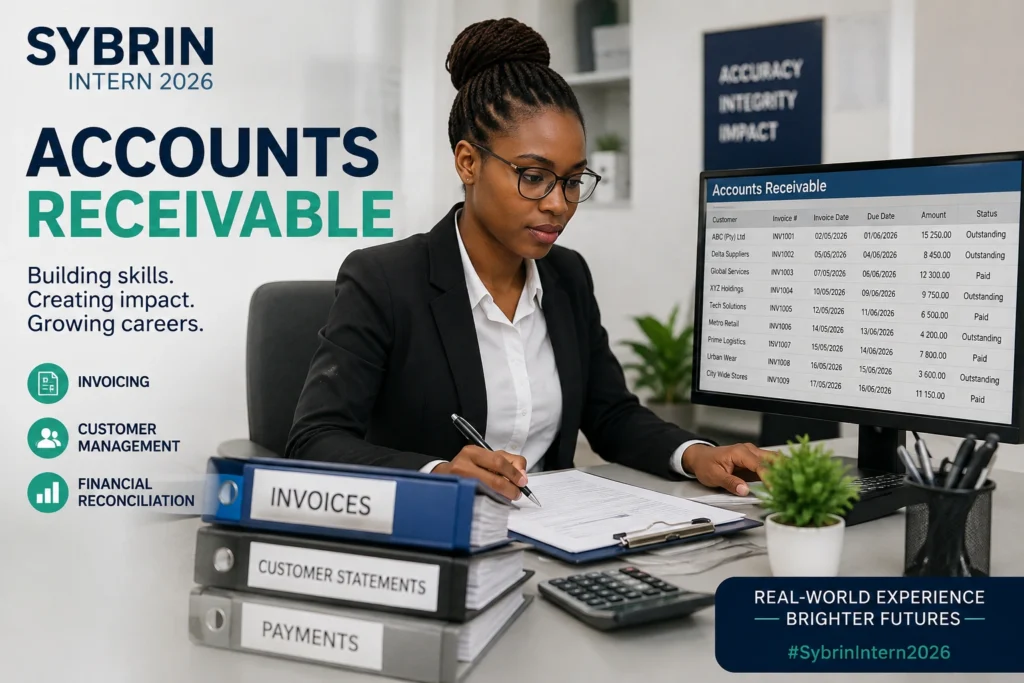

Imagine starting your finance career not in a traditional accounting firm, but inside a technology company where invoices, customer payments and financial records support software solutions used by businesses.
That is the opportunity behind the Sybrin Intern 2026 vacancy for an Accounts Receivable Intern in Johannesburg. For a graduate or student who has studied accounting or finance, the position offers something particularly useful: exposure to finance operations within a technology-driven business.
The role is hybrid and structured as a 12-month internship, with the successful intern reporting to the Financial Manager. Rather than being limited to theoretical accounting work, the position involves practical responsibilities such as allocating customer payments, processing invoices, following up on outstanding accounts, supporting collections and assisting with financial reporting.
For young South Africans trying to move from qualification to workplace experience, that distinction matters. A finance qualification can demonstrate that you understand accounting principles, but an employer also wants evidence that you can work accurately, communicate professionally, manage information and operate within real business processes.
Important: The supplied vacancy information does not specify a closing date, so applicants should avoid waiting for a deadline that may not exist. Where the vacancy remains available, applying early is the safer approach.
Why the Sybrin Intern 2026 opportunity stands out
Sybrin operates in the information technology and software development environment, creating solutions intended to help businesses improve efficiency and customer experiences.
For an Accounts Receivable Intern, this creates an interesting learning environment. You are not simply learning finance in isolation. You are learning how a finance function operates within a technology business, where customers, contracts, invoices, payment records and internal systems all have to work together.
Sybrin also highlights its focus on quality, information security and privacy through certifications including ISO 9001, ISO/IEC 27001 and ISO/IEC 27701.
For a finance intern, that background has an important practical implication.
Financial information is sensitive. Customer balances, invoices, payment details and account information cannot simply be handled casually. Accuracy and confidentiality are part of the job.
This means the internship could help develop workplace habits that are valuable well beyond the 12-month placement.
An intern may learn to:
- work with financial information carefully and confidentially;
- reconcile information between records and transactions;
- communicate with customers about outstanding accounts;
- maintain accurate documentation;
- understand how finance supports other departments;
- work within established company procedures and controls.
These are transferable skills that can strengthen a CV when applying for permanent finance positions later.
Vacancy at a glance
| Detail | Information |
|---|---|
| Position | Accounts Receivable Intern |
| Company | Sybrin |
| Location | Johannesburg, Gauteng |
| Work arrangement | Hybrid |
| Duration | 12 months |
| Reports to | Financial Manager |
| Study background | Accounting, Finance, Financial Management or related field |
| Main focus | Accounts receivable and customer account administration |
| Application | Online through the Sybrin careers portal |
| Closing date | Not specified |
The absence of a published closing date should not be interpreted as an indication that applications will remain open indefinitely. Recruitment can change quickly, particularly where an employer receives substantial interest.
What will an Accounts Receivable Intern actually do?
The phrase “accounts receivable” can sound technical if you have never worked in a finance department.
In simple terms, accounts receivable is about money that customers owe a business.
Suppose a company provides a service to a customer and issues an invoice for R50,000. Until the customer pays, that amount sits as money owed to the company. The accounts receivable function helps ensure that invoices are correctly recorded, payments are received and customer accounts accurately reflect what has been paid and what remains outstanding.
An intern working in this area may therefore be exposed to several stages of that process.
Payment allocations
When money arrives in a company’s bank account, the finance team needs to identify which customer and invoice the payment belongs to.
An incorrectly allocated payment can make one customer’s account appear unpaid while another account appears to have received money that does not belong there.
This is why attention to detail matters.
Invoicing
The intern may assist with invoice-related administration, ensuring that information is captured correctly and supporting the wider billing process.
This is an area where seemingly small mistakes can create larger problems. An incorrect amount, reference number or customer detail can delay payment or create unnecessary queries.
Customer account follow-ups
Outstanding invoices often require communication with customers.
That does not necessarily mean aggressively demanding payment. Professional collections are about understanding what is outstanding, confirming whether the customer has received the invoice, identifying disputes and helping move the account towards resolution.
For a young graduate, this can be an unexpectedly valuable communication lesson.
You may have excellent accounting knowledge, but working in finance also means being able to explain information clearly to people who do not work in finance.
Debtor administration and reporting
The internship may also provide exposure to debtor-related records and financial reporting.
This can help an intern understand the relationship between individual transactions and the bigger financial picture.
That perspective is particularly useful for someone considering a longer-term career in accounting, financial management, credit control or finance operations.
Who should consider applying?
The opportunity is aimed at candidates who have completed or are currently completing a Certificate, Diploma or Degree in Accounting, Finance, Financial Management or a related field, according to the supplied vacancy details.
However, having the right qualification is only one part of being competitive.
An employer recruiting an Accounts Receivable Intern is likely to value evidence that you can handle routine work without becoming careless. Finance departments depend heavily on accurate information, and small errors can have consequences.
A strong applicant should therefore be able to demonstrate qualities such as:
Accuracy: You are comfortable checking figures, names, dates and references before submitting work.
Organisation: You can manage several tasks without losing track of deadlines or outstanding items.
Communication: You can communicate professionally with colleagues and customers.
Numerical confidence: You do not become uncomfortable when working with figures, transactions and financial records.
Willingness to learn: You understand that an internship is an opportunity to develop practical competence rather than simply obtain a certificate.
Professional judgement: You understand that financial and customer information should be treated confidentially.
One useful strategy is to look beyond your qualification when preparing your CV. If you have completed a university project involving financial analysis, worked with spreadsheets, handled administration, assisted with a student organisation’s finances or completed accounting-related coursework, make the relevant experience visible.
You do not need years of employment history to demonstrate potential.
The hidden value of learning finance inside a technology company
Expert-style insight: The most valuable aspect of this internship may not be the accounts receivable tasks themselves. It is the opportunity to see how finance interacts with technology, customers and operational systems.
Modern finance departments increasingly depend on digital systems to process transactions, track customer accounts, produce reports and identify outstanding balances.
That means today’s junior finance professional benefits from more than traditional accounting knowledge.
They need to understand how information moves through a business.
A payment begins as a transaction. It becomes a financial record. That record affects a customer’s account. The customer account contributes to debtor reporting. The reporting then helps management understand cash flow and business performance.
The better you understand that chain, the more valuable your finance knowledge becomes.
This is one reason an internship at a technology-focused organisation can be useful for graduates who want to develop a career that sits between finance and business systems.
How to make your application stronger
An internship application should answer a simple question: Why should this employer believe you are ready to learn and contribute?
Avoid sending the same generic CV to every internship.
For the Sybrin role, your CV should make your finance background immediately visible. If you have relevant academic projects, Excel experience, accounting software exposure or administrative experience, include them where they genuinely apply.
Your application preparation can follow this sequence:
- Check the vacancy requirements carefully. Make sure your qualification fits the stated accounting, finance or related-field requirement.
- Update your CV. Put your most relevant qualification, skills and experience where a recruiter can find them quickly.
- Emphasise practical abilities. Mention spreadsheet skills, financial administration, reconciliation, data capturing or reporting experience if you genuinely have them.
- Proofread everything. A finance application containing avoidable spelling or numerical errors can undermine an otherwise strong profile.
- Apply through the official Sybrin recruitment channel. Avoid relying on third-party pages when the employer provides its own application route.
- Keep your documents ready. Have your CV and relevant qualification or academic records available if requested.
- Monitor your communication channels. Check your email and phone regularly after applying.
APPLY HERE: Sybrin Intern 2026
ALSO APPLY FOR: Mukuru Intern 2026
Because no closing date is specified in the information provided, early application is sensible.
Don’t overlook the hybrid-work requirement
“Hybrid” does not mean that the position is necessarily fully remote.
The vacancy is based in Johannesburg, Gauteng, so applicants should consider whether they can realistically meet any office attendance requirements associated with the role.
This is particularly important for graduates living outside Johannesburg. Before applying, consider transport, accommodation, commuting costs and the practical demands of a 12-month placement.
An opportunity is only useful if you can realistically participate in it.
Frequently asked questions
2. Where is the Sybrin internship based?
The position is listed in Johannesburg, Gauteng, with a hybrid work arrangement.
3. Is there a closing date?
No closing date is specified in the vacancy information provided. Applicants should therefore avoid delaying their application and should check the official recruitment listing for the latest status.
Final assessment
For a finance graduate or student looking for practical workplace exposure, the Sybrin Accounts Receivable Intern position is worth serious consideration.
Its strongest feature is the combination of finance experience and a technology-company environment. An intern can potentially develop practical knowledge of invoicing, payment allocation, collections, customer accounts and financial reporting while also learning how a modern business manages sensitive information and digital processes.
It is also important to approach the opportunity realistically. An internship is not a guarantee of permanent employment, and applicants should not assume that every successful intern will automatically receive a full-time position.
The better way to view the opportunity is as a 12-month period in which you can build evidence of what you can actually do.
For someone entering South Africa’s competitive graduate employment market, that evidence can be powerful. A CV saying you studied finance is useful. A CV showing that you have worked with customer accounts, payment allocations, invoicing, collections and reporting in a professional business environment tells a much stronger story.
The Sybrin Intern 2026 opportunity therefore represents more than a first line on a CV. It could be a practical bridge between academic knowledge and the realities of working in finance—and, importantly, an introduction to the increasingly connected world of finance and technology.
Application note: Since the closing date is not specified, prospective applicants should verify that the vacancy is still open on Sybrin’s official careers platform before submitting their application.