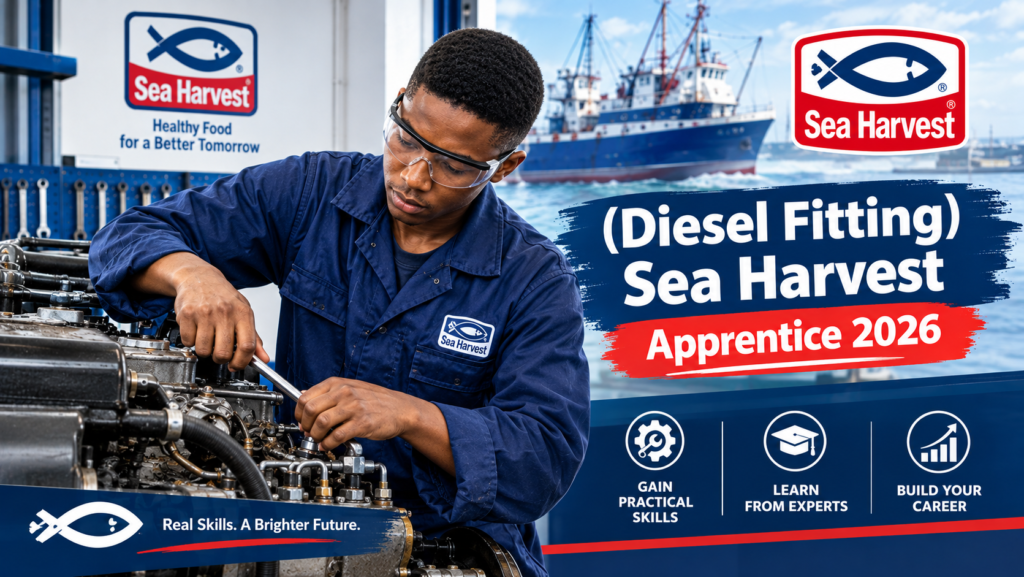

For an unemployed young person in Saldanha Bay, finding the first serious opportunity to enter the engineering industry can be difficult. Having Matric is often not enough, while having a technical qualification without workplace experience can leave candidates caught in the middle.
That is why the Sea Harvest Apprentice 2026 opportunity deserves attention.
Sea Harvest has opened a Diesel Fitting Apprenticeship in Saldanha Bay, Western Cape, aimed at an unemployed candidate and preferably a young person. Applications close on 10 September 2026.
The apprenticeship is linked to the company’s Fleet Engineering department and combines practical workshop training with structured learning through a Technical and Vocational Education and Training (TVET) college.
For someone interested in mechanical engineering, diesel technology or technical maintenance, this is potentially an important first step into a skilled occupation.
However, applicants should understand exactly what is being offered. Sea Harvest has confirmed that the successful candidate will be employed on a fixed-term contract covering the training period. The company has not stated the exact duration of the apprenticeship or disclosed a stipend or salary amount in the available information.
What makes this apprenticeship different from an ordinary job?
Imagine a candidate who has completed Matric with Mathematics and Science but has never worked in a professional workshop.
They may understand basic scientific and mathematical concepts, but they have not yet had the opportunity to work around industrial equipment, follow maintenance procedures or learn from experienced technicians.
An apprenticeship is designed to bridge that gap.
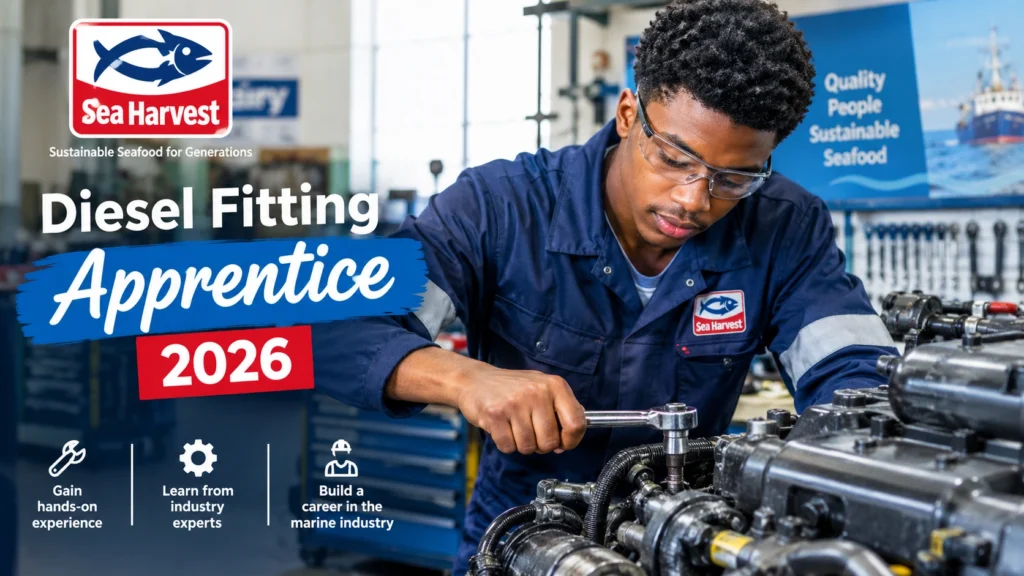
The Sea Harvest programme combines workplace-based experiential training with a Centre of Specialisation programme at a TVET college. In practical terms, the apprentice will not only be learning from textbooks. They will also be developing workplace skills in a Fleet Engineering environment.
Diesel fitting requires more than knowing how an engine works. A technician must learn how to inspect equipment, identify faults, use tools correctly, follow technical instructions and work safely.
That is why the combination of college learning and practical training is significant.
For an unemployed candidate, the experience gained can potentially become one of the most valuable parts of the CV.
Who can apply for the Sea Harvest Apprentice 2026?
Sea Harvest has provided several qualification pathways.
You can qualify through one of these routes:
- National Technical Certificate 3 (N3), with four subjects passed
- NQF Level 4 qualification
- Matric with Mathematics and Science
- Technical Matric
Relevant practical training or experience in a similar occupational field is an advantage, although it is not listed as a compulsory requirement.
Sea Harvest also indicates a preference for young candidates, but no specific age range has been provided.
This means applicants should not automatically exclude themselves simply because they do not have years of experience. If you meet one of the stated educational requirements, you may still have a basis for applying.
What will the apprentice actually learn?
The Fleet Engineering environment is important because diesel fitting is a hands-on occupation.
While the exact daily duties for this intake have not been published in detail, applicants should expect the apprenticeship to involve learning within a technical workshop environment and developing occupational competence under supervision.
The broader learning journey can include understanding mechanical systems, equipment maintenance, fault identification and safe workshop practices.
The college component adds another layer by providing structured technical education.
This is particularly valuable for candidates who want to build a career rather than simply find temporary employment.
A strong apprentice should leave the programme with more than a line on a CV. They should aim to develop:
- Practical mechanical skills
- Technical problem-solving ability
- Workshop safety awareness
- Understanding of maintenance procedures
- Experience working under supervision
- Workplace discipline and reliability
- A clearer understanding of diesel and mechanical systems
These are transferable foundations for future technical opportunities.
Why Saldanha Bay is an important location
The location of this apprenticeship should not be overlooked.
Saldanha Bay has a strong industrial, fishing, marine and logistics presence. These sectors depend heavily on equipment, vehicles, vessels and mechanical systems functioning reliably.
That creates a natural environment for technical skills to have practical relevance.
For someone living in the Western Cape, an apprenticeship connected to an established industrial operation can therefore provide exposure to a working environment that is difficult to obtain through classroom study alone.
It also highlights the importance of vocational careers in South Africa.
Not every successful technical career begins with a university degree. Apprenticeships and occupational training can provide another route for people who are interested in practical engineering work.
Expert insight: the experience gap matters
One of the biggest challenges facing entry-level job seekers is the experience paradox: employers want experience, but young people need someone to give them their first opportunity.
An apprenticeship partly addresses this problem.
Instead of expecting an inexperienced candidate to arrive as a fully trained technician, the programme is designed around learning and supervised development.
That does not mean the selection process will be easy. Employers still need candidates who demonstrate commitment, basic academic competence, safety awareness and a genuine interest in the occupation.
The strongest applicant is therefore not necessarily the person with the longest CV. It may be the candidate who can clearly demonstrate: I meet the requirements, I understand what this trade involves, and I am prepared to learn.
How to Apply for the Sea Harvest Apprentice 2026
Because the closing date is 10 September 2026, candidates should prepare their applications without unnecessary delay.
Follow these steps:
Step 1: Confirm that you meet the qualification requirement
Check your academic record before applying.
You should be able to demonstrate at least one of the accepted routes:
- N3 with four subjects passed
- NQF Level 4 qualification
- Matric with Mathematics and Science
- Technical Matric
APPLY HERE: Sea Harvest Apprentice 2026
Do not claim a qualification you have not completed.
Step 2: Prepare an updated CV
Your CV should be concise and focused on the apprenticeship.
Make sure it includes:
- Full name and contact details
- Highest qualification
- Subjects and relevant technical subjects
- Any practical training
- Workshop or mechanical exposure
- Relevant work experience, if applicable
- Computer or technical skills where relevant
- References, if appropriate
If you have worked on machinery, completed practical projects or undertaken technical training, explain this clearly.
Step 3: Make your technical interest obvious
Do not submit a CV that looks as though you are applying for every available job.
The employer should be able to see why diesel fitting interests you.
If you have studied mechanical subjects, worked with tools, participated in practical training or developed an interest in engines and machinery, make that relevant experience visible.
Do not exaggerate. Genuine information is more useful than impressive-sounding claims.
Step 4: Check your documents
Before submitting, make sure your supporting documents are clear and accurate.
Depending on the employer’s application instructions, applicants may need to provide proof of qualifications or other supporting information.
Only submit documents requested through the official recruitment process, and make sure your personal information is correct.
Step 5: Submit through the official Sea Harvest recruitment process
Use the application route specified in the original Sea Harvest vacancy.
Be particularly careful when applying online. Recruitment scams can involve requests for money, banking details or payment for supposedly guaranteed employment.
You should never pay someone to secure an apprenticeship.
If you encounter a different closing date, salary figure or application method on an unofficial website, verify it against the employer’s recruitment information before proceeding.
Step 6: Do not wait until the deadline
The closing date is 10 September 2026.
Submitting early gives you time to correct mistakes if an application is incomplete or a document is unclear.
It also prevents a simple technical problem from becoming the reason you miss the opportunity.
ALSO APPLY FOR: BHBW Apprentice 2026-2027
What could strengthen your application?
Meeting the minimum requirements gets you into consideration, but candidates can still improve how their applications present them.
Think about what a Fleet Engineering team needs from an apprentice.
A good candidate should be able to demonstrate a willingness to learn and an understanding that technical work requires discipline.
If you have relevant experience, highlight it. If you do not, focus on genuine evidence of your interest and readiness to learn.
Avoid filling your CV with unrelated information simply to make it longer.
Instead, show evidence of:
- Interest in mechanical or diesel-related work
- Reliability and punctuality
- Ability to follow instructions
- Safety-conscious behaviour
- Willingness to learn
- Teamwork
- Attention to detail
These qualities become particularly important in workshop environments where mistakes can damage equipment or create safety risks.
Important details applicants should know
There are several points prospective candidates should not assume.
The apprenticeship duration has not been disclosed. Sea Harvest states that the successful candidate will be on a fixed-term contract covering the training period, but no exact number of months or years has been provided.
The stipend or salary has not been stated. Applicants should not rely on unofficial figures circulating online.
Young candidates are preferred, but no age limit is specified. This is different from stating that applicants must fall within a particular age range.
Previous relevant experience is an advantage, not a stated minimum requirement. Candidates who meet the academic criteria should therefore consider applying even if they are new to the industry.
Frequently Asked Questions
1. What is the closing date for the Sea Harvest apprenticeship?
Applications close on 10 September 2026.
2. Where is the apprenticeship based?
The Diesel Fitting Apprenticeship is based in Saldanha Bay, Western Cape, within Sea Harvest’s Fleet Engineering environment.
3. Does Sea Harvest disclose the apprenticeship salary?
No stipend or salary amount has been disclosed in the available opportunity information. Candidates should verify any payment information directly through the official recruitment process.
A practical opportunity, but not a shortcut
The Sea Harvest Apprentice 2026 opportunity should be viewed realistically.
It is not a promise of permanent employment, and applicants should not assume that completing the training automatically results in a permanent position. The advertised arrangement is a fixed-term contract covering the training period.
But that does not diminish its potential value.
For an unemployed candidate with the right academic background, the opportunity could provide something that is difficult to obtain when starting out: structured technical education combined with real workplace exposure.
The deadline is 10 September 2026, so eligible candidates should focus on getting the basics right—accurate qualifications, a relevant CV, complete documentation and a genuine explanation of their interest in diesel fitting.
For young people considering a technical career, the bigger lesson is perhaps even more important. Skilled trades are built through practice, discipline and continuous learning. An apprenticeship can provide the bridge between having the theoretical foundation and becoming capable of contributing in a real engineering environment.
For the right candidate, Saldanha Bay could be where that journey begins.