

For many South African students, getting accepted into university is only the first hurdle. The bigger challenge can be finding enough money to pay registration, tuition, accommodation, meals, books and other study-related costs. This is where a comprehensive bursary can make a significant difference.
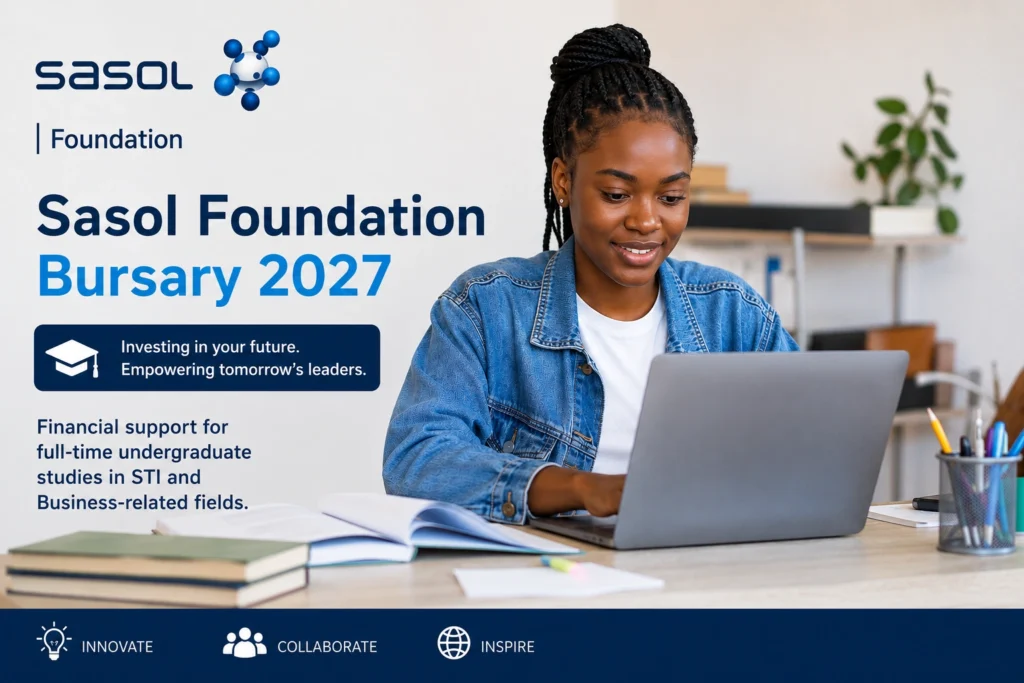
The Sasol Foundation Bursary 2027 is aimed primarily at South African students pursuing undergraduate studies in STEM and other approved future-focused fields at public universities and universities of technology. According to the information provided for the 2027 intake, applications are open from 1 August to 23 August 2026 at midnight.
The programme is particularly relevant to students interested in engineering, information technology, data science, mathematical sciences, chemistry, environmental sciences and other critical-skill areas. Sasol Foundation reporting also highlights the programme’s focus on developing STEM capabilities and providing students with support beyond simply paying academic fees.
If you are considering applying, however, it is important to understand the eligibility rules before spending time on the application.
What You Should Know First
The first thing to understand is that the Sasol Foundation Bursary 2027 is an undergraduate bursary.
This means it is intended for students working towards their first undergraduate degree. The current application information specifically states that postgraduate bursaries are not available in this cycle.
The programme is also not simply an open bursary for every qualification. STEM students are the main target group, while non-STEM funding is restricted to particular categories connected to Sasol’s broader community and stakeholder objectives.
The application window is:
- Opening date: 1 August 2026
- Closing date: 23 August 2026 at midnight
- Study level: Undergraduate
- Institution: Approved South African public university or university of technology
- Citizenship: South African citizen by birth
- Maximum household income: Less than R800,000 per year
- Age requirement: Under 25 at the time of application
The Foundation’s broader tertiary education programme is designed not only to improve access to university but also to support students through mentorship, psychosocial assistance and preparation for the workplace.
That makes this opportunity worth examining as a complete student-support programme rather than viewing it as tuition assistance alone.
What Is the Sasol Foundation Bursary?
The Sasol Foundation is part of Sasol’s investment in education and skills development in South Africa. Its tertiary programmes have historically focused strongly on STEM disciplines because of the country’s need for technical and scientific skills.
The Foundation’s reporting shows that undergraduate support is connected to future-of-work capabilities, while special categories can also receive support for approved non-STEM studies. These categories include qualifying children of Sasol employees, children of Sasol Khanyisa shareholders and students from Sasol fence-line communities.
In practical terms, the bursary is intended to reduce the financial barriers that can prevent academically capable students from completing a university qualification.
For a qualifying student, this can mean that several of the largest expenses associated with tertiary education are addressed through one programme.
What Does the Bursary Cover?
The Sasol Foundation Bursary 2027 is described as providing comprehensive financial and developmental support.
The listed benefits include:
- Registration fees
- Tuition fees, excluding repeat modules
- Book allowance
- Monthly stipend
- Meal allowance
- Accommodation allowance
- Once-off computer allowance
- Once-off calculator allowance
- Psychosocial support
- Student-development support
The exclusion of repeat modules is important. Students should not assume that funding automatically covers every academic cost if they fail a subject and need to repeat it.
The developmental component is another important feature. Sasol’s recent reporting describes psychosocial and mentorship support, graduate development and work-readiness assistance as parts of its student wraparound approach.
So, the value of the programme is not limited to a payment towards university fees.
Which Fields of Study Are Supported?
The strongest emphasis is on STEM and future-capability fields.
Potential areas include:
- Engineering
- Information Technology
- Computer Science
- Data Sciences
- Mathematical Sciences
- Chemistry
- Agricultural Science
- Environmental Sciences
- Medical Sciences
- Construction
- Manufacturing
- Financial Science and related approved fields
- Education where the qualification majors specifically in STEM subjects
This makes the programme particularly relevant to students considering careers in technical, scientific, digital and quantitative fields.
For example, a student accepted into an approved engineering degree may fit naturally within the programme’s main STEM focus. Similarly, someone pursuing Computer Science or Data Science could potentially fall within the Foundation’s future-skills priorities.
However, students should not rely solely on the broad name of their qualification. The exact qualification and institution should be checked against the Sasol application platform before submitting.
Who Is Eligible?
Meeting the basic academic and financial requirements is essential.
According to the supplied 2027 application information, applicants must:
1. Be a South African citizen by birth
The programme is intended for South African citizens by birth.
Applicants should therefore have the appropriate South African identification documentation available.
2. Be under 25
You must be younger than 25 at the time of application.
This is an important screening requirement because an otherwise strong academic applicant could still be ineligible if they fall outside the specified age range.
3. Be pursuing a first undergraduate degree
The bursary is for students completing their first undergraduate qualification.
Someone looking for funding for a second degree or postgraduate qualification should therefore investigate other funding opportunities.
4. Study at an approved public institution
Applicants must be accepted or provisionally accepted for full-time degree study at an approved South African public university or university of technology.
This means acceptance is an important part of the application process.
5. Meet the household-income requirement
The combined annual household income must be less than R800,000.
Applicants should prepare supporting financial documentation because income eligibility may need to be verified.
6. Meet the academic requirements
Students already at university who are applying for later-year funding must have achieved an average of at least 60% across all modules.
They must also not have failed modules during the previous academic year.
This requirement matters because being financially eligible does not automatically guarantee continued bursary support.
What About Non-STEM Students?
This is one of the areas applicants need to understand carefully.
The Sasol Foundation programme does support certain non-STEM studies, but this does not mean that every student studying a humanities, social sciences or other non-STEM qualification can apply.
Non-STEM support is restricted to specific groups, including qualifying students from:
- Sasol fence-line communities
- Children of Sasol Khanyisa/Inzalo shareholders
- Children of Sasol employees
Therefore, a non-STEM applicant should first determine whether they meet one of these additional eligibility routes.
A student who does not fall into one of the qualifying categories should not assume that the general bursary is available simply because their household income is below R800,000.
Documents You Should Prepare
A strong application begins with preparation.
Before starting the online application, gather:
- South African ID document or ID card
- University acceptance or provisional acceptance letter
- Latest school or university results
- Full academic record, if already studying
- Proof of household income
- Proof of permanent home residence, where required
- Any additional supporting documentation requested by the application platform
Preparing these documents before the application deadline reduces the chance of rushing through the final stages.
It is also worth checking that documents are readable and contain the information required for verification.
How to Apply for the Sasol Foundation Bursary 2027
The application process should be completed through the official Sasol bursary application route, rather than by sending documents to an unrelated email address or third-party website.
A sensible step-by-step approach is:
Step 1: Confirm your eligibility
Before completing the form, check your citizenship, age, household income, study level, academic status and field of study.
Step 2: Confirm your institution and qualification
Make sure your university or university of technology is an approved institution and that your qualification falls within the supported study areas.
Step 3: Secure university acceptance
If the application requires proof of acceptance or provisional acceptance, have the relevant document ready.
Step 4: Gather your financial documents
Household income is part of the eligibility assessment, so do not leave financial verification until the last day.
Step 5: Complete the online application
Enter your personal, academic, financial and study information carefully.
APPLY HERE: Sasol Foundation Bursary 2027
Step 6: Upload supporting documents
Check every upload before proceeding. Missing documentation can create unnecessary problems during verification.
Step 7: Review everything
Check names, ID numbers, academic information, contact details and uploaded documents.
Step 8: Submit before the deadline
The stated closing date is 23 August 2026 at midnight.
Do not treat midnight on the closing date as extra preparation time. Technical problems, slow internet connections or missing documents can prevent a last-minute submission.
ALSO APPLY FOR: Ernst & Ethel Eriksen Trust Bursary 2027
Why the Closing Date Matters
The application window is relatively short: 1 August to 23 August 2026.
That gives applicants just over three weeks to complete the process.
Students who are interested should therefore start gathering documentation as soon as possible rather than waiting until the final weekend.
This is particularly important for current university students who need full academic records or applicants who need to obtain updated proof of household income.
Common Misunderstandings About Sasol Foundation Bursary 2027
“Any Sasol bursary advertisement is the same.”
Not necessarily. The current Foundation bursary should not be confused with other Sasol-related bursary initiatives or partnerships.
Always check the programme name and application period before applying.
“Postgraduate students can apply.”
Not for this particular cycle, according to the supplied 2027 information. The current opportunity is for undergraduate study.
“All qualifications are funded.”
No. STEM fields are the main focus, while non-STEM support is restricted to specific qualifying categories.
“Being financially needy guarantees selection.”
No. Meeting the eligibility requirements allows an applicant to be considered; it does not mean that funding is automatically awarded.
“Tuition covers repeat subjects.”
The stated funding excludes repeat modules, so students should understand the academic-performance implications of the bursary.
“I can apply through any bursary website.”
Applicants should use the official Sasol bursary application platform and verify information directly with Sasol.
How Competitive Is the Bursary?
The Sasol Foundation Bursary should be regarded as competitive, particularly because it targets high-priority STEM disciplines and provides broad financial support.
Sasol’s own reporting indicates that its undergraduate programme is designed to develop a pool of critical STEM skills and support students through their transition into university and eventually the workplace.
That means applicants should not approach the application as a simple financial-aid form.
A strong candidate should demonstrate that they meet all requirements, have the required academic performance, are studying an approved field and have submitted complete supporting documentation.
The best strategy is accuracy rather than exaggeration.
Tips for Improving Your Application
A few practical steps can make the process smoother:
Apply early. Don’t wait for 23 August.
Check your qualification carefully. A broad STEM-related description is not enough if your exact programme is not approved.
Keep your academic record ready. Current students should obtain their complete record before applying.
Prepare financial evidence. Make sure household-income documents are current and readable.
Read every question carefully. Small errors in an online application can create larger verification problems.
Save evidence of submission. Keep confirmation information and copies of the documents you uploaded.
Most importantly, never pay an individual claiming they can guarantee a Sasol bursary. Legitimate bursary applications should follow the official process.
Common Reasons an Application May Fail
Applicants can undermine otherwise strong applications by overlooking basic requirements.
Potential problems include:
- Being over the age limit
- Applying for postgraduate study
- Pursuing a second undergraduate degree
- Choosing an unsupported qualification
- Exceeding the household-income threshold
- Not meeting the academic requirements for current university students
- Having failed modules in the previous study year
- Leaving out required documents
- Providing inconsistent information
- Missing the closing date
These issues are avoidable when applicants carefully check the requirements before submitting.
Frequently Asked Questions
1. When does the Sasol Foundation Bursary 2027 close?
The stated closing date is 23 August 2026 at midnight.
2. Does the bursary fund postgraduate study?
No. The current 2027 application cycle described here is for undergraduate students.
3. Can non-STEM students apply?
Only certain non-STEM applicants qualify. The programme identifies specific groups, including students from Sasol fence-line communities and qualifying children of Sasol employees or Sasol Khanyisa/Inzalo shareholders.
4. What income limit applies?
The combined household income must be less than R800,000 per year, subject to the programme’s verification process.
Key Takeaways
The Sasol Foundation Bursary 2027 is an important funding opportunity for eligible South African undergraduate students, especially those pursuing STEM and future-focused qualifications.
The most important points are:
- Applications open 1 August 2026.
- Applications close 23 August 2026 at midnight.
- The programme is for undergraduate study.
- Postgraduate bursaries are not available in this cycle.
- Applicants must be South African citizens by birth.
- Applicants must be under 25 when applying.
- Household income must be below R800,000 annually.
- STEM fields receive the main focus.
- Some non-STEM students can qualify through specific Sasol-linked categories.
- Funding can include tuition, registration, books, accommodation, meals and a stipend.
- Additional psychosocial and student-development support is available.
- Current university students need at least a 60% average and must not have failed modules in the previous study year.
- Applications should be submitted through the official Sasol bursary platform.
Final Summary
The Sasol Foundation Bursary 2027 is more than an opportunity to have university fees paid. Its structure combines financial assistance with student-development and support services, reflecting Sasol Foundation’s wider focus on developing critical skills in South Africa. Sasol’s recent reporting specifically identifies STEM and future-of-work capabilities as major priorities for its tertiary education programmes.
For prospective applicants, the most important thing is to check eligibility before applying, prepare all supporting documents and submit early. The 23 August 2026 deadline leaves limited room for correcting mistakes.
Students should also remember that eligibility does not guarantee selection. The safest approach is to provide accurate information, meet every stated requirement and use the official application route.