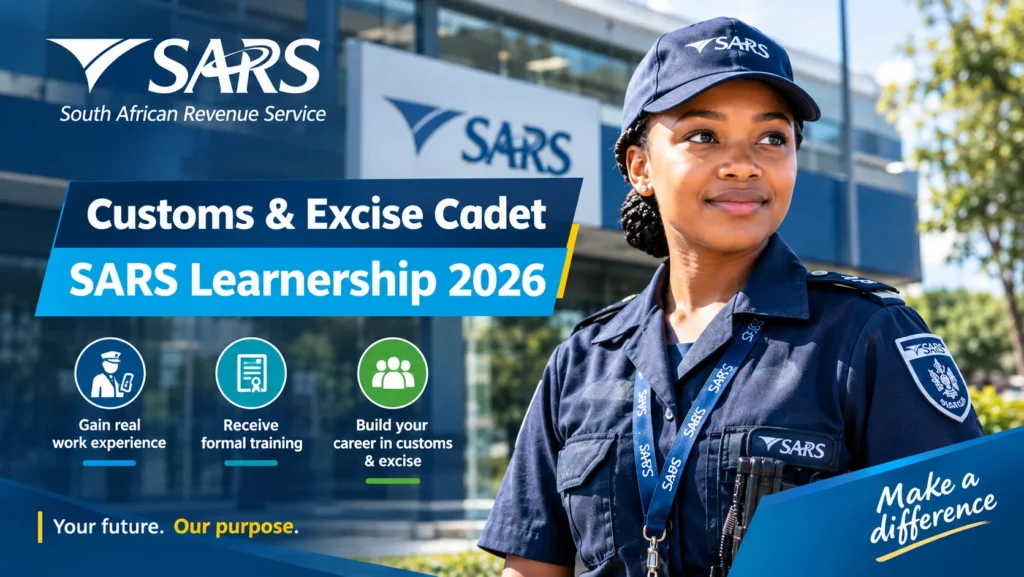

Finding an entry-level opportunity can be difficult when employers ask for previous work experience, a driver’s licence and skills that many young jobseekers have not yet had the chance to develop. The SARS Learnership 2026 recruitment drive stands out because it combines structured learning with practical exposure in one of South Africa’s most specialised public-sector environments.
The South African Revenue Service (SARS) is recruiting 80 young South Africans for its Customs & Excise Cadet Learnership Programme. The programme runs for 12 months and is aimed at candidates between 18 and 35 years old who meet the required education, experience, computer literacy and driving requirements.
Applications close on 30 September 2026, making preparation important for anyone who wants to apply.
This is also not a typical office-based learnership. Successful cadets may be placed at airports, harbours, land border posts and inland Customs operations, including locations that may be remote. SARS’s Customs and Excise function deals with the movement of goods and the collection and administration of duties and levies, making operational accuracy and compliance central to the environment.
What Is the SARS Customs & Excise Cadet Learnership?
The SARS Customs & Excise Cadet Programme is a 12-month workplace learning opportunity designed to expose participants to Customs and Excise operations while developing practical workplace skills.
Rather than simply attending classroom lessons, cadets can expect to learn within an operational environment where procedures, documentation, service delivery and compliance matter.
The programme can help participants develop experience in areas such as:
- Administration
- Customs processes
- Data collection
- Record management
- Reporting
- Client service
- Computer systems
- Operational procedures
- Governance and compliance
- Workplace communication
- Problem-solving
- Professional conduct
This combination is particularly relevant for young people interested in careers connected to Customs, logistics, supply chains, border operations, administration and government services.
SARS’s Customs and Excise activities cover a wide range of goods and transactions. The organisation publishes detailed operational information and schedules for Excise duties, demonstrating the importance of accurate administration and compliance within this area.
SARS Learnership 2026 at a glance
| Requirement | Details |
|---|---|
| Programme | Customs & Excise Cadet Learnership |
| Organisation | South African Revenue Service |
| Duration | 12 months |
| Positions | 80 |
| Age | 18–35 years |
| Citizenship | South African |
| Qualification | NQF Level 4 with Mathematics and/or Accounting |
| Experience | At least 1 year in administration, logistics or customer service |
| Licence | Valid Code B or EB |
| Computer skills | Required |
| Work environment | Customs operational sites |
| Working arrangements | Shifts, weekends, public holidays and overtime may be required |
| Closing date | 30 September 2026 |
Who Can Apply for the SARS Learnership 2026?
Meeting the basic requirements is important because a strong CV cannot compensate for an applicant failing a compulsory requirement.
According to the opportunity information provided, candidates should have the following:
- South African citizenship
- Be between 18 and 35 years old
- An NQF Level 4 qualification
- Mathematics and/or Accounting as part of the required qualification
- At least one year of relevant experience
- Experience in administration, logistics or customer service
- A valid Code B or EB driver’s licence
- Computer literacy
- Microsoft Office proficiency
- Physical fitness suitable for the operational environment
- Willingness to work shifts
- Willingness to work weekends and public holidays
- Willingness to work overtime when required
- Willingness to work at different Customs operational locations
Does Grade 12 qualify?
This is one of the areas applicants should check carefully.
An NQF Level 4 qualification can include the National Senior Certificate, commonly referred to as Matric or Grade 12. However, the requirement specified for this opportunity includes Mathematics and/or Accounting.
Therefore, do not assume that having Matric automatically means you meet the academic requirement.
Look at your actual statement of results and confirm the subjects you completed.
For example, if you have Grade 12 but neither Mathematics nor Accounting appears among the subjects relevant to the stated requirement, you should not assume that your qualification satisfies the advert.
Why This Issue Matters
A common problem with learnership applications is that jobseekers focus on the closing date and submit quickly without checking the less obvious requirements.
That can result in applications from people who have the wrong qualification, lack the required experience or do not have the necessary driving licence.
The SARS opportunity is particularly important to examine carefully because the work environment may differ significantly from a conventional administrative internship.
A cadet could potentially be working around border crossings, ports, airports or inland Customs operations, rather than spending every day in a standard corporate office.
That means applicants need to think beyond the question, “Do I need a job?”
They should also ask:
“Am I prepared for the working conditions associated with Customs operations?”
Shift work, weekends, public holidays and overtime can affect transport, family responsibilities and personal schedules. A placement in a different location can also create accommodation and commuting challenges.
Understanding these realities before applying helps candidates make a more informed decision.
What Could You Learn During the Programme?
One of the strongest practical aspects of a Customs and Excise learnership is the possibility of developing transferable workplace skills.
A participant could gain exposure to tasks involving:
Administration
Accurate administration is essential in environments where records, declarations, documents and transactions have to be handled according to established procedures.
Customer service
Customs operations involve interaction with different people and organisations. This can help participants develop professional communication and service skills.
Data and reporting
Cadets may gain experience working with information, capturing data and preparing reports or maintaining records.
Compliance
Customs and Excise work operates within formal rules and procedures. Learning to follow these processes can build strong workplace discipline.
Operational teamwork
Border and Customs environments often require different teams to coordinate their activities. This can give young workers experience in communication, teamwork and accountability.
These skills can remain useful even if a participant later moves into logistics, administration, customer service or another operational career.
How to Prepare Your Application Step by Step
Don’t wait until the final day to discover that your documents are incomplete.
Step 1: Check your eligibility
Go through every requirement individually.
Confirm:
- Your age
- Citizenship
- NQF level
- Mathematics and/or Accounting requirement
- Relevant experience
- Driver’s licence
- Computer skills
- Availability for shifts and operational work
If one of the mandatory requirements is unclear, check the official SARS recruitment information before submitting.
Step 2: Prepare your CV
Your CV should make the relevant experience easy to identify.
If you have worked in administration, logistics or customer service, explain what you actually did.
Instead of simply writing:
“Administrative experience – 1 year”
give useful details such as:
- Capturing information
- Filing documents
- Assisting customers
- Answering enquiries
- Using Microsoft Office
- Maintaining records
- Processing paperwork
- Coordinating deliveries or stock
- Preparing reports
Only include responsibilities that genuinely reflect your experience.
Step 3: Check your driver’s licence
Make sure you have the required Code B or EB licence and that your details are correctly reflected in your application documentation.
Do not wait until after submitting to discover that your licence category does not meet the requirement.
Step 4: Check your academic documents
Keep your qualification and results documentation available.
Pay particular attention to Mathematics and/or Accounting.
If your qualification has different terminology or you are unsure whether it meets the requirement, verify it against the official recruitment information rather than guessing.
Step 5: Review your computer skills
Applicants should be comfortable with basic computer work, particularly Microsoft Office.
Depending on the operational environment, useful skills can include:
- Microsoft Word
- Excel
- Data capturing
- Document management
- Basic reporting
You do not necessarily need to be an advanced Excel user simply because Excel appears on your CV. Be honest about your actual skill level.
Step 6: Submit through the official recruitment process
Use the official SARS recruitment channel and follow the instructions attached to the vacancy.
APPLY HERE: SARS Learnership 2026
SARS publishes official information about its Customs and Excise operations through its own website, which is the appropriate place to verify organisational information.
Step 7: Keep proof of your application
After applying, keep a copy or screenshot of your submission confirmation and retain your CV and supporting documents.
This is particularly useful if you later need to refer back to the position or prepare for an assessment or interview.
ALSO APPLY FOR: TSU Protection Services Learnership 2026
Best Practices Experts Recommend
A strong application is not necessarily the longest one. It is the one that makes it easy to see that the applicant meets the requirements.
Use these practical strategies:
- Match your CV to the opportunity. Highlight administration, logistics, customer service and computer experience.
- Don’t hide your Matric subjects. Clearly show Mathematics and/or Accounting where applicable.
- Describe experience using evidence. Explain what you actually did rather than listing generic skills.
- Keep your CV easy to scan. Recruiters should quickly find qualifications, experience and contact information.
- Prepare for an operational environment. Think about shifts, transport and possible relocation before applying.
- Research Customs and Excise. Understanding the environment can help you communicate more confidently if shortlisted.
- Check everything before submission. Spelling mistakes, missing documents and incorrect information can undermine an otherwise suitable application.
- Apply before the deadline. Technical problems are easier to manage when you are not submitting at the last minute.
Frequently Asked Questions
1. Is the SARS Customs & Excise Cadet Programme a permanent job?
No permanent appointment should be assumed. The opportunity described is a 12-month learnership programme. Completing it does not automatically guarantee permanent employment.
2. Can someone apply with Matric?
Potentially, if the applicant’s NQF Level 4 qualification and subjects satisfy the stated requirements. However, the candidate must also meet the experience, driver’s licence and other requirements.
3. Will cadets work only in offices?
Not necessarily. The programme can involve Customs operational environments such as airports, harbours, land border posts and inland operations. Applicants should be prepared for operational placements.
4. When does the SARS Learnership 2026 close?
The stated closing date is 30 September 2026. Applicants should verify the closing date and application instructions through the official SARS recruitment information before submitting.
Final Advice: Check the Requirements Before You Apply
The SARS Learnership 2026 Customs & Excise Cadet Programme offers 80 positions for young South Africans looking to gain structured experience in a specialised operational environment.
But the opportunity is not simply about having Matric and needing work.
Applicants should carefully check the combination of NQF Level 4, Mathematics and/or Accounting, relevant experience, computer literacy and a Code B or EB driver’s licence. They should also be comfortable with the possibility of shifts, weekends, public holidays, overtime and placement at different Customs operational sites.
If you meet the requirements, prepare your documents early, tailor your CV around your relevant experience and submit through the official recruitment process before 30 September 2026.
Most importantly, verify the details directly with SARS before submitting. The official SARS website provides information on Customs and Excise functions and procedures, making it a useful starting point for understanding the environment in which cadets may work.