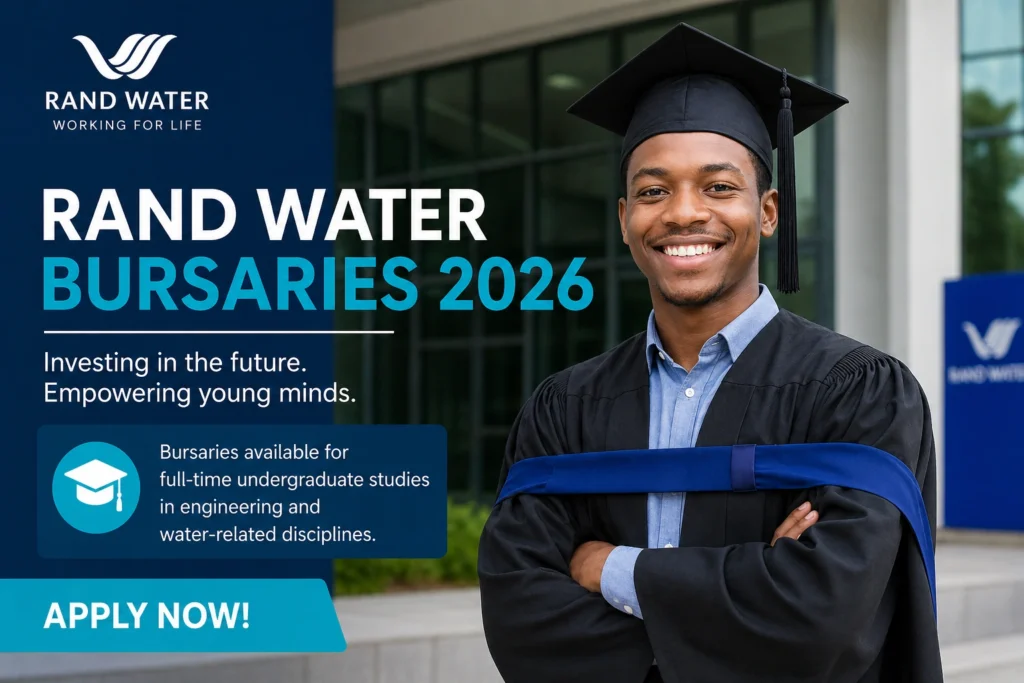

If you’re a South African student looking for financial support to study in engineering, science, or public service fields, the Rand Water Bursaries 2026 programme is an opportunity worth serious attention. With rising education costs and increasing demand for skilled professionals in infrastructure and environmental sectors, bursaries like this can open doors that might otherwise stay closed.
This programme isn’t just about funding your studies—it’s about preparing a new generation to solve real-world challenges, especially those related to water supply, sanitation, and sustainable development in South Africa.
What You Should Know First
The Rand Water Bursaries 2026 programme offers financial support to eligible South African students pursuing studies in fields linked to water systems, engineering, science, and governance.
Here’s the core idea:
- It targets students from previously disadvantaged backgrounds
- Requires a minimum academic average of 65%
- Covers both undergraduate and postgraduate studies
- Focuses on careers that support national infrastructure and water sustainability
- Applications close on 7 May 2026
If your career goals align with improving water systems or infrastructure in South Africa, this bursary could be a strong stepping stone.
APPLY HERE: Rand Water Bursaries 2026
Understanding the Rand Water Bursary Programme
Why This Programme Exists
South Africa faces ongoing challenges with water access, aging infrastructure, and environmental pressures. Rand Water, as a major utility, invests in education to ensure there’s a pipeline of skilled professionals ready to tackle these issues.
This bursary programme is part of a broader effort to:
- Build technical and scientific expertise
- Promote transformation and inclusion
- Strengthen public sector capacity
Key Programme Details
- Organisation: Rand Water
- Location: Rietvlei, Glenvista (Gauteng)
- Reference Number: RAN260423-1
- Closing Date: 7 May 2026
Fields Covered by Rand Water Bursaries 2026
The programme supports a wide range of disciplines. Choosing the right field is important because your studies should align with national development priorities.
1. Engineering and Technical Fields
These are the backbone of infrastructure development:
- Civil Engineering
- Electrical / Electronic Engineering
- Mechanical Engineering
- Water Science and Technology
Example:
A civil engineering student might later work on designing water pipelines or dams, directly impacting water access in communities.
2. Science and Environmental Fields
These fields focus on water quality, health, and sustainability:
- Water Science and Sanitation
- Chemistry (Honours)
- Microbiology (Honours)
- Public Health (Master’s)
Example:
A microbiology graduate could help ensure drinking water is free from harmful bacteria, protecting public health.
3. Built Environment and Professional Fields
Not all roles are technical—some are strategic and administrative:
- Architecture
- Geomatics / Surveying
- BCom Accounting
- LLB (Law)
Example:
A law graduate might work on water regulations, ensuring compliance with environmental laws.
Minimum Requirements Explained
To qualify for the Rand Water Bursaries 2026, you must meet both basic and academic requirements.
Basic Requirements
- South African citizenship
- Under 35 years old
- Full-time student
- Not receiving another bursary
- From a previously disadvantaged background
Academic Requirements
- Minimum 65% average
- Strong performance in subjects related to your chosen field
Step-by-step tip:
If you’re applying for engineering, your maths and science marks matter more than unrelated subjects. Make sure these are strong before applying.

APPLY HERE: Rand Water Bursaries 2026
Documents You Need Before Applying
Preparation is where many applicants succeed—or fail.
Make sure you have:
- Certified copy of your South African ID
- Certified matric certificate
- Latest academic transcript
- Proof of registration
- Clear, readable copies of all documents
Important: Certification must be recent and visible. Blurry or outdated documents can lead to automatic rejection.
How to Apply for Rand Water Bursaries 2026
Applying is straightforward if you follow each step carefully.
Step-by-Step Process
- Visit the official Rand Water recruitment portal
- Register or log in
- Complete the application form
- Upload all required documents
- Submit before the deadline
APPLY HERE: Rand Water Bursaries 2026
ALSO APPLY FOR: Milpark Education Bursary 2026
Pro Tip:
Don’t wait until the last day. Online systems often experience heavy traffic close to deadlines.
What Happens After You Apply?
Once your application is submitted:
- Applications are reviewed after the closing date
- Shortlisted candidates may be contacted for assessments
- If you don’t hear back within 30 days, your application was likely unsuccessful
This process can feel uncertain, but it’s standard for competitive bursaries.
Responsibilities of Successful Applicants
Getting the bursary is only the beginning. You’ll be expected to:
- Maintain good academic performance
- Complete your qualification on time
- Follow all bursary agreement terms
- Stay committed to your field
Think of it as a partnership—Rand Water invests in you, and you commit to your development.
Common Misunderstandings About Rand Water Bursaries 2026
“I just need to meet the minimum requirements”
Not quite. Meeting the minimum (like 65%) doesn’t guarantee selection. Stronger candidates often exceed these benchmarks.
“Any field of study is accepted”
Incorrect. Your field must align with water, infrastructure, or related sectors.
“Late applications might still be considered”
They won’t. Deadlines are strict, and late submissions are usually rejected automatically.
“Documents don’t need to be perfect”
This is a major mistake. Incomplete or unclear documents are one of the top reasons applications fail—even for strong students.
Why Rand Water Bursaries 2026 Stand Out
This bursary is competitive for good reason. It offers:
- Financial support for tuition and study needs
- Exposure to a major public utility organisation
- Career pathways in high-demand sectors
- Alignment with national development goals
If you’re serious about contributing to South Africa’s future—especially in water and infrastructure—this programme is highly relevant.
Key Takeaways
- Rand Water Bursaries 2026 support students in engineering, science, and related fields
- Applications close on 7 May 2026
- You need at least a 65% academic average
- Proper documentation is critical for success
- The bursary focuses on building skills for water and infrastructure development
- Strong applicants go beyond minimum requirements
Frequently Asked Questions (FAQ).
1. Who can apply for Rand Water Bursaries 2026?
South African students under 35 who meet academic requirements and are studying relevant fields can apply.
2. What is the minimum academic requirement?
You need at least a 65% average, but higher marks improve your chances.
3. Can I apply if I already have another bursary?
No. Applicants must not be receiving another bursary.
4. When will I know if I’m successful?
If you don’t hear back within 30 days after the closing date, your application was likely unsuccessful.
Final Thoughts
The Rand Water Bursaries 2026 programme is more than financial aid—it’s an investment in South Africa’s future. By supporting students in critical fields like engineering, science, and public service, it helps build the expertise needed to address real challenges in water and infrastructure.
If you meet the requirements, take the time to prepare a strong, complete application. Small details—like properly certified documents and accurate information—can make the difference between success and rejection.
APPLY HERE: Rand Water Bursaries 2026
ALSO APPLY FOR: Milpark Education Bursary 2026