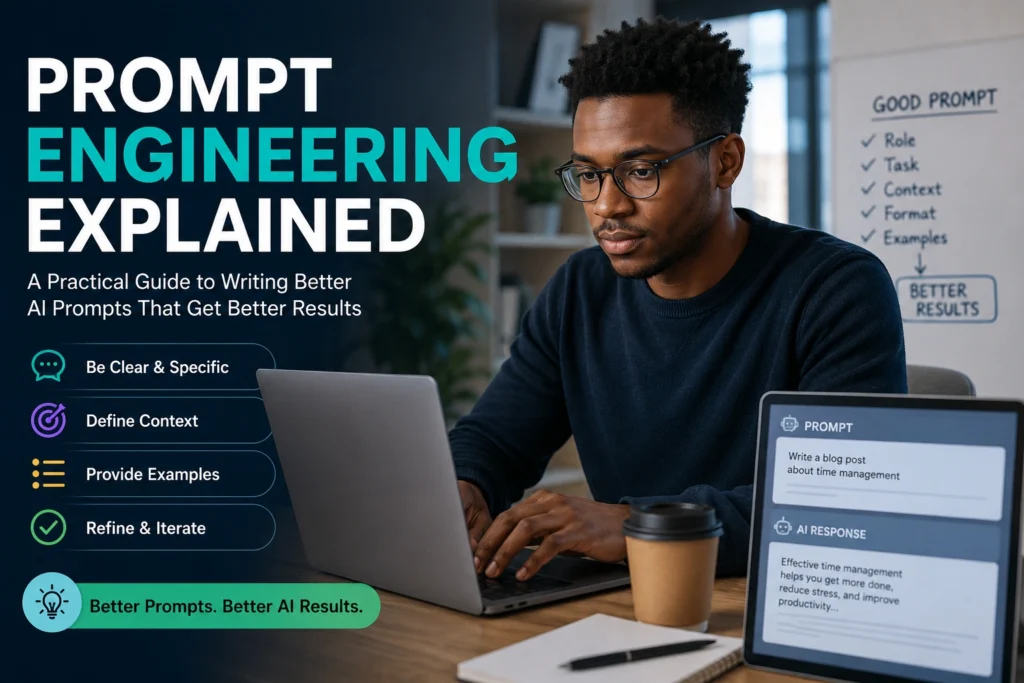

Artificial intelligence tools have become part of everyday work, learning, and creativity. Yet many people become frustrated after only a few attempts because the responses they receive are too vague, inaccurate, or completely different from what they expected. They often assume the AI is unreliable, when the real problem is usually the way the question was asked.
This is where Prompt Engineering Explained becomes important. Understanding how to communicate effectively with AI can dramatically improve the quality of responses, whether you’re writing emails, creating marketing content, learning new skills, coding software, or researching complex topics.
Prompt engineering is not about learning programming languages or becoming an AI scientist. It is simply the skill of giving AI clear, structured instructions that help it understand exactly what you want. As AI becomes more common in workplaces, schools, and businesses, this skill is quickly becoming one of the most valuable forms of digital literacy.
This practical guide explains prompt engineering in plain English, shows why it matters, and provides proven techniques anyone can start using immediately.
What Is Prompt Engineering Explained?
Prompt engineering is the process of designing clear and effective instructions—called prompts—that help artificial intelligence generate useful, accurate, and relevant responses.
Think of AI as a highly knowledgeable assistant that cannot read your mind. If you ask vague questions, you’ll usually receive vague answers. If you provide detailed instructions, context, and expectations, the quality of the output improves significantly.
For example, compare these prompts:
Weak prompt
Write an article about climate change.
Better prompt
Write a 1,200-word beginner-friendly article explaining climate change for South African high school learners. Include practical examples, simple language, and five actionable tips families can use to reduce their carbon footprint.
The second prompt gives the AI:
- A clear audience
- Desired length
- Tone
- Geographic context
- Structure
- Specific objectives
As a result, the response is usually far more useful.
Prompt engineering is simply learning how to provide these kinds of instructions consistently.
ALSO APPLY FOR: Swiss Re Internships 2026
ALSO APPLY FOR: Managed People Solutions Intern 2026
Why This Issue Matters
Artificial intelligence is already changing how people work across many industries.
Businesses use AI to draft reports, customer support responses, marketing campaigns, and meeting summaries. Students use it to understand difficult subjects. Developers use it to generate code. Designers brainstorm ideas, while entrepreneurs research markets faster than before.
However, there’s a growing gap between people who know how to communicate effectively with AI and those who don’t.
Someone with strong prompt engineering skills can often:
- Finish tasks faster
- Produce higher-quality work
- Reduce repetitive editing
- Improve productivity
- Learn new topics more efficiently
- Generate creative ideas more consistently
In many workplaces, employees who know how to use AI effectively are becoming more valuable because they combine human judgment with AI assistance rather than replacing their own thinking.
Prompt engineering isn’t just about saving time—it improves the quality of decisions and work output.
Prompt Engineering Explained Through a Simple Example
Imagine asking a travel agent:
Tell me about holidays.
That request is too broad.
Now compare it with:
Recommend a five-day family holiday in Cape Town during December with a budget under R20,000, including activities suitable for young children.
The travel agent now understands:
- Destination
- Budget
- Duration
- Audience
- Time of year
- Preferred activities
AI works in a very similar way.
The more relevant information you provide, the more tailored the response becomes.
The Building Blocks of a Great Prompt
Most effective prompts contain several key ingredients.
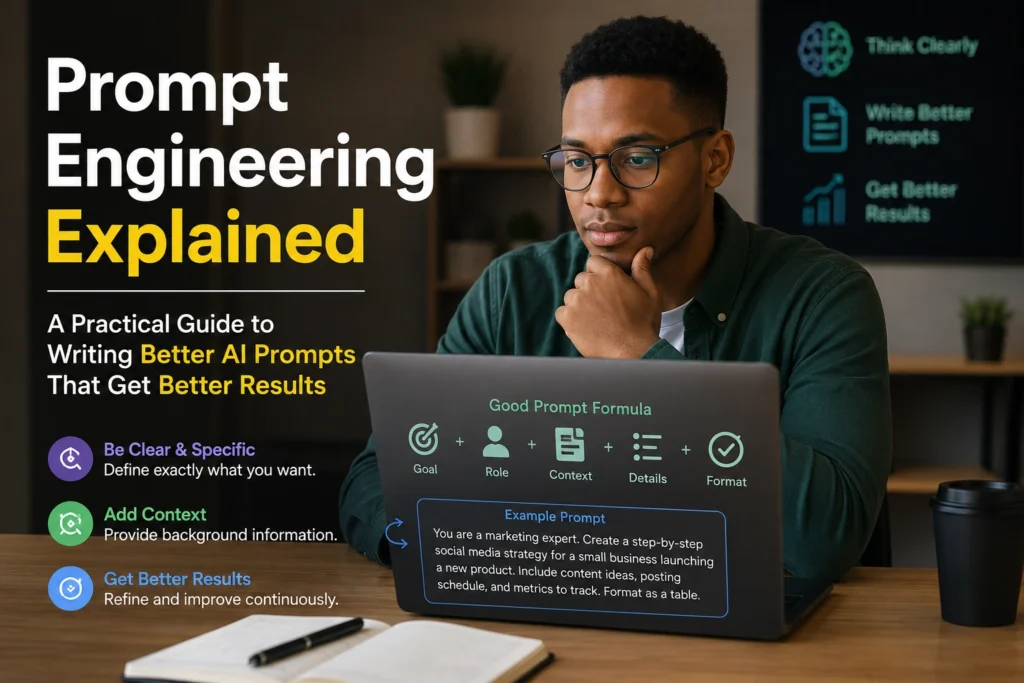
1. Define Your Goal
Start by explaining exactly what you want.
Instead of:
Help me with marketing.
Try:
Create a one-month social media marketing plan for a small bakery.
Clear goals produce focused answers.
2. Provide Context
Context helps AI understand your situation.
Examples include:
- Industry
- Country
- Audience
- Experience level
- Business type
- Academic level
For example:
Explain investing to a South African university student with no financial background.
Without context, the AI must make assumptions.
3. Specify the Format
Tell the AI how you want the information presented.
Examples:
- Bullet points
- Table
- Checklist
- Step-by-step guide
- Blog article
- Lesson plan
- Summary
Instead of asking for “information,” request the exact format you need.
4. Describe the Tone
Different situations require different writing styles.
Examples include:
- Professional
- Friendly
- Conversational
- Technical
- Formal
- Persuasive
- Educational
A prompt can specify:
Write in plain English suitable for beginners.
or
Use an executive business tone.
5. Set Constraints
Constraints reduce unwanted results.
You might specify:
- Maximum word count
- Reading level
- Number of examples
- Geographic focus
- Sources to avoid
- Formatting requirements
Example:
Keep the explanation under 500 words and avoid technical jargon.
ALSO READ ABOUT: Careers Growing in the Western Cape
Step-by-Step Guide to Better Prompt Engineering
Learning prompt engineering becomes easier when you follow a simple process.
Step 1: Know the Outcome You Want
Before typing anything, ask yourself:
“What would success look like?”
If you can’t answer this question clearly, the AI probably can’t either.
Step 2: Give Background Information
Imagine you’re explaining the task to someone new.
Helpful context includes:
- Who the audience is
- Why you’re doing the task
- Existing information
- Important limitations
The AI performs much better when it understands the situation.
Step 3: Break Large Tasks into Smaller Ones
Instead of asking:
Write my entire business plan.
Split it into stages:
- Market research
- Customer analysis
- Competitor review
- Marketing strategy
- Financial planning
Smaller prompts usually produce stronger results.
Step 4: Review the First Response
Prompt engineering is rarely a one-step process.
Treat AI as a collaborator.
Read the response and ask follow-up questions such as:
- Can you simplify this?
- Add more examples.
- Rewrite for beginners.
- Shorten the introduction.
- Expand section three.
Each refinement improves the final output.
Step 5: Iterate Until Satisfied
Professional AI users often improve prompts several times.
Rather than expecting perfection immediately, they gradually refine both the prompt and the response.
This iterative approach consistently delivers better outcomes.
Prompt Engineering Explained for Different Uses
Different tasks require different prompting techniques.
Content Writing
Include:
- Target audience
- Tone
- Word count
- SEO keywords
- Desired structure
Studying
Ask AI to:
- Explain difficult concepts
- Create quizzes
- Generate flashcards
- Summarize textbooks
- Provide practice questions
Programming
Developers often specify:
- Programming language
- Framework
- Expected output
- Performance requirements
- Error handling
Business
Professionals use prompts for:
- Email drafting
- Meeting summaries
- Proposal writing
- Marketing ideas
- SWOT analyses
- Customer support templates
Personal Productivity
AI can help with:
- Weekly planning
- Goal setting
- Meal planning
- Budgeting
- Travel itineraries
- Project organization
Best Practices Experts Recommend
Experienced AI users often follow several principles that consistently improve results.
Be Specific
Detailed prompts outperform general requests.
Specificity reduces misunderstanding.
Give Examples
If you want a particular writing style, include an example.
AI often performs better when shown what success looks like.
Assign a Role
Role prompting can improve relevance.
Examples:
Act as a financial advisor.
Act as a university lecturer.
Act as an experienced recruiter.
Roles help AI adjust its perspective.
Ask for Reasoning or Alternatives
Instead of requesting one answer, ask for several.
Example:
Provide three possible solutions and explain the advantages of each.
This encourages broader thinking.
Refine Instead of Restarting
Many beginners keep starting over.
Experts usually continue improving an existing conversation because the AI already understands previous context.
Verify Important Information
AI is a powerful assistant, but it should not replace independent verification.
Always confirm:
- Legal information
- Medical advice
- Financial calculations
- Official regulations
- Current news
- Scientific claims
Critical decisions deserve reliable, up-to-date sources.
Mistakes People Often Make
Prompt engineering is a skill, and beginners commonly make similar mistakes.
Being Too Vague
Questions like:
Tell me about business.
leave too much room for interpretation.
Specific requests lead to better answers.
Forgetting the Audience
Content for executives differs from content for school learners.
Always identify who the information is for.
Expecting Perfection Immediately
Good prompting often involves several rounds of improvement.
Don’t judge AI after only one response.
Asking Multiple Unrelated Questions
Combining several topics into one prompt can confuse the AI.
Separate different tasks whenever possible.
Ignoring Context
Without background information, AI fills gaps using assumptions.
Adding context almost always improves relevance.
Trusting Every Response Blindly
AI can occasionally make mistakes or present outdated or inaccurate information confidently.
Use critical thinking and verify important facts before relying on them.
How Prompt Engineering Is Likely to Shape the Future
AI tools continue to evolve rapidly, but one thing remains consistent: they respond best to thoughtful instructions.
Many employers now encourage staff to use AI responsibly for drafting, brainstorming, research, and automation. Educational institutions increasingly teach students how to collaborate with AI rather than avoid it entirely.
Prompt engineering is becoming less of a niche technical skill and more of a practical workplace competency.
Whether you’re a student, entrepreneur, marketer, teacher, developer, or job seeker, learning how to communicate effectively with AI can improve both productivity and the quality of your work.
Frequently Asked Questions
Is prompt engineering difficult to learn?
No. Most people can understand the fundamentals within a few hours of practice. Like any communication skill, it improves with experience and experimentation.
Do I need programming knowledge?
Not at all. Prompt engineering mainly involves writing clear instructions using natural language. Technical knowledge may help in specialised fields, but it is not required for everyday use.
Which AI tools use prompt engineering?
Almost every modern generative AI platform benefits from effective prompting, including AI chatbots, image generators, coding assistants, writing tools, and productivity applications.
Can prompt engineering improve AI accuracy?
Yes. While no prompt guarantees perfect results, providing clear objectives, context, constraints, and formatting instructions generally produces more accurate and useful responses than vague requests.
Final Thoughts
Understanding Prompt Engineering Explained is less about mastering complex technology and more about improving communication. AI systems are becoming increasingly capable, but the quality of their responses still depends heavily on the quality of the instructions they receive.
Start by defining your goal, providing useful context, specifying the format you want, and refining the response through follow-up questions. Over time, you’ll notice that AI becomes a far more effective assistant for learning, working, creating, and solving problems.
The most successful AI users aren’t necessarily the most technical—they’re often the clearest communicators. Developing strong prompt engineering skills today will help you work more efficiently, make better use of AI tools, and stay prepared as these technologies continue to become part of everyday life.
ALSO APPLY FOR: Swiss Re Internships 2026
ALSO APPLY FOR: Managed People Solutions Intern 2026
ALSO READ ABOUT: Careers Growing in the Western Cape