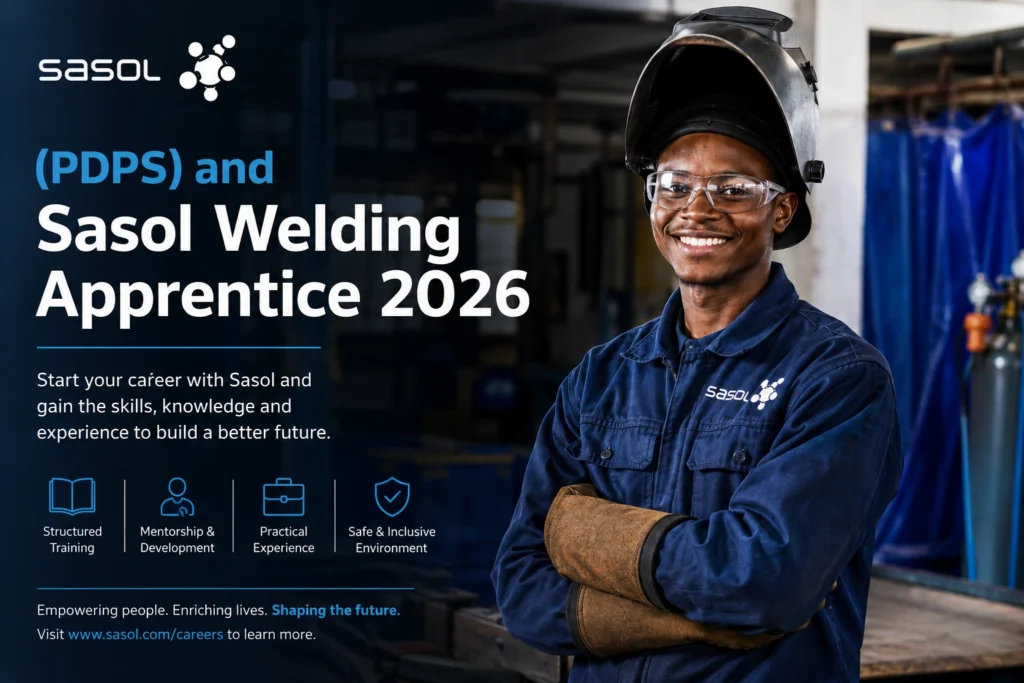

Opportunities that combine technical training with workplace experience rarely stay under the radar in South Africa’s competitive job market. That is exactly why the Plant Design & Project Services (PDPS) and Sasol Welding Apprentice 2026 has quickly become a talking point among young people looking to enter engineering and manufacturing careers.
Unlike many entry-level opportunities that focus mainly on classroom learning, this apprenticeship promises practical exposure in a field where employers consistently value hands-on experience. At a time when artisan shortages continue to affect several industries, programmes like this naturally attract significant interest.
The announcement comes as many school leavers, NCV graduates and N3 engineering students continue searching for structured pathways into technical occupations. Rather than requiring years of prior work experience, the apprenticeship focuses on identifying motivated candidates who demonstrate the academic foundation needed to succeed in welding.
Applications close on 17 July 2026, giving interested applicants a limited window to prepare the necessary documents and ensure they meet every eligibility requirement.
Understanding the Opportunity
The Plant Design & Project Services (PDPS) and Sasol Welding Apprentice 2026 is a partnership between Sasol and Plant Design and Project Services (PDPS), designed to develop future welding artisans through structured apprenticeship training.
The programme targets unemployed South African youth who have an interest in engineering, fabrication and metalworking. Instead of simply offering theoretical instruction, the apprenticeship is intended to expose learners to real workplace environments where technical skills are developed through practical experience.
For many aspiring artisans, this combination of structured learning and workplace exposure represents one of the strongest entry routes into technical industries.
The apprenticeship focuses specifically on welding—a trade that remains essential across multiple sectors of the economy.
Why Welding Continues to Be a High-Demand Trade
Although discussions about the future of work often focus on digital careers, skilled trades remain fundamental to industrial development.
Virtually every large industrial project requires qualified welders.
Whether constructing pipelines, maintaining factories or supporting mining operations, welding remains one of the core technical skills needed across South Africa.
Industries that regularly employ qualified welders include:
- Petrochemical operations
- Mining
- Heavy engineering
- Manufacturing
- Infrastructure projects
- Energy generation
- Construction
- Steel fabrication
- Maintenance engineering
As infrastructure investment and industrial maintenance continue across the country, experienced artisans remain valuable assets to employers.
That broader industry demand helps explain why apprenticeship announcements frequently receive considerable attention.
How the Programme Fits into South Africa’s Skills Development Goals
South Africa has spent years encouraging greater participation in artisan development.
Government departments, major employers and industry partners have repeatedly highlighted the importance of increasing the number of qualified artisans entering the workforce.
One reason is straightforward.
Many experienced tradespeople are approaching retirement, while industries continue requiring technically skilled workers capable of maintaining equipment, supporting production and contributing to large engineering projects.
Apprenticeships bridge that gap by allowing new entrants to learn directly within working environments.
The PDPS and Sasol partnership reflects this broader effort to strengthen technical skills while creating opportunities for unemployed youth.
Who Can Apply?
The apprenticeship is intended for applicants who demonstrate both academic readiness and genuine interest in welding.
Candidates should be:
- Passionate about welding and engineering
- Willing to learn
- Self-motivated
- Well presented
- Committed to completing technical training
- Interested in becoming qualified artisans
Applicants must also satisfy specific residential requirements, making the programme community-focused.
Eligible residential areas include:
- Govan Mbeki Municipality
- Ekandustria Region 7
- City of Tshwane
- Dark City
- Ekangala
- Rethabiseng
- Zithobeni
Proof of residence forms an important part of the application process.
Three Qualification Pathways Open the Door
One positive aspect of this apprenticeship is that applicants are not limited to a single educational route.
Instead, three qualification pathways are recognised.
Grade 12 Route
Applicants may qualify with Grade 12 provided they have:
- English
- Pure Mathematics
- Physical Science
Engineering Graphic Design provides an advantage, while technical subjects such as Welding or Platers Theory may strengthen an application.
Importantly, Mathematics Literacy is not accepted under this pathway.
N3 Engineering Route
Applicants with N3 qualifications should have completed:
- English
- Engineering Mathematics N3
- Engineering Science N3
Trade-related theory subjects may improve competitiveness.
NCV Level 4 Route
Applicants holding NCV Level 4 qualifications should possess:
- English or First Additional Language
- Pure Mathematics
- Engineering Science
- Engineering Processes
- Professional Engineering Practice
- Applied Engineering Technology
- Trade-related theory including Welding or Platers Theory
By recognising multiple educational pathways, the programme broadens access to aspiring artisans from different technical education backgrounds.

ALSO VISIT: https://pdps.co.za
The Importance of Preparing the Application Carefully
One feature that stands out is the detailed documentation required.
Applicants need certified copies of:
- South African ID
- Updated CV
- Qualifications
- Academic results
- Driver’s licence (where applicable)
- Municipal account confirming residence
Additional residence documentation may also be required where the applicant does not own the property.
These include affidavits, bank statements and SARS confirmation reflecting the same residential address.
Although gathering these documents takes time, complete applications generally demonstrate preparedness and attention to detail—qualities often valued during apprenticeship selection.
Application Process at a Glance
Applications must be submitted via email.
Email: welderapprentices2026@pdps.co.za
Applicants should email all required certified documents while quoting the reference number:
Reference Number: 2026 Welding Apprenticeship
Applications should be sent before the 17 July 2026 deadline.
Late submissions are unlikely to be considered.
Manual CV deliveries will not be accepted.
Shortlisted candidates will be invited for interviews, while unsuccessful applicants may not receive individual feedback beyond the stated response period.
ALSO APPLY FOR: Scania BSO Apprentice Programme 2026
Public Reaction Shows Strong Interest
Whenever apprenticeship opportunities linked to established industrial companies become available, public interest tends to grow rapidly.
Online discussions frequently reflect several recurring themes.
Many young South Africans welcome opportunities that combine practical workplace exposure with recognised technical training.
Parents often encourage school leavers to consider artisan careers because they offer specialised skills that remain valuable across multiple industries.
Career advisers also continue highlighting apprenticeships as alternatives to traditional university pathways, particularly for students who enjoy practical engineering work.
At the same time, many applicants recognise that programmes linked to major industrial employers are likely to attract significant competition.
This awareness has prompted prospective candidates to begin preparing their documents well before the closing date.
Why This Matters Right Now
South Africa continues facing two important realities.
The first is persistent youth unemployment.
The second is ongoing demand for qualified technical skills across industrial sectors.
The Plant Design & Project Services (PDPS) and Sasol Welding Apprentice 2026 sits directly at the intersection of these challenges.
Rather than offering temporary employment alone, the programme focuses on developing technical competence that could support long-term career growth.
For many applicants, the apprenticeship represents more than training.
It offers an opportunity to begin building a recognised trade within industries that continue requiring skilled artisans.
That makes the programme especially relevant in today’s labour market, where employers increasingly value practical experience alongside academic qualifications.
Looking Beyond the Apprenticeship
Completing apprenticeship training can create opportunities across numerous industries.
Possible career paths include:
- Qualified Welder
- Fabricator
- Boilermaker
- Maintenance Technician
- Welding Inspector
- Workshop Supervisor
Some artisans later specialise in pressure vessel welding, coded welding or industrial maintenance, while others eventually establish their own fabrication businesses.
Career progression usually depends on experience, additional certifications and continuous skills development.
Competition Is Likely to Be Strong
While the opportunity is promising, applicants should approach the process realistically.
Major industrial apprenticeships often receive hundreds—or even thousands—of applications.
Meeting the minimum requirements does not automatically guarantee selection.
Candidates who submit complete documentation, carefully follow application instructions and demonstrate genuine interest in technical careers may improve their chances during shortlisting.
Applicants currently participating in other training programmes should also note that they are not eligible for this apprenticeship.
What Could Happen Next
As the application deadline approaches, interest is likely to increase further.
Career guidance platforms, community organisations and technical colleges may continue sharing information about the opportunity to ensure eligible young people are aware of it.
If the programme successfully develops new artisans, similar partnerships between industry and specialised engineering companies could become increasingly common.
Industrial employers continue recognising that investing in apprenticeship programmes supports both workforce planning and long-term operational sustainability.
For applicants, the next few weeks will focus on ensuring documentation is complete and applications are submitted before the closing date.
After that, shortlisted candidates will move into interview and selection stages, where motivation, readiness and commitment to technical careers may become key differentiators.
Final Thoughts
The Plant Design & Project Services (PDPS) and Sasol Welding Apprentice 2026 represents more than another apprenticeship announcement. It reflects the continued importance of artisan development in South Africa’s industrial economy and provides a structured opportunity for unemployed young people to enter a respected technical profession.
For eligible candidates living within the specified communities, the programme offers a practical pathway into welding through workplace-based learning and industry exposure. While competition is expected to be strong, applicants who meet the Grade 12, N3 or NCV Level 4 requirements and carefully prepare their applications have an opportunity to position themselves for long-term careers in engineering, manufacturing and related sectors.
As South Africa continues investing in technical skills development, initiatives like this demonstrate how partnerships between established companies and specialist engineering organisations can help build the next generation of qualified artisans. For aspiring welders, the coming application deadline is not simply another date on the calendar—it is an opportunity to take the first step toward a career built on practical expertise, continuous learning and the essential skills that keep industry moving.