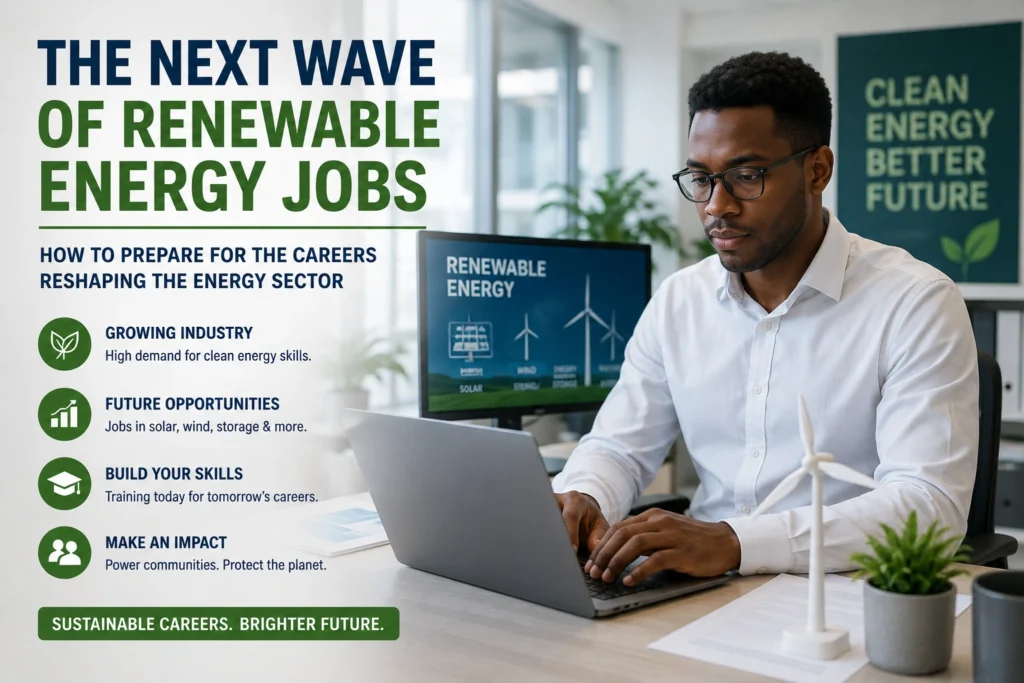

The renewable energy industry is expanding, but that does not automatically make it easy to get a job in the sector. Many jobseekers hear about solar farms, wind projects, battery storage and green hydrogen and assume that most opportunities will be for engineers. In reality, the energy transition is creating demand across a much wider range of occupations.
The challenge is knowing where the jobs are emerging, which skills employers actually need, and how to prepare before competition increases.
For young people, graduates, artisans, technicians and experienced workers considering a career change, The Next Wave of Renewable Energy Jobs could create opportunities across engineering, construction, operations, maintenance, project management, environmental services, finance, information technology and technical trades.
But the strongest candidates will not simply be interested in renewable energy. They will have practical skills that can be applied to renewable-energy projects.
What Is Driving the Next Wave of Renewable Energy Jobs?
The renewable energy sector is no longer limited to installing solar panels on rooftops.
Large-scale solar photovoltaic projects, wind farms, battery energy storage systems, transmission infrastructure and increasingly sophisticated energy-management technologies are changing how electricity is generated, stored and distributed.
This creates a chain of employment opportunities.
A renewable energy project needs people to assess land, conduct environmental studies, design electrical systems, manufacture or source equipment, construct facilities, install machinery, manage logistics, test systems and maintain assets after commissioning.
That means the energy transition can create jobs before, during and after construction.
Some roles require university qualifications, while others depend heavily on technical training and workplace experience.
Examples include:
- Electrical and mechanical engineers
- Solar photovoltaic technicians
- Wind turbine technicians
- Electricians
- Millwrights
- Instrumentation technicians
- Civil construction workers
- Health and safety officers
- Environmental specialists
- Project coordinators
- Supply-chain professionals
- Data and energy-management specialists
- Operations and maintenance technicians
- Finance and commercial professionals
ALSO APPLY FOR: TIH YES Learnership 2026
ALSO APPLY FOR: Mondi Learnerships 2026
The important point is that renewable energy is becoming an industry ecosystem rather than a single occupation.
Why This Issue Matters
South Africa’s energy transition has implications far beyond electricity generation.
The country needs additional energy infrastructure while also dealing with skills shortages, economic pressure and the need to create employment opportunities. Renewable projects can require large teams during development and construction, followed by smaller specialist teams responsible for long-term operations and maintenance.
For jobseekers, this means understanding the difference between short-term project employment and sustainable technical careers.
A construction worker might find employment during the building of a solar facility. A qualified electrician or technician may have opportunities throughout the operating life of an energy installation. An engineer may move between different projects, technologies and employers.
There is also an important regional dimension.
Renewable projects can be located far from major cities, meaning workers may need to consider opportunities in areas such as the Northern Cape, Western Cape, Eastern Cape, Free State and other regions where energy infrastructure is being developed.
For South African students and TVET College learners, this makes technical education particularly relevant. Qualifications in electrical engineering, mechanical engineering, instrumentation, fitting, welding, construction and related fields can provide a foundation for entering the energy sector.
The Next Wave of Renewable Energy Jobs Will Need More Than Traditional Skills
One of the biggest changes taking place is the combination of traditional technical skills with digital technology.
A solar plant is not simply a collection of panels. Modern facilities use monitoring systems, sensors, automated controls, communications networks and software to track performance.
Battery storage facilities similarly depend on sophisticated electrical and digital systems.
Consequently, someone entering renewable energy should think beyond a single qualification.
An electrical technician who understands industrial automation may have a stronger profile than someone with electrical knowledge alone. A maintenance worker who can interpret digital monitoring information can potentially contribute more effectively to a modern facility.
This does not mean everyone needs to become a software developer.
It means workers should become comfortable with digital tools, data, automation and technology-enabled maintenance.
Where the New Opportunities Are Emerging
1. Solar Energy
Solar remains one of the most visible areas of renewable energy employment.
Opportunities can appear across:
- Solar installation
- Electrical work
- System design
- Construction
- Operations and maintenance
- Procurement
- Project management
- Quality control
- Health and safety
Entry-level candidates should investigate electrical and renewable-energy training rather than focusing only on the phrase “solar job”.
2. Wind Energy
Wind farms require specialist technicians capable of maintaining turbines and associated electrical and mechanical systems.
Working at height, mechanical maintenance, electrical systems, troubleshooting and safety procedures can all become important.
For people with mechanical, electrical or mechatronics backgrounds, wind energy can therefore be an interesting career direction.
3. Battery Energy Storage
Energy storage is becoming increasingly important because renewable generation is variable.
Battery projects create demand for workers with knowledge of electrical systems, battery technologies, monitoring equipment, safety procedures, controls and maintenance.
This is an area worth watching because it connects renewable generation with grid reliability.
4. Green Hydrogen
Green hydrogen remains a developing industry, but it could create specialist opportunities across engineering, chemical processing, water management, electrical infrastructure, logistics and project development.
Jobseekers should be cautious about treating every hydrogen announcement as an immediate employment opportunity. Some projects take years to develop.
The better strategy is to build transferable technical skills that remain useful even if a particular project is delayed.
5. Grid Infrastructure
Renewable generation cannot deliver value without appropriate transmission and distribution infrastructure.
This creates opportunities beyond renewable-energy companies themselves.
Electrical engineers, technicians, construction teams, planners, project managers and infrastructure specialists can all play roles in connecting new generation capacity to the electricity system.
ALSO READ ABOUT: Digital Detox During Exams
How to Prepare for The Next Wave of Renewable Energy Jobs
Knowing where opportunities are emerging is only the first step. The next question is what a jobseeker can actually do.
Step 1: Choose a Career Lane
Do not start by searching for every renewable-energy vacancy you can find.
First identify your likely career lane.
For example:
Technical route: electrician, technician, millwright, instrumentation specialist or maintenance worker.
Engineering route: electrical, mechanical, civil, chemical, environmental or renewable-energy engineering.
Construction route: civil works, equipment installation, welding, rigging, supervision or health and safety.
Business route: procurement, finance, administration, supply chain or project coordination.
Digital route: data analysis, automation, monitoring systems, information technology or energy-management software.
Once you identify your lane, your job search becomes much more targeted.
Step 2: Build a Relevant Qualification
A qualification is not automatically a ticket into the industry, but it can establish your technical foundation.
TVET College programmes can be particularly relevant for people interested in technical occupations.
Depending on your career direction, investigate qualifications related to:
- Electrical engineering
- Mechanical engineering
- Civil engineering
- Mechatronics
- Instrumentation
- Fitting and turning
- Welding
- Construction
- Information technology
- Environmental management
Always check that the institution and qualification are properly recognised before paying fees or enrolling.
Step 3: Add Industry-Relevant Skills
Once your core qualification is established, look for additional skills that complement it.
For example, an electrical candidate could learn more about:
- Solar PV systems
- Industrial automation
- Electrical safety
- Programmable logic controllers
- Basic data analysis
- Energy monitoring
- Electrical testing
The objective is not to collect certificates randomly.
Every additional skill should answer the question: What problem could I solve for an employer?
Step 4: Gain Practical Experience
This can be the most difficult stage for young jobseekers.
If you cannot immediately secure a permanent position, look for internships, apprenticeships, learnerships, workplace-based learning and entry-level technical opportunities.
Construction experience can also be valuable because many renewable projects involve substantial civil and electrical construction work.
Keep evidence of your practical experience, including projects completed, equipment used, responsibilities and relevant training.
Step 5: Learn How Renewable Projects Actually Work
A candidate who understands the project lifecycle can communicate more effectively during interviews.
A simplified renewable project lifecycle looks like this:
Development → Planning → Environmental assessment → Financing → Procurement → Construction → Commissioning → Operations → Maintenance
Different professionals enter the process at different points.
Understanding this makes it easier to identify where your skills fit.
Step 6: Search Beyond Job Titles
One of the biggest mistakes is searching only for “renewable energy jobs”.
Companies may advertise relevant positions under conventional titles such as:
- Electrical Technician
- Maintenance Technician
- Site Supervisor
- Project Administrator
- Mechanical Technician
- HSE Officer
- Procurement Officer
- Commissioning Technician
- Graduate Engineer
- Field Service Technician
The employer may work in renewable energy even when the job title does not contain the word “renewable”.
Step 7: Follow Projects, Not Just Vacancies
A useful job-search strategy is to monitor companies and projects before vacancies appear.
Follow renewable developers, engineering companies, construction contractors, equipment suppliers and energy-service businesses.
When a project reaches construction or commissioning, employment requirements can change significantly.
This approach can give you more context than simply submitting applications to job boards.
Best Practices Experts Recommend
People building careers in renewable energy should concentrate on transferable competence rather than fashionable job titles.
An electrical qualification, practical troubleshooting ability, safety awareness and willingness to work on sites can remain valuable across solar, wind, storage and conventional infrastructure.
Another best practice is to maintain a professional record of your skills.
Your CV should make it easy for an employer to identify:
- Your highest qualification
- Technical subjects completed
- Practical experience
- Equipment or systems you have worked with
- Safety training
- Software knowledge
- Driver’s licence, where relevant
- Location and willingness to travel
- Availability
Also prepare a short explanation of why you want to work in the energy sector.
Avoid generic statements such as “I am passionate about renewable energy.”
Instead, explain the connection between your existing skills and the work you want to perform.
For example, an electrical graduate could explain that they want to apply their electrical knowledge to renewable generation, energy storage and industrial power systems.
That is more specific and credible.
Mistakes People Often Make
Chasing every “green job”
Not every vacancy mentioning sustainability is a renewable-energy position. Read the actual duties and requirements.
Assuming engineering is the only route
Renewable projects need electricians, technicians, construction workers, administrators, safety professionals, logistics specialists and many others.
Collecting certificates without practical experience
Ten short courses do not necessarily compensate for a lack of hands-on ability.
Choose training strategically.
Ignoring safety
Energy projects can involve high voltages, heavy machinery, working at height, construction equipment and hazardous environments. Safety competence is not an optional extra.
Applying without checking requirements
If a vacancy requires a particular qualification, registration, trade certificate, experience level or driver’s licence, do not assume that enthusiasm will compensate for a mandatory requirement.
Believing every advertised project will create jobs immediately
Large infrastructure projects can experience delays involving finance, permits, environmental requirements, procurement or grid connections.
Build a career around transferable skills rather than depending on one project.
Frequently Asked Questions
1. Do I need a university degree to work in renewable energy?
No. Many renewable-energy roles are technical and can be accessed through vocational education, apprenticeships, trade qualifications and workplace experience. Engineers and certain specialist positions generally require degrees, but the industry needs many other occupations.
2. Which skills are useful for renewable-energy careers?
Electrical and mechanical skills are particularly valuable, while construction, instrumentation, automation, safety, project management, digital systems and data skills can also be relevant.
3. Is solar energy the only renewable-energy career option?
No. Solar is one major area, but opportunities can also develop around wind power, battery storage, grid infrastructure, green hydrogen and supporting engineering and construction services.
4. What should young South Africans do now?
Start with a recognised qualification or trade pathway, gain practical experience, add targeted technical skills and monitor companies and projects operating in the energy sector. Do not wait until a large project begins advertising hundreds of vacancies before preparing.
Final Summary: Prepare Before the Jobs Arrive
The Next Wave of Renewable Energy Jobs will not necessarily look like the energy jobs of the past.
The sector is becoming more technical, more digital and increasingly interconnected with construction, infrastructure, manufacturing and information technology.
That creates opportunities, but it also raises the standard for applicants.
The most practical approach is to choose a career direction, obtain a relevant qualification, build hands-on experience and add skills that employers can immediately use. Electrical, mechanical, construction, instrumentation, automation, environmental, digital and project-management skills can all provide possible routes into the growing energy economy.
For students and unemployed jobseekers, the message is simple: do not wait for the perfect renewable-energy vacancy before preparing.
Build skills that can work across multiple projects and technologies. Follow the companies developing energy infrastructure. Look beyond obvious job titles. Verify every vacancy before applying, and treat apprenticeships, internships, learnerships and workplace-based training as potential stepping stones rather than lesser alternatives.
The renewable-energy transition will create opportunities, but preparation will determine who is ready to take advantage of them.
ALSO APPLY FOR: TIH YES Learnership 2026
ALSO APPLY FOR: Mondi Learnerships 2026
ALSO READ ABOUT: Digital Detox During Exams